Laxative classes and secretagogues, peripherally acting mu-opioid receptor antagonists, antidiarrheal agents, Clostridioides difficile therapy, and IBS pharmacotherapy
GAST · Module 5 of 8Osmotic, stimulant, bulk-forming, and secretagogue laxatives; peripherally acting mu-opioid receptor antagonists for opioid-induced constipation; and clinical selection principles
Constipation pharmacotherapy spans several mechanistically distinct drug classes. Selecting the right agent depends on understanding the underlying mechanism — functional constipation, opioid-induced constipation, and secretory disorders each have different pharmacological targets.
Osmotic laxatives retain water in the intestinal lumen through osmotic pressure, increasing luminal fluid volume, softening stool, and stimulating propulsive contractions. Polyethylene glycol 3350 is a high-molecular-weight polymer that passes through the gastrointestinal tract intact without absorption or metabolism, dragging an obligate water load. It is the preferred osmotic agent for chronic constipation — negligible systemic absorption, no significant electrolyte shifts at standard doses, and appropriate for elderly patients and those with renal impairment. Lactulose is a non-absorbable disaccharide fermented by colonic bacteria to short-chain fatty acids, lowering pH and increasing osmotic pressure; fermentation-related bloating limits tolerability. Magnesium hydroxide and magnesium citrate act osmotically and also stimulate cholecystokinin release; they should be used cautiously in renal impairment because magnesium is partially absorbed.
Senna and bisacodyl stimulate myenteric plexus neurons and inhibit colonic fluid absorption. Sennosides are prodrugs activated by colonic bacteria to anthranoid metabolites. Bisacodyl is converted by intestinal esterases to its active form, which directly stimulates submucosal secretomotor neurons. Both have a 6 to 12 hour oral onset. The historical concern that chronic use causes permanent enteric nerve damage (cathartic colon) has not been supported by prospective data; current evidence supports their safety for long-term use when needed.
Lubiprostone activates type-2 chloride channels on the apical surface of intestinal epithelial cells, driving chloride and water secretion into the lumen. It is approved for chronic idiopathic constipation, irritable bowel syndrome with predominant constipation, and opioid-induced constipation. Minimal systemic absorption confines activity to the intestinal lumen. Nausea occurs in approximately 30 percent of patients and is reduced by taking with food. Linaclotide and plecanatide are guanylate cyclase-C agonists — discussed further in Section 4 in the context of irritable bowel syndrome.
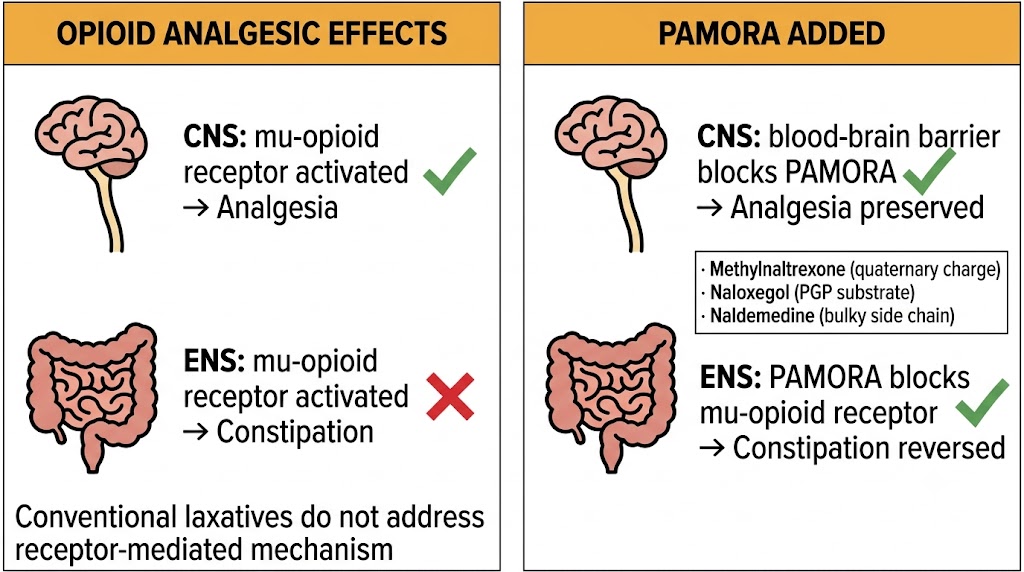
Opioid-induced constipation arises because mu-opioid receptors in the enteric nervous system — present at the highest density of any site outside the central nervous system — are activated by opioid analgesics, producing reduced propulsive motility, increased segmental contractions, reduced secretion, and increased anal sphincter tone. Conventional laxatives do not address this receptor-mediated mechanism and are frequently inadequate. Peripherally acting mu-opioid receptor antagonists were developed to block gastrointestinal opioid effects without reversing central nervous system analgesia.
Methylnaltrexone is a quaternary ammonium derivative of naltrexone; the permanent positive charge substantially limits central nervous system penetration, confining antagonism to peripheral mu-opioid receptors. Naloxegol is a polyethylene glycol-conjugated naloxol derivative that is a P-glycoprotein substrate at the blood-brain barrier, reducing central nervous system exposure to less than 1 percent of plasma concentrations. Naldemedine has a bulky side chain reducing blood-brain barrier penetration and once-daily oral dosing. All three reverse opioid-induced constipation within 24 to 48 hours without compromising analgesia. They are contraindicated when gastrointestinal obstruction is known or suspected. Naloxegol is a cytochrome P450 3A4 substrate; strong cytochrome P450 3A4 inhibitors are contraindicated and moderate inhibitors require dose reduction.
Mild functional constipation (long-term maintenance): polyethylene glycol 3350 first-line; psyllium as adjunct. Acute constipation (rapid relief): bisacodyl or senna orally, onset 6 to 12 hours. Renal impairment: avoid magnesium-containing laxatives; polyethylene glycol preferred. Opioid-induced constipation refractory to standard laxatives: peripherally acting mu-opioid receptor antagonist (methylnaltrexone subcutaneously for rapid effect; naloxegol or naldemedine orally for outpatient use). Confirm no gastrointestinal obstruction before initiating peripherally acting mu-opioid receptor antagonist therapy.
Loperamide mechanism and peripheral selectivity, bismuth subsalicylate, bile acid sequestrants for bile acid diarrhea, rifaximin for traveler's diarrhea, and when not to use antidiarrheal agents
Antidiarrheal agent selection requires distinguishing acute infectious diarrhea — where motility inhibition may be harmful — from chronic or functional diarrhea where slowing transit is the therapeutic goal. The pharmacological profile of loperamide, including its peripheral selectivity and the clinical situations where it is contraindicated, are high-yield at the second-year level.
Loperamide is a potent synthetic mu-opioid receptor agonist in the myenteric plexus that reduces propulsive peristalsis, increases segmental non-propulsive contractions, reduces intestinal secretion, and increases anal sphincter tone. Unlike morphine, loperamide does not produce central nervous system opioid effects at standard doses because it is an extremely high-affinity P-glycoprotein substrate at the blood-brain barrier; central nervous system concentrations are negligible at therapeutic doses. At supratherapeutic doses used recreationally, P-glycoprotein efflux saturates and potentially fatal cardiac arrhythmias including corrected QT interval prolongation and ventricular tachycardia have been reported, prompting FDA packaging restrictions on high-unit sales.
Loperamide is appropriate for non-inflammatory acute diarrhea and chronic functional diarrhea. It is contraindicated in confirmed or suspected Clostridioides difficile infection (risk of toxic megacolon), dysenteric presentations with blood in stool or high fever (invasive pathogens require motility for clearance), and acute severe ulcerative colitis flares (toxic megacolon risk).
Bismuth subsalicylate has direct antimicrobial activity against enteropathogenic bacteria, salicylate-mediated inhibition of intestinal prostaglandin synthesis reducing secretion, and bismuth-mediated toxin binding. It is effective for traveler's diarrhea prophylaxis and treatment. The salicylate component is systemically absorbed; bismuth subsalicylate should not be used in children or adolescents with viral illness (Reye syndrome risk), in patients on anticoagulants (salicylate interaction with warfarin), or in patients with salicylate allergy. Black discoloration of stools and tongue from bismuth sulfide formation should be explained to patients to avoid confusion with gastrointestinal bleeding.
Rifaximin is a minimally absorbed rifamycin derivative with less than 0.4 percent systemic bioavailability, achieving high intraluminal antibiotic concentrations against enteric pathogens without systemic antibiotic effects. It is approved for traveler's diarrhea caused by non-invasive enterotoxigenic Escherichia coli and is inappropriate when invasive enteric pathogens are likely. Cholestyramine, a bile acid sequestrant anion exchange resin, binds bile acids in the intestinal lumen and is effective for bile acid diarrhea arising after ileal resection, cholecystectomy, or as an idiopathic condition often misdiagnosed as irritable bowel syndrome with diarrhea. Cholestyramine binds numerous co-medications in the intestinal lumen — thyroxine, warfarin, digoxin, fat-soluble vitamins — requiring at least 1 to 2 hours separation of all other drugs.
Contraindicated in: Clostridioides difficile infection (toxic megacolon risk); dysenteric diarrhea with blood, mucus, or fever above 38.5 degrees Celsius (invasive pathogens require motility for clearance); antibiotic-associated diarrhea of uncertain etiology pending Clostridioides difficile testing; acute severe ulcerative colitis flare. Avoid in children under age 2. Oral rehydration solution remains the cornerstone of management for dehydrating diarrhea regardless of antidiarrheal use.
Oral vancomycin and fidaxomicin as first-line therapy, the downgraded role of metronidazole, fidaxomicin's recurrence advantage, fecal microbiota transplant for recurrent disease, and bezlotoxumab for high-risk patients
Clostridioides difficile infection treatment has been substantially revised over the past decade. Fidaxomicin and oral vancomycin have replaced metronidazole as first-line agents based on clinical trial data showing superior outcomes. Knowing the correct drug hierarchy and when to use fecal microbiota transplant are high-yield clinical pharmacology topics.
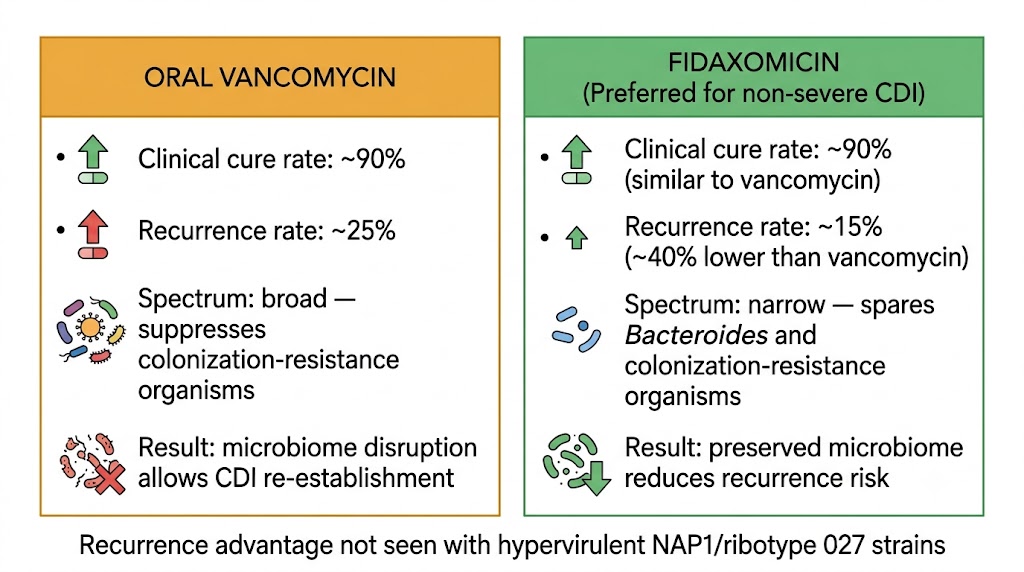
Oral vancomycin 125 milligrams four times daily for 10 days achieves high intraluminal concentrations — exceeding 1000 micrograms per milliliter in stool — with negligible systemic absorption, avoiding the nephrotoxicity and ototoxicity of intravenous vancomycin. Fidaxomicin 200 milligrams twice daily for 10 days is a macrolide antibiotic minimally absorbed from the gastrointestinal tract that inhibits bacterial RNA polymerase at a site distinct from rifamycins. In two phase 3 randomized controlled trials, fidaxomicin produced similar clinical cure rates to vancomycin but significantly lower recurrence rates for non-hypervirulent strains — approximately 40 percent lower recurrence — attributed to its narrower spectrum and relative sparing of colonization-resistance organisms that vancomycin suppresses. Fidaxomicin is now the preferred first-line agent for non-severe Clostridioides difficile infection per major guidelines, though cost limits access in some settings.
Metronidazole has been downgraded by the Infectious Diseases Society of America guidelines and is no longer recommended as first-line for any severity category. Head-to-head trials show inferior cure rates and higher recurrence compared with vancomycin. Metronidazole is now an alternative only when vancomycin and fidaxomicin are unavailable or cost-prohibitive.
Severe Clostridioides difficile infection — defined by white blood cell count greater than 15,000 cells per microliter or serum creatinine greater than 1.5 milligrams per deciliter — is treated with oral vancomycin 125 milligrams four times daily, as available data favor vancomycin over fidaxomicin for severe disease. Fulminant disease with hypotension, ileus, or toxic megacolon requires vancomycin 500 milligrams four times daily orally or via nasogastric tube plus intravenous metronidazole 500 milligrams every 8 hours, with immediate surgical consultation.
Fecal microbiota transplant transfers screened donor stool into the gastrointestinal tract of patients with recurrent Clostridioides difficile infection, restoring colonization resistance through microbiome reconstitution. Meta-analyses of randomized controlled trials demonstrate resolution rates of 80 to 90 percent for multiply recurrent infection, substantially higher than antibiotic therapy alone. The FDA has approved standardized fecal microbiota products for recurrent Clostridioides difficile infection: Rebyota (fecal microbiota, live-jslm) as a rectal formulation and Vowst (fecal microbiota spores, live-brpk) as oral capsules approved in 2023.
Bezlotoxumab is a human monoclonal antibody against Clostridioides difficile toxin B given as a single intravenous infusion of 10 milligrams per kilogram during standard antibiotic treatment. It does not treat active infection but reduces recurrence risk by approximately 10 percentage points compared with placebo — from approximately 26 percent to 17 percent — with the greatest benefit in high-risk patients including those aged 65 or older, immunocompromised patients, and patients with prior Clostridioides difficile episodes. Bezlotoxumab carries a black box warning for heart failure exacerbation and should be used cautiously in patients with pre-existing heart failure.
Guanylate cyclase-C agonists for IBS with predominant constipation, alosetron and eluxadoline for IBS with predominant diarrhea, rifaximin for microbiome dysbiosis, and low-dose tricyclic antidepressants for visceral hypersensitivity
Irritable bowel syndrome pharmacotherapy is subtype-driven. IBS with predominant constipation and IBS with predominant diarrhea have distinct drug armamentaria. Visceral hypersensitivity — the core pathophysiological mechanism across subtypes — is the target of centrally acting neuromodulators used regardless of subtype.
Linaclotide and plecanatide are guanylate cyclase-C agonists that mimic the endogenous ligands guanylin and uroguanylin. Guanylate cyclase-C activation increases intracellular cyclic guanosine monophosphate, activating the cystic fibrosis transmembrane conductance regulator channel and driving chloride and bicarbonate secretion into the intestinal lumen. Luminal cyclic guanosine monophosphate also directly inhibits submucosal pain-sensing neurons, providing an analgesic benefit on abdominal pain in irritable bowel syndrome beyond the prokinetic effect — the pain reduction mechanism is distinct from laxative action. Both agents have negligible systemic absorption. The primary adverse effect is dose-dependent diarrhea. Both carry an FDA black box warning against use in patients under 2 years of age due to risk of severe dehydrating diarrhea from secretory channel activation in immature gastrointestinal physiology. Linaclotide 290 micrograms daily is approved for IBS with predominant constipation; plecanatide 3 milligrams daily is an alternative.
Tenapanor inhibits the sodium/hydrogen exchanger isoform 3, the primary intestinal sodium absorption transporter, reducing sodium and water absorption from the intestinal lumen and accelerating transit. It is approved for IBS with predominant constipation and also reduces intestinal phosphate absorption (separately approved for hyperphosphatemia in dialysis patients). Negligible systemic bioavailability; primary adverse effect is diarrhea.
Alosetron is a potent 5-HT3 receptor antagonist that slows colonic transit, increases colonic compliance, and reduces visceral afferent signaling, reducing stool frequency, urgency, and pain in IBS with predominant diarrhea. After withdrawal from the market in 2000 due to reports of ischemic colitis and severe constipation, it was reintroduced under a restricted prescribing program (Risk Evaluation and Mitigation Strategy). It is approved only for women with severe IBS with predominant diarrhea unresponsive to conventional therapies; only enrolled prescribers may dispense it. Patients must be instructed to stop immediately if constipation or rectal bleeding develops.
Eluxadoline is a mixed opioid receptor modulator — mu-opioid receptor agonist, kappa-opioid receptor agonist, and delta-opioid receptor antagonist — that reduces intestinal secretion and motility with minimal systemic absorption. It is absolutely contraindicated in patients without a gallbladder, because unopposed mu-opioid receptor agonism at the sphincter of Oddi causes spasm and acute pancreatitis in post-cholecystectomy patients. Also contraindicated in patients with biliary duct obstruction, alcoholism, or alcohol consumption exceeding three drinks daily. Rifaximin 550 milligrams three times daily for 14 days produces modest but statistically significant global symptom improvement in IBS with predominant diarrhea, likely through correction of small intestinal bacterial overgrowth or dysbiosis; it can be retreated on relapse with similar efficacy to the initial course.
Low-dose tricyclic antidepressants — amitriptyline, nortriptyline, or desipramine at 10 to 50 milligrams at bedtime — reduce visceral afferent signaling through sodium channel blockade on sensory neurons and enhanced descending pain inhibition, independent of their antidepressant mechanism. Their gastrointestinal transit-slowing effect from anticholinergic activity makes them particularly useful in IBS with predominant diarrhea. Meta-analyses show efficacy for global IBS symptom reduction with a number needed to treat of approximately 4 to 5. Patients should be counseled that the indication is visceral pain modulation, not mood treatment, to improve acceptance and adherence. Selective serotonin reuptake inhibitors accelerate gastrointestinal transit through serotonin 5-HT4 receptor activity and are better suited to IBS with predominant constipation or pain-predominant IBS.
| Author / Organization | Title | Source |
|---|---|---|
| Chey WD et al. | Naloxegol for opioid-induced constipation in patients with noncancer pain | N Engl J Med 2014;370(25):2387–2396 |
| Awouters F et al. | Loperamide: survey of studies on mechanism of its antidiarrheal activity | Dig Dis Sci 1993;38(6):977–995 |
| McDonald LC et al. | Clinical practice guidelines for Clostridioides difficile infection: 2017 IDSA/SHEA update | Clin Infect Dis 2018;66(7):e1–e48 |
| Louie TJ et al. | Fidaxomicin versus vancomycin for Clostridioides difficile infection | N Engl J Med 2011;364(5):422–431 |
| Wilcox MH et al. | Bezlotoxumab for prevention of recurrent Clostridioides difficile infection (MODIFY trials) | N Engl J Med 2017;376(4):305–317 |
| van Nood E et al. | Duodenal infusion of donor feces for recurrent Clostridioides difficile | N Engl J Med 2013;368(5):407–415 |
| Rao S et al. | A 12-week randomized controlled trial evaluating linaclotide in irritable bowel syndrome with constipation | Am J Gastroenterol 2012;107(11):1714–1724 |
| Chang L et al. | Incidence of ischemic colitis and serious complications of constipation with alosetron | Am J Gastroenterol 2006;101(5):1069–1079 |
| Ford AC et al. | Effect of antidepressants and psychological therapies in irritable bowel syndrome: updated meta-analysis | Am J Gastroenterol 2019;114(1):21–39 |
| Pimentel M et al. | Rifaximin therapy for patients with irritable bowel syndrome without constipation (TARGET trials) | N Engl J Med 2011;364(1):22–32 |