CHAPTER 27  ·  GASTROINTESTINAL PHARMACOLOGY
Section 1

Hepatitis B Pharmacotherapy

Nucleos(t)ide analogues as the preferred treatment backbone, tenofovir and entecavir as first-line agents, resistance profiles, treatment endpoints, and the role of pegylated interferon

Chronic hepatitis B virus infection affects approximately 250 million people worldwide and is a leading cause of cirrhosis and hepatocellular carcinoma. Treatment aims to suppress viral replication below the limit of detection, reducing liver inflammation and fibrosis progression. Selecting the right nucleos(t)ide analogue and understanding treatment endpoints are the key clinical pharmacology points at the second-year level.

Nucleos(t)ide Analogues: Mechanism and First-Line Agents

Nucleos(t)ide analogues are the backbone of hepatitis B virus treatment. They are incorporated into the viral DNA chain by the hepatitis B virus reverse transcriptase (which also functions as the viral DNA polymerase), acting as chain terminators that halt viral DNA synthesis. All currently approved nucleos(t)ide analogues for hepatitis B — entecavir, tenofovir disoproxil fumarate, and tenofovir alafenamide — are administered orally once daily and are well tolerated.

Entecavir and tenofovir disoproxil fumarate are the two preferred first-line agents per international guidelines, based on their high potency, negligible resistance rates, and extensive long-term safety data. Entecavir has an exceptionally high barrier to resistance in treatment-naive patients — resistance requires three concurrent mutations in the reverse transcriptase gene — but is significantly less effective in patients with prior lamivudine resistance, in whom tenofovir is strongly preferred. Tenofovir disoproxil fumarate has no documented resistance in clinical practice and is preferred in lamivudine-experienced patients. Tenofovir alafenamide achieves higher intrahepatic drug concentrations at a lower plasma dose, reducing the nephrotoxicity and bone mineral density loss associated with tenofovir disoproxil fumarate and is preferred in patients with renal impairment or osteoporosis risk.

Older nucleos(t)ide analogues — lamivudine, adefovir, and telbivudine — are no longer recommended as first-line therapy because of low barriers to resistance. Lamivudine resistance (tyrosine-methionine-aspartate-aspartate domain mutations) develops in approximately 20 percent of patients per year of treatment. These older agents may still be encountered in patients treated years ago.

Treatment Endpoints and Duration

The primary goal of hepatitis B nucleos(t)ide analogue therapy is suppression of hepatitis B virus DNA to below the limit of detection, which correlates with normalization of alanine aminotransferase, reduction of hepatic inflammation on biopsy, and reduced risk of cirrhosis and hepatocellular carcinoma. Functional cure — defined as loss of hepatitis B surface antigen — occurs in only a small minority of patients on nucleos(t)ide analogues and is not a realistic treatment goal for most. In hepatitis B e-antigen-positive patients who seroconvert to hepatitis B e-antigen-negative status with surface antibody development, treatment can be considered for discontinuation after 12 additional months of consolidation therapy. In hepatitis B e-antigen-negative disease, which represents a more advanced phase of chronic infection, indefinite treatment is generally required because relapse rates after stopping are high.

Pegylated Interferon

Pegylated interferon alfa-2a is an alternative to nucleos(t)ide analogues for selected patients with chronic hepatitis B. It has a finite treatment duration of 48 weeks, offers a higher rate of hepatitis B surface antigen loss than nucleos(t)ide analogues in responding patients, and avoids the need for indefinite therapy. However, it requires subcutaneous injection, produces significant constitutional adverse effects including flu-like symptoms, fatigue, depression, and cytopenias, and has an absolute contraindication in decompensated cirrhosis where its immunomodulatory effects can precipitate acute-on-chronic liver failure. It is most appropriate for young patients with high alanine aminotransferase, low hepatitis B virus DNA levels, and genotype A or B infection, who have the highest rates of durable response.

First-Line Agents
Entecavir vs. Tenofovir
  • Entecavir: high resistance barrier in treatment-naive; not preferred after lamivudine failure
  • Tenofovir disoproxil fumarate: no documented resistance; preferred after lamivudine failure
  • Tenofovir alafenamide: lower nephrotoxicity and bone density loss; preferred in renal impairment
  • All three: once daily oral; suppress hepatitis B virus DNA to undetectable in majority
Pegylated Interferon
Finite Duration, Significant Toxicity
  • 48-week fixed course; higher surface antigen loss rate in responders
  • Adverse effects: flu-like symptoms, depression, cytopenias, thyroid dysfunction
  • Absolute contraindication: decompensated cirrhosis (risk of acute-on-chronic liver failure)
  • Best candidates: young patients, high ALT, low hepatitis B virus DNA, genotype A or B

Section 2

Hepatitis C Pharmacotherapy: Direct-Acting Antivirals

The three drug target classes, pan-genotypic regimens, cure rates exceeding 95 percent, drug interactions via CYP3A4 and P-glycoprotein, and key contraindications

Direct-acting antivirals have transformed hepatitis C from a difficult-to-treat chronic infection to a curable disease in 8 to 12 weeks. Understanding the three drug classes, their targets in the hepatitis C virus replication cycle, and their interaction profiles is the essential pharmacology content at the second-year level.
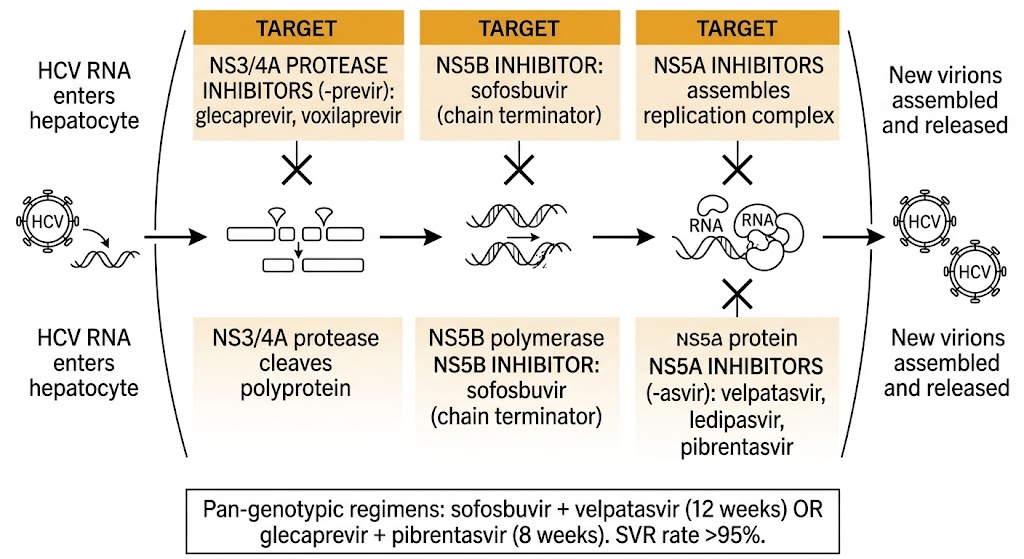
Diagram of the hepatitis C virus replication cycle showing the three targets of direct-acting antivirals: NS3/4A protease, NS5B polymerase, and NS5A protein
The three classes of direct-acting antivirals each target a distinct step in the hepatitis C virus replication cycle. Pan-genotypic combinations achieve sustained virologic response rates exceeding 95 percent in 8 to 12 weeks.
Three Drug Classes and Their Targets

Direct-acting antivirals target three essential enzymes in the hepatitis C virus replication cycle. NS3/4A protease inhibitors (ending in "-previr") block the viral serine protease responsible for cleaving the polyprotein precursor into functional viral proteins; examples include glecaprevir, voxilaprevir, and grazoprevir. NS5B polymerase inhibitors (nucleoside analogue: sofosbuvir) block the RNA-dependent RNA polymerase responsible for viral genome replication; sofosbuvir is a prodrug activated intracellularly to its triphosphate form and acts as a chain terminator. NS5A inhibitors (ending in "-asvir") target the NS5A protein required for viral replication complex assembly and virion assembly; examples include ledipasvir, velpatasvir, pibrentasvir, and elbasvir.

Pan-Genotypic Regimens

Current treatment guidelines favor pan-genotypic regimens that achieve cure — defined as sustained virologic response at 12 weeks after completing therapy, which is equivalent to undetectable hepatitis C virus RNA 12 weeks post-treatment — without requiring genotype testing. The two dominant pan-genotypic regimens are sofosbuvir plus velpatasvir (Epclusa) for 12 weeks and glecaprevir plus pibrentasvir (Mavyret) for 8 weeks in treatment-naive patients without cirrhosis. Both achieve sustained virologic response rates exceeding 95 percent across all genotypes. Patients with compensated cirrhosis or prior treatment experience typically receive extended courses of 12 to 16 weeks. Patients with decompensated cirrhosis cannot receive NS3/4A protease inhibitors, as these agents can worsen hepatic function; sofosbuvir plus velpatasvir is the regimen of choice in decompensated cirrhosis.

Drug Interactions

Direct-acting antivirals have clinically important drug interactions mediated primarily through cytochrome P450 3A4 and P-glycoprotein. NS3/4A protease inhibitors are substrates and inhibitors of cytochrome P450 3A4 and P-glycoprotein; co-administration with strong cytochrome P450 3A4 inducers such as rifampin, carbamazepine, and phenytoin substantially reduces protease inhibitor plasma concentrations and risks treatment failure. Sofosbuvir is a P-glycoprotein substrate; P-glycoprotein inducers reduce its absorption. Amiodarone combined with sofosbuvir-containing regimens has caused serious and fatal bradycardia, including complete heart block; amiodarone is contraindicated with sofosbuvir-containing regimens. The NS5A inhibitor ledipasvir requires an acidic environment for absorption; proton pump inhibitors significantly reduce ledipasvir exposure and should be avoided or given at the lowest effective dose with ledipasvir-containing regimens.

Direct-Acting Antiviral Drug Interaction Checklist

Before starting any direct-acting antiviral regimen: check for CYP3A4 inducers (rifampin, carbamazepine, phenytoin, St. John's wort) which can cause treatment failure. Check for amiodarone — contraindicated with sofosbuvir due to fatal bradycardia risk. Check proton pump inhibitor use if prescribing ledipasvir-containing regimen. Check for HIV antiretroviral drug interactions, particularly with regimens containing ritonavir-boosted protease inhibitors. Hepatitis C treatment is now curative in most patients; a missed interaction causing treatment failure wastes the opportunity for cure.

Section 3

Hepatitis D: Bulevirtide and Management Overview

Hepatitis D virus biology and its obligate dependence on hepatitis B surface antigen, bulevirtide as the first approved hepatitis D-specific therapy, and the role of pegylated interferon in chronic hepatitis D

Hepatitis D Biology and Treatment Context

Hepatitis D virus is a defective RNA virus that requires hepatitis B surface antigen as its envelope protein for assembly and cell entry; it can only infect patients who are simultaneously infected with hepatitis B virus, either as a co-infection or as a superinfection. Chronic hepatitis D superinfection accelerates fibrosis progression substantially compared with hepatitis B monoinfection and carries the highest risk of cirrhosis and liver failure among the viral hepatitides. Treatment of the underlying hepatitis B infection with nucleos(t)ide analogues suppresses hepatitis B virus DNA but does not suppress hepatitis D virus replication, as hepatitis D uses the hepatitis B surface antigen regardless of hepatitis B virus DNA levels.

Bulevirtide

Bulevirtide is a lipopeptide entry inhibitor that blocks hepatitis D virus (and hepatitis B virus) cell entry by competitively inhibiting the sodium-taurocholate co-transporting polypeptide (NTCP) receptor, which serves as the common hepatocyte entry receptor for both viruses. It is the first drug approved specifically for chronic hepatitis D infection. It is given subcutaneously and is approved in Europe for treatment of chronic hepatitis D in adults with compensated liver disease. Clinical trials demonstrate significant reductions in hepatitis D virus RNA and alanine aminotransferase with bulevirtide monotherapy or combination with pegylated interferon compared with no treatment. Bulevirtide causes a dose-dependent increase in serum bile acid concentrations by blocking bile acid uptake through the same NTCP transporter; this is a pharmacological effect rather than hepatotoxicity and does not require drug discontinuation.

Pegylated Interferon in Hepatitis D

Pegylated interferon alfa has historically been the only treatment option for chronic hepatitis D and remains a component of combination regimens. It suppresses hepatitis D virus RNA and achieves sustained virologic response — defined as undetectable hepatitis D virus RNA 24 weeks after stopping — in approximately 25 to 30 percent of patients with 48 weeks of therapy. Response rates are substantially lower than in hepatitis C and relapse is common. The same adverse effect profile and contraindications as described for hepatitis B apply. Patients with decompensated cirrhosis cannot receive pegylated interferon.


Section 4

Acute Liver Failure: N-Acetylcysteine and Supportive Management

Acetaminophen toxicity as the leading cause of acute liver failure in the United States, the mechanism of N-acetylcysteine as glutathione replenishment, King's College Criteria for transplant listing, and the principles of supportive management

Acute liver failure is a medical emergency defined by coagulopathy and encephalopathy in a patient without pre-existing liver disease. Acetaminophen hepatotoxicity is the most common cause in the United States and the United Kingdom, and N-acetylcysteine is the specific antidote with the strongest evidence base. Knowing the mechanism of N-acetylcysteine and the indications for urgent transplant evaluation are the high-yield pharmacology and clinical points at the second-year level.

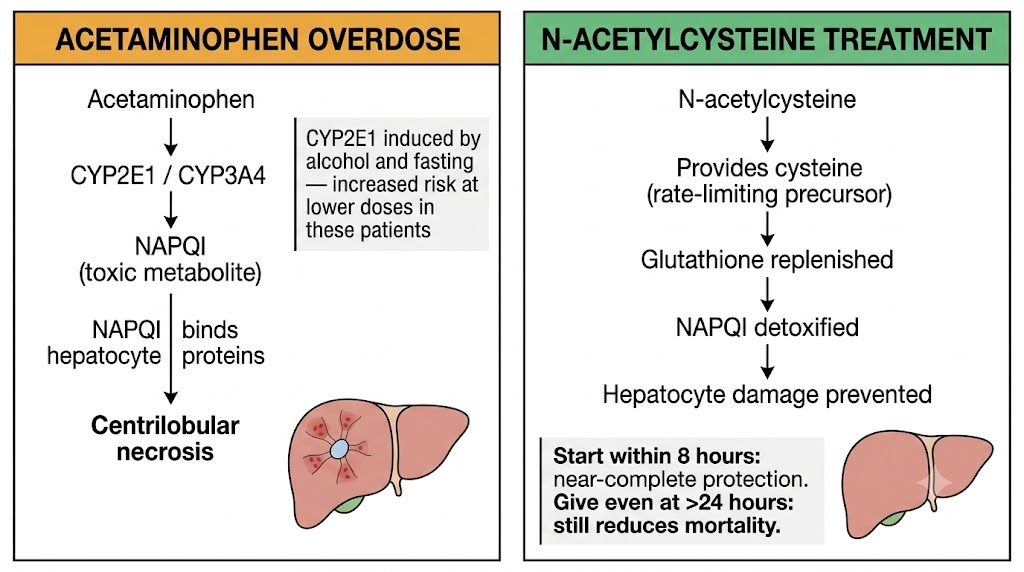
Two-panel diagram showing acetaminophen hepatotoxicity mechanism through NAPQI accumulation and how N-acetylcysteine reverses toxicity by replenishing glutathione
In overdose, depleted glutathione stores allow NAPQI to accumulate and cause centrilobular hepatocyte necrosis. N-acetylcysteine replenishes glutathione by providing cysteine, the rate-limiting precursor.
Acetaminophen Hepatotoxicity Mechanism

Acetaminophen is normally metabolized primarily by glucuronidation and sulfation to non-toxic conjugates. A small fraction undergoes cytochrome P450 2E1 and cytochrome P450 3A4 metabolism to N-acetyl-para-benzoquinoneimine, a reactive electrophilic metabolite. In therapeutic doses, N-acetyl-para-benzoquinoneimine is immediately detoxified by conjugation with glutathione. In overdose, glucuronidation and sulfation pathways become saturated, shunting a larger fraction through cytochrome P450 metabolism; N-acetyl-para-benzoquinoneimine accumulates faster than glutathione can neutralize it, covalently binding hepatocyte macromolecules and causing centrilobular necrosis. Cytochrome P450 2E1 is induced by chronic alcohol use and fasting, which is why chronic alcoholics and malnourished patients are at higher risk of hepatotoxicity at lower acetaminophen doses than the general population.

N-Acetylcysteine

N-acetylcysteine is the antidote for acetaminophen hepatotoxicity. It replenishes hepatic glutathione by serving as a cysteine precursor — the rate-limiting substrate for glutathione synthesis — enabling continued detoxification of N-acetyl-para-benzoquinoneimine. Intravenous N-acetylcysteine is given as a 21-hour loading and maintenance infusion protocol. The decision to treat is guided by the Rumack-Matthew nomogram, which plots serum acetaminophen concentration against time since ingestion to define the probable, possible, and treatment-not-indicated risk zones; treatment is initiated when concentration falls in the probable hepatotoxicity zone or above the possible hepatotoxicity line as a precaution. Treatment initiated within 8 hours of ingestion virtually eliminates the risk of severe hepatotoxicity; efficacy decreases progressively with delayed presentation, but intravenous N-acetylcysteine has demonstrated benefit even in patients presenting more than 24 hours post-ingestion with established acute liver failure, through mechanisms that may include improved hepatic microcirculation and antioxidant effects beyond glutathione replenishment.

N-acetylcysteine is also used in non-acetaminophen acute liver failure — most commonly indeterminate etiology — where it may improve transplant-free survival, though the evidence is strongest for acetaminophen-related injury. The principal adverse effect of intravenous N-acetylcysteine is anaphylactoid reactions — flushing, urticaria, bronchospasm — that occur in approximately 10 to 20 percent of patients, are most common during the loading infusion, and are managed by temporarily stopping the infusion and administering antihistamines; N-acetylcysteine is restarted at a slower rate after symptoms resolve.

Transplant Evaluation and Supportive Care

The King's College Criteria identify patients with acute liver failure who are unlikely to survive without liver transplantation. For acetaminophen-related acute liver failure, the criteria are: arterial pH below 7.3 after adequate resuscitation, or the combination of all three of prothrombin time greater than 100 seconds, serum creatinine greater than 300 micromoles per liter, and grade III or IV hepatic encephalopathy. For non-acetaminophen acute liver failure, the criteria are: prothrombin time greater than 100 seconds alone, or any three of five factors including unfavorable etiology, age extremes, jaundice-to-encephalopathy interval greater than 7 days, bilirubin above 300 micromoles per liter, and prothrombin time greater than 50 seconds. Patients meeting King's College Criteria should be urgently evaluated for liver transplantation.

Supportive management includes aggressive management of hepatic encephalopathy with lactulose and rifaximin, correction of coagulopathy only if active bleeding or invasive procedures are planned (not prophylactically), renal replacement therapy for hepatorenal syndrome, and vasopressors for hemodynamic instability. Prophylactic antibiotic use in acute liver failure reduces the high infection risk but has not been shown to improve survival in randomized trials.

N-Acetylcysteine: Time Is Liver

N-acetylcysteine started within 8 hours of acetaminophen ingestion virtually eliminates severe hepatotoxicity. At 16 hours the benefit is substantially reduced. At 24 hours most hepatocyte damage has occurred, but intravenous N-acetylcysteine still reduces mortality in established acute liver failure and should be given regardless of time since ingestion. Never withhold N-acetylcysteine while waiting for the Rumack-Matthew nomogram calculation in a patient with a concerning history — treat empirically and adjust based on levels. Anaphylactoid reactions to the intravenous loading infusion are common but manageable; they are not a reason to withhold the drug.


Suggested References
Author / Organization Title Source
Terrault NA et al. AASLD guidelines for treatment of chronic hepatitis B Hepatology 2018;67(4):1560–1599
Lok AS et al. Antiviral therapy for chronic hepatitis B viral infection in adults: a systematic review and meta-analysis Hepatology 2016;63(1):284–306
AASLD-IDSA HCV guidance: recommendations for testing, managing, and treating hepatitis C Hepatology 2018;68(2):827–879
Roth A et al. Bulevirtide monotherapy or with pegylated interferon alfa-2a for chronic hepatitis D (MYR204) Lancet 2021;397(10283):1399–1409
Rumack BH, Matthew H Acetaminophen poisoning and toxicity Pediatrics 1975;55(6):871–876
Lee WM et al. Intravenous N-acetylcysteine improves transplant-free survival in early stage non-acetaminophen acute liver failure Gastroenterology 2009;137(3):856–864
O'Grady JG et al. Early indicators of prognosis in fulminant hepatic failure (King's College Criteria) Gastroenterology 1989;97(2):439–445