Fluid resuscitation and antibiotic stewardship in acute pancreatitis, enzyme replacement in chronic pancreatitis, somatostatin analogues for pancreatic endocrine tumors, and refeeding syndrome
GAST · Module 8 of 8Aggressive early fluid resuscitation as the cornerstone of management, lactated Ringer's over normal saline, opioid analgesia, the limited role of antibiotics, and early enteral nutrition
Acute pancreatitis management is largely supportive — there is no specific pharmacological therapy that interrupts the inflammatory cascade. The key pharmacological and management decisions at the second-year level involve fluid resuscitation strategy, analgesia selection, knowing when antibiotics are and are not indicated, and the timing of nutrition.
Early aggressive intravenous fluid resuscitation is the most important intervention in acute pancreatitis. Pancreatic inflammation causes significant third-space fluid losses into peripancreatic tissue and the retroperitoneum, resulting in intravascular volume depletion that drives progression from mild to severe disease through pancreatic microvascular ischemia. Current guidelines recommend goal-directed fluid resuscitation targeting heart rate below 120 beats per minute, mean arterial pressure above 65 millimeters of mercury, and urine output above 0.5 milliliters per kilogram per hour, typically requiring 250 to 500 milliliters per hour for the first 12 to 24 hours.
Lactated Ringer's solution is preferred over normal saline based on the WATERFALL (Lactated Ringer's Solution vs Normal Saline for Acute Pancreatitis) randomized controlled trial, which demonstrated that lactated Ringer's was associated with lower rates of the systemic inflammatory response syndrome compared with normal saline. The proposed mechanism is that normal saline's high chloride content causes hyperchloremic metabolic acidosis and promotes inflammation, whereas lactated Ringer's is pH-neutral and provides lactate as a metabolic substrate. Over-resuscitation with excessive volumes also carries risks including abdominal compartment syndrome and pulmonary edema; fluid volumes should be adjusted based on response monitoring rather than fixed protocols.
Acute pancreatitis causes severe pain requiring effective analgesia. Intravenous opioids are the standard of care; hydromorphone or fentanyl are preferred over morphine because morphine has been associated with sphincter of Oddi spasm in vitro, though clinical evidence that this worsens outcomes in pancreatitis is limited. Non-steroidal anti-inflammatory drugs reduce opioid requirements and are appropriate adjuncts in patients without renal impairment or other contraindications. Epidural analgesia has been used in severe acute pancreatitis in intensive care settings and may also improve splanchnic blood flow.
Antibiotics are not indicated in acute pancreatitis unless there is evidence of infected pancreatic necrosis or an extrapancreatic infectious complication such as cholangitis or urinary tract infection. Prophylactic antibiotics were studied in multiple randomized controlled trials to prevent the development of infected pancreatic necrosis; meta-analyses consistently found no reduction in mortality, infected necrosis, or surgical interventions with prophylactic antibiotics. Routine prophylactic antibiotic use in acute pancreatitis is therefore not recommended and may contribute to selection of resistant organisms and fungal superinfection. When infected pancreatic necrosis is suspected based on clinical deterioration with fever, persistent organ failure, or imaging findings showing gas within pancreatic necrosis, cultures should be obtained via endoscopic ultrasound-guided or computed tomography-guided fine-needle aspiration to guide antibiotic selection; imipenem or meropenem are often used empirically because they achieve adequate pancreatic tissue penetration.
Early enteral nutrition — starting within 24 to 48 hours of admission in patients with severe acute pancreatitis — is superior to parenteral nutrition and is now strongly recommended. Enteral nutrition preserves gut barrier function, reduces bacterial translocation, and reduces infection complications. Nasojejunal feeding distal to the ligament of Treitz is preferred over nasogastric feeding when the latter is poorly tolerated due to gastroparesis, but nasogastric feeding is acceptable if tolerated. Parenteral nutrition is reserved for patients in whom enteral access cannot be established or maintained after attempts, as it is associated with higher rates of infectious complications, hyperglycemia, and central venous catheter-related complications than enteral nutrition.
Do NOT use: prophylactic antibiotics in acute pancreatitis regardless of severity — randomized controlled trials show no benefit and potential for harm. Do use: when infected pancreatic necrosis is confirmed or strongly suspected (clinical deterioration, gas on imaging); obtain cultures and use antibiotics with pancreatic tissue penetration (imipenem or meropenem). Do use: for concurrent extrapancreatic infections (cholangitis, urinary tract infection, pneumonia) per standard indications. The absence of fever in the early days of acute pancreatitis does not exclude the diagnosis; the systemic inflammatory response alone can cause fever without infection.
Pancreatic enzyme replacement therapy dosing and administration principles, fat-soluble vitamin supplementation, pain management with analgesics and pancreatic enzymes, and the role of endoscopic and surgical intervention
Chronic pancreatitis causes progressive destruction of the exocrine pancreas, leading to exocrine pancreatic insufficiency with fat malabsorption when more than 90 percent of exocrine function is lost. Pharmacological management addresses enzyme deficiency, micronutrient malabsorption, and pain.
Pancreatic enzyme replacement therapy (PERT) is the cornerstone of treatment for exocrine pancreatic insufficiency. Enteric-coated pancreatic enzyme preparations contain lipase, amylase, and protease derived from porcine pancreas. Lipase activity is the primary determinant of fat absorption; current guidelines recommend a minimum of 40,000 to 50,000 international units of lipase activity with each main meal and 20,000 to 25,000 international units with snacks. Dosing is titrated based on response — steatorrhea resolution, weight gain, and normalization of fecal elastase levels.
Administration timing is critical: enzyme capsules must be taken with meals, ideally divided between the beginning and middle of the meal to ensure mixing with chyme in the duodenum at the time of maximum fat digestion. Enteric coating protects enzymes from gastric acid degradation; however, patients with gastric acid hypersecretion — common in chronic pancreatitis because pancreatic bicarbonate secretion is reduced — may have persistently low duodenal pH that prevents enteric coat dissolution and impairs enzyme release. In these patients, adding a proton pump inhibitor improves enzyme efficacy by raising duodenal pH and facilitating enteric coat dissolution. Crushing or chewing enteric-coated preparations destroys the enteric coating and should be avoided.
Fat malabsorption in exocrine pancreatic insufficiency causes deficiency of fat-soluble vitamins A, D, E, and K. Vitamin D deficiency is the most clinically consequential in chronic pancreatitis because it contributes to osteopenia and osteoporosis, already elevated risks in chronic pancreatitis patients from alcohol use, smoking, and reduced physical activity. Serum 25-hydroxyvitamin D levels should be measured at baseline and monitored during treatment; supplementation targets sufficient levels above 30 nanograms per milliliter. Vitamin K deficiency produces coagulopathy measurable by prolonged prothrombin time. Vitamin A and vitamin E deficiencies are less commonly symptomatic but should be assessed, particularly in patients with severe malabsorption.
Pain in chronic pancreatitis is often the most debilitating symptom and the most pharmacologically challenging to manage. Non-opioid analgesics — acetaminophen and non-steroidal anti-inflammatory drugs — are the first-line approach. Pancreatic enzyme replacement at supraphysiological doses may reduce pain in a subset of patients by suppressing pancreatic secretion through a negative feedback mechanism — luminal proteases provide duodenal feedback that reduces cholecystokinin-driven pancreatic exocrine stimulation. The evidence for this mechanism is most robust in idiopathic chronic pancreatitis and less convincing in alcoholic chronic pancreatitis. Tricyclic antidepressants at low doses are used as analgesic adjuncts for the neuropathic pain component. Opioids are often required for moderate to severe pain but carry high risks of dependence and opioid-induced hyperalgesia in this population, who already have elevated substance use disorder risk; they should be used at the lowest effective dose with clear goals and regular reassessment. Endoscopic therapy for ductal obstruction or pseudocysts and surgical drainage or resection procedures address structural causes of pain and often provide more durable relief than pharmacological approaches alone.
Octreotide and lanreotide as somatostatin analogues for VIPoma, glucagonoma, and carcinoid syndrome, diazoxide for insulinoma, and the management principles for functional pancreatic neuroendocrine tumors
Functional pancreatic neuroendocrine tumors secrete hormones that produce distinct clinical syndromes. Pharmacological management aims to control hormone hypersecretion and its sequelae while surgical resection remains the definitive treatment when feasible. Somatostatin analogues are the cornerstone of medical management for most functional tumors.
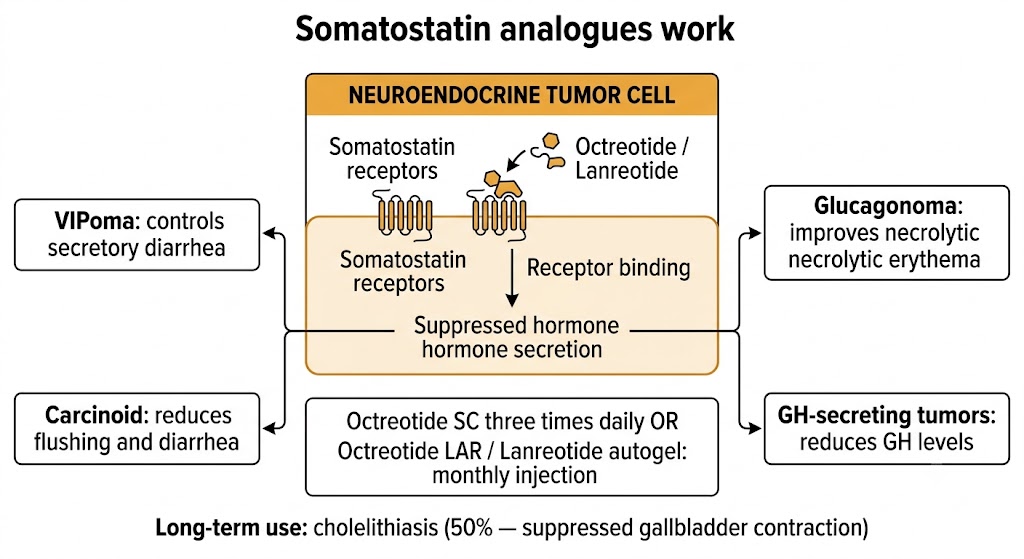
Somatostatin is an endogenous peptide that suppresses the secretion of growth hormone, insulin, glucagon, gastrin, vasoactive intestinal peptide, and numerous other hormones through binding to somatostatin receptors (primarily subtypes 2 and 5) on secretory cells. Natural somatostatin has a half-life of only 1 to 3 minutes, limiting clinical utility. Octreotide and lanreotide are synthetic somatostatin analogues with substantially longer half-lives — octreotide at 100 micrograms three times daily subcutaneously has an effective half-life of approximately 2 hours, while octreotide long-acting release (LAR) given intramuscularly monthly and lanreotide autogel given subcutaneously monthly provide sustained hormone suppression with monthly dosing.
In VIPoma (vasoactive intestinal peptide-secreting tumor), octreotide rapidly controls the profuse secretory diarrhea by suppressing vasoactive intestinal peptide secretion, allowing fluid and electrolyte replacement to stabilize the patient before surgery. In glucagonoma, octreotide suppresses glucagon hypersecretion, improving the necrolytic migratory erythema and glucose intolerance. In carcinoid syndrome caused by serotonin-secreting neuroendocrine tumors, somatostatin analogues suppress serotonin secretion, reducing flushing and diarrhea; both octreotide LAR and lanreotide autogel have demonstrated antiproliferative activity in well-differentiated neuroendocrine tumors in addition to their antisecretory effects.
Adverse effects of somatostatin analogues include cholelithiasis — suppression of cholecystokinin reduces gallbladder contractility, causing bile stasis and gallstone formation in up to 50 percent of patients on long-term therapy — steatorrhea from suppressed pancreatic enzyme secretion, nausea, abdominal cramping, and transient glucose elevation from inhibited insulin secretion. Gallbladder surveillance with ultrasound is recommended during long-term somatostatin analogue therapy.
Insulinoma produces autonomous insulin hypersecretion causing recurrent fasting hypoglycemia. Diazoxide is the primary pharmacological agent for medical management of insulinoma. It is a potassium channel opener that hyperpolarizes beta cell membranes by opening adenosine triphosphate-sensitive potassium channels, suppressing calcium influx and thereby inhibiting insulin secretion. At the doses used for insulinoma (150 to 300 milligrams daily in divided doses), diazoxide effectively reduces hypoglycemic episodes in a majority of patients. Adverse effects include sodium and water retention — diuretic co-administration is typically required — hirsutism with chronic use, nausea, and tachycardia. Somatostatin analogues are an alternative for insulinomas expressing somatostatin receptors, but must be used cautiously because they also suppress glucagon secretion and can paradoxically worsen hypoglycemia in patients whose counter-regulatory glucagon response is intact.
Zollinger-Ellison syndrome results from autonomous gastrin hypersecretion by a gastrinoma, causing massive acid hypersecretion, severe peptic ulceration, and diarrhea. High-dose proton pump inhibitors are the medical treatment of choice: omeprazole or esomeprazole at doses of 60 to 120 milligrams daily in divided doses suppress acid secretion sufficiently to heal ulcers and resolve diarrhea. The dose required is substantially higher than for standard peptic ulcer disease because the massive acid output overwhelms standard doses. Proton pump inhibitor therapy controls symptoms reliably, though surgical resection of the gastrinoma is pursued when feasible and is the only potential cure.
Parenteral nutrition composition and complications, refeeding syndrome as a potentially fatal phosphate-depletion syndrome, thiamine deficiency before glucose in malnourished patients, and clinically important micronutrient deficiency presentations
Nutritional pharmacology at the second-year level focuses on the complications of parenteral nutrition, the life-threatening electrolyte shifts of refeeding syndrome, and the clinical pharmacology of micronutrient deficiencies. Refeeding syndrome is a high-yield clinical pharmacology topic because it is preventable, potentially fatal, and requires understanding the biochemical mechanism to anticipate and prevent it.
Parenteral nutrition delivers glucose, amino acids, lipid emulsion, electrolytes, vitamins, and trace elements directly into the bloodstream via a central venous catheter. It is indicated when the gastrointestinal tract cannot be used for enteral nutrition for an extended period — for example, in high-output proximal fistulae, short bowel syndrome with insufficient absorptive capacity, and prolonged bowel rest when the enteral route is genuinely inaccessible. Parenteral nutrition is associated with significantly higher rates of infectious complications compared with enteral nutrition, primarily central venous catheter-related bloodstream infections and bacterial translocation-related infections from gut barrier disruption. Metabolic complications include hyperglycemia requiring insulin infusion management, hypertriglyceridemia from lipid overload, hepatic steatosis and cholestasis with prolonged use, and electrolyte imbalances. Line sepsis prevention requires meticulous catheter care protocols.
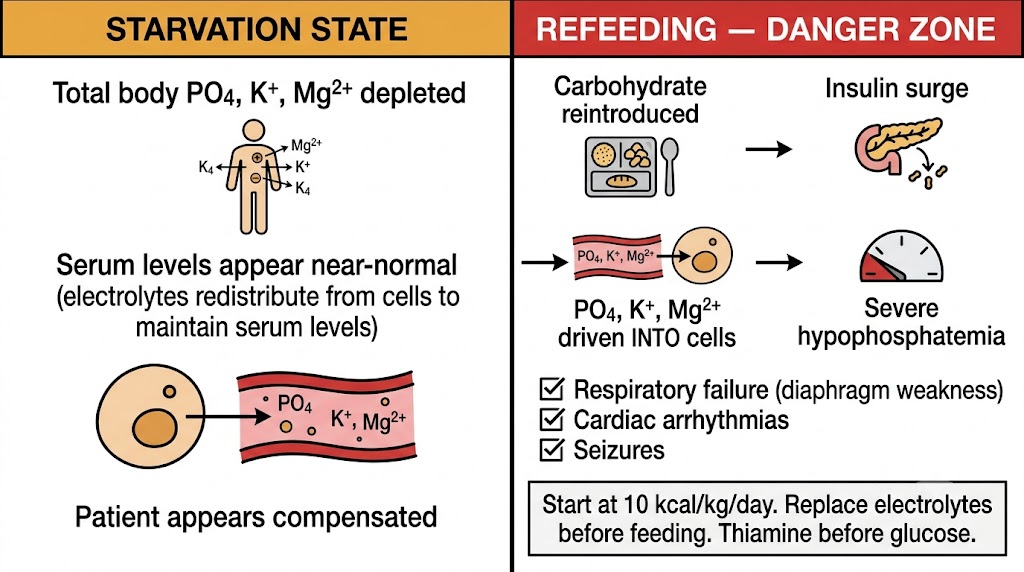
Refeeding syndrome is a potentially fatal metabolic complication that occurs when nutrition is reintroduced — either enterally or parenterally — to severely malnourished patients after a prolonged period of starvation or very low caloric intake. During starvation, total body phosphate, potassium, and magnesium stores are depleted while serum levels may remain near-normal because cellular electrolytes redistribute to maintain serum concentrations. When carbohydrate is reintroduced, insulin secretion surges in response to the glucose load, driving phosphate, potassium, and magnesium from the extracellular space into cells as part of anabolic metabolism, causing rapid and severe hypophosphatemia, hypokalemia, and hypomagnesemia.
Severe hypophosphatemia is the most dangerous electrolyte shift. Phosphate is required for adenosine triphosphate synthesis; its depletion impairs cellular energy metabolism in every organ system. Clinical manifestations include respiratory failure from diaphragm weakness (the most common cause of death), cardiac arrhythmias, hemolytic anemia, rhabdomyolysis, seizures, and altered mental status. Prevention requires identifying at-risk patients — those with body mass index below 16 kilograms per square meter, less than 10 percent of normal body weight for more than 2 months, negligible intake for more than 5 days, or a history of alcoholism, anorexia nervosa, or prolonged nil by mouth — measuring baseline electrolytes, replacing phosphate, potassium, and magnesium aggressively before and during refeeding, and starting nutrition slowly at 10 calories per kilogram per day or less, increasing gradually over 4 to 7 days.
Thiamine (vitamin B1) is an essential cofactor for pyruvate dehydrogenase, alpha-ketoglutarate dehydrogenase, and transketolase — three enzymes central to glucose metabolism, the citric acid cycle, and the pentose phosphate pathway. In chronically malnourished patients, particularly those with alcohol use disorder, thiamine stores are severely depleted. Administering glucose to a thiamine-deficient patient without first replenishing thiamine precipitates Wernicke's encephalopathy — a triad of ocular abnormalities (nystagmus, ophthalmoplegia), cerebellar ataxia, and confusion caused by thiamine-deficient neurons failing to metabolize the glucose load. Wernicke's encephalopathy progressing to Korsakoff syndrome (permanent amnestic syndrome) is irreversible. Thiamine 100 to 200 milligrams intravenously must be given before any glucose-containing fluid or food in malnourished patients presenting to hospital, including those receiving parenteral nutrition initiation.
Several micronutrient deficiency presentations are high-yield at the second-year level. Iron deficiency — the most common nutritional deficiency worldwide — presents with microcytic hypochromic anemia; oral ferrous sulfate is first-line treatment, with intravenous iron sucrose or ferric carboxymaltose used when oral iron is not tolerated or absorbed, as in inflammatory bowel disease or post-bariatric surgery states. Vitamin B12 deficiency produces megaloblastic anemia and subacute combined degeneration of the spinal cord (posterior and lateral column demyelination); intramuscular hydroxocobalamin is used when oral absorption is impaired, as in pernicious anemia (lack of intrinsic factor) or terminal ileal disease. Folate deficiency also causes megaloblastic anemia without neurological features; oral folate 5 milligrams daily corrects deficiency. Zinc deficiency impairs wound healing, immune function, taste, and smell, and is common in inflammatory bowel disease, alcoholism, and malabsorption. Selenium deficiency is associated with cardiomyopathy (Keshan disease) and is a risk with long-term parenteral nutrition without trace element supplementation.
| Author / Organization | Title | Source |
|---|---|---|
| Tenner S et al. | American College of Gastroenterology guideline: management of acute pancreatitis | Am J Gastroenterol 2013;108(9):1400–1415 |
| de-Madaria E et al. | Lactated Ringer's solution versus normal saline for acute pancreatitis (WATERFALL trial) | N Engl J Med 2022;387(11):982–991 |
| Weimann A et al. | ESPEN guideline: clinical nutrition in surgery | Clin Nutr 2017;36(3):623–650 |
| Dominguez-Munoz JE | Pancreatic exocrine insufficiency: diagnosis and treatment | J Gastroenterol Hepatol 2011;26(Suppl 2):12–16 |
| Kvols LK et al. | Treatment of the malignant carcinoid syndrome: evaluation of a long-acting somatostatin analogue | N Engl J Med 1986;315(11):663–666 |
| Stehling LC, Simon TL | The role of diazoxide in the medical management of insulinoma | Arch Intern Med 1995;155(3):357–361 |
| Crook MA et al. | The importance of the refeeding syndrome | Nutrition 2001;17(7–8):632–637 |
| National Institute for Health and Care Excellence | Nutrition support for adults: oral nutrition support, enteral tube feeding and parenteral nutrition (CG32) | NICE 2006 (updated 2017) |