Combined oral contraceptives prevent pregnancy through three pharmacologically distinct mechanisms that operate in a hierarchy. Anovulation is the primary and most reliable mechanism: sustained elevation of exogenous estrogen and progestin suppresses the hypothalamic-pituitary-ovarian axis, eliminating the mid-cycle luteinizing hormone surge and preventing follicular development. In perfect-use conditions, anovulation occurs in more than 99% of cycles. This is the mechanism that matters most — if ovulation does not occur, there is no egg to fertilize.
The second mechanism is cervical mucus thickening. Progestins convert mid-cycle cervical mucus from its fluid, permeable state to a viscous, impenetrable consistency that blocks sperm. This mechanism is operative even in cycles where ovulation is not suppressed and is the primary mechanism of progestin-only methods that do not reliably suppress ovulation. The norethindrone 0.35 mg minipill depends almost entirely on this mechanism — and because mucus permeability begins to return within 3 to 4 hours of a missed dose, this pill must be taken within the same 3-hour window each day.
The third mechanism is endometrial atrophy. Sustained combined hormonal exposure produces a thin, poorly vascularized endometrium unsuitable for implantation. This is a backup mechanism; it matters only if both anovulation and mucus thickening fail. Understanding this hierarchy clarifies why missed pills are dangerous: it is disruption of anovulation — not endometrial effects — that creates the highest risk of pregnancy.
Primary: anovulation (combined oral contraceptives, etonogestrel implant, desogestrel minipill). Secondary: cervical mucus thickening (all progestin-containing methods). Tertiary backup: endometrial atrophy. For the norethindrone minipill and the levonorgestrel intrauterine device at systemic concentrations, mucus thickening is the dominant mechanism because ovulation suppression is inconsistent at those doses.
Modern combined oral contraceptives contain 20 to 35 micrograms of ethinyl estradiol in the majority of prescribed preparations. The 20 microgram dose provides adequate contraceptive efficacy with the lowest venous thromboembolism risk within the ethinyl estradiol-containing class. The 35 microgram dose produces greater sex hormone-binding globulin induction and therefore a greater reduction in free androgen levels, making it preferable when treating androgen-excess conditions such as polycystic ovary syndrome and acne. Ultra-low-dose preparations (10 to 15 micrograms) provide minimal cycle control and are rarely first-line choices.
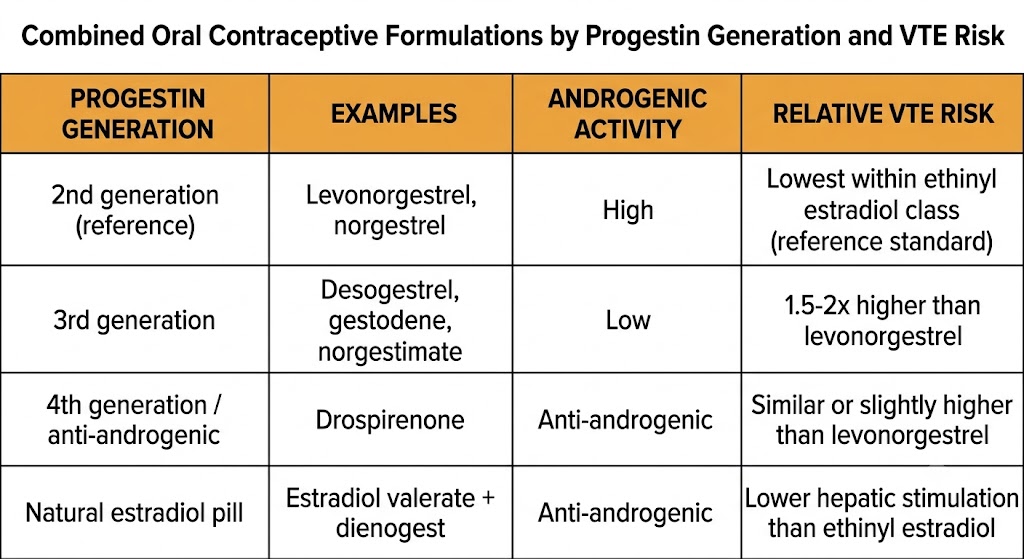
All ethinyl estradiol-containing combined oral contraceptives increase venous thromboembolism risk approximately three to four times above the non-pregnant, non-pill baseline. Within this class, the progestin component determines the relative risk ranking.
Second-generation progestins — levonorgestrel and norgestrel — carry the lowest venous thromboembolism risk of any ethinyl estradiol-containing combination and have the longest safety record. They are the reference standard for venous thromboembolism risk comparisons. Third-generation progestins — desogestrel, gestodene, and norgestimate — have lower androgenic activity and a more favorable lipid profile than levonorgestrel, but epidemiological data consistently show approximately 1.5 to 2 times higher venous thromboembolism risk than levonorgestrel-containing pills. Drospirenone-containing pills carry a similar or slightly higher venous thromboembolism risk compared to levonorgestrel formulations.
The absolute excess venous thromboembolism risk from any modern low-dose combined oral contraceptive is small — approximately 5 to 10 additional events per 10,000 woman-years — and substantially lower than the venous thromboembolism risk of pregnancy itself. The relative risk difference between progestin generations is most clinically relevant in women who already have venous thromboembolism risk factors, where the additive risk of a higher-risk progestin generation matters more.
The combination of estradiol valerate and dienogest (Natazia/Qlaira) is the only combined oral contraceptive using natural estradiol rather than ethinyl estradiol. Estradiol valerate is rapidly converted after absorption to 17-beta-estradiol, producing lower hepatic estrogenic stimulation than ethinyl estradiol. Dienogest provides anti-androgenic progestational activity. This formulation is an option for women who desire a combined oral contraceptive with a more physiological estrogen component, though cycle control is somewhat less predictable than with standard ethinyl estradiol preparations.
Lowest VTE risk within the ethinyl estradiol class: levonorgestrel (2nd generation) at 20 micrograms ethinyl estradiol. Higher relative VTE risk: 3rd generation (desogestrel, gestodene) and drospirenone. All are far safer than pregnancy for VTE. Transdermal estradiol (used in hormone therapy, not contraception) does not increase VTE risk at all. The key distinction is the presence of ethinyl estradiol and its first-pass hepatic coagulation factor stimulation.
Two progestin-only pills are available and they differ in a clinically important way. The norethindrone 0.35 mg minipill works primarily by thickening cervical mucus rather than suppressing ovulation — the dose is too low to consistently suppress the luteinizing hormone surge. Because cervical mucus permeability begins to recover within 3 to 4 hours after the plasma norethindrone level falls below its threshold, this pill must be taken within the same 3-hour window each day. Missing this window by more than 3 hours is treated as a missed pill with the need for backup contraception.
The desogestrel 75-microgram pill (Cerazette/Cerelle) reliably suppresses ovulation in the great majority of cycles and allows a 12-hour missed-pill window, providing efficacy comparable to combined oral contraceptives without ethinyl estradiol. This makes it substantially more forgiving than the norethindrone minipill and the preferred progestin-only pill option when ovulation suppression is desired without estrogen.
The etonogestrel subdermal implant (Nexplanon) is a single rod inserted in the inner upper arm that suppresses ovulation for 3 years. It is the most effective reversible contraceptive available because it removes adherence as a failure variable entirely. Irregular bleeding in the first year affects approximately 20% of users and is the most common reason for early discontinuation. Fertility returns within 3 to 4 weeks of removal.
Depot medroxyprogesterone acetate (150 mg intramuscular every 12 weeks) suppresses ovulation within 24 hours of injection and is highly effective. The two clinically essential counseling points are: first, the delayed return to fertility — on average 9 to 10 months after the last injection, occasionally longer — which is the longest fertility delay of any reversible contraceptive method and must be discussed before starting; and second, bone mineral density reduction with prolonged use, which is reversible after discontinuation and does not increase fracture risk in adults. The World Health Organization advises caution with use beyond 2 years in adolescents who have not yet achieved peak bone mass.
Three levonorgestrel intrauterine device formulations exist, differentiated primarily by their levonorgestrel load and duration: the 52 mg system (Mirena) is approved for 5 to 8 years; the 19.5 mg system (Kyleena) for 5 years; and the 13.5 mg system (Skyla) for 3 years. The primary contraceptive mechanism is local: high levonorgestrel concentrations in the endometrium produce atrophy and in cervical mucus produce impermeability. Systemic absorption is minimal, explaining why systemic progestogenic side effects are far less prominent than with oral progestin methods. Ovulation suppression occurs in some cycles (particularly early with the 52 mg device) but becomes the minority mechanism over time as the local endometrial and cervical effects predominate.
The implant, levonorgestrel intrauterine device, and copper intrauterine device achieve their efficacy without daily or coital action, making perfect-use and typical-use failure rates nearly identical. For comparison, combined oral contraceptives have a perfect-use failure rate of 0.3% per year but a typical-use rate of approximately 7 to 9% because of missed pills. Whenever consistent daily pill adherence is uncertain, a long-acting reversible contraceptive is pharmacologically superior regardless of stated intent.
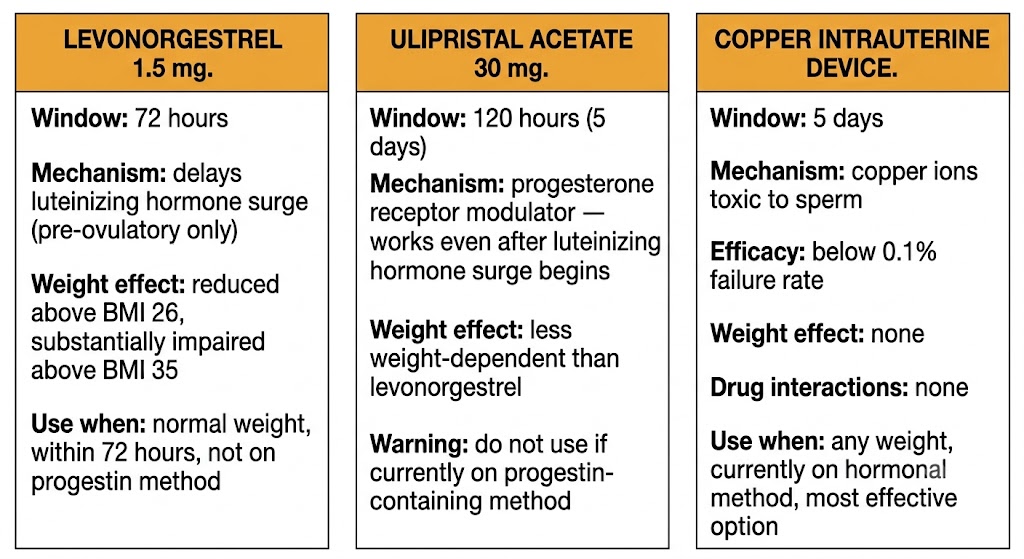
Levonorgestrel 1.5 mg (Plan B and generics) works by inhibiting or delaying ovulation when taken before the luteinizing hormone surge. It has no consistent effect after ovulation has already occurred — its mechanism is entirely pre-ovulatory. Efficacy is highest within 24 hours of unprotected intercourse and falls substantially by 48 to 72 hours, defining a practical 72-hour window.
Body weight substantially reduces efficacy. At body mass index above approximately 26 kg/m², levonorgestrel concentrations are lower and ovulation suppression becomes less reliable. At body mass index above 35 kg/m², efficacy is substantially impaired and an alternative should be offered. Ulipristal acetate or the copper intrauterine device are preferred in women above this weight threshold.
Ulipristal acetate 30 mg is a selective progesterone receptor modulator that can inhibit follicular rupture even after the luteinizing hormone surge has begun — a capability levonorgestrel lacks. This extends its effective window to 120 hours (5 days) after unprotected intercourse. Within the 72-hour window shared with levonorgestrel, ulipristal acetate is more effective, particularly as time elapses and the luteinizing hormone surge has already started. It shows less weight-dependent attenuation than levonorgestrel and is the preferred pharmacological emergency contraceptive in women with body mass index above 26 kg/m².
A critical pharmacological interaction exists between ulipristal acetate and progestins. Because ulipristal acetate partially antagonizes the progesterone receptor, co-administration with progestin-containing methods reduces its efficacy. Women currently using a combined oral contraceptive, progestin-only pill, implant, depot medroxyprogesterone acetate, or levonorgestrel intrauterine device who need emergency contraception should not rely on ulipristal acetate — the copper intrauterine device is the appropriate choice. Additionally, ulipristal acetate use should be followed by a 5-day delay before starting any progestin-containing contraceptive method.
The copper intrauterine device is the most effective emergency contraception available, with a failure rate below 0.1% when inserted within 5 days of unprotected intercourse. Its mechanism — cytotoxic effects of copper ions on sperm — is entirely independent of ovulation timing and entirely independent of body weight or concurrent hormonal methods. It provides ongoing highly effective contraception for up to 10 years. It is the preferred emergency contraception option for women with body mass index above 35 kg/m², women currently using a progestin-containing method, and women who require the most reliable ongoing contraception.
Levonorgestrel: within 72 hours, normal weight, not currently on progestin method. Ulipristal acetate: up to 120 hours, body mass index above 26 kg/m², not currently on progestin method — then wait 5 days before starting hormonal contraception. Copper intrauterine device: any weight, any timing within 5 days, currently on any hormonal method, most effective option available.
When a patient takes a cytochrome P450 3A4 inducer — rifampin, or an enzyme-inducing antiepileptic drug such as carbamazepine, phenytoin, phenobarbital, or oxcarbazepine — the choice of contraceptive method matters. Oral, patch, and ring combined hormonal methods are not recommended because induced metabolism reduces ethinyl estradiol and progestin concentrations to potentially subtherapeutic levels.
The levonorgestrel intrauterine device is unaffected by enzyme inducers because it acts locally at the endometrium and cervix at concentrations that vastly exceed systemic levels regardless of any induction effect. It is the recommended hormonal contraceptive option in women on enzyme-inducing antiepileptic drugs. Depot medroxyprogesterone acetate provides a large depot buffer against induction — concentrations after a 150 mg injection remain substantially above the contraceptive threshold even with moderate cytochrome P450 3A4 induction — and is an acceptable choice. The etonogestrel implant may have reduced efficacy with strong enzyme inducers and is generally not recommended in this context.
As covered in Module 1, ethinyl estradiol reduces lamotrigine levels by 40 to 65% through enzyme induction, creating seizure risk on starting a combined oral contraceptive and toxicity risk on stopping. For women stabilized on lamotrigine, any ethinyl estradiol-containing method — combined oral contraceptive, patch, or ring — is contraindicated in practice. The levonorgestrel intrauterine device or etonogestrel implant are the pharmacologically ideal options: highly effective, progestin-only (no ethinyl estradiol), and long-acting with no interaction with lamotrigine.
Avoid: combined oral contraceptive, patch, ring, etonogestrel implant (with strong inducers). Acceptable: depot medroxyprogesterone acetate (large depot buffer). Preferred: levonorgestrel intrauterine device (local mechanism, unaffected by systemic induction). For lamotrigine specifically: any progestin-only method is safe from the pharmacokinetic standpoint; levonorgestrel intrauterine device and etonogestrel implant are ideal.
The World Health Organization Medical Eligibility Criteria for Contraceptive Use grades contraceptive safety in the presence of medical conditions using four categories: Category 1 means no restriction; Category 2 means advantages generally outweigh risks; Category 3 means risks generally outweigh advantages (use only when other options are unavailable); Category 4 is an absolute contraindication representing an unacceptable health risk.
The following conditions are absolute contraindications (Category 4) for combined hormonal contraceptives — the combined oral contraceptive, contraceptive patch, and vaginal ring. These contraindications arise predominantly from the ethinyl estradiol component and its effects on coagulation, blood pressure, hepatic function, and stroke risk.
For most conditions that are Category 3 or 4 for combined hormonal methods, progestin-only methods (progestin-only pills, implant, depot medroxyprogesterone acetate, levonorgestrel intrauterine device) are Category 1 or 2. This includes prior venous thromboembolism, thrombophilia, migraine with aura, hypertension, age over 35 with smoking, breastfeeding in the first 6 weeks postpartum, and most liver conditions. The one major exception is current breast cancer, which is Category 4 for all hormonal methods.
Migraine with aura is a Category 4 absolute contraindication for combined hormonal methods. Progestin-only methods are Category 2 — safe with advantages outweighing risks. Many clinicians incorrectly apply the combined method contraindication to all hormonal methods. The levonorgestrel intrauterine device or etonogestrel implant are the preferred hormonal options in women with migraine with aura.
| Author / Organization | Title | Source |
|---|---|---|
| Hatcher RA, Nelson AL, Trussell J, et al. | Contraceptive Technology, 21st ed. | Ayer Company Publishers; 2018 |
| McCann MF, Potter LS. | Progestin-only oral contraception: a comprehensive review | Contraception. 1994;50(6 Suppl 1):S1–195 |
| Trussell J. | Contraceptive failure in the United States | Contraception. 2011;83(5):397–404 |
| Schindler AE. | Non-contraceptive benefits of oral hormonal contraceptives | Int J Endocrinol Metab. 2013;11(1):41–47 |
| Lidegaard O, Nielsen LH, Skovlund CW, et al. | Risk of venous thromboembolism from use of oral contraceptives containing different progestogens and oestrogen doses | BMJ. 2011;343:d6423 |
| World Health Organization. | Medical Eligibility Criteria for Contraceptive Use, 5th ed. | WHO Press; 2015 |
| Mansour D, Inki P, Gemzell-Danielsson K. | Efficacy of contraceptive methods: a review of the literature | Eur J Contracept Reprod Health Care. 2010;15(1):4–16 |
| Nilsson CG, Haukkamaa M, Vierola H, Luukkainen T. | Tissue concentrations of levonorgestrel in women using a levonorgestrel-releasing IUD | Clin Endocrinol (Oxf). 1982;17(5):529–536 |
| Glasier AF, Cameron ST, Fine PM, et al. | Ulipristal acetate versus levonorgestrel for emergency contraception: a randomised non-inferiority trial and meta-analysis | Lancet. 2010;375(9714):555–562 |
| Brache V, Cochon L, Deniaud M, Croxatto HB. | Ulipristal acetate prevents ovulation more effectively than levonorgestrel: analysis of pooled data from three randomized trials | Contraception. 2013;88(5):611–618 |
| Simmons KB, Haddad LB, Nanda K, Curtis KM. | Drug interactions between rifamycin antibiotics and hormonal contraception: a systematic review | BJOG. 2018;125(7):804–811 |
| Reimers A, Brodtkorb E, Sabers A. | Interactions between hormonal contraception and antiepileptic drugs: clinical and mechanistic considerations | Seizure. 2015;28:66–70 |
| Lidegaard O, Lokkegaard E, Jensen A, et al. | Thrombotic stroke and myocardial infarction with hormonal contraception | N Engl J Med. 2012;366(24):2257–2266 |