CHAPTER 31  ·  GONADAL & OVARIAN PHARMACOLOGY
Section 1
Clomiphene Citrate vs. Letrozole
Mechanisms, advantages, and why letrozole is now preferred for polycystic ovary syndrome
Clomiphene Citrate: Mechanism and the Pharmacological Paradox

Clomiphene citrate induces ovulation by blocking estrogen receptors in the hypothalamus. Normally, circulating estradiol provides negative feedback that suppresses gonadotropin-releasing hormone pulsatility and keeps follicle-stimulating hormone low. Clomiphene occupies hypothalamic estrogen receptor alpha and prevents this feedback signal, creating a perceived estrogen-deficient state. The hypothalamic-pituitary axis responds by increasing follicle-stimulating hormone secretion, which recruits and drives follicular development in women with intact axis function — typically women with anovulation due to polycystic ovary syndrome.

The pharmacological paradox of clomiphene is that the same estrogen receptor blockade that restores follicle-stimulating hormone simultaneously impairs the uterine and cervical environment. The endometrium becomes thin and poorly proliferating; cervical mucus becomes viscous and impenetrable. These anti-estrogenic peripheral effects explain why ovulation rates with clomiphene are high but live birth rates per cycle are substantially lower — the treatment restores the egg but damages the path to implantation.
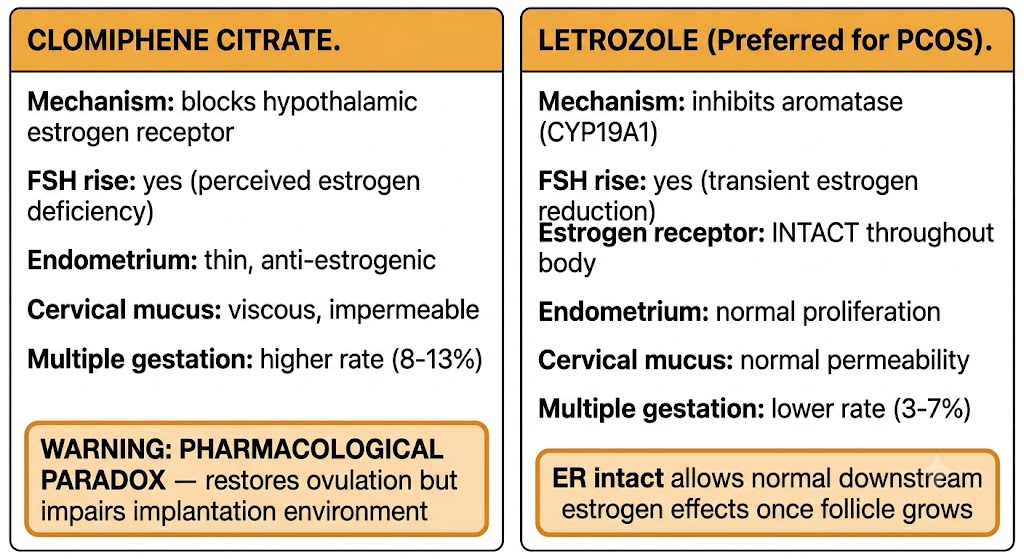
Two-panel comparison of clomiphene citrate (blocks hypothalamic estrogen receptor, FSH rise, thin anti-estrogenic endometrium, viscous cervical mucus, higher multiple gestation rate, pharmacological paradox callout) versus letrozole preferred for PCOS (inhibits aromatase CYP19A1, FSH rise, estrogen receptor intact, normal endometrium and cervical mucus, lower multiple gestation rate).
Gemini AI illustration. Clomiphene citrate versus letrozole for ovulation induction: mechanisms, endometrial effects, and clinical outcomes.
Letrozole: Mechanism and Advantages over Clomiphene

Letrozole is an aromatase inhibitor that reduces estrogen production by blocking conversion of androgens to estrogens in ovarian granulosa cells. The resulting transient drop in estradiol removes negative feedback from the hypothalamic-pituitary axis — the same net result as clomiphene but by a different route: inhibiting synthesis rather than blocking the receptor.

The critical advantage is that letrozole leaves estrogen receptors throughout the body free to respond to whatever estradiol the developing follicle produces. As the follicle grows and begins secreting estradiol, that estradiol can act normally on the endometrium (producing good proliferation) and on cervical mucus (maintaining permeability). By the time significant follicular estradiol production begins, letrozole has been cleared from the body — its half-life is short — so it does not interfere with these downstream effects. The result is a more physiological reproductive environment, a higher live birth rate than clomiphene, and a lower rate of multiple gestation because the intact negative feedback loop limits excessive follicular recruitment.

Letrozole is now the preferred first-line ovulation induction agent for women with polycystic ovary syndrome. It is used off-label for this indication in the United States but is the standard of care per guidelines from the American Society for Reproductive Medicine.

Clomiphene vs. Letrozole: The Key Distinction

Clomiphene blocks estrogen receptor throughout the body — restores ovulation but creates hostile endometrium and cervical mucus. Letrozole inhibits aromatase transiently — restores ovulation and leaves estrogen receptor intact for normal endometrial and cervical response. Result: letrozole produces higher live birth rates and lower multiple gestation rates. Preferred for polycystic ovary syndrome.

Section 2
Exogenous Gonadotropins
FSH, LH, and human menopausal gonadotropin preparations
Types of Gonadotropin Preparations

Exogenous gonadotropins bypass the hypothalamic-pituitary axis entirely and directly stimulate the ovary. They are used when oral ovulation induction agents fail, in women with hypogonadotropic hypogonadism (where both follicle-stimulating hormone and luteinizing hormone are absent), and as the core pharmacological component of all controlled ovarian stimulation protocols in assisted reproduction.

Human menopausal gonadotropin (menotropins) is a urinary-derived preparation extracted from the urine of postmenopausal women, which is rich in gonadotropins due to the absence of ovarian feedback. It contains both follicle-stimulating hormone and luteinizing hormone activity. Highly purified urinary follicle-stimulating hormone preparations contain follicle-stimulating hormone only. Recombinant follicle-stimulating hormone preparations (follitropin alfa, follitropin beta) are manufactured using recombinant DNA technology, providing highly consistent, defined-potency follicle-stimulating hormone without luteinizing hormone contamination. Recombinant luteinizing hormone is available as a separate preparation for supplementation.

Why LH Is Required in Hypogonadotropic Hypogonadism

In women with hypogonadotropic hypogonadism (World Health Organization Group I anovulation), both follicle-stimulating hormone and luteinizing hormone are absent or insufficient. Follicle-stimulating hormone alone cannot produce adequate follicular development in these women because granulosa cell aromatase requires androgen substrate — androstenedione and testosterone — produced by theca cells under luteinizing hormone stimulation. Without luteinizing hormone, theca cells produce no androgens, granulosa cells have no substrate for estradiol synthesis, and follicular development stalls. The treatment requirement is therefore both follicle-stimulating hormone and luteinizing hormone together: either human menopausal gonadotropin (which contains both) or recombinant follicle-stimulating hormone combined with recombinant luteinizing hormone. In women with normal endogenous luteinizing hormone (World Health Organization Group II anovulation, as in polycystic ovary syndrome), follicle-stimulating hormone alone is sufficient.

Two-Cell Model Applied: When LH Must Be Added

Theca cells require luteinizing hormone to make androgens. Granulosa cells require follicle-stimulating hormone plus androgen substrate to make estradiol via aromatase. In hypogonadotropic hypogonadism, both gonadotropins are absent — follicle-stimulating hormone alone fails because there is no luteinizing hormone-driven androgen substrate. Human menopausal gonadotropin or recombinant follicle-stimulating hormone plus recombinant luteinizing hormone is required. In polycystic ovary syndrome with normal endogenous luteinizing hormone, follicle-stimulating hormone alone is appropriate.


Section 3
hCG and Luteal Support
hCG as an LH surrogate, ovulation triggering, and progesterone supplementation
hCG as an LH Surrogate

Human chorionic gonadotropin is structurally homologous to luteinizing hormone — both share an identical alpha subunit and closely related beta subunits — and binds the luteinizing hormone receptor with high affinity. This cross-reactivity is the basis for using human chorionic gonadotropin as an injection to replicate the mid-cycle luteinizing hormone surge in ovulation induction and assisted reproduction cycles, where endogenous gonadotropin stimulation has suppressed spontaneous ovulation. A trigger injection of human chorionic gonadotropin causes follicular rupture approximately 34 to 36 hours later, establishing the timing for intercourse or oocyte retrieval.

The pharmacologically important difference between human chorionic gonadotropin and native luteinizing hormone is duration of action. The luteinizing hormone half-life is approximately 60 minutes; human chorionic gonadotropin persists for 24 to 36 hours, producing sustained luteinizing hormone receptor stimulation for 5 to 7 days after injection. This prolonged activity is what makes human chorionic gonadotropin useful — but also what makes it the principal driver of ovarian hyperstimulation syndrome.

Luteal Phase Support

In assisted reproduction cycles, concurrent use of gonadotropin-releasing hormone agonists or antagonists for pituitary suppression impairs endogenous luteinizing hormone secretion in the post-retrieval luteal phase. Without luteinizing hormone, the multiple corpora lutea cannot sustain adequate progesterone production, and the endometrium is insufficient for implantation. Progesterone supplementation is therefore mandatory in all fresh embryo transfer cycles, continued from embryo transfer until a positive pregnancy test and typically to 8 to 12 weeks of gestation if pregnancy is confirmed.

GnRH Agonist Trigger for OHSS Prevention

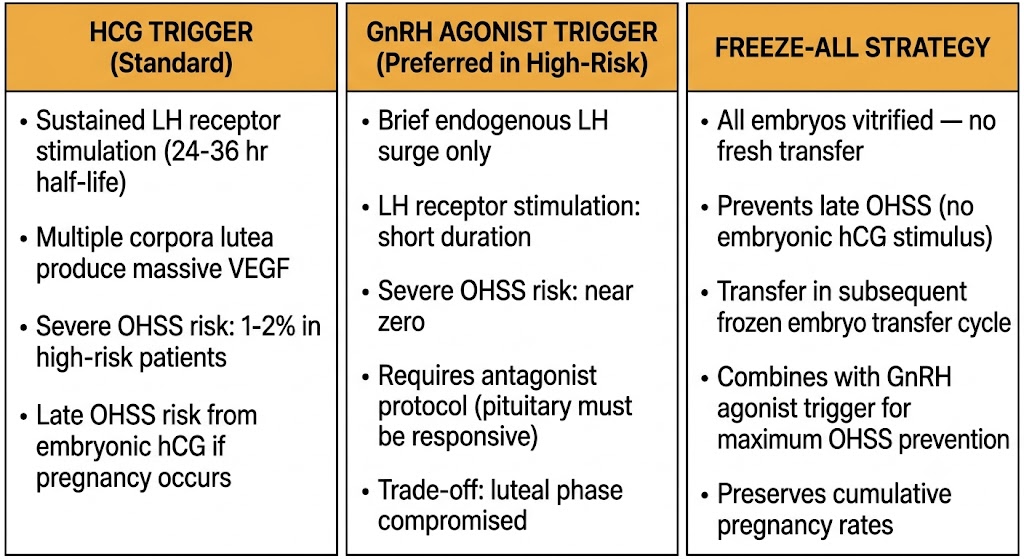
In antagonist-protocol cycles, a gonadotropin-releasing hormone agonist can be substituted for human chorionic gonadotropin as the ovulation trigger. The agonist stimulates a brief endogenous luteinizing hormone surge from the pituitary (which remains responsive because antagonists have not caused downregulation). This endogenous surge is much shorter in duration than exogenous human chorionic gonadotropin, dramatically reducing sustained luteinizing hormone receptor stimulation of the multiple corpora lutea and eliminating severe ovarian hyperstimulation syndrome in virtually all high-risk patients. The trade-off is an inadequate luteal phase, which requires either intensive luteal support or — preferably in high-risk patients — a freeze-all strategy: all embryos are vitrified and transferred in a subsequent cycle without fresh stimulation.

GnRH Agonist Trigger + Freeze-All: The OHSS Elimination Strategy

GnRH agonist trigger (antagonist cycles only) replaces sustained human chorionic gonadotropin receptor stimulation with a brief endogenous surge — eliminating the principal driver of ovarian hyperstimulation syndrome. Freeze-all avoids the further human chorionic gonadotropin stimulus from an implanting embryo. Combined, these two strategies eliminate virtually all severe ovarian hyperstimulation syndrome while preserving cumulative pregnancy rates through subsequent frozen embryo transfer.


Section 4
Assisted Reproductive Technology (ART) Stimulation Protocols
Long agonist, antagonist, and individualized dosing
The Dual Challenge of Controlled Ovarian Stimulation

Controlled ovarian stimulation for assisted reproduction requires simultaneously achieving two pharmacological goals that are in tension: providing enough exogenous follicle-stimulating hormone to recruit multiple follicles beyond the natural single-follicle selection, while preventing the rising estradiol from those multiple follicles from triggering a premature endogenous luteinizing hormone surge before oocyte retrieval can be performed. Two principal pituitary suppression strategies exist, differing in mechanism, timing, and ovarian hyperstimulation syndrome risk.

Longer Protocol
Long GnRH Agonist Protocol
  • Start GnRH agonist in mid-luteal phase of preceding cycle
  • Achieve full pituitary downregulation (10–14 days)
  • Begin follicle-stimulating hormone stimulation once downregulation confirmed
  • Continue agonist throughout stimulation to prevent luteinizing hormone recovery
  • Trigger with human chorionic gonadotropin when follicles mature
  • Duration: approximately 4–6 weeks total
  • Cannot use GnRH agonist trigger (pituitary already downregulated)
  • Higher ovarian hyperstimulation syndrome risk in high responders
Shorter Protocol — Now Preferred
GnRH Antagonist Protocol
  • Start follicle-stimulating hormone stimulation directly at cycle start
  • Add GnRH antagonist when leading follicle reaches ~14 mm (day 5–6)
  • Antagonist produces immediate competitive blockade, no flare
  • Duration: approximately 10–14 days total
  • Enables GnRH agonist triggering → near-zero severe ovarian hyperstimulation syndrome
  • Preferred for high-risk patients, polycystic ovary syndrome, most standard responders today
  • Shorter, fewer injections, more patient-friendly
Individualizing Follicle-Stimulating Hormone Dose

Anti-Mullerian hormone and antral follicle count (by transvaginal ultrasound) predict ovarian response. High anti-Mullerian hormone or high antral follicle count indicates a high responder — start with a low follicle-stimulating hormone dose to reduce ovarian hyperstimulation syndrome risk. Low anti-Mullerian hormone or low antral follicle count indicates a poor responder who may need higher follicle-stimulating hormone doses. This individualized approach minimizes both ovarian hyperstimulation syndrome risk in high responders and inadequate response in poor responders.


Section 5
Ovarian Hyperstimulation Syndrome: Pathophysiology
VEGF, hCG, third-space fluid accumulation, and risk factors
Mechanism: VEGF and Vascular Permeability

Ovarian hyperstimulation syndrome is an iatrogenic complication of ovarian stimulation caused by supraphysiological vascular endothelial growth factor production from multiple stimulated corpora lutea and large pre-ovulatory follicles. Vascular endothelial growth factor binds receptors on peritoneal and ovarian capillary endothelium, dramatically increasing vascular permeability. Protein-rich plasma leaks out of capillaries into the peritoneal cavity (ascites) and other third spaces, reducing intravascular volume while fluid accumulates outside vessels. The result is simultaneous third-space fluid overload and intravascular hypovolemia — hemoconcentration, reduced urine output, and in severe cases, thromboembolism and organ impairment.

Why hCG Is the Trigger — Early vs. Late Onset

Human chorionic gonadotropin drives ovarian hyperstimulation syndrome by providing sustained luteinizing hormone receptor stimulation to multiple corpora lutea simultaneously, amplifying vascular endothelial growth factor secretion far beyond what a natural luteinizing hormone surge on a single corpus luteum would produce. The prolonged half-life of human chorionic gonadotropin (versus the short-lived endogenous luteinizing hormone) sustains this stimulus for days. This is why the exogenous trigger injection can cause early-onset ovarian hyperstimulation syndrome beginning within 3 to 9 days of injection.

Late-onset ovarian hyperstimulation syndrome begins approximately 10 or more days after the trigger, driven by rising endogenous human chorionic gonadotropin from an implanting embryo. Late-onset ovarian hyperstimulation syndrome is typically more severe and more prolonged than early onset because the human chorionic gonadotropin stimulus is continuous and rising throughout the first trimester. The freeze-all strategy prevents late-onset ovarian hyperstimulation syndrome entirely.

Risk Factors

High ovarian reserve (elevated anti-Mullerian hormone, high antral follicle count), polycystic ovary syndrome, prior history of ovarian hyperstimulation syndrome, young age, and low body weight all identify women at higher risk. A previous episode of ovarian hyperstimulation syndrome is the strongest historical predictor and mandates proactive protocol modification in subsequent cycles.

Late OHSS: Driven by Embryonic hCG

Early ovarian hyperstimulation syndrome resolves if pregnancy does not occur — the exogenous human chorionic gonadotropin trigger clears and the corpus lutea regress. Late ovarian hyperstimulation syndrome is perpetuated by the implanting embryo's own human chorionic gonadotropin, making it more severe and prolonged. The freeze-all strategy eliminates late ovarian hyperstimulation syndrome by preventing embryo transfer in the stimulated cycle.


Section 6
OHSS Classification, Prevention, and Management
Severity grading, pharmacological prevention, and supportive care
Severity Classification

Ovarian hyperstimulation syndrome severity is classified as mild (abdominal bloating, nausea, small ovarian enlargement — managed with outpatient hydration and monitoring), moderate (ultrasound-visible ascites, moderate abdominal pain, vomiting — outpatient monitoring with daily tracking), severe (tense ascites, hemoconcentration, reduced urine output, renal or hepatic impairment — requires inpatient management), and critical (thromboembolism, acute respiratory distress syndrome, renal failure — intensive care unit admission).

Pharmacological Prevention

The single most effective pharmacological prevention strategy is substituting a gonadotropin-releasing hormone agonist for human chorionic gonadotropin as the ovulation trigger in antagonist-protocol cycles. This reduces severe ovarian hyperstimulation syndrome from approximately 1 to 2% with human chorionic gonadotropin trigger to near zero, by replacing sustained exogenous luteinizing hormone receptor stimulation with a brief endogenous surge. It is only possible in antagonist cycles (the pituitary must remain responsive to gonadotropin-releasing hormone stimulation).

Cabergoline, a dopamine receptor agonist, is used as adjunctive prophylaxis in high-risk patients. It reduces vascular endothelial growth factor-driven vascular permeability by modulating vascular endothelial growth factor receptor signaling on endothelial cells, without blocking vascular endothelial growth factor production itself. Cabergoline significantly reduces early ovarian hyperstimulation syndrome incidence in high-risk patients and is recommended as adjunctive prophylaxis when human chorionic gonadotropin triggering is used.

Three-panel comparison of OHSS prevention strategies: hCG trigger (sustained LH receptor stimulation, massive VEGF, 1-2% severe OHSS risk, late OHSS from embryonic hCG), GnRH agonist trigger preferred in high-risk (brief endogenous LH surge, near-zero severe OHSS, requires antagonist protocol, luteal phase compromised), and freeze-all strategy (all embryos vitrified, prevents late OHSS, transfer in subsequent cycle, preserves cumulative pregnancy rates).
Gemini AI illustration. OHSS prevention strategies: hCG trigger versus GnRH agonist trigger versus freeze-all strategy.
Management of Established OHSS

Active ovarian hyperstimulation syndrome management targets the consequences of intravascular hypovolemia and third-space accumulation. Intravenous crystalloid corrects hypovolemia. Paracentesis (ultrasound-guided drainage of ascitic fluid) relieves abdominal distension, improves respiratory function, and removes the osmotic driver pulling further intravascular fluid into the peritoneum — it may need to be repeated. Anticoagulation with low-molecular-weight heparin is recommended for hospitalized patients because hemoconcentration, immobility, and the hypercoagulable state of early pregnancy combine to create significant venous thromboembolism risk; thromboembolism is a leading cause of ovarian hyperstimulation syndrome-related mortality.

OHSS Prevention Hierarchy

Best: GnRH agonist trigger in antagonist cycle (eliminates severe ovarian hyperstimulation syndrome) + freeze-all (eliminates late onset). Adjunctive: cabergoline in high-risk patients when human chorionic gonadotropin trigger is used. Management of established severe disease: intravenous fluids, paracentesis, anticoagulation. Thromboembolism is the leading preventable cause of death from ovarian hyperstimulation syndrome — anticoagulation is mandatory in severe cases.


Suggested References
Author / OrganizationTitleSource
Adashi EY.Clomiphene citrate: mechanism(s) and site(s) of action — a hypothesis revisitedFertil Steril. 1984;42(3):331–344
Legro RS, Brzyski RG, Diamond MP, et al; NICHD Reproductive Medicine Network.Letrozole versus clomiphene for infertility in the polycystic ovary syndromeN Engl J Med. 2014;371(2):119–129
Mitwally MF, Casper RF.Use of an aromatase inhibitor for induction of ovulation in patients with an inadequate response to clomiphene citrateFertil Steril. 2001;75(2):305–309
Balen AH, Platteau P, Andersen AN, et al.The influence of body weight on response to ovulation induction with gonadotrophins in 335 women with WHO Group II anovulatory infertilityBJOG. 2006;113(10):1195–1202
Devroey P, Boostanfar R, Koper NP, et al; ENGAGE Investigators.A double-blind, non-inferiority RCT comparing corifollitropin alfa and recombinant FSH during the first 7 days of ovarian stimulation using a GnRH antagonist protocolHum Reprod. 2009;24(12):3063–3072
Miyamoto K, Hasegawa Y, Igarashi M, et al.Identification of the second gonadotropin-releasing hormone in chicken hypothalamusProc Natl Acad Sci USA. 1984;81(12):3874–3878
van der Linden M, Buckingham K, Farquhar C, et al.Luteal phase support for assisted reproduction cyclesCochrane Database Syst Rev. 2015;7:CD009154
Humaidan P, Quartarolo J, Papanikolaou EG.Preventing ovarian hyperstimulation syndrome: guidance for the clinicianFertil Steril. 2010;94(2):389–400
Fauser BC, Diedrich K, Devroey P; Evian Annual Reproduction Workshop Group 2007.Predictors of ovarian response: progress towards individualized treatment in ovulation induction and ovarian stimulationHum Reprod Update. 2008;14(1):1–14
Delvigne A, Rozenberg S.Systematic review of data concerning etiopathology of ovarian hyperstimulation syndromeInt J Fertil Womens Med. 2002;47(5):211–226
Royal College of Obstetricians and Gynaecologists.Ovarian Hyperstimulation Syndrome: Green-top Guideline No. 5RCOG Press; 2016
Alvarez C, Marti-Bonmati L, Novella-Maestre E, et al.Dopamine agonist cabergoline reduces hemoconcentration and ascites in hyperstimulated women undergoing assisted reproductionJ Clin Endocrinol Metab. 2007;92(8):2931–2937