CHAPTER 31  ·  GONADAL & OVARIAN PHARMACOLOGY
Section 1
Androgen Physiology: Testosterone, Dihydrotestosterone (DHT), and the Androgen Receptor
Biosynthesis, active metabolites, and tissue-selective androgenic effects
Testosterone Biosynthesis and Circulation

Testosterone is the principal circulating androgen in men, produced predominantly by the Leydig cells of the testes under luteinizing hormone stimulation. A small fraction is derived from peripheral conversion of adrenal androgen precursors. Testosterone circulates mostly bound to plasma proteins — predominantly sex hormone-binding globulin (high affinity) and albumin (lower affinity) — with only 1 to 3% free. Only the free and albumin-bound fractions are biologically active. Conditions that raise sex hormone-binding globulin (aging, estrogen use, liver disease) can lower free testosterone despite a normal total testosterone level, and the reverse applies when sex hormone-binding globulin is reduced (obesity, insulin resistance).

Testosterone vs. Dihydrotestosterone: Tissue-Selective Actions

Testosterone itself mediates effects on skeletal muscle protein synthesis, bone density, erythropoiesis, libido, and mood through direct androgen receptor binding. In certain target tissues — prostate, skin, scalp, and external genitalia — testosterone is converted intracellularly to dihydrotestosterone by the enzyme 5-alpha-reductase. Dihydrotestosterone binds the androgen receptor with approximately 3 to 5 times greater affinity than testosterone and produces a more stable receptor complex. Dihydrotestosterone is the primary mediator of prostate growth, male-pattern hair loss, beard and body hair development, and sebaceous gland activity.

This tissue-selective distribution of 5-alpha-reductase activity is the pharmacological basis for 5-alpha-reductase inhibitors: by blocking dihydrotestosterone production, they selectively reduce androgenic stimulation in the prostate and scalp without substantially impairing the muscle, bone, and erythropoietic effects driven by testosterone itself.

Aromatization to Estradiol

A significant fraction of testosterone undergoes peripheral aromatization to estradiol via aromatase (CYP19A1) in adipose tissue, muscle, and other sites. This estradiol serves essential physiological functions in men: maintaining bone mineral density, regulating gonadotropin negative feedback, and contributing to libido. At supraphysiological testosterone levels — as in testosterone replacement therapy at high doses or anabolic-androgenic steroid use — increased aromatization raises circulating estradiol, producing gynecomastia, fluid retention, and mood effects.

Dihydrotestosterone (DHT) vs. Testosterone: Tissue-Selective Androgenic Activity

Testosterone: muscle, bone, erythropoiesis, libido, mood. Dihydrotestosterone (via 5-alpha-reductase): prostate growth, male-pattern hair loss, beard/body hair, external genital virilization, sebaceous glands. 5-alpha-reductase inhibitors reduce dihydrotestosterone without substantially reducing testosterone — selectively targeting dihydrotestosterone-mediated effects while preserving testosterone-mediated effects.


Section 2
Testosterone Replacement Therapy Formulations
Intramuscular, transdermal, subcutaneous, and oral options
Intramuscular Testosterone Esters

Testosterone enanthate and testosterone cypionate are long-acting injectable ester formulations administered every 1 to 2 weeks. Both are depot preparations that release testosterone gradually from the injection site. The major pharmacokinetic drawback of biweekly injection is significant peak-to-trough fluctuation: supraphysiological peaks in the first 48 to 72 hours followed by troughs that may fall below the normal range before the next dose, producing cyclical symptom variation. Weekly injection reduces this fluctuation substantially.

Testosterone undecanoate (Nebido) is a much longer-acting injectable formulation given every 10 to 14 weeks, producing more stable levels. However, it carries a risk of pulmonary oil microembolism from inadvertent intravascular injection of its castor oil vehicle — symptoms include cough, dyspnea, and chest pain within minutes of injection. All Nebido injections must be administered by a healthcare professional with a mandatory 30-minute post-injection observation period. This restriction does not apply to enanthate or cypionate.

Transdermal Formulations

Testosterone gels (applied daily to skin) and patches bypass hepatic first-pass metabolism and produce more stable serum testosterone concentrations than biweekly injections. The primary safety concern with gels is accidental transfer to female partners or children through skin contact, which can cause virilization. Patients must wash hands after application, cover the site with clothing, and avoid skin-to-skin contact at the application site for several hours.

Subcutaneous Pellets and Oral Formulations

Subcutaneous testosterone pellets (Testopel) are implanted in the hip or buttock every 3 to 6 months, providing compliance-independent sustained release. Disadvantages include the need for a minor insertion procedure and the inability to adjust the dose after implantation.

Oral testosterone undecanoate (Jatenzo) is absorbed via the intestinal lymphatic system rather than the portal circulation, which avoids the hepatotoxicity seen with older oral androgens (methyltestosterone) that required C17-alpha-alkylation for oral bioavailability. Blood pressure elevation is the most clinically relevant adverse effect of the oral formulation.
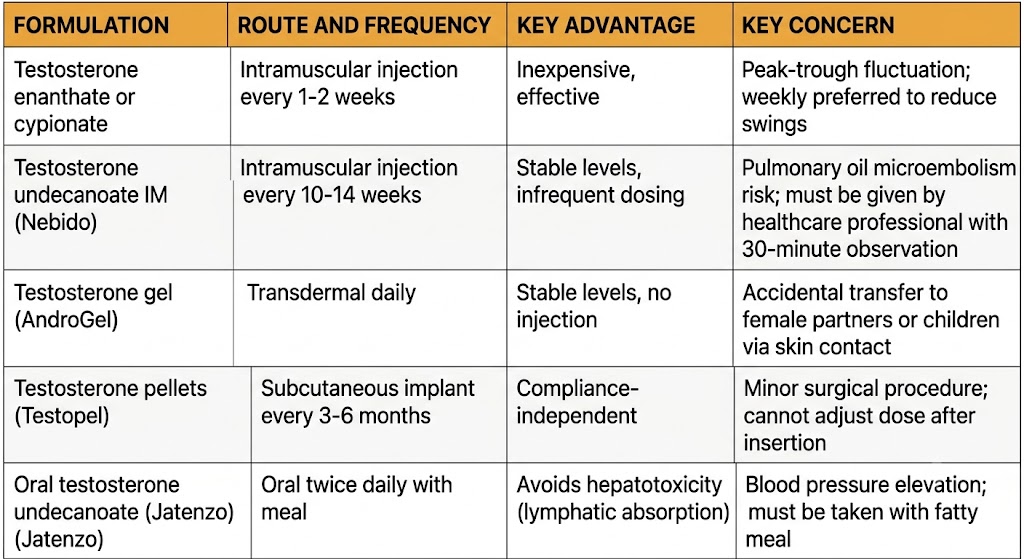
Reference table of testosterone replacement therapy formulations: testosterone enanthate/cypionate (intramuscular every 1-2 weeks, inexpensive, peak-trough fluctuation); testosterone undecanoate IM Nebido (every 10-14 weeks, stable, pulmonary oil microembolism risk, 30-min observation); testosterone gel AndroGel (transdermal daily, stable, accidental transfer risk); testosterone pellets Testopel (subcutaneous every 3-6 months, compliance-independent, cannot adjust after insertion); oral testosterone undecanoate Jatenzo (twice daily with meal, lymphatic absorption avoids hepatotoxicity, blood pressure elevation).
Gemini AI illustration. Testosterone replacement therapy formulations compared by route, frequency, key advantages, and key safety concerns.
Testosterone Undecanoate IM (Nebido): 30-Minute Observation Required

Pulmonary oil microembolism can occur within 30 minutes of Nebido injection due to inadvertent intravascular delivery of the castor oil vehicle. Must be administered by a healthcare professional. Symptoms: cough, dyspnea, chest pain, syncope. This requirement does not apply to testosterone enanthate or cypionate, which use smaller injection volumes and different vehicles.

Section 3
Testosterone Replacement Therapy Adverse Effects and Monitoring
Erythrocytosis, cardiovascular risk, spermatogenesis suppression, and monitoring
Erythrocytosis

Erythrocytosis is the most common dose-dependent adverse effect of testosterone replacement therapy, occurring most frequently with injectable formulations due to their higher peak testosterone concentrations. Testosterone stimulates erythropoiesis through androgen receptor activation in bone marrow and through erythropoietin upregulation. Elevated hematocrit increases blood viscosity and raises venous thromboembolism and arterial event risk. Hematocrit should be checked at baseline, at 3 months, and annually. When hematocrit rises above the threshold for action, dose reduction, switching to a transdermal formulation (which produces lower, more stable levels), or therapeutic phlebotomy is appropriate.

Cardiovascular Risk

Cardiovascular safety of testosterone replacement therapy has been debated extensively. The largest randomized controlled trial to date (the TRAVERSE trial) found no significant increase in major adverse cardiovascular events in men with hypogonadism and elevated cardiovascular risk, but did identify increased rates of atrial fibrillation and pulmonary embolism in the testosterone group. Testosterone replacement therapy is contraindicated in men with a recent myocardial infarction or stroke (within 6 months) and in those with severe heart failure.

Spermatogenesis Suppression

Testosterone replacement therapy suppresses spermatogenesis by inhibiting the hypothalamic-pituitary-gonadal axis through negative feedback, reducing gonadotropin secretion and thereby reducing the intratesticular testosterone concentration required to maintain sperm production. Most men develop profound oligospermia or azoospermia within 3 to 6 months of starting testosterone replacement therapy. Recovery typically occurs over 6 to 24 months after stopping, but may be incomplete.

Hypogonadal men who wish to preserve fertility should not receive testosterone replacement therapy. Instead, human chorionic gonadotropin maintains intratesticular testosterone by providing luteinizing hormone receptor stimulation without suppressing the hypothalamic-pituitary-gonadal axis. Clomiphene citrate stimulates endogenous testosterone and gonadotropin secretion by blocking hypothalamic estrogen receptor feedback. Both approaches preserve spermatogenesis while improving testosterone-deficiency symptoms.

Testosterone Replacement Therapy and Fertility

Testosterone replacement therapy is a reliable male contraceptive — it suppresses spermatogenesis in most men within months. For hypogonadal men desiring future fertility: use human chorionic gonadotropin (maintains intratesticular testosterone via luteinizing hormone receptor without suppressing hypothalamic-pituitary-gonadal axis) or clomiphene (raises endogenous luteinizing hormone and follicle-stimulating hormone). Neither approach replaces testosterone replacement therapy for all symptoms, but both preserve sperm production.


Section 4
5-Alpha-Reductase Inhibitors
Finasteride, dutasteride, isoform selectivity, and the PSA correction rule
Two Isoforms and a High-Yield Clinical Example

5-alpha-reductase exists in two clinically relevant isoforms. Type 1 is expressed predominantly in skin, sebaceous glands, and liver. Type 2 is expressed predominantly in the prostate, seminal vesicles, and hair follicles, and is responsible for the majority of intraprostatic dihydrotestosterone production.

The clinical importance of type 2 5-alpha-reductase is illustrated by the phenotype of men born with congenital type 2 5-alpha-reductase deficiency: they are born with ambiguous or female-appearing external genitalia because dihydrotestosterone is required for male external genital virilization during fetal development. However, they have normal internal male structures (wolffian duct derivatives) because those are driven by testosterone, not dihydrotestosterone. At puberty, rising testosterone levels partially compensate, producing dramatic phallic virilization. This is a high-yield pharmacogenomic example that also explains why finasteride (which blocks type 2) selectively reduces prostate and scalp androgenic effects without impairing muscle, bone, or fertility effects.

Finasteride and Dutasteride: Clinical Uses

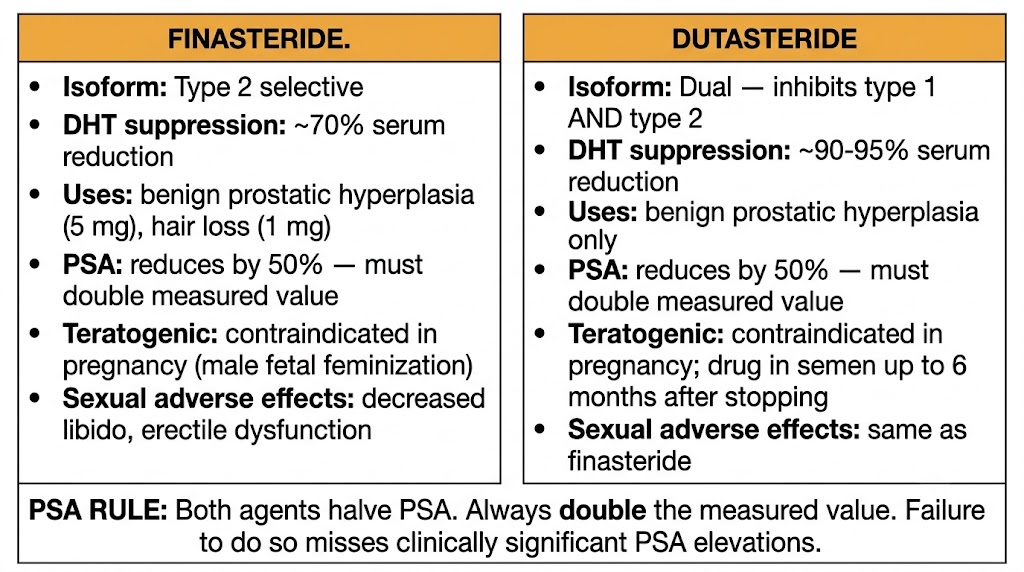
Finasteride selectively inhibits type 2 5-alpha-reductase. At 5 mg per day it is used for benign prostatic hyperplasia — reducing prostate volume, improving urinary flow, and reducing the risk of acute urinary retention and surgery with long-term use. At 1 mg per day it is used for male-pattern hair loss, stabilizing hair loss and producing modest regrowth in the vertex scalp.

Dutasteride inhibits both type 1 and type 2 5-alpha-reductase, achieving greater overall dihydrotestosterone suppression than finasteride, though this does not translate into meaningfully superior benign prostatic hyperplasia outcomes in head-to-head comparisons. Both agents are used for benign prostatic hyperplasia; finasteride is also approved for hair loss.

Two-panel comparison of finasteride (type 2 selective, 70% DHT suppression, approved for benign prostatic hyperplasia and hair loss, PSA halved, teratogenic) versus dutasteride (dual type 1 and 2, 90-95% DHT suppression, approved for benign prostatic hyperplasia only, PSA halved, drug in semen up to 6 months) with shared PSA rule box: always double the measured PSA value.
Gemini AI illustration. Finasteride versus dutasteride: isoform selectivity, indications, and the PSA halving rule.
Prostate-Specific Antigen Correction and Safety

Both finasteride and dutasteride reduce prostate-specific antigen by approximately 50% within 3 to 6 months. This is a pharmacodynamic effect on prostate-specific antigen gene transcription, not a sign of prostate cancer suppression. The measured prostate-specific antigen must be doubled to estimate the true value in men on these agents — failure to do so will cause a clinically significant prostate-specific antigen rise (indicating possible prostate cancer) to be missed. Any upward trend in prostate-specific antigen despite 5-alpha-reductase inhibitor therapy requires investigation regardless of the absolute value.

Both agents are absolutely contraindicated in women who are pregnant or may become pregnant. Dihydrotestosterone is required for male fetal external genital virilization; exposure during pregnancy causes feminization of a male fetus. Women of childbearing potential must not handle crushed tablets. Dutasteride is present in semen for up to 6 months after stopping, requiring precautions for partners who are or may become pregnant.

Adverse Effects

Sexual adverse effects occur in approximately 5 to 9% of patients: decreased libido, erectile dysfunction, reduced ejaculate volume, and gynecomastia. These result from reduced dihydrotestosterone-mediated peripheral androgenic signaling and a shift in the androgen-to-estrogen ratio. Post-finasteride syndrome — persistent sexual, neurological, and psychological symptoms after stopping the drug — is a debated clinical entity reported by some patients that warrants mention before prescribing.

PSA on 5-Alpha-Reductase Inhibitors: Double the Measured Value

Finasteride and dutasteride both halve prostate-specific antigen within 6 months. A man on finasteride with a prostate-specific antigen of 1.5 ng/mL has an estimated true value of approximately 3.0 ng/mL. Failing to double the value means a clinically significant elevation can be missed. Any failure of prostate-specific antigen to fall at least 50% after 6 months on therapy, or any upward trend, should prompt investigation regardless of the absolute number.


Section 5
Anti-Androgens
Spironolactone, bicalutamide, enzalutamide, and cyproterone acetate
Spironolactone

Spironolactone is primarily a mineralocorticoid receptor antagonist (potassium-sparing diuretic) that also blocks the androgen receptor at higher clinical doses. It is used for androgen-excess conditions in women — polycystic ovary syndrome, hirsutism, acne — and as a component of feminizing hormone therapy in transgender women. The major adverse effects in these contexts are menstrual irregularity, hyperkalemia (from mineralocorticoid receptor blockade reducing renal potassium excretion, requiring monitoring when combined with other potassium-retaining drugs), and hypotension. Spironolactone is teratogenic in males (feminization of male fetuses in animal studies), so contraception is required in women of childbearing potential.

Bicalutamide

Bicalutamide is a high-affinity non-steroidal androgen receptor antagonist with no intrinsic agonist activity. Because it blocks androgen receptor in the hypothalamus and pituitary, negative feedback is lost, and luteinizing hormone levels rise — driving endogenous testosterone up approximately 1.5-fold. This compensatory testosterone rise partially offsets peripheral androgen receptor blockade, which is why bicalutamide is usually combined with a gonadotropin-releasing hormone agonist or antagonist in prostate cancer. Hepatotoxicity occurs in approximately 1 to 3% of patients — liver function tests require monitoring. Gynecomastia and breast tenderness are common due to elevated testosterone being aromatized to estradiol in a setting of androgen receptor blockade in breast tissue.

Enzalutamide

Enzalutamide is a second-generation androgen receptor antagonist with approximately 5 to 8 times greater androgen receptor affinity than bicalutamide. Beyond competing at the ligand-binding site, it also inhibits nuclear translocation of the androgen receptor complex and blocks its deoxyribonucleic acid binding — more complete androgen receptor pathway suppression than bicalutamide alone. It is approved for castration-resistant prostate cancer and metastatic hormone-sensitive prostate cancer.

The principal resistance mechanism is the androgen receptor splice variant 7 (AR-V7), a truncated constitutively active androgen receptor lacking the ligand-binding domain. Because all competitive androgen receptor antagonists bind the ligand-binding domain, androgen receptor splice variant 7 is intrinsically resistant to the entire class. Patients with androgen receptor splice variant 7-positive tumors derive minimal benefit from enzalutamide and should transition to taxane chemotherapy.

A distinctive adverse effect of enzalutamide is seizure risk (approximately 0.5% per year) from negative allosteric modulation of gamma-aminobutyric acid type A receptors — a mechanism distinct from all other anti-androgens. Fatigue and cognitive impairment are also more prominent than with bicalutamide.

Cyproterone Acetate

Cyproterone acetate is a steroidal androgen receptor antagonist that also has potent progestogenic and anti-gonadotropic activity, suppressing both androgen receptor signaling and gonadotropin-driven testosterone production simultaneously. It is used widely outside the United States for prostate cancer, hirsutism, and feminizing hormone therapy, but is not approved in the United States. A significant safety concern is dose-dependent and duration-dependent meningioma risk with long-term use at doses of 25 mg per day or higher, leading to regulatory restrictions in several countries. Venous thromboembolism risk is elevated due to its progestogenic activity.

Enzalutamide Seizure Risk and AR-V7 Resistance

Enzalutamide is a gamma-aminobutyric acid type A receptor negative allosteric modulator — seizure risk approximately 0.5% per year — use with caution in patients with seizure history. Androgen receptor splice variant 7 lacks the ligand-binding domain and is constitutively active, conferring resistance to all ligand-competitive androgen receptor antagonists (bicalutamide, enzalutamide, apalutamide, darolutamide). Androgen receptor splice variant 7-positive circulating tumor cells signal the need to switch to taxane chemotherapy.


Section 6
Anabolic-Androgenic Steroids
Pharmacology, hepatotoxicity, cardiovascular toxicity, and endocrine consequences
Classification: Oral vs. Injectable

Anabolic-androgenic steroids are synthetic testosterone derivatives engineered to enhance anabolic effects (muscle protein synthesis, bone density) relative to androgenic effects. No available agent fully separates these properties because both are mediated through the same androgen receptor. Non-medical doses used for performance enhancement are typically 10 to 100 times higher than therapeutic testosterone replacement therapy doses.

The primary pharmacokinetic classification distinguishes oral from injectable forms. Oral anabolic-androgenic steroids (including stanozolol, oxandrolone, oxymetholone) require C17-alpha-alkylation to resist first-pass hepatic degradation — a chemical modification that also blocks the liver's normal mechanisms for conjugating and excreting the steroid. The result is intrahepatic cholestasis, peliosis hepatis (blood-filled cysts in liver parenchyma), and with prolonged use, hepatocellular adenoma and hepatocellular carcinoma. Injectable anabolic-androgenic steroids (nandrolone decanoate and others) undergo normal ester cleavage and hepatic metabolism after absorption — they avoid this hepatotoxicity while retaining full systemic androgenic activity.

Cardiovascular Toxicity

Cardiovascular toxicity is the most life-threatening consequence of anabolic-androgenic steroid misuse and the leading cause of premature death in users. The principal mechanisms are: left ventricular hypertrophy from cardiomyocyte androgen receptor stimulation, producing pathological concentric hypertrophy with reduced diastolic compliance and predisposition to arrhythmia; a markedly adverse lipid profile (high-density lipoprotein cholesterol substantially reduced, low-density lipoprotein cholesterol increased); accelerated coronary artery disease with premature atherosclerotic calcification; and myocardial fibrosis. Erythrocytosis from supraphysiological testosterone further elevates thrombotic risk.

Endocrine and Other Consequences

Exogenous anabolic-androgenic steroids suppress gonadotropin secretion through negative feedback, producing testicular atrophy and azoospermia in men, and menstrual disruption and virilization in women. Recovery of the hypothalamic-pituitary-gonadal axis and spermatogenesis after stopping can take 6 to 24 months and may be incomplete with prolonged use. Human chorionic gonadotropin and selective estrogen receptor modulators (clomiphene, tamoxifen) are used in the anabolic-androgenic steroid-using community to stimulate hypothalamic-pituitary-gonadal axis recovery after cessation.

Gynecomastia in male users occurs because supraphysiological androgens drive increased aromatization to estradiol. Additional adverse effects include acne (sebaceous gland androgen receptor stimulation), tendon rupture (muscle mass outpacing tendon tensile strength), psychiatric effects during use (aggression, hypomania, impulsivity), and withdrawal-related dysphoria and hypogonadal symptoms between cycles.

C17-Alpha-Alkylation: Why Oral Anabolic Steroids Are Hepatotoxic and Injectables Are Not

Normal testosterone is metabolized at the C17-beta hydroxyl position in the liver and cleared. The C17-alpha methyl group in oral anabolic-androgenic steroids blocks this oxidation, trapping the steroid in hepatocytes and impairing bile acid transport → cholestasis → peliosis hepatis → adenoma/carcinoma with prolonged use. Injectable testosterone esters undergo normal ester cleavage and hepatic metabolism — no hepatotoxicity. Route of administration is the determinant of hepatotoxicity in androgen pharmacology.


Suggested References
Author / OrganizationTitleSource
Mooradian AD, Morley JE, Korenman SG.Biological actions of androgensEndocr Rev. 1987;8(1):1–28
Bhasin S, Cunningham GR, Hayes FJ, et al; Endocrine Society.Testosterone therapy in men with androgen deficiency syndromes: an Endocrine Society clinical practice guidelineJ Clin Endocrinol Metab. 2010;95(6):2536–2559
Imperato-McGinley J, Guerrero L, Gautier T, Peterson RE.Steroid 5alpha-reductase deficiency in man: an inherited form of male pseudohermaphroditismScience. 1974;186(4170):1213–1215
Lincoff AM, Bhasin S, Flevaris P, et al; TRAVERSE Study Investigators.Cardiovascular safety of testosterone-replacement therapyN Engl J Med. 2023;389(2):107–117
Hsieh TC, Pastuszak AW, Hwang K, Lipshultz LI.Concomitant intramuscular human chorionic gonadotropin preserves spermatogenesis in men undergoing testosterone replacement therapyJ Urol. 2013;189(2):647–650
Thompson IM, Goodman PJ, Tangen CM, et al.The influence of finasteride on the development of prostate cancerN Engl J Med. 2003;349(3):215–224
Huggins C, Hodges CV.Studies on prostatic cancer: the effect of castration, of estrogen and of androgen injection on serum phosphatases in metastatic carcinoma of the prostateCancer Res. 1941;1(4):293–297
Beer TM, Armstrong AJ, Rathkopf DE, et al; PREVAIL Investigators.Enzalutamide in metastatic prostate cancer before chemotherapyN Engl J Med. 2014;371(5):424–433
Pope HG, Wood RI, Rogol A, et al.Adverse health consequences of performance-enhancing drugs: an Endocrine Society scientific statementEndocr Rev. 2014;35(3):341–375
Baggish AL, Weiner RB, Kanayama G, et al.Long-term anabolic-androgenic steroid use is associated with left ventricular dysfunction and premature coronary artery diseaseCirc Heart Fail. 2010;3(4):472–476