CHAPTER 10 ยท CONGESTIVE HEART FAILURE

Section 1

Introduction

Heart failure is a clinical syndrome, not a single disease. It results when the heart cannot pump enough blood to meet the body needs, or can only do so at abnormally high filling pressures. Almost every form of structural heart disease eventually leads to heart failure if it progresses far enough, which makes heart failure one of the most common reasons for hospitalization in adults. The drugs used to treat heart failure were developed by understanding the body compensatory responses to a failing heart and then blocking the harmful parts of those responses. This module builds the mechanistic foundation that the rest of this chapter relies on: how heart failure is classified, what drives its progression, and how the major drug classes fit into an overall treatment framework.


Section 2

Defining the Syndrome — Three Categories of Heart Failure

Heart failure is classified by left ventricular ejection fraction because this single measurement predicts prognosis and determines which drug classes have proven benefit.

Heart Failure with Reduced Ejection Fraction

Heart failure with reduced ejection fraction is defined as left ventricular ejection fraction of 40 percent or less. This is the classic systolic dysfunction phenotype: the heart muscle itself has lost contractile strength, usually from a prior heart attack or from a primary disease of the heart muscle. The chamber dilates to compensate, filling pressures rise, and the patient develops the fatigue and fluid retention symptoms typical of heart failure.

Heart failure with reduced ejection fraction is the phenotype with the strongest evidence base. Nearly every major heart failure drug class proven to reduce mortality was studied specifically in this population, and the four-pillar treatment framework introduced later in this module applies to heart failure with reduced ejection fraction.

Heart Failure with Preserved Ejection Fraction

Heart failure with preserved ejection fraction is defined as left ventricular ejection fraction of 50 percent or greater, with symptoms and objective evidence of elevated filling pressures. Here the contractile pumping function is preserved, but the ventricle has become stiff and relaxes poorly between beats. This impaired relaxation, called diastolic dysfunction, raises filling pressures even though the ejection fraction looks normal.

Heart failure with preserved ejection fraction now accounts for roughly half of all heart failure cases, and its prevalence is rising alongside the conditions that drive it, including obesity, hypertension, and diabetes. For many years no drug class clearly improved survival in this population. Sodium-glucose cotransporter 2 inhibitors are the first drug class to change that, and their role in heart failure with preserved ejection fraction is covered in Module 5.

Heart Failure with Mildly Reduced Ejection Fraction

Heart failure with mildly reduced ejection fraction covers the range of 41 to 49 percent. This intermediate category behaves more like heart failure with reduced ejection fraction than like heart failure with preserved ejection fraction, and current guidelines extend the same renin-angiotensin-aldosterone system blockers and beta-blockers used in heart failure with reduced ejection fraction to this group.
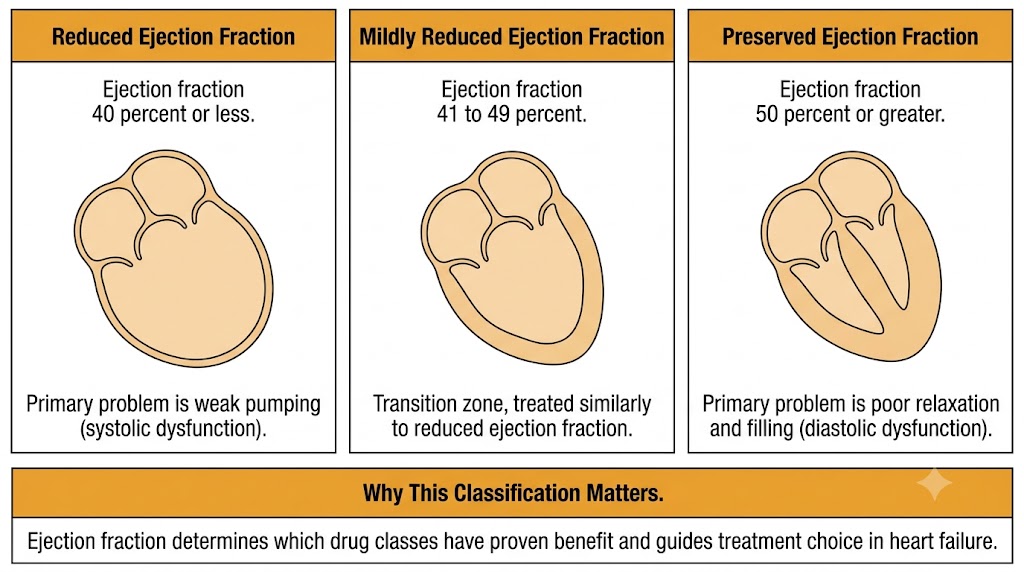
A three-panel comparison diagram showing reduced, mildly reduced, and preserved ejection fraction heart failure, illustrating the difference between a dilated, weakly contracting ventricle and a stiff, poorly relaxing ventricle.
The three ejection fraction categories reflect two distinct underlying problems: weak pumping versus poor relaxation and filling.

Section 3

Neurohormonal Activation — The Engine of Disease Progression

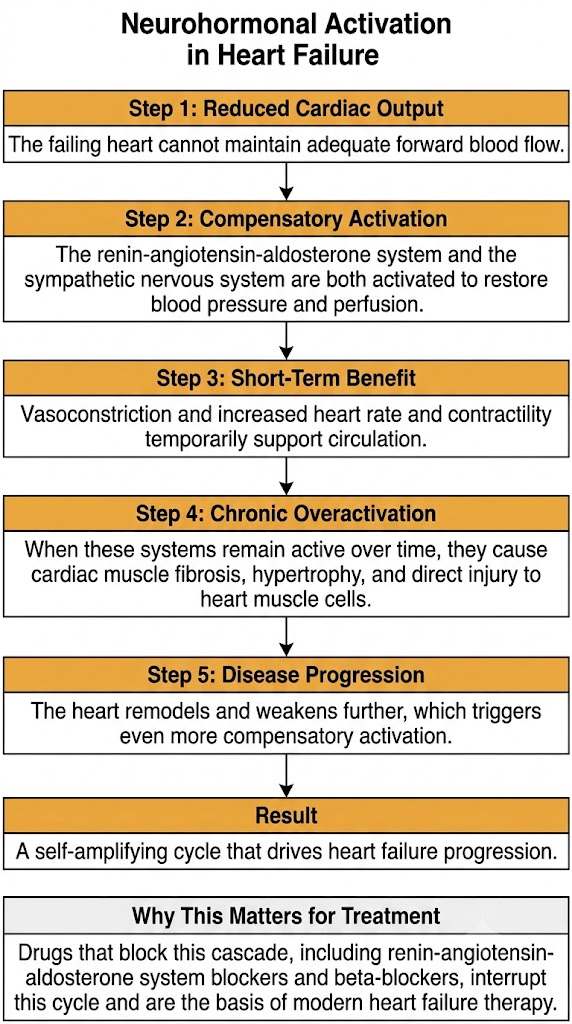
The body compensatory responses to a failing heart, helpful at first, become the main drivers of disease progression when they persist chronically.

The Renin-Angiotensin-Aldosterone System

When cardiac output falls, the kidney senses reduced perfusion and releases renin. Renin converts angiotensinogen to angiotensin I, and angiotensin-converting enzyme converts angiotensin I to angiotensin II, the active effector of the system. In the short term, angiotensin II supports blood pressure through vasoconstriction and through aldosterone-driven sodium and water retention.

Sustained activation, however, becomes harmful. Chronically elevated angiotensin II raises afterload, which increases the work the failing heart must do, and it directly promotes cardiac muscle hypertrophy and fibrosis. Aldosterone, released downstream of angiotensin II, independently promotes fibrosis and potassium wasting through the mineralocorticoid receptor. Blocking this system at multiple points, with angiotensin-converting enzyme inhibitors, angiotensin receptor blockers, and mineralocorticoid receptor antagonists, is one of the central strategies of guideline-directed medical therapy and is explored in Modules 2 and 4.

The Sympathetic Nervous System

Reduced cardiac output also activates the sympathetic nervous system, increasing heart rate and contractility through beta-1 adrenergic receptors and increasing vascular resistance through alpha-1 receptors. Like the renin-angiotensin-aldosterone system, this response is adaptive in the short term and harmful when sustained.

Chronic catecholamine excess injures cardiac muscle cells directly, reduces the heart responsiveness to further sympathetic stimulation, and increases the risk of dangerous arrhythmias. Plasma norepinephrine levels in heart failure correlate with mortality, an observation that helped establish beta-blockade, discussed in Module 3, as a cornerstone of treatment despite the seemingly counterintuitive idea of slowing down an already struggling heart.

The Natriuretic Peptide System

The heart has its own counter-regulatory hormone system. Atrial natriuretic peptide and B-type natriuretic peptide are released from stretched cardiac muscle in response to elevated wall stress. These peptides oppose the renin-angiotensin-aldosterone system and the sympathetic nervous system: they promote sodium and water excretion, cause vasodilation, and have anti-fibrotic effects on the heart muscle.

B-type natriuretic peptide and its inactive cleavage product are the most widely used laboratory markers for diagnosing and tracking heart failure severity. An enzyme called neprilysin breaks down natriuretic peptides. Blocking neprilysin while simultaneously blocking the renin-angiotensin-aldosterone system, the strategy used by the combination drug sacubitril/valsartan, amplifies the protective natriuretic peptide signal. This drug class is discussed in Module 2.

A vertical flow diagram showing how reduced cardiac output triggers compensatory activation of the renin-angiotensin-aldosterone system and sympathetic nervous system, which initially supports circulation but causes chronic harm and disease progression when sustained.
Neurohormonal activation begins as a compensatory response to reduced cardiac output and becomes a driver of disease progression when sustained chronically.

Section 4

Cardiac Remodeling — The Structural Consequence of Neurohormonal Activation

Cardiac remodeling describes the changes in the shape, size, and function of the ventricle that occur as a result of chronic neurohormonal activation and ongoing cardiac injury. Over time, the chamber dilates and shifts from its normal elongated shape toward a rounder one, the muscle becomes hypertrophied and progressively fibrotic, and the heart loses contractile efficiency. These structural changes are what allow heart failure to progress even when the original triggering injury, such as a heart attack, is no longer active.

Remodeling and neurohormonal activation reinforce one another. Worsening ventricular geometry increases the workload on the heart, which further activates the renin-angiotensin-aldosterone system and the sympathetic nervous system, which in turn drives further remodeling. This self-amplifying cycle is the structural and hormonal basis for why heart failure tends to progress without effective treatment.

A central finding from heart failure drug trials is that guideline-directed medical therapy does not simply control symptoms; it can partially reverse this remodeling process. Angiotensin-converting enzyme inhibitors, angiotensin receptor blockers, the angiotensin receptor-neprilysin inhibitor sacubitril/valsartan, and beta-blockers have all been shown to reduce ventricular size and improve ejection fraction over time in patients with heart failure with reduced ejection fraction. This reverse remodeling effect is part of why these drug classes improve survival rather than only relieving symptoms.


Section 5

A Framework of Therapeutic Targets

Heart failure drugs can be organized by which physiological problem they address. This framework explains why multiple drug classes are combined rather than used one at a time.

Preload Reduction

Elevated filling pressures, or preload, cause the congestion that produces shortness of breath and swelling. Loop diuretics lower preload by increasing sodium and water excretion in the kidney, providing rapid symptom relief. Mineralocorticoid receptor antagonists also reduce sodium retention, but their primary survival benefit comes from blocking aldosterone-driven fibrosis rather than from diuresis alone. Preload-reducing drugs are covered in Module 4.

Afterload Reduction

Elevated systemic vascular resistance, or afterload, makes it harder for the weakened ventricle to eject blood. Renin-angiotensin-aldosterone system blockers reduce afterload by blocking angiotensin II-mediated vasoconstriction, while also providing the anti-fibrotic benefits described in Section 3. Hydralazine, a direct arterial vasodilator, lowers afterload through a separate mechanism that does not involve the renin-angiotensin-aldosterone system. The combination of hydralazine and isosorbide dinitrate is used in patients who cannot tolerate angiotensin-converting enzyme inhibitors or angiotensin receptor blockers, and it has shown a particular mortality benefit in Black patients, a finding discussed further in Module 5.

Neurohormonal Blockade

Directly interrupting the renin-angiotensin-aldosterone system and sympathetic nervous system pathways described in Section 3 is the strategy responsible for most of the mortality benefit seen in modern heart failure therapy. The drug classes that accomplish this, renin-angiotensin-aldosterone system blockers, beta-blockers, mineralocorticoid receptor antagonists, and sodium-glucose cotransporter 2 inhibitors, form the four pillars of guideline-directed medical therapy introduced in Section 6.

Contractility Enhancement

Inotropic drugs increase the force of cardiac contraction, typically by increasing the calcium available to the contractile machinery of the cardiac muscle cell. While effective for short-term hemodynamic support, inotropes carry meaningful risks, including dangerous arrhythmias and increased myocardial oxygen demand, which limits their use to acute decompensation, bridging therapy, or palliative care. Digoxin is a partial exception: it has only modest direct inotropic effects, and its clinical benefit in chronic heart failure with reduced ejection fraction comes mainly from reducing sympathetic nervous system activity. Inotropes and digoxin are covered in Module 6.


Section 6

The Four Pillars of Guideline-Directed Medical Therapy

Four drug classes, each targeting a different piece of the neurohormonal cascade, together form the backbone of modern heart failure with reduced ejection fraction treatment.

Current guidelines recommend starting all four pillars together, or in rapid succession, rather than adding them one at a time. Each class has been shown to provide its own independent survival benefit, so delaying any one of them represents a missed opportunity for the patient.

Pillar 1

Renin-Angiotensin-Aldosterone System Blockade

  • Angiotensin-converting enzyme inhibitor, angiotensin receptor blocker, or the angiotensin receptor-neprilysin inhibitor sacubitril/valsartan
  • The angiotensin receptor-neprilysin inhibitor is preferred when tolerated
  • Full pharmacology in Module 2

Pillar 2

Beta-Blockade

  • Carvedilol, metoprolol succinate, or bisoprolol only
  • These three agents have proven mortality benefit; other beta-blockers are not interchangeable for this indication
  • Full pharmacology in Module 3

Pillar 3

Mineralocorticoid Receptor Antagonism

  • Spironolactone or eplerenone
  • Used in heart failure with reduced ejection fraction with adequate kidney function and potassium levels
  • Full pharmacology in Module 4

Pillar 4

Sodium-Glucose Cotransporter 2 Inhibition

  • Dapagliflozin or empagliflozin
  • Recommended regardless of whether the patient has diabetes
  • Full pharmacology in Module 5

Looking Ahead

Modules 2 through 6 of this chapter build out the full pharmacology of each of these drug classes individually, along with additional agents used in selected patients. Module 7 addresses heart failure with preserved ejection fraction and several special clinical populations.

Suggested References
Author / Organization Title Source
Savarese G, Lund LHGlobal public health burden of heart failureCard Fail Rev. 2017;3(1):7-11
Heidenreich PA, Bozkurt B, Aguilar D, et al2022 AHA/ACC/HFSA guideline for the management of heart failureJ Am Coll Cardiol. 2022;79(17):e263-e421
McDonagh TA, Metra M, Adamo M, et al2021 ESC guidelines for the diagnosis and treatment of acute and chronic heart failureEur Heart J. 2021;42(36):3599-3726
Redfield MMHeart failure with preserved ejection fractionN Engl J Med. 2016;375(19):1868-1877
Stevenson LW, Perloff JKThe limited reliability of physical signs for estimating hemodynamics in chronic heart failureJAMA. 1989;261(6):884-888
Bristow MRTreatment of chronic heart failure with beta-adrenergic receptor antagonists: a convergence of receptor pharmacology and clinical cardiologyCirc Res. 2011;109(10):1176-1194
Pfeffer MA, Braunwald EVentricular remodeling after myocardial infarction: experimental observations and clinical implicationsCirculation. 1990;81(4):1161-1172
Zannad F, McMurray JJ, Krum H, et alEplerenone in patients with systolic heart failure and mild symptomsN Engl J Med. 2011;364(1):11-21
Cohn JN, Levine TB, Olivari MT, et alPlasma norepinephrine as a guide to prognosis in patients with chronic congestive heart failureN Engl J Med. 1984;311(13):819-823
McMurray JJ, Packer M, Desai AS, et alAngiotensin-neprilysin inhibition versus enalapril in heart failureN Engl J Med. 2014;371(11):993-1004
Cohn JN, Ferrari R, Sharpe NCardiac remodeling - concepts and clinical implications: a consensus paper from an international forum on cardiac remodelingJ Am Coll Cardiol. 2000;35(3):569-582