CHAPTER 10 ยท CONGESTIVE HEART FAILURE

Section 1

Introduction

Blockade of the renin-angiotensin-aldosterone system was the first strategy ever shown to improve survival in heart failure, and it remains one of the four pillars of treatment introduced in Module 1. Three related drug classes act on this pathway: angiotensin-converting enzyme inhibitors, angiotensin receptor blockers, and the combination drug sacubitril/valsartan. This module covers how each class works, how they relate to one another, and the key clinical points a student needs to understand their role in heart failure with reduced ejection fraction.


Section 2

Angiotensin-Converting Enzyme Inhibitors

The first drug class shown to improve survival in heart failure, and still a backbone of treatment.

Mechanism of Action

Angiotensin-converting enzyme inhibitors block the enzyme that converts angiotensin I to angiotensin II. With less angiotensin II being formed, blood vessels relax, afterload falls, and aldosterone secretion decreases, which reduces sodium retention. Angiotensin-converting enzyme inhibitors also blunt the harmful fibrotic and hypertrophic effects of angiotensin II on the heart muscle described in Module 1, contributing to reverse remodeling over time.

The same enzyme that converts angiotensin I to angiotensin II also breaks down bradykinin, a peptide that causes vasodilation. Blocking this enzyme therefore raises bradykinin levels in addition to lowering angiotensin II. Elevated bradykinin contributes a small additional vasodilator benefit, but it is also responsible for the two adverse effects that distinguish angiotensin-converting enzyme inhibitors from the other RAAS blockers discussed later in this module: a dry cough and, rarely, angioedema.

Practical Use

Angiotensin-converting enzyme inhibitors are started at a low dose and increased gradually as tolerated, while blood pressure, kidney function, and potassium are monitored. A mild rise in creatinine after starting therapy is expected and reflects the drug working as intended on kidney blood flow; it is not by itself a reason to stop the medication.

Contraindications and Key Adverse Effects
  • Pregnancy — angiotensin-converting enzyme inhibitors are teratogenic and are contraindicated at every stage of pregnancy
  • Bilateral renal artery stenosis — blocking angiotensin II in this setting can precipitate acute kidney injury
  • Prior angioedema with an angiotensin-converting enzyme inhibitor is an absolute contraindication to using the class again
  • Hyperkalemia — reduced aldosterone means reduced potassium excretion by the kidney; this risk is higher with kidney disease or with other potassium-sparing drugs
  • Cough — a dry, persistent cough caused by elevated bradykinin; the most common reason patients switch from an angiotensin-converting enzyme inhibitor to an angiotensin receptor blocker
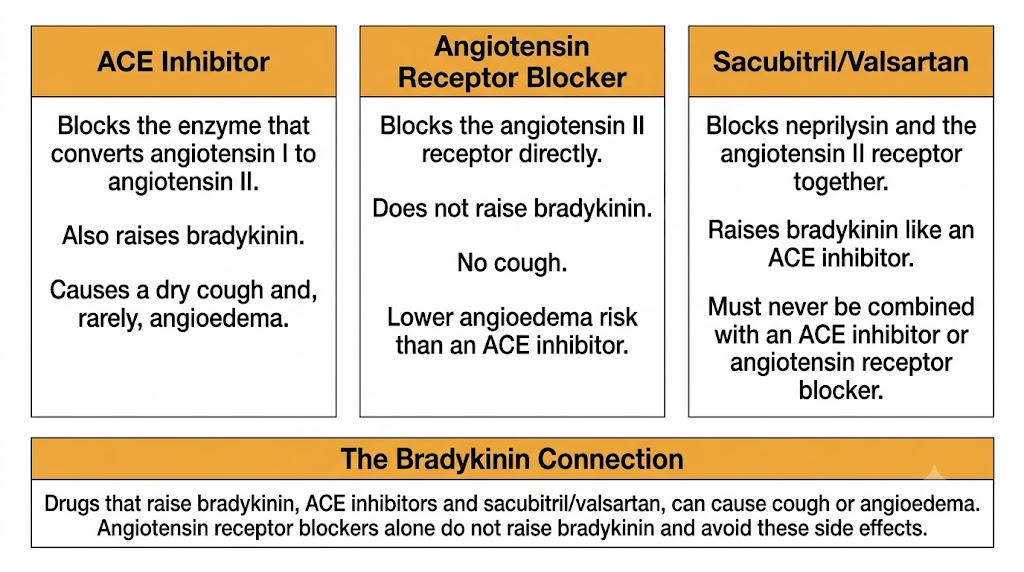
  • A three-panel comparison diagram of ACE inhibitors, angiotensin receptor blockers, and sacubitril/valsartan, showing that ACE inhibitors and sacubitril/valsartan raise bradykinin and can cause cough or angioedema, while angiotensin receptor blockers do not.
    All three drug classes block the renin-angiotensin-aldosterone system, but only those that raise bradykinin carry the risk of cough or angioedema. Figure generated by Gemini AI.

    Section 3

    Angiotensin Receptor Blockers

    An alternative to angiotensin-converting enzyme inhibitors for patients who cannot tolerate the bradykinin-related side effects.

    Mechanism of Action

    Angiotensin receptor blockers act one step downstream of angiotensin-converting enzyme inhibitors. Instead of preventing the formation of angiotensin II, they block the receptor that angiotensin II acts on, producing the same downstream benefits of reduced vasoconstriction, reduced aldosterone release, and reduced cardiac fibrosis and hypertrophy.

    Because angiotensin receptor blockers do not affect the enzyme that breaks down bradykinin, they do not raise bradykinin levels. This eliminates the cough seen with angiotensin-converting enzyme inhibitors and substantially lowers, though does not completely eliminate, the risk of angioedema.

    Practical Use

    In heart failure with reduced ejection fraction, angiotensin receptor blockers are reserved for patients who cannot tolerate an angiotensin-converting enzyme inhibitor, typically because of cough. Their overall clinical effectiveness is similar to angiotensin-converting enzyme inhibitors. Angiotensin receptor blockers share the same major contraindications as angiotensin-converting enzyme inhibitors: pregnancy and bilateral renal artery stenosis. Combining an angiotensin-converting enzyme inhibitor with an angiotensin receptor blocker is not recommended, since blocking the system at two points simultaneously increases the risk of kidney injury and hyperkalemia without added survival benefit.


    Section 4

    Sacubitril/Valsartan — The Preferred RAAS Blocker in Reduced Ejection Fraction

    A single drug that pairs two complementary mechanisms: amplifying a protective hormone system while blocking a harmful one.

    Mechanism of Action

    Sacubitril/valsartan combines two drugs in one tablet. Sacubitril inhibits neprilysin, the enzyme that normally breaks down the protective natriuretic peptides introduced in Module 1, so blocking it raises natriuretic peptide levels and amplifies their beneficial effects of vasodilation, sodium excretion, and reduced cardiac fibrosis. Valsartan is an angiotensin receptor blocker, providing the same angiotensin II blockade described in Section 3.

    Neprilysin also happens to break down angiotensin II, so inhibiting neprilysin alone would raise angiotensin II levels and work against the goal of treatment. Combining a neprilysin inhibitor with an angiotensin receptor blocker solves this problem: angiotensin II signaling is blocked at the receptor regardless of how much is produced. This combination, amplifying the protective natriuretic peptide system while blocking the harmful renin-angiotensin-aldosterone system at the same time, produces a more complete neurohormonal effect than an angiotensin-converting enzyme inhibitor or angiotensin receptor blocker alone.

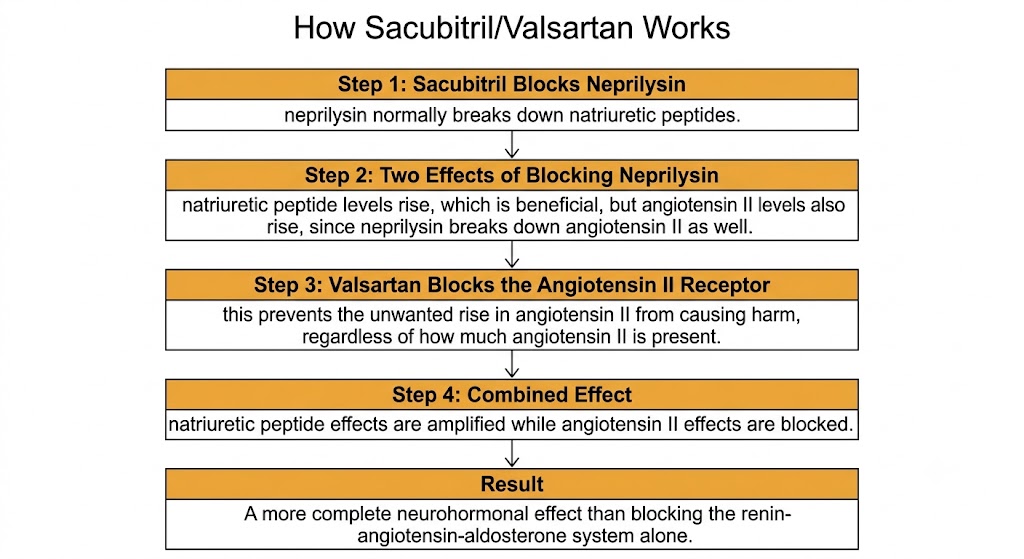
    A vertical flow diagram showing how sacubitril blocks neprilysin to raise natriuretic peptide levels, while valsartan blocks the angiotensin II receptor to prevent the unwanted rise in angiotensin II that neprilysin inhibition alone would cause.
    Sacubitril and valsartan work together to amplify a protective hormone system while blocking a harmful one at the same time. Figure generated by Gemini AI.

    Clinical Role

    In patients with heart failure with reduced ejection fraction who can tolerate it, sacubitril/valsartan is now preferred over an angiotensin-converting enzyme inhibitor or angiotensin receptor blocker alone, since it has demonstrated a greater reduction in mortality and hospitalization in clinical trials. Patients already taking an angiotensin-converting enzyme inhibitor or angiotensin receptor blocker are commonly switched to sacubitril/valsartan for this reason.

    Contraindications and Key Adverse Effects
    Because sacubitril/valsartan contains an angiotensin receptor blocker, it shares the same major contraindications as angiotensin-converting enzyme inhibitors and angiotensin receptor blockers: pregnancy and bilateral renal artery stenosis. A history of angioedema with an angiotensin-converting enzyme inhibitor is also a contraindication, since sacubitril, like an angiotensin-converting enzyme inhibitor, raises bradykinin levels by blocking one of the enzymes that degrades it.

    Hypotension is the most common reason for dose adjustment. Hyperkalemia and a modest rise in creatinine can occur, just as with the other renin-angiotensin-aldosterone system blockers in this module. An important safety rule: sacubitril/valsartan must never be combined with an angiotensin-converting enzyme inhibitor or another angiotensin receptor blocker, since this would cause excessive bradykinin elevation and a high risk of angioedema.

    When RAAS Blockade Cannot Be Used

    Patients who cannot tolerate any renin-angiotensin-aldosterone system blocker, often because of kidney disease or hyperkalemia, can be treated with the combination of hydralazine and isosorbide dinitrate instead. This combination directly dilates blood vessels without acting on the renin-angiotensin-aldosterone system. It has shown a particular mortality benefit in self-identified Black patients with heart failure with reduced ejection fraction who remain symptomatic despite standard therapy, and guidelines specifically recommend adding it in this population. Hydralazine and isosorbide dinitrate are discussed further in Module 5.

    Suggested References
    Author / Organization Title Source
    CONSENSUS Trial Study GroupEffects of enalapril on mortality in severe congestive heart failureN Engl J Med. 1987;316(23):1429-1435
    Heidenreich PA, Bozkurt B, Aguilar D, et al2022 AHA/ACC/HFSA guideline for the management of heart failureJ Am Coll Cardiol. 2022;79(17):e263-e421
    The SOLVD InvestigatorsEffect of enalapril on survival in patients with reduced left ventricular ejection fractions and congestive heart failureN Engl J Med. 1991;325(5):293-302
    Packer M, Poole-Wilson PA, Armstrong PW, et alComparative effects of low and high doses of the angiotensin-converting enzyme inhibitor, lisinopril, on morbidity and mortality in chronic heart failure (ATLAS)Circulation. 1999;100(23):2312-2318
    Cohn JN, Johnson G, Ziesche S, et alA comparison of enalapril with hydralazine-isosorbide dinitrate in the treatment of chronic congestive heart failureN Engl J Med. 1991;325(5):303-310
    Cohn JN, Tognoni G; Valsartan Heart Failure Trial InvestigatorsA randomized trial of the angiotensin-receptor blocker valsartan in chronic heart failureN Engl J Med. 2001;345(23):1667-1675
    McMurray JJ, Ostergren J, Swedberg K, et alEffects of candesartan in patients with chronic heart failure and reduced left-ventricular systolic function taking angiotensin-converting-enzyme inhibitors: the CHARM-Added trialLancet. 2003;362(9386):767-771
    Velazquez EJ, Morrow DA, DeVore AD, et alAngiotensin-neprilysin inhibition in acute decompensated heart failure (PIONEER-HF)N Engl J Med. 2019;380(6):539-548