CHAPTER 10 ยท CONGESTIVE HEART FAILURE

Section 1

Introduction

Sodium-glucose cotransporter 2 inhibitors, originally developed as glucose-lowering drugs for diabetes, have become the fourth pillar of guideline-directed medical therapy introduced in Module 1, and they are the first drug class shown to improve outcomes in heart failure with preserved ejection fraction. Beyond the four pillars, three additional agents, vericiguat, hydralazine combined with isosorbide dinitrate, and ivabradine, play more selective roles in particular patients. This module covers the mechanism and clinical role of each.


Section 2

SGLT2 Inhibitors

A drug class developed for diabetes that turned out to be one of the most broadly useful tools in heart failure.

Mechanism of Action

Sodium-glucose cotransporter 2 inhibitors block glucose and sodium reabsorption in the proximal tubule of the kidney. The resulting glucose and sodium loss in the urine produces a mild, sustained osmotic diuresis that reduces blood volume and ventricular filling pressures, similar in direction to the effect of a loop diuretic but considerably gentler.

The benefit of this drug class in heart failure is larger than this modest diuretic effect alone would predict, and the full explanation remains an area of active research. What is clear clinically is that the benefit applies broadly: this is the first drug class shown to improve outcomes across the full spectrum of ejection fraction, including heart failure with preserved ejection fraction, which had resisted nearly every other pharmacological treatment attempt.

Clinical Use and Key Adverse Effects

Sodium-glucose cotransporter 2 inhibitors are now recommended for essentially all patients with heart failure, regardless of ejection fraction category and regardless of whether the patient has diabetes, since the cardiovascular benefit does not depend on having diabetes.

The most common adverse effect is genital fungal infection, a direct consequence of glucose appearing in the urine, which creates an environment favorable to yeast overgrowth. A rarer but more dangerous adverse effect is diabetic ketoacidosis, which can occur even when blood glucose is only mildly elevated, a presentation called euglycemic diabetic ketoacidosis that can delay diagnosis if blood glucose alone is used to screen for ketoacidosis.


Section 3

Vericiguat

A drug for patients who continue to worsen despite already being on the four pillars of therapy.

Vericiguat works through a mechanism distinct from every other heart failure drug class discussed so far. In normal physiology, nitric oxide activates an enzyme that produces a vasodilating signal inside vascular smooth muscle. In advanced heart failure, nitric oxide availability is often reduced, weakening this pathway. Vericiguat directly stimulates the same enzyme that nitric oxide normally activates, restoring the vasodilating signal even when the body own nitric oxide supply is depleted. This distinguishes vericiguat from nitrate drugs, which depend on adequate nitric oxide availability to work and lose effectiveness in the same advanced heart failure state that vericiguat is designed to treat.
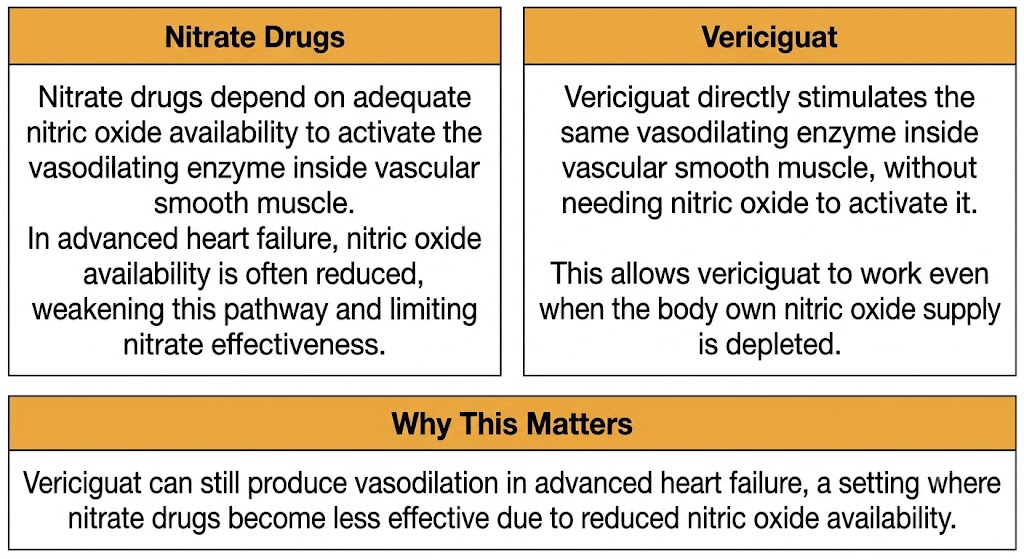
A two-panel diagram contrasting nitrate drugs, which depend on nitric oxide availability and lose effectiveness in advanced heart failure, with vericiguat, which directly activates the same vasodilating enzyme without requiring nitric oxide.
Vericiguat works through the same pathway as nitrate drugs but does not depend on nitric oxide availability, allowing it to remain effective in advanced heart failure. Figure generated by Gemini AI.

Vericiguat is reserved for patients with heart failure with reduced ejection fraction who continue to worsen, for example requiring hospitalization, despite already being on optimized therapy with the four pillars described earlier in this chapter. It is not a replacement for any of the four pillars, but an additional option for patients whose disease is progressing despite standard treatment.

Section 4

Hydralazine and Isosorbide Dinitrate

A vasodilator combination first introduced in Module 2 as an alternative when renin-angiotensin-aldosterone system blockade is not possible.

Hydralazine and isosorbide dinitrate are both direct vasodilators. Hydralazine primarily relaxes arteries, reducing afterload, while isosorbide dinitrate primarily relaxes veins, reducing preload. Used together, this combination produces hemodynamic effects similar to a renin-angiotensin-aldosterone system blocker, but through a mechanism that does not involve the renin-angiotensin-aldosterone system at all.

This combination has two established clinical roles. First, it is used in patients who cannot tolerate any renin-angiotensin-aldosterone system blocker, providing vasodilator therapy through an alternative pathway. Second, it has a specific, well-established mortality benefit when added to standard therapy in self-identified Black patients with heart failure with reduced ejection fraction who remain symptomatic despite optimized treatment, a point introduced in Module 2.


Section 5

Ivabradine

A drug that slows the heart rate without the negative effect on contractility that limits beta-blocker titration.

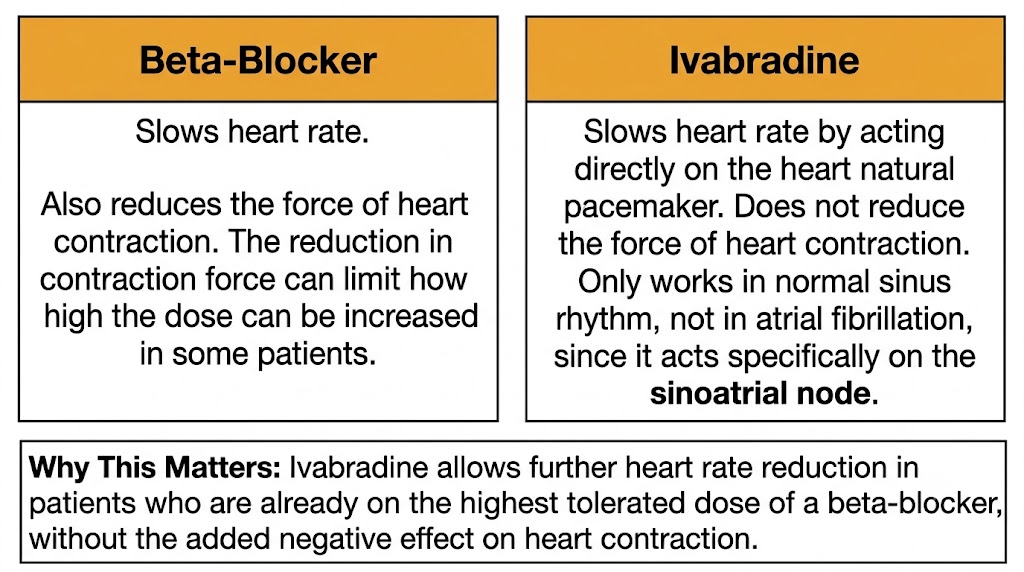
Ivabradine slows the heart natural pacemaker activity in the sinoatrial node, reducing heart rate without affecting how forcefully the heart contracts. This is a meaningful distinction from beta-blockers, which slow heart rate but also reduce contractility, a property that can limit how high a beta-blocker dose a patient can tolerate.

A two-panel diagram contrasting beta-blockers, which slow heart rate and also reduce contraction force, with ivabradine, which slows heart rate by acting on the sinoatrial node without affecting contraction force.
Ivabradine slows heart rate through a different mechanism than beta-blockers, allowing further rate control without the added negative effect on heart contraction. Figure generated by Gemini AI.

Ivabradine is used as an add-on therapy in patients with heart failure with reduced ejection fraction who remain in normal sinus rhythm with a persistently fast resting heart rate despite being on the maximally tolerated dose of a beta-blocker. Because ivabradine works specifically on the sinoatrial node, it is not effective and is not used in patients with atrial fibrillation, since the abnormal heart rhythm in atrial fibrillation does not originate from the sinoatrial node. The most characteristic adverse effect is the appearance of visual light phenomena called phosphenes, transient flashes or brightness in the visual field, which are generally harmless but can be bothersome enough to prompt discontinuation.

Suggested References
Author / Organization Title Source
McMurray JJ, Solomon SD, Inzucchi SE, et alDapagliflozin in patients with heart failure and reduced ejection fraction (DAPA-HF)N Engl J Med. 2019;381(21):1995-2008
Packer M, Anker SD, Butler J, et alCardiovascular and renal outcomes with empagliflozin in heart failure (EMPEROR-Reduced)N Engl J Med. 2020;383(15):1413-1424
Zinman B, Wanner C, Lachin JM, et alEmpagliflozin, cardiovascular outcomes, and mortality in type 2 diabetes (EMPA-REG OUTCOME)N Engl J Med. 2015;373(22):2117-2128
Anker SD, Butler J, Filippatos G, et alEmpagliflozin in heart failure with a preserved ejection fraction (EMPEROR-Preserved)N Engl J Med. 2021;385(16):1451-1461
Solomon SD, McMurray JJV, Claggett B, et alDapagliflozin in heart failure with mildly reduced or preserved ejection fraction (DELIVER)N Engl J Med. 2022;387(12):1089-1098
Heidenreich PA, Bozkurt B, Aguilar D, et al2022 AHA/ACC/HFSA guideline for the management of heart failureJ Am Coll Cardiol. 2022;79(17):e263-e421
Armstrong PW, Pieske B, Anstrom KJ, et alVericiguat in patients with heart failure and reduced ejection fraction (VICTORIA)N Engl J Med. 2020;382(20):1883-1893
Cohn JN, Archibald DG, Ziesche S, et alEffect of vasodilator therapy on mortality in chronic congestive heart failure (V-HeFT I)N Engl J Med. 1986;314(24):1547-1552
Taylor AL, Ziesche S, Yancy C, et alCombination of isosorbide dinitrate and hydralazine in blacks with heart failure (A-HeFT)N Engl J Med. 2004;351(20):2049-2057
Swedberg K, Komajda M, Bohm M, et alIvabradine and outcomes in chronic heart failure (SHIFT)Lancet. 2010;376(9744):875-885