Module 4 — Loop Diuretics and Aldosterone Antagonists
Module 4 of 7Section 1
Loop diuretics and aldosterone antagonists both promote sodium and water loss, but they play very different roles in heart failure with reduced ejection fraction. Loop diuretics are the primary tool for relieving congestion and are essential for symptom control in most patients, but they do not improve survival. Mineralocorticoid receptor antagonists, by contrast, are one of the four pillars of guideline-directed medical therapy introduced in Module 1: they reduce mortality through effects on cardiac fibrosis that go well beyond their modest diuretic action. Understanding this distinction, one class controls symptoms, the other changes the disease course, is the key organizing idea of this module.
Section 2
The fastest and most effective way to relieve fluid overload in heart failure, though they do not extend survival on their own.
Mechanism of Action
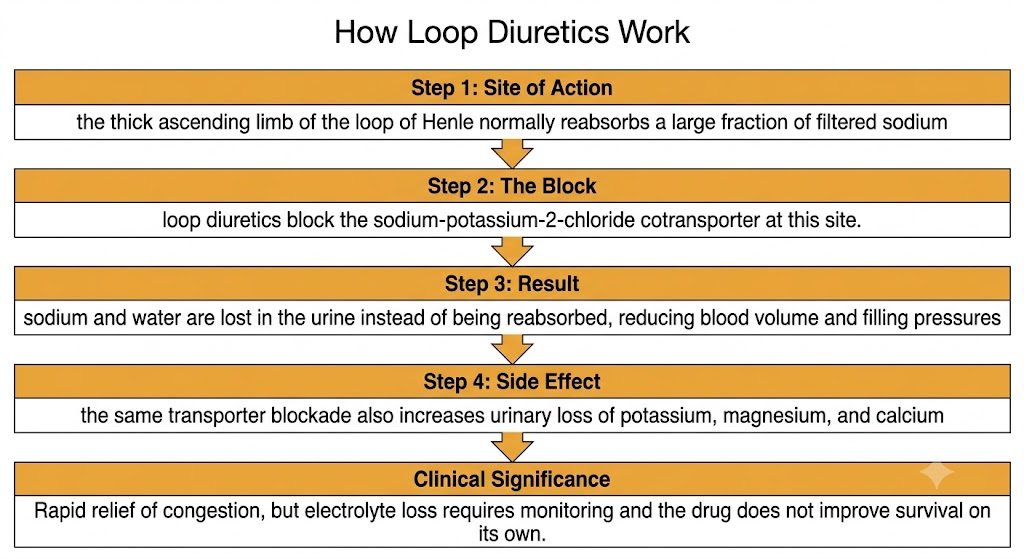
Loop diuretics block the sodium-potassium-2-chloride cotransporter in the thick ascending limb of the loop of Henle, a segment of the kidney that normally reabsorbs a large fraction of filtered sodium. Blocking this transporter produces a substantial loss of sodium and water in the urine, which reduces blood volume and lowers the elevated filling pressures responsible for the shortness of breath and swelling seen in decompensated heart failure.
Because this same transporter is involved in handling other electrolytes, blocking it also causes increased urinary loss of potassium, magnesium, and calcium. Patients on loop diuretics require monitoring for these electrolyte losses, and hypokalemia in particular increases the risk of dangerous arrhythmias.
Key Agents
Furosemide is the most widely used loop diuretic. Its absorption from the gut can be unreliable in patients with decompensated heart failure, since the same fluid overload that the drug is meant to treat can also cause swelling of the gut wall and reduce drug absorption. For this reason, intravenous administration is commonly used in the hospital for patients with significant fluid overload, since it bypasses this absorption problem entirely. Torsemide and bumetanide are alternative loop diuretics with more predictable oral absorption, and are sometimes preferred for long-term outpatient use.
Section 3
A mineralocorticoid receptor antagonist that does far more than promote modest sodium loss: it directly improves survival.
Mechanism of Action
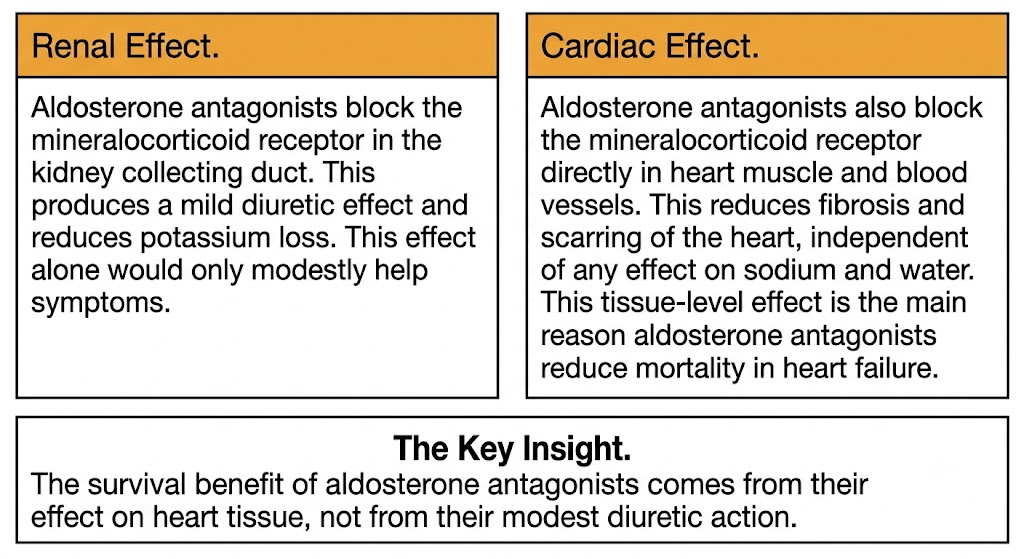
Aldosterone normally acts on the kidney collecting duct to promote sodium retention and potassium excretion. Spironolactone and eplerenone block the mineralocorticoid receptor that aldosterone acts on, producing a mild diuretic effect and reducing potassium loss.
The reason aldosterone antagonists are one of the four pillars of guideline-directed medical therapy has little to do with this modest diuretic action. Aldosterone also acts directly on the heart and blood vessels to promote fibrosis, independent of its effects on sodium and water balance. By blocking this tissue-level effect, aldosterone antagonists reduce the progressive scarring and stiffening of the heart muscle described in Module 1, producing a meaningful reduction in mortality that is disproportionate to their mild diuretic effect.
Spironolactone Versus Eplerenone
Spironolactone is the older and more widely used agent, but it also binds androgen and progesterone receptors in addition to the mineralocorticoid receptor. This cross-reactivity causes the class characteristic side effect of gynecomastia and breast tenderness, particularly in men. Eplerenone is a more selective mineralocorticoid receptor antagonist with minimal effect on sex hormone receptors, and it is commonly substituted when spironolactone causes these endocrine side effects.
Section 4
Loop diuretics and aldosterone antagonists are frequently used in the same patient, and their opposite effects on potassium are an important practical consideration. Loop diuretics promote potassium loss, while aldosterone antagonists reduce potassium loss. When both are used together, as they often are alongside the renin-angiotensin-aldosterone system blockers from Module 2, the net effect on serum potassium depends on the balance between these opposing forces, and regular monitoring is required.
Putting It Together
A patient on a renin-angiotensin-aldosterone system blocker, a beta-blocker, an aldosterone antagonist, and a loop diuretic is receiving a representative combination of guideline-directed medical therapy. Three of these four drug classes can raise potassium, while the loop diuretic lowers it, which is one reason potassium is checked regularly throughout heart failure treatment.
| Author / Organization | Title | Source |
|---|---|---|
| Felker GM, Lee KL, Bull DA, et al | Diuretic strategies in patients with acute decompensated heart failure (DOSE trial) | N Engl J Med. 2011;364(9):797-805 |
| Heidenreich PA, Bozkurt B, Aguilar D, et al | 2022 AHA/ACC/HFSA guideline for the management of heart failure | J Am Coll Cardiol. 2022;79(17):e263-e421 |
| Mentz RJ, Anstrom KJ, Eisenstein EL, et al | Effect of torsemide vs furosemide after discharge on all-cause mortality in patients hospitalized with heart failure (TRANSFORM-HF) | JAMA. 2023;329(3):214-223 |
| Mullens W, Dauw J, Martens P, et al | Acetazolamide in acute decompensated heart failure with volume overload (ADVOR) | N Engl J Med. 2022;387(13):1185-1195 |
| Pitt B, Zannad F, Remme WJ, et al | The effect of spironolactone on morbidity and mortality in patients with severe heart failure (RALES) | N Engl J Med. 1999;341(10):709-717 |
| Pitt B, Remme W, Zannad F, et al | Eplerenone, a selective aldosterone blocker, in patients with left ventricular dysfunction after myocardial infarction (EPHESUS) | N Engl J Med. 2003;348(14):1309-1321 |
| Zannad F, McMurray JJ, Krum H, et al | Eplerenone in patients with systolic heart failure and mild symptoms (EMPHASIS-HF) | N Engl J Med. 2011;364(1):11-21 |
| Pitt B, Pfeffer MA, Assmann SF, et al | Spironolactone for heart failure with preserved ejection fraction (TOPCAT) | N Engl J Med. 2014;370(15):1383-1392 |