CHAPTER 32  ·  HYPOTHALAMIC PHARMACOLOGY
Section 1
GnRH Agonists: Mechanism, Flare, and Downregulation
From initial luteinizing hormone surge to sustained medical castration
Mechanism of Downregulation

Gonadotropin-releasing hormone agonist analogs are structural modifications of the native gonadotropin-releasing hormone decapeptide that bind the gonadotropin-releasing hormone receptor with higher affinity and resist peptidase degradation, producing prolonged non-pulsatile receptor occupancy. At initiation, this triggers an indistinguishable Gq-mediated signal: phospholipase C beta activation, inositol trisphosphate and diacylglycerol generation, calcium mobilization, and protein kinase C activation, driving an initial surge of luteinizing hormone and follicle-stimulating hormone lasting 1 to 2 weeks. In men with prostate cancer, serum testosterone rises 50 to 80% above baseline during this flare period.

The transition to suppression proceeds in two phases. Phase one: within hours, protein kinase C-mediated phosphorylation uncouples the receptor from Gq without significant surface receptor loss. Phase two: over days to weeks, receptor internalization via a clathrin-independent pathway reduces surface receptor density by 80 to 95%. Testosterone falls to castrate levels (below 50 nanograms per deciliter) within 3 to 4 weeks of the first depot injection.

Flare Prevention

The testosterone flare poses clinical risk in prostate cancer patients with vertebral metastases (spinal cord compression), bulky nodal disease, or severe urinary obstruction. Standard management is co-administration of a non-steroidal anti-androgen beginning 7 to 14 days before the first depot injection and continued for 4 weeks. Bicalutamide 50 milligrams daily is most commonly used. Combined androgen blockade — continuous gonadotropin-releasing hormone agonist plus anti-androgen — provides only marginal additional benefit over agonist alone but substantially increases adverse effects, so most guidelines limit anti-androgen use to flare prevention only.

Gonadotropin-releasing hormone antagonists (degarelix, oral relugolix) avoid the flare entirely by competitively blocking the receptor without any initial activation and are the preferred choice when rapid testosterone suppression is needed or flare risk is high.
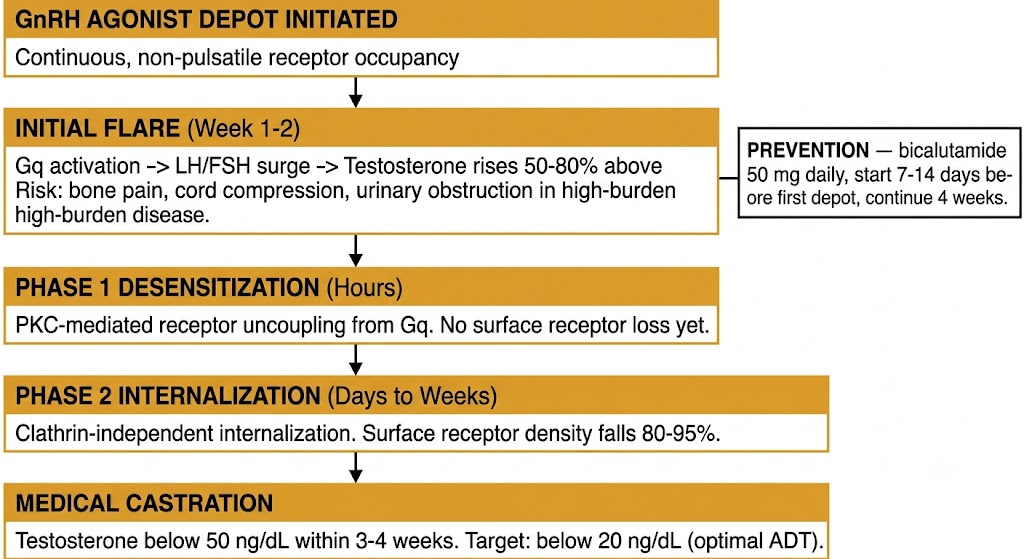
Flow diagram showing the two-phase mechanism by which a GnRH agonist depot produces medical castration after an initial testosterone flare, with bicalutamide flare prevention protocol.
GnRH agonist depot mechanism: initial testosterone flare followed by two-phase receptor downregulation leading to medical castration. Generated by Gemini AI.
Flare Prevention: When It Matters Most

Anti-androgen coverage is mandatory in prostate cancer patients with vertebral metastases, bulky nodal disease, or severe urinary obstruction. Protocol: bicalutamide 50 milligrams daily beginning 7 to 14 days before the first depot injection, continued for 4 weeks. Alternative: start with a gonadotropin-releasing hormone antagonist (degarelix or oral relugolix), which produces immediate testosterone suppression without any flare. Do not use anti-androgen monotherapy as a substitute for depot agonist — it provides inferior testosterone suppression.
Section 2
GnRH Agonist Depot Formulations
Leuprolide, goserelin, and triptorelin — delivery systems, dosing intervals, and monitoring
Leuprolide

Leuprolide acetate is the most widely used gonadotropin-releasing hormone agonist in North America. The microsphere depot (Lupron Depot) uses poly(lactic-co-glycolic acid) polymer microspheres injected intramuscularly; slow hydrolysis releases leuprolide over the dosing interval. Available in 1-month (7.5 milligrams), 3-month (22.5 milligrams), 4-month (30 milligrams), and 6-month (45 milligrams) formulations. A subcutaneous atrigel formulation (Eligard) gels at the injection site and provides equivalent 1-month, 3-month, and 6-month options. Testosterone should be confirmed at castrate levels before each injection in prostate cancer patients on androgen deprivation therapy; non-castrate testosterone (above 50 nanograms per deciliter) despite ongoing depot therapy occurs in approximately 4 to 13% of patients and requires investigation of injection technique and site rotation.

Goserelin and Triptorelin

Goserelin acetate (Zoladex) is a rod-shaped biodegradable implant placed subcutaneously in the anterior abdominal wall using a trocar device — no mixing or reconstitution required. The 1-month formulation contains 3.6 milligrams and the 3-month formulation contains 10.8 milligrams. Correct subcutaneous (not intramuscular) placement is essential; intramuscular injection of the implant prevents controlled release. Goserelin is eliminated primarily renally (approximately 90%) with no clinically significant dose adjustment needed for mild to moderate renal impairment. Triptorelin (Trelstar) is available as an intramuscular microsphere depot in 1-month (3.75 milligrams), 3-month (11.25 milligrams), and 6-month (22.5 milligrams) formulations, with hepatic peptidase metabolism and renal elimination.

Non-Castrate Testosterone on Depot Therapy

Testosterone above 50 nanograms per deciliter despite ongoing depot gonadotropin-releasing hormone agonist therapy indicates delivery failure. Causes include incorrect injection technique, subcutaneous fibrosis at the injection site impairing absorption, and end-of-dose escape before the next scheduled injection. Clinical action: verify injection technique, rotate sites, and consider switching to a gonadotropin-releasing hormone antagonist (degarelix or relugolix), which maintains castrate levels more consistently in some comparative studies. Some guidelines now target testosterone below 20 nanograms per deciliter as the optimal threshold for androgen deprivation therapy.


Section 3
GnRH Antagonists: Injectable and Pulsatile Therapy
Degarelix, competitive receptor blockade, and pulsatile pump therapy for hypogonadotropic hypogonadism
Degarelix

Degarelix (Firmagon) is the first gonadotropin-releasing hormone antagonist approved specifically for prostate cancer. It competitively blocks the gonadotropin-releasing hormone receptor without any initial activation, producing castrate testosterone levels (below 50 nanograms per deciliter) in more than 96% of patients within 3 days of the first injection — without any testosterone flare. The loading dose is 240 milligrams given as two 120-milligram subcutaneous injections on day 1, followed by monthly maintenance doses of 80 milligrams subcutaneous. After injection, degarelix forms a depot gel at the subcutaneous site, releasing drug over approximately 28 days. Elimination is primarily through hepatic peptide metabolism.

The key limitation of degarelix is injection site reactions: pain, erythema, and nodule formation occur in approximately 35 to 40% of patients, substantially more than with intramuscular leuprolide or goserelin. These are generally self-limited but may require site rotation and warm compresses. Unlike gonadotropin-releasing hormone agonist depots, there is no long-acting formulation of degarelix beyond the monthly subcutaneous injection, which some patients find inconvenient compared to quarterly depot agonist formulations.

Pulsatile Gonadotropin-Releasing Hormone Therapy

Pulsatile gonadotropin-releasing hormone therapy is the therapeutic opposite of depot agonist therapy. A portable infusion pump delivers native gonadotropin-releasing hormone in subcutaneous or intravenous pulses of 2.5 to 20 micrograms every 60 to 120 minutes, mimicking physiological hypothalamic secretion. This approach is used exclusively in patients with hypogonadotropic hypogonadism caused by isolated gonadotropin-releasing hormone deficiency (Kallmann syndrome or normosmic idiopathic hypogonadotropic hypogonadism), where absent pulsatile secretion leads to prepubertal gonadal function despite an intact pituitary.

Pulsatile gonadotropin-releasing hormone therapy reliably induces spermatogenesis in men (adequate sperm counts for natural conception in approximately 75 to 80% of treated patients) and ovulation in women (cumulative pregnancy rates of 80 to 90% over multiple treatment cycles). Because it restores physiological signaling, it avoids the supraphysiological gonadotropin levels and multiple follicular development that complicate exogenous gonadotropin therapy in women with hypogonadotropic hypogonadism.

Antagonist vs. Agonist: When the Choice Changes Outcomes

Prefer gonadotropin-releasing hormone antagonist (degarelix or oral relugolix) over depot agonist when: vertebral metastases or bulky disease make testosterone flare dangerous; rapid testosterone suppression is needed; patient has had a major adverse cardiovascular event within 6 months (relugolix showed 54% lower major adverse cardiovascular event rate versus leuprolide in the HERO trial); or non-castrate testosterone has occurred on agonist depot therapy. Antagonists also allow faster testosterone recovery after discontinuation, which matters when treatment completion and fertility restoration are goals.


Section 4
Oral GnRH Antagonists: Elagolix and Relugolix
Non-peptide small molecules achieving dose-dependent hypothalamic-pituitary-gonadal axis suppression with oral bioavailability
Elagolix

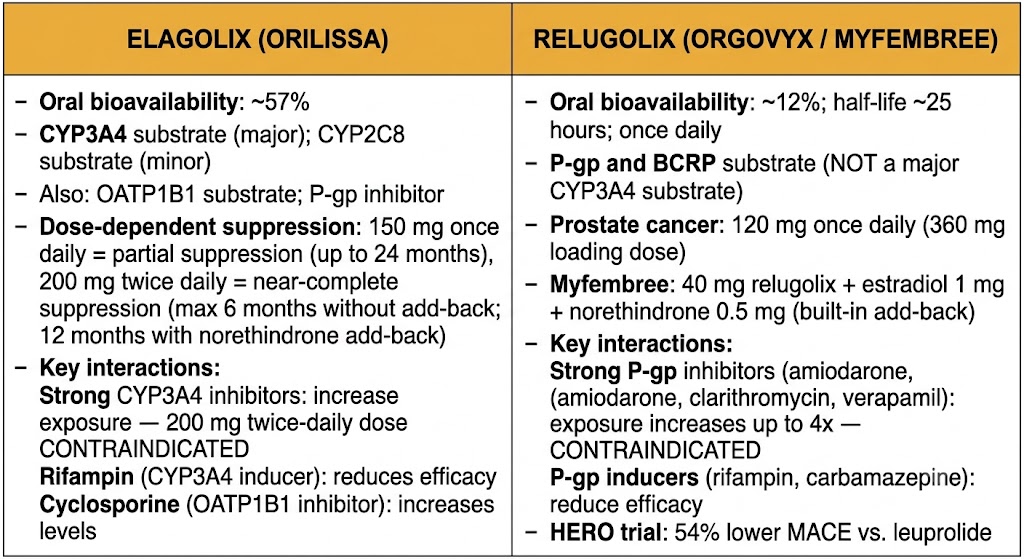
Elagolix (Orilissa) is a non-peptide oral gonadotropin-releasing hormone receptor antagonist approved for endometriosis-associated pain. Oral bioavailability is approximately 57%. Its key clinical distinction from depot gonadotropin-releasing hormone agonists is dose-dependent partial versus complete hypothalamic-pituitary-gonadal axis suppression. The 150-milligram once-daily dose produces partial estradiol suppression (to early follicular phase levels), reducing endometriosis pain while preserving some ovarian function and minimizing bone mineral density loss. The 200-milligram twice-daily dose produces near-complete suppression equivalent to surgical menopause, with superior pain control but greater bone mineral density loss. This titratable suppression is not achievable with depot agonists, which invariably produce profound, non-titratable suppression.

Elagolix is metabolized primarily by cytochrome P450 3A4, with secondary contribution from cytochrome P450 2C8. It is also a substrate of organic anion-transporting polypeptide 1B1 and an inhibitor of P-glycoprotein. Strong cytochrome P450 3A4 inhibitors (ketoconazole, ritonavir, clarithromycin) substantially increase elagolix exposure; the 200-milligram twice-daily dose is contraindicated with strong cytochrome P450 3A4 inhibitors. Strong cytochrome P450 3A4 inducers (rifampin, carbamazepine) reduce elagolix exposure and may impair efficacy. Cyclosporine (an organic anion-transporting polypeptide 1B1 inhibitor) significantly increases elagolix plasma concentrations.

Relugolix

Relugolix (Orgovyx for prostate cancer; Myfembree when combined with estradiol and norethindrone acetate for uterine fibroids and endometriosis) is an oral non-peptide gonadotropin-releasing hormone antagonist with oral bioavailability of approximately 12% and a plasma half-life of approximately 25 hours enabling once-daily dosing. In the pivotal HERO trial, relugolix 120 milligrams once daily (after a 360-milligram loading dose) achieved sustained castrate testosterone in 96.7% of patients at 48 weeks versus 88.8% for leuprolide, without any testosterone flare. The relugolix arm had a 54% lower rate of major adverse cardiovascular events compared with leuprolide, attributed to faster testosterone recovery after discontinuation and avoidance of the sustained metabolic effects of depot agonist therapy.

Relugolix is a substrate and moderate inhibitor of P-glycoprotein and breast cancer resistance protein. Strong P-glycoprotein inhibitors (amiodarone, clarithromycin, itraconazole, verapamil) increase relugolix exposure up to fourfold, raising risk of prolonged testosterone suppression; these combinations are contraindicated or require dose reduction. Strong P-glycoprotein inducers (rifampin, carbamazepine, St. John's wort) reduce relugolix exposure and risk inadequate testosterone suppression. Relugolix is not significantly metabolized by cytochrome P450 3A4, which differentiates its drug interaction profile from elagolix.

Two-panel comparison of elagolix and relugolix showing oral bioavailability, metabolic pathways, drug interactions, dosing regimens, and key clinical trial results.
Oral GnRH antagonists: elagolix versus relugolix — pharmacokinetics, drug interactions, and clinical applications compared. Generated by Gemini AI.
Oral Antagonist Drug Interactions: High-Yield Summary

Elagolix: cytochrome P450 3A4 substrate (major); P-glycoprotein inhibitor; organic anion-transporting polypeptide 1B1 substrate. Strong cytochrome P450 3A4 inhibitors contraindicated with 200-milligram twice-daily dose. Rifampin reduces efficacy. Cyclosporine increases elagolix levels.

Relugolix: P-glycoprotein and breast cancer resistance protein substrate; not a major cytochrome P450 substrate. Strong P-glycoprotein inhibitors (amiodarone, clarithromycin, verapamil) increase exposure up to fourfold — contraindicated or dose-reduce. Strong P-glycoprotein inducers (rifampin, carbamazepine) reduce efficacy.

Both agents: monitor for hypoestrogenic or hypogonadal effects (vasomotor symptoms, bone mineral density loss, mood changes) during therapy.


Section 5
Clinical Applications by Indication
Prostate cancer, endometriosis, uterine fibroids, and central precocious puberty
Prostate Cancer

Androgen deprivation therapy with a gonadotropin-releasing hormone agonist or antagonist is the cornerstone of treatment for metastatic hormone-sensitive prostate cancer, biochemically recurrent disease after local therapy, and locally advanced disease in combination with radiotherapy. The clinical goal is sustained testosterone below 50 nanograms per deciliter (or preferably below 20 nanograms per deciliter by current guidelines). Intermittent androgen deprivation therapy — alternating treatment cycles and treatment holidays guided by prostate-specific antigen levels — is an option for biochemically recurrent disease without metastases, offering similar overall survival in selected patients while allowing partial testosterone recovery between cycles. Continuous androgen deprivation therapy is required for metastatic disease. Duration combined with radiotherapy for high-risk localized disease is typically 18 to 36 months based on randomized trial data. The HERO trial established relugolix as an alternative to leuprolide with cardiovascular advantage, which is clinically relevant because cardiovascular disease is the leading non-cancer cause of death in men with prostate cancer receiving androgen deprivation therapy.

Endometriosis

In endometriosis, gonadotropin-releasing hormone agonist depots (leuprolide 3.75 milligrams monthly or 11.25 milligrams every 3 months; goserelin 3.6 milligrams monthly) reduce dysmenorrhea, pelvic pain, and dyspareunia in approximately 85% of patients, comparable to surgical management in symptom control. Treatment is limited to 6 months of continuous use without add-back therapy owing to hypoestrogenic bone mineral density loss of approximately 4 to 6% at the lumbar spine over 6 months. Add-back therapy with low-dose estrogen plus progestin (norethindrone acetate 5 milligrams daily, or conjugated equine estrogen 0.625 milligrams plus norethindrone acetate 5 milligrams daily) maintains pain control while attenuating bone mineral density loss by keeping estradiol in the range of 20 to 40 picograms per milliliter — below the threshold for endometriosis stimulation but adequate for bone protection. Elagolix 150 milligrams daily (partial suppression) may be used for up to 24 months; elagolix 200 milligrams twice daily is limited to 6 months without add-back but up to 12 months with norethindrone acetate 1 milligram daily add-back.

Uterine Fibroids and Central Precocious Puberty

In uterine fibroids, gonadotropin-releasing hormone agonists reduce fibroid volume by 35 to 65% over 3 to 6 months through hypoestrogenic shrinkage, useful preoperatively to reduce surgical bleeding. Fibroid regrowth occurs within 3 to 6 months of stopping therapy in most patients. The oral combination product Myfembree (relugolix 40 milligrams plus estradiol 1 milligram plus norethindrone acetate 0.5 milligrams once daily) provides sustained fibroid symptom control with built-in add-back therapy, enabling use beyond 6 months with bone mineral density monitoring.

In central precocious puberty — defined as hypothalamic-pituitary-gonadal axis activation before age 8 in girls and age 9 in boys — depot gonadotropin-releasing hormone agonist therapy is the standard of care. Continuous hypothalamic-pituitary-gonadal suppression halts pubertal progression and protects final adult height by extending the period for skeletal growth before epiphyseal fusion. Leuprolide depot (Lupron Depot-Ped) at 0.3 milligrams per kilogram intramuscularly every 4 weeks (minimum 7.5 milligrams) is most commonly used. Histrelin acetate subcutaneous implant (Supprelin LA) provides continuous agonist delivery from an annually replaced subcutaneous implant. Adequacy of suppression is confirmed by stimulated luteinizing hormone below 2 international units per liter after gonadotropin-releasing hormone agonist stimulation at 30 to 60 minutes.

Add-Back Therapy: The Estrogen Threshold Principle

Endometriosis implants require estradiol above approximately 20 picograms per milliliter to grow. Bone mineral density loss from hypoestrogenia occurs at estradiol below approximately 30 to 40 picograms per milliliter. Add-back therapy maintains estradiol in the 20 to 40 picograms per milliliter window: low enough to suppress endometriosis while protecting bone. Norethindrone acetate 5 milligrams daily alone (without estrogen) also provides bone protection via progestin-mediated effects and is an alternative in women who cannot take estrogen. Add-back does not significantly reduce pain control efficacy when used appropriately.


Section 6
Adverse Effects, Drug Interactions, and Monitoring
QT prolongation, bone loss, metabolic syndrome, and cardiovascular risk during androgen deprivation therapy
QT Prolongation

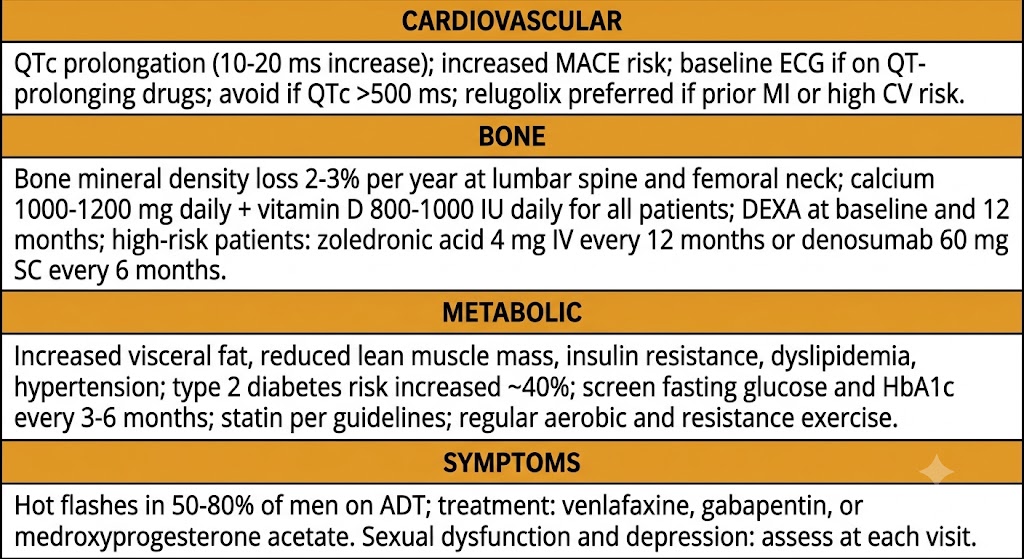
Androgen deprivation therapy-induced testosterone suppression prolongs the cardiac action potential duration, increasing the corrected QT interval by approximately 10 to 20 milliseconds on average. Concurrent use of other QT-prolonging agents substantially amplifies this risk. High-risk combinations include antiarrhythmic drugs (amiodarone, sotalol, quinidine), certain antipsychotics (haloperidol, quetiapine), antimicrobials (fluoroquinolones, azithromycin, fluconazole), and methadone. A baseline electrocardiogram is prudent before starting androgen deprivation therapy in patients on any QT-prolonging medication, with repeat at 1 to 3 months. Patients with congenital long QT syndrome or corrected QT interval above 500 milliseconds at baseline should not receive gonadotropin-releasing hormone agonists without cardiology input.

Bone Loss and Metabolic Effects

Bone mineral density declines by approximately 2 to 3% per year at the lumbar spine and femoral neck during testosterone suppression in men. Calcium 1,000 to 1,200 milligrams daily and vitamin D 800 to 1,000 international units daily are recommended for all patients on androgen deprivation therapy. Baseline dual-energy X-ray absorptiometry scanning and repeat at 12 months is appropriate for men on continuous androgen deprivation therapy. In high-risk patients (T-score below negative 1.0 at baseline, prior fragility fracture, or androgen deprivation therapy duration exceeding 12 months), zoledronic acid 4 milligrams intravenously every 12 months or denosumab 60 milligrams subcutaneously every 6 months provides bone protection.

The metabolic syndrome of androgen deprivation therapy — increased visceral adiposity, reduced lean muscle mass, insulin resistance, dyslipidemia, and hypertension — increases type 2 diabetes risk by approximately 40% and major cardiovascular event risk by 10 to 20% over 1 to 5 years. Regular aerobic and resistance exercise meaningfully attenuates these changes and is recommended for all patients. Screening for diabetes and cardiovascular risk factors is appropriate at baseline and every 3 to 6 months during androgen deprivation therapy. Hot flashes, occurring in 50 to 80% of men on androgen deprivation therapy, can be treated with venlafaxine, gabapentin, or medroxyprogesterone acetate.

Organ system summary of androgen deprivation therapy adverse effects covering cardiovascular QTc prolongation, bone mineral density loss, metabolic syndrome, and symptomatic effects with monitoring recommendations.
Androgen deprivation therapy adverse effects by organ system with monitoring recommendations. Generated by Gemini AI.
Androgen Deprivation Therapy Cardiovascular Risk: Practical Points

Relugolix (HERO trial): 54% lower major adverse cardiovascular event rate versus leuprolide at 48 weeks. Prefer relugolix for patients with established cardiovascular disease, prior myocardial infarction or stroke within 6 months, heart failure, or high baseline cardiovascular risk. All androgen deprivation therapy patients: baseline electrocardiogram if on QT-prolonging drugs; regular exercise and statin therapy per guidelines; screen for diabetes at every visit. Do not delay necessary androgen deprivation therapy for cardiovascular concerns without oncology input — untreated prostate cancer is also life-threatening.


Suggested References
Author / Organization Title Source
Conn PM, Crowley WF Jr Gonadotropin-releasing hormone and its analogs N Engl J Med. 1991;324(2):93–103
Seidenfeld J, Samson DJ, Hasselblad V, et al Single-therapy androgen suppression in men with advanced prostate cancer: a systematic review and meta-analysis Ann Intern Med. 2000;132(7):566–577
Higano CS Side effects of androgen deprivation therapy: monitoring and minimizing toxicity Urology. 2003;61(2 Suppl 1):32–38
Levine GN, D'Amico AV, Berger P, et al Androgen-deprivation therapy in prostate cancer and cardiovascular risk Circulation. 2010;121(6):833–840
Sharifi N, Gulley JL, Dahut WL Androgen deprivation therapy for prostate cancer JAMA. 2005;294(2):238–244
Klotz L, Boccon-Gibod L, Shore ND, et al The efficacy and safety of degarelix: a 12-month, comparative, randomized, open-label, parallel-group phase III study in patients with prostate cancer BJU Int. 2008;102(11):1531–1538
Boehm U, Bouloux PM, Dattani MT, et al Expert consensus document: European Consensus Statement on congenital hypogonadotropic hypogonadism — pathogenesis, diagnosis and treatment Nat Rev Endocrinol. 2015;11(9):547–564
Taylor HS, Giudice LC, Lessey BA, et al Treatment of endometriosis-associated pain with elagolix, an oral GnRH antagonist N Engl J Med. 2017;377(1):28–40
Giudice LC, As-Sanie S, Arjona Ferreira JC, et al Once daily oral relugolix combination therapy versus placebo in patients with endometriosis-associated pain (SPIRIT 1 and 2) Lancet. 2022;399(10343):2267–2279
Shore ND, Saad F, Cookson MS, et al; HERO Study Investigators Oral relugolix for androgen-deprivation therapy in advanced prostate cancer N Engl J Med. 2020;382(23):2187–2196
Vercellini P, Vigano P, Somigliana E, Fedele L Endometriosis: pathogenesis and treatment Nat Rev Endocrinol. 2014;10(5):261–275
Carel JC, Eugster EA, Rogol A, et al; ESPE-LWPES GnRH Analogs Consensus Conference Group Consensus statement on the use of gonadotropin-releasing hormone analogs in children Pediatrics. 2009;123(4):e752–e762
↑ Top