CHAPTER 32  ·  HYPOTHALAMIC PHARMACOLOGY
Section 1
Growth Hormone Axis Physiology and Pharmacological Targets
Growth hormone-releasing hormone, somatostatin, ghrelin, and insulin-like growth factor-1 feedback
Axis Overview

The growth hormone axis offers four levels of pharmacological intervention. At the hypothalamus, growth hormone-releasing hormone drives growth hormone secretion while somatostatin suppresses it; ghrelin from the stomach provides a third stimulatory input. At the pituitary, growth hormone is stored in somatotroph cells and released in pulses — the largest burst normally occurring during slow-wave sleep. In the liver and peripheral tissues, growth hormone drives insulin-like growth factor-1 (also called somatomedin C) synthesis. At target cells, insulin-like growth factor-1 mediates most growth-promoting and anabolic effects. Each level has a corresponding drug class in clinical use.

Growth hormone-releasing hormone acts through a Gs-coupled G protein-coupled receptor on somatotrophs, raising cyclic adenosine monophosphate and activating protein kinase A to stimulate growth hormone gene transcription and secretion. Somatostatin acts through five Gi-coupled receptor subtypes (somatostatin receptor subtypes 1 through 5), inhibiting adenylyl cyclase, opening inwardly rectifying potassium channels, and blocking voltage-gated calcium channels. Somatostatin receptor subtype 2 and somatostatin receptor subtype 5 predominate on pituitary somatotrophs and are the primary targets for growth hormone suppression by somatostatin analogs.

Insulin-like growth factor-1, produced predominantly by the liver under growth hormone stimulation, circulates bound to insulin-like growth factor binding protein-3, extending its half-life to approximately 12 to 15 hours. It provides long-loop negative feedback to both the hypothalamus (stimulating somatostatin release, suppressing growth hormone-releasing hormone) and the pituitary (directly suppressing somatotroph output). Serum insulin-like growth factor-1 is the preferred clinical monitoring marker for both growth hormone excess and growth hormone deficiency because it reflects integrated 24-hour growth hormone secretion more reliably than a single growth hormone measurement.

Acromegaly: The Central Clinical Context

Acromegaly results from autonomous growth hormone hypersecretion, almost always from a pituitary somatotroph adenoma. Excess growth hormone drives supraphysiological insulin-like growth factor-1, producing progressive soft tissue and skeletal changes, insulin resistance, cardiovascular disease, and sleep apnea. Diagnosis requires failure of growth hormone suppression below 1 nanogram per milliliter (or below 0.4 nanogram per milliliter by ultrasensitive assay) after a 75-gram oral glucose tolerance test, combined with elevated age- and sex-adjusted serum insulin-like growth factor-1. First-line treatment is transsphenoidal surgery; pharmacotherapy is used for residual or recurrent disease and for pre-surgical tumor control.


Section 2
Somatostatin Analogs: Octreotide, Lanreotide, and Pasireotide
Receptor selectivity, depot formulations, metabolic consequences, and clinical applications
Octreotide and Lanreotide

Octreotide is a synthetic octapeptide somatostatin analog with a plasma half-life of approximately 1.5 to 2 hours from subcutaneous injection, compared to 1 to 3 minutes for native somatostatin. It binds selectively to somatostatin receptor subtype 2 and somatostatin receptor subtype 5 (with moderate affinity for somatostatin receptor subtype 3), producing potent growth hormone and insulin-like growth factor-1 suppression in acromegaly. Subcutaneous octreotide three times daily achieves growth hormone normalization in approximately 50 to 60% of acromegaly patients. The long-acting release depot formulation (Sandostatin long-acting release) uses poly(lactic-co-glycolic acid) microspheres for intramuscular injection every 28 days, available in 20, 30, and 40 milligram doses. A bridging period of approximately 14 days with subcutaneous octreotide is needed after the first long-acting release injection while therapeutic plasma concentrations are being established from the microsphere depot.

Lanreotide has comparable receptor affinity to octreotide at somatostatin receptor subtype 2 and somatostatin receptor subtype 5. Its key distinction is the formulation: Lanreotide Autogel (Somatuline Depot) is a high-viscosity aqueous gel delivered by deep subcutaneous injection from a pre-filled syringe, forming a depot that releases lanreotide over approximately 28 days without the 14-day loading period required by octreotide long-acting release. Available in 60, 90, and 120 milligram doses every 4 weeks, with extended dosing intervals of every 6 or 8 weeks possible for patients achieving biochemical control. Elimination is predominantly fecal (biliary excretion), with less than 5% renal excretion, making dose adjustment unnecessary in renal impairment. Octreotide long-acting release and lanreotide Autogel achieve equivalent rates of growth hormone and insulin-like growth factor-1 normalization in head-to-head comparisons.

Pasireotide

Pasireotide is a pan-somatostatin receptor agonist with high affinity for somatostatin receptor subtypes 1, 2, 3, and 5 — with somatostatin receptor subtype 5 affinity approximately 40-fold higher than octreotide. This broader receptor profile provides additive growth hormone and adrenocorticotropic hormone suppression beyond what somatostatin receptor subtype 2-selective agents alone can achieve. In the PAOLA trial, pasireotide long-acting release 40 and 60 milligrams monthly produced biochemical control (normal growth hormone and insulin-like growth factor-1) in 31 to 38% of patients with inadequate control on first-generation somatostatin analogs, compared to 19% for switching to the alternative first-generation agent. Pasireotide is also approved for Cushing disease, where corticotroph adenomas predominantly express somatostatin receptor subtype 5.

The metabolic liability of pasireotide substantially exceeds that of octreotide and lanreotide. Hyperglycemia occurs in approximately 57 to 73% of pasireotide-treated patients versus 10 to 20% with somatostatin receptor subtype 2-selective agents. The mechanism is profound somatostatin receptor subtype 5-mediated suppression of both insulin secretion and incretin hormone (glucagon-like peptide-1 and glucose-dependent insulinotropic polypeptide) release from pancreatic and intestinal cells. Because the hyperglycemia is driven by reduced insulin secretion rather than increased insulin resistance, dipeptidyl peptidase-4 inhibitors are largely ineffective (they depend on intact incretin responses) and metformin has limited efficacy. Glucagon-like peptide-1 receptor agonists and insulin are the preferred agents for managing pasireotide-induced hyperglycemia.
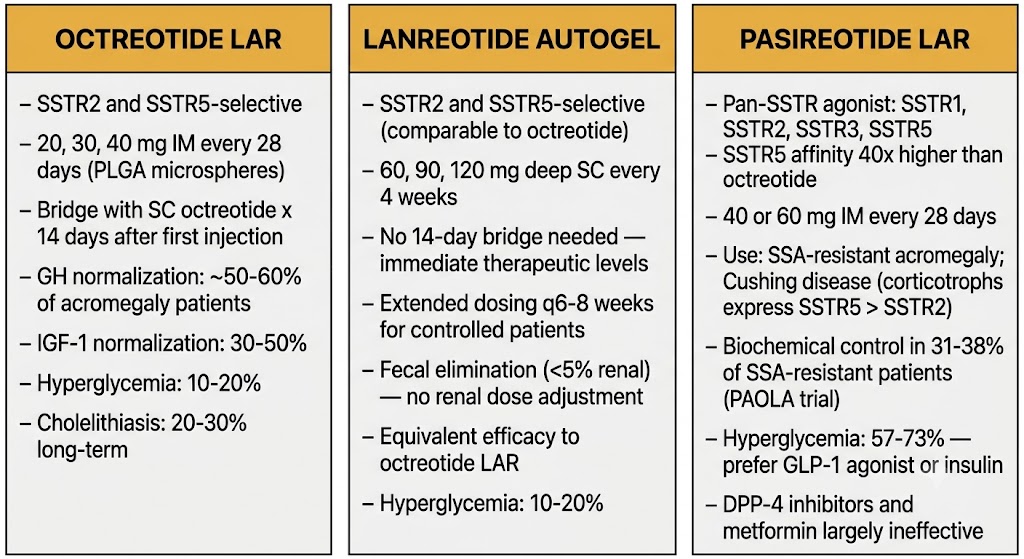
Three-panel comparison of octreotide LAR, lanreotide Autogel, and pasireotide LAR showing receptor selectivity, depot formulations, efficacy rates, and hyperglycemia risk.
Somatostatin analog comparison: SSTR2/5-selective agents versus pan-SSTR pasireotide — formulations, efficacy, and metabolic risk. Generated by Gemini AI.
Pasireotide Hyperglycemia: Why Standard Agents Underperform

Pasireotide suppresses insulin secretion (via somatostatin receptor subtype 5) and incretin release (glucagon-like peptide-1 and glucose-dependent insulinotropic polypeptide). Dipeptidyl peptidase-4 inhibitors work by enhancing incretin action — ineffective when incretins are suppressed at their source. Metformin reduces hepatic glucose output but does not restore the insulin secretory defect. Sodium-glucose cotransporter-2 inhibitors reduce glycosuria but do not address the underlying secretory failure. First-line choice: glucagon-like peptide-1 receptor agonist (exenatide, liraglutide) or insulin. Monitor fasting glucose and hemoglobin A1c at baseline, at 1 to 3 months, and every 6 months during pasireotide therapy.
Section 3
Growth Hormone-Releasing Hormone Analogs and Secretagogues
Sermorelin, tesamorelin, and macimorelin
Sermorelin and Tesamorelin

Sermorelin is a synthetic analog comprising the biologically active N-terminal 29 amino acids of native growth hormone-releasing hormone. Administered by daily subcutaneous injection, it stimulates pituitary somatotroph growth hormone-releasing hormone receptor and releases endogenous growth hormone in a physiological pulsatile pattern, preserving normal negative feedback. Because sermorelin acts upstream of the pituitary rather than replacing growth hormone directly, it requires an intact somatotroph pool and is ineffective in patients with primary pituitary disease or radiation-induced somatotroph destruction. Its primary use has been as a diagnostic provocative agent for growth hormone secretory reserve in children with suspected growth hormone deficiency; it has largely been supplanted in adults by direct growth hormone replacement (somatropin).

Tesamorelin is a growth hormone-releasing hormone analog in which the full 44-amino-acid native sequence is stabilized by conjugation with a trans-3-hexenoic acid group at the N-terminus, protecting the molecule from dipeptidyl peptidase-4 cleavage. It is approved for the reduction of excess visceral adipose tissue in human immunodeficiency virus-infected patients with antiretroviral therapy-associated lipodystrophy — a condition characterized by excessive central fat accumulation driven partly by suppressed endogenous growth hormone pulsatility from increased somatostatin tone. In pivotal trials, tesamorelin 2 milligrams subcutaneously daily reduced trunk fat by approximately 15 to 20% over 26 weeks with concurrent lipid improvements. Like sermorelin, it stimulates endogenous growth hormone release rather than replacing it, so insulin-like growth factor-1 rises modestly and glucose metabolism may worsen in patients with pre-existing insulin resistance. Tesamorelin is contraindicated in active malignancy owing to the growth-promoting effects of insulin-like growth factor-1 elevation.

Macimorelin

Macimorelin (Macrilen) is an orally bioavailable small molecule ghrelin receptor (growth hormone secretagogue receptor type 1a) agonist approved for the diagnosis of adult growth hormone deficiency. In the standard test, a single oral dose of 0.5 milligrams per kilogram (maximum 40 milligrams) is given after an overnight fast; peak growth hormone is measured at 30, 45, 60, and 90 minutes. A peak growth hormone below 2.8 nanograms per milliliter establishes the diagnosis of adult growth hormone deficiency. The sensitivity and specificity of macimorelin are comparable to those of the insulin tolerance test, which carries significant hypoglycemia risk; macimorelin provides a safer and more practical diagnostic alternative.

Macimorelin has a plasma half-life of approximately 4 hours and is metabolized by cytochrome P450 3A4. It is also a moderate inhibitor of P-glycoprotein. Strong cytochrome P450 3A4 inducers (rifampin, carbamazepine, phenytoin) reduce macimorelin exposure and can produce a falsely low growth hormone peak, increasing the rate of false-positive growth hormone deficiency diagnoses — these agents should be discontinued before testing. Corrected QT interval prolongation has been reported; a baseline electrocardiogram is recommended and the test should be avoided if the corrected QT interval exceeds 500 milliseconds.

Macimorelin vs. Insulin Tolerance Test for Growth Hormone Deficiency Diagnosis

Insulin tolerance test: induces hypoglycemia (glucose below 40 milligrams per deciliter) as the stimulus; peak growth hormone below 3 nanograms per milliliter = growth hormone deficiency. Contraindicated in seizure disorders, cardiovascular disease, and age above 55 years. Macimorelin test: oral, no hypoglycemia risk; peak growth hormone below 2.8 nanograms per milliliter = growth hormone deficiency; comparable sensitivity and specificity. Interference: avoid strong cytochrome P450 3A4 inducers and QT-prolonging agents before testing. Baseline electrocardiogram required. The cutoff value is assay-method dependent.


Section 4
Growth Hormone Replacement: Somatropin
Recombinant growth hormone — pharmacokinetics, dosing, adverse effects, and drug interactions
Pharmacokinetics and Dosing

Somatropin is recombinant human growth hormone, a 191-amino acid polypeptide produced by recombinant deoxyribonucleic acid technology. All approved formulations are administered parenterally — nearly exclusively by daily subcutaneous injection — because growth hormone is a peptide that undergoes gastrointestinal hydrolysis. Subcutaneous bioavailability is approximately 70 to 90%, with peak plasma concentrations at 3 to 5 hours and a plasma elimination half-life of approximately 2 to 4 hours. Growth hormone exerts sustained biological effects through insulin-like growth factor-1 induction (half-life 12 to 15 hours in circulation), providing the pharmacodynamic basis for once-daily dosing despite the short growth hormone half-life.

Adult growth hormone deficiency dosing follows weight-independent titration: starting doses of 0.2 to 0.3 milligrams subcutaneously daily in younger adults and 0.1 to 0.2 milligrams daily in older patients or those with diabetes, titrated upward by 0.1 to 0.2 milligram increments every 4 to 8 weeks based on serum insulin-like growth factor-1 response and tolerability. The therapeutic target is insulin-like growth factor-1 in the upper half of the age- and sex-adjusted normal range. Pediatric dosing for growth failure is weight-based (0.025 to 0.05 milligrams per kilogram per day subcutaneously), adjusted by linear growth velocity and bone age.

Adverse Effects and Drug Interactions

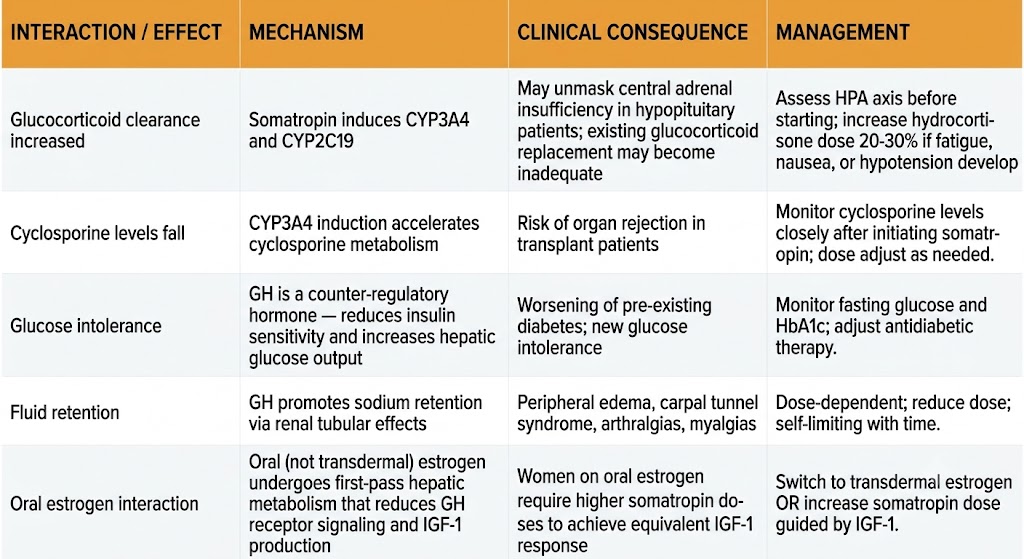
The most common and dose-related early adverse effect is fluid retention: growth hormone promotes sodium retention via renal tubular effects, producing peripheral edema, carpal tunnel syndrome (median nerve compression from synovial swelling), arthralgias, and myalgias. These are generally dose-dependent and resolve with dose reduction. Glucose intolerance and worsening of pre-existing diabetes mellitus are important metabolic adverse effects, because growth hormone is a counter-regulatory hormone that reduces insulin sensitivity and promotes hepatic glucose output. Somatropin is contraindicated in active malignancy and in patients with acute critical illness (associated with increased mortality in pivotal studies).

Somatropin has two clinically important drug interactions mediated by its induction of cytochrome P450 enzyme expression. First, growth hormone replacement significantly increases cytochrome P450 3A4 and cytochrome P450 2C19 activity, accelerating glucocorticoid metabolism. This can unmask previously subclinical central adrenal insufficiency or render existing glucocorticoid replacement doses inadequate in panhypopituitary patients — potentially precipitating adrenal crisis. Before starting growth hormone replacement, the hypothalamic-pituitary-adrenal axis should be assessed and glucocorticoid replacement confirmed as adequate. Second, somatropin accelerates cyclosporine metabolism by cytochrome P450 3A4 induction, reducing cyclosporine plasma levels and risking organ rejection in transplant patients. Monitoring of glucocorticoid adequacy and cyclosporine levels is mandatory when initiating somatropin.

Growth Hormone Replacement and Hidden Adrenal Insufficiency

Panhypopituitary patients on growth hormone replacement frequently have concurrent central adrenal insufficiency. Growth hormone accelerates cortisol clearance via cytochrome P450 3A4 induction; initiating growth hormone in a patient on a borderline hydrocortisone replacement dose may unmask insufficiency. Before starting: assess the hypothalamic-pituitary-adrenal axis; confirm glucocorticoid replacement is adequate. After starting: watch for fatigue, nausea, weight loss, or hypotension in the first weeks. Adjust hydrocortisone dose upward by 20 to 30% if needed. This interaction does not apply in patients with normal adrenal function.


Section 5
Pegvisomant: Growth Hormone Receptor Antagonism
Mechanism distinct from somatostatin analogs, insulin-like growth factor-1 as the sole monitoring marker, and hepatotoxicity surveillance
Mechanism and Monitoring

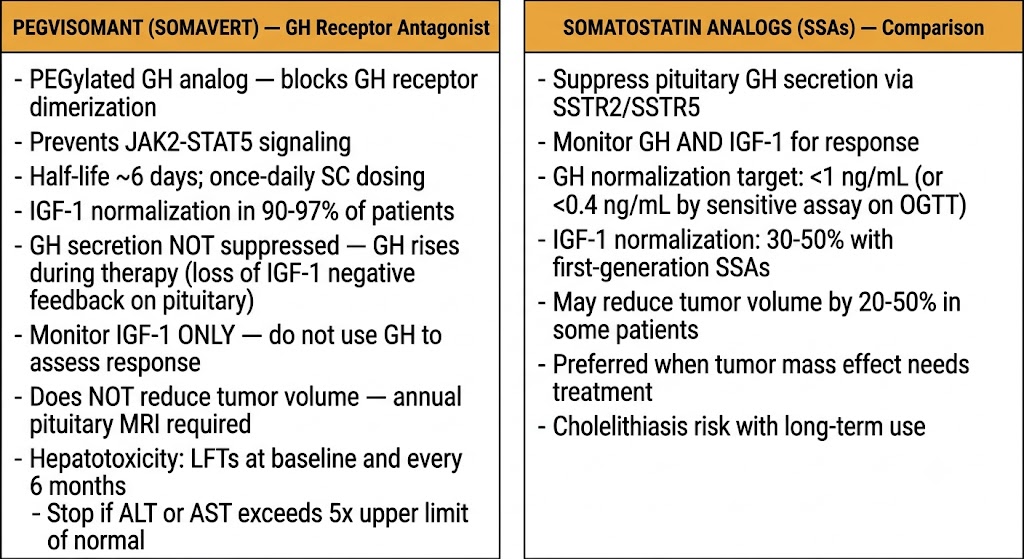
Pegvisomant (Somavert) is a genetically engineered growth hormone receptor antagonist derived from native growth hormone but modified with amino acid substitutions that prevent receptor dimerization and signal transduction while preserving high-affinity receptor binding. Native growth hormone activates its receptor by binding a single growth hormone receptor molecule, inducing dimerization of two receptor subunits and initiating downstream Janus kinase 2 and signal transducer and activator of transcription 5 signaling. Pegvisomant competes with endogenous growth hormone for receptor binding but once bound prevents productive dimerization and downstream signaling. The molecule is conjugated with polyethylene glycol chains (PEGylated) to reduce immunogenicity and extend the elimination half-life to approximately 6 days, enabling once-daily or every-other-day subcutaneous dosing.

Because pegvisomant acts peripherally at the growth hormone receptor and does not suppress pituitary growth hormone secretion, serum growth hormone is not a useful monitoring marker — in fact, growth hormone levels typically rise during pegvisomant therapy because insulin-like growth factor-1 suppression removes negative feedback on the pituitary. Serum insulin-like growth factor-1 is the sole reliable monitoring marker for treatment response and dose titration. The starting dose is 40 to 80 milligrams subcutaneously daily, titrated based on monthly insulin-like growth factor-1 measurements, with a target in the age- and sex-adjusted normal range. Insulin-like growth factor-1 normalization is achieved in 90 to 97% of patients at therapeutic doses — substantially higher than the 30 to 50% normalization rates achieved with somatostatin analogs alone. The principal limitation of pegvisomant monotherapy is that it does not reduce pituitary tumor volume, in contrast to somatostatin analogs, which can produce tumor shrinkage of 20 to 50% in some patients.

Hepatotoxicity and Combination Therapy

Hepatotoxicity is the most important safety concern with pegvisomant. Clinically significant elevations of alanine aminotransferase and aspartate aminotransferase occur in approximately 5 to 8% of patients, with rare cases of serious hepatotoxicity requiring drug discontinuation. Liver function tests must be measured at baseline and every 6 months during therapy. Any elevation of aspartate aminotransferase or alanine aminotransferase exceeding three times the upper limit of normal requires more frequent monitoring; an elevation exceeding five times the upper limit of normal requires drug discontinuation pending investigation. In patients with inadequate insulin-like growth factor-1 control on somatostatin analog monotherapy, combination of somatostatin analog plus pegvisomant achieves superior biochemical control while the somatostatin analog component may continue to modestly limit tumor growth.

Two-panel comparison of pegvisomant and somatostatin analogs showing mechanism, monitoring markers, tumor volume effects, and hepatotoxicity surveillance requirements.
Pegvisomant versus somatostatin analogs: key differences in mechanism, monitoring, and tumor volume management. Generated by Gemini AI.
Pegvisomant Monitoring: The Key Distinction from Somatostatin Analogs

Somatostatin analog monitoring: serum growth hormone (target below 1 nanogram per milliliter random, or below 0.4 nanogram per milliliter nadir on oral glucose tolerance test) AND serum insulin-like growth factor-1 (age- and sex-adjusted normal range). Pegvisomant monitoring: serum insulin-like growth factor-1 only — serum growth hormone is not informative and should not be used. Growth hormone rises during pegvisomant therapy due to loss of negative feedback; a rising growth hormone does not indicate treatment failure. Also required: liver function tests at baseline then every 6 months, and pituitary magnetic resonance imaging annually (tumor growth is not prevented by pegvisomant).


Section 6
Drug Interactions, Adverse Effects, and Monitoring Framework
Somatostatin analog dose titration, acromegaly treatment algorithm, and growth hormone deficiency surveillance
Somatostatin Analog Drug Interactions

The most clinically significant drug interaction common to all somatostatin analogs is suppression of insulin and glucagon secretion, which alters glycemic responses to antidiabetic agents unpredictably. In diabetic patients receiving somatostatin analogs, glucose monitoring in the first weeks of initiation or dose escalation is essential. Somatostatin analogs also reduce cyclosporine absorption from the gastrointestinal tract by inhibiting intestinal motility and secretion; cyclosporine levels should be monitored after somatostatin analog initiation in transplant recipients. All somatostatin analogs inhibit gallbladder contractility by suppressing cholecystokinin release; symptomatic cholelithiasis develops in approximately 20 to 30% of patients on long-term therapy, though only 1 to 2% require cholecystectomy.

The interaction between somatropin and glucocorticoids is bidirectional. Growth hormone replacement induces cytochrome P450 3A4, increasing glucocorticoid clearance and potentially unmasking adrenal insufficiency as described in Section 4. In the opposite direction, pharmacological glucocorticoid doses suppress insulin-like growth factor-1 production at the hepatic level and blunt the anabolic response to growth hormone replacement, so patients on anti-inflammatory glucocorticoid doses may show attenuated insulin-like growth factor-1 responses to somatropin. Additionally, women on oral estrogen require higher somatropin doses than women on transdermal estrogen or men, because oral (but not transdermal) estrogen undergoes first-pass hepatic metabolism that reduces growth hormone receptor signaling and insulin-like growth factor-1 production.

Acromegaly Treatment Algorithm

Transsphenoidal surgery is first-line for all resectable tumors. For residual or recurrent disease, first-generation somatostatin analogs (octreotide long-acting release or lanreotide Autogel) are started at the lowest available dose and uptitrated every 3 months based on random serum growth hormone (target below 1 nanogram per milliliter) and age- and sex-adjusted insulin-like growth factor-1. If full-dose first-generation somatostatin analog fails to normalize both markers, three options exist: switch to pasireotide long-acting release (superior efficacy but greater hyperglycemia risk); add pegvisomant to the somatostatin analog for combined biochemical control when insulin-like growth factor-1 alone remains elevated; or add cabergoline to the somatostatin analog if serum prolactin is also elevated (suggesting co-secreting tumor with dopamine type 2 receptor expression, where cabergoline monotherapy achieves insulin-like growth factor-1 normalization in approximately 10 to 15% of acromegaly patients). Radiotherapy is reserved for aggressive or multiple drug-refractory tumors; its effect on growth hormone and insulin-like growth factor-1 may take years.

Reference table of somatropin drug interactions and adverse effects covering glucocorticoid clearance, cyclosporine levels, glucose intolerance, fluid retention, and oral estrogen interaction with mechanisms and management.
Somatropin drug interactions and adverse effects: mechanisms, clinical consequences, and management. Generated by Gemini AI.
Acromegaly Treatment Algorithm: Clinical Decision Points

Step 1: Transsphenoidal surgery (first-line for all resectable tumors). Step 2 (residual or recurrent disease): first-generation somatostatin analog — octreotide long-acting release or lanreotide Autogel, uptitrate to maximum dose over 6 to 12 months. Step 3 (inadequate somatostatin analog control): switch to pasireotide long-acting release if both growth hormone and insulin-like growth factor-1 remain elevated and hyperglycemia risk is acceptable; add pegvisomant to somatostatin analog when insulin-like growth factor-1 alone remains elevated; add cabergoline to somatostatin analog if prolactin is co-elevated. Step 4 (pegvisomant monotherapy): use when somatostatin analogs are not tolerated or ineffective; monitor insulin-like growth factor-1 only, not growth hormone; pituitary magnetic resonance imaging annually.


Suggested References
Author / Organization Title Source
Giustina A, Veldhuis JD Pathophysiology of the neuroregulation of growth hormone secretion in experimental animals and the human Endocr Rev. 1998;19(6):717–797
Patel YC Somatostatin and its receptor family Front Neuroendocrinol. 1999;20(3):157–198
Kojima M, Hosoda H, Date Y, Nakazato M, Matsuo H, Kangawa K Ghrelin is a growth-hormone-releasing acylated peptide from stomach Nature. 1999;402(6762):656–660
Melmed S Acromegaly pathogenesis and treatment J Clin Invest. 2009;119(11):3189–3202
Freda PU Somatostatin analogs in acromegaly J Clin Endocrinol Metab. 2002;87(7):3013–3018
Gadelha MR, Bronstein MD, Brue T, et al; PAOLA study investigators Pasireotide versus continued treatment with octreotide or lanreotide in patients with inadequately controlled acromegaly (PAOLA): a randomised, phase 3 trial Lancet Diabetes Endocrinol. 2014;2(11):875–884
Henry RR, Ciaraldi TP, Armstrong D, Burke P, Ligueros-Saylan M, Mudaliar S Hyperglycemia associated with pasireotide: results from a mechanistic study in healthy volunteers J Clin Endocrinol Metab. 2013;98(8):3446–3453
Falutz J, Allas S, Blot K, et al Metabolic effects of a growth hormone-releasing factor in patients with HIV N Engl J Med. 2007;357(23):2359–2370
Yuen KCJ, Biller BMK, Radovick S, et al American Association of Clinical Endocrinologists and American College of Endocrinology guidelines for management of growth hormone deficiency in adults and patients transitioning from pediatric to adult care Endocr Pract. 2019;25(Suppl 2):1–44
Molitch ME, Clemmons DR, Malozowski S, Merriam GR, Vance ML; Endocrine Society Evaluation and treatment of adult growth hormone deficiency: an Endocrine Society clinical practice guideline J Clin Endocrinol Metab. 2011;96(6):1587–1609
Trainer PJ, Drake WM, Katznelson L, et al Treatment of acromegaly with the growth hormone-receptor antagonist pegvisomant N Engl J Med. 2000;342(16):1171–1177
van der Lely AJ, Hutson RK, Trainer PJ, et al Long-term treatment of acromegaly with pegvisomant, a growth hormone receptor antagonist Lancet. 2001;358(9295):1754–1759
Giustina A, Chanson P, Bronstein MD, et al; Acromegaly Consensus Group A consensus on criteria for cure of acromegaly J Clin Endocrinol Metab. 2010;95(7):3141–3148
Abs R, Verhelst J, Maiter D, et al Cabergoline in the treatment of acromegaly: a study in 64 patients J Clin Endocrinol Metab. 1998;83(2):374–378
↑ Top