Prolactinomas account for approximately 40% of all pituitary adenomas and are the most common cause of non-physiological hyperprolactinemia in adults. Lactotroph adenoma cells retain dopamine type 2 receptor expression in most cases, enabling dopamine agonists to recapitulate the tonic inhibitory signal that is lost when the tumor mass compresses the pituitary stalk and interrupts portal dopamine delivery. Beyond suppressing prolactin secretion, dopamine agonists produce direct antiproliferative effects on lactotroph adenoma cells through sustained dopamine type 2 receptor activation, leading to measurable tumor volume reduction in 80 to 90% of patients and normalization of tumor size in many cases with prolonged treatment.
The clinical goals of dopamine agonist therapy are fourfold: normalization of serum prolactin, restoration of gonadal function (resumption of menses and restoration of fertility in women; recovery of testosterone and sexual function in men), tumor volume reduction to relieve mass effect on the optic chiasm and adjacent structures, and prevention of hypogonadism-related bone loss. In microadenomas (diameter below 10 millimeters), dopamine agonist monotherapy achieves prolactin normalization in 85 to 95% of patients. In macroprolactinomas (diameter 10 millimeters or above), prolactin lowering is similarly effective but cure after drug withdrawal is less common and treatment durations are longer. Surgical resection is reserved for patients intolerant of or resistant to dopamine agonists, or who require acute decompression for apoplexy or progressive visual field loss.
Dopamine agonist resistance — failure to normalize prolactin or achieve at least 50% tumor volume reduction at maximally tolerated doses — occurs in approximately 10 to 15% of patients receiving cabergoline and in a higher proportion receiving bromocriptine. Resistance is more common with larger, more invasive tumors that have reduced dopamine type 2 receptor expression. For resistant prolactinomas, surgical resection or temozolomide (for aggressive or malignant pituitary adenomas) may be required.
A clinically important diagnostic pitfall with very large macroprolactinomas is the hook effect: extremely high prolactin concentrations saturate both the capture and detection antibodies in standard immunometric assays, preventing signal formation and producing a falsely low or even normal prolactin result. A large pituitary mass found with normal or only minimally elevated prolactin should prompt serial dilution (1:100) of the serum to unmask true prolactin concentration.
A large pituitary mass with a normal or minimally elevated prolactin on standard assay may represent a macroprolactinoma causing hook effect rather than a non-functioning adenoma. Clinical rule: always request a 1:100 serum dilution when a large pituitary mass is found with an unexpectedly low prolactin. Values that normalize or paradoxically fall further on dilution confirm hook effect and indicate dopamine agonist therapy rather than surgery as the first-line approach.
Cabergoline is an ergot-derived dopamine type 2 receptor agonist with significantly higher dopamine type 2 receptor affinity and selectivity than bromocriptine and a substantially longer elimination half-life of approximately 63 to 68 hours, enabling twice-weekly oral dosing. Typical starting dose is 0.25 milligrams twice weekly, titrated upward by 0.25 to 0.5 milligram increments every 4 weeks based on serum prolactin response; most patients achieve normoprolactinemia at 1 milligram per week or less, with an effective dose range of 0.5 to 2 milligrams per week. Cabergoline undergoes extensive first-pass hepatic metabolism primarily via cytochrome P450 3A4, with predominantly fecal elimination. Drug interactions are modest: strong cytochrome P450 3A4 inhibitors (azole antifungals, macrolide antibiotics) can increase cabergoline levels, and dopamine antagonists (antipsychotics, metoclopramide) pharmacodynamically oppose its prolactin-lowering effect.
The most important long-term safety consideration for cabergoline is cardiac valvulopathy — fibrotic thickening of cardiac valve leaflets, predominantly tricuspid and mitral, with regurgitation. This was first described in Parkinson disease patients receiving high cumulative doses (3 to 6 milligrams per day), far exceeding prolactinoma doses. At typical prolactinoma doses (0.5 to 3.5 milligrams per week), large clinical series have not demonstrated significantly elevated risk of clinically significant valve disease compared with the general population. However, baseline echocardiography is recommended before starting cabergoline and periodic surveillance is appropriate, particularly when doses exceed 2 milligrams per week. The valvulopathy risk is mediated by cabergoline's agonist activity at serotonin 5-hydroxytryptamine 2B receptors on cardiac valve fibroblasts — a non-dopaminergic effect unrelated to the therapeutic mechanism.
Drug withdrawal after sustained normoprolactinemia is an important management decision. Approximately 65 to 70% of patients who achieve sustained normoprolactinemia on cabergoline and have no visible tumor on magnetic resonance imaging remain normoprolactinemic at 1 year after withdrawal. Candidates for withdrawal include patients with normalized prolactin for at least 2 consecutive years and no visible tumor or at most minimal residual changes on magnetic resonance imaging. Recurrence rates reach approximately 30 to 35% within 1 year and up to 70% at 5 years; recurrence is managed by restarting cabergoline.
Bromocriptine is an older ergot dopamine agonist with a shorter half-life (approximately 6 to 8 hours) requiring twice or three times daily oral dosing, and with substantially higher rates of nausea, vomiting, orthostatic hypotension, and nasal stuffiness than cabergoline. Despite inferior tolerability, bromocriptine retains two important advantages. First, it has the longest and largest safety record in pregnancy — over four decades of data with reassuring first-trimester exposure outcomes. Current practice in many centers is to switch women planning pregnancy from cabergoline to bromocriptine before conception, or to discontinue dopamine agonists entirely once pregnancy is confirmed in patients with microadenomas. Second, bromocriptine is substantially less expensive than cabergoline, an important consideration in resource-limited settings. Rare but serious adverse effects with long-term high-dose bromocriptine use include pleuropulmonary fibrosis and retroperitoneal fibrosis.
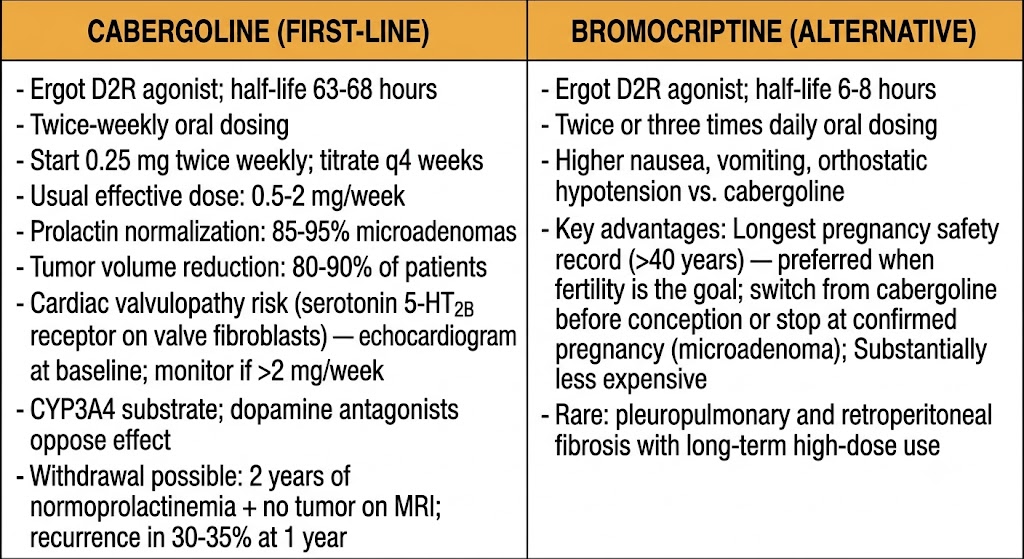
Candidates: prolactin normalized for at least 2 consecutive years; magnetic resonance imaging shows no visible tumor or minimal residual changes; no history of macroprolactinoma with significant suprasellar extension. Taper cabergoline over 2 to 4 months rather than abrupt discontinuation. Monitor prolactin at 1, 3, and 6 months post-withdrawal, then annually. Recurrence rates: approximately 30 to 35% within 1 year, up to 70% at 5 years. Macroprolactinoma or persistent tumor on magnetic resonance imaging: higher recurrence risk, usually requires indefinite therapy. Pregnancy planning complicates withdrawal timing and should be coordinated with endocrinology and obstetrics.
Cushing disease results from autonomous adrenocorticotropic hormone hypersecretion by a corticotroph pituitary adenoma, driving bilateral adrenocortical hyperplasia and sustained cortisol excess. Transsphenoidal resection achieves biochemical remission in approximately 70 to 80% of microadenomas and 40 to 50% of macroadenomas in experienced centers. Pharmacotherapy is used for pre-surgical cortisol lowering to reduce operative risk, management of persistent or recurrent disease after surgery, and palliation in patients who are not surgical candidates. Drug classes operate at four levels: pituitary-directed agents reduce adrenocorticotropic hormone secretion; adrenal steroidogenesis inhibitors block cortisol biosynthesis; the glucocorticoid receptor antagonist mifepristone blocks cortisol action at the tissue level; and bilateral adrenalectomy remains an option for refractory disease.
Pasireotide is approved for Cushing disease, acting via somatostatin receptor subtype 5 activation on corticotroph adenoma cells (which express somatostatin receptor subtype 5 more than somatostatin receptor subtype 2) to suppress adrenocorticotropic hormone secretion. In the pivotal phase 3 trial, subcutaneous pasireotide 600 or 900 micrograms twice daily produced urinary free cortisol normalization in approximately 26 to 35% of patients at 6 months. A long-acting release formulation (40 or 60 milligrams intramuscularly monthly) produces comparable outcomes with monthly convenience. Hyperglycemia occurs in over 70% of Cushing disease patients on pasireotide — particularly high because these patients already carry cortisol-driven metabolic risk — and is managed with glucagon-like peptide-1 receptor agonists or insulin as preferred agents.
Cabergoline suppresses adrenocorticotropic hormone in some corticotroph adenomas via dopamine type 2 receptor activation. Published series report urinary free cortisol normalization with cabergoline monotherapy in approximately 25 to 40% of Cushing disease patients, though sustained long-term control is often incomplete or lost within 12 to 24 months due to developing resistance. Cabergoline is most useful as a bridge therapy while awaiting surgery or radiation effect, or in combination with a steroidogenesis inhibitor. Doses used for Cushing disease are higher than those for prolactinoma (typically 1 to 7 milligrams per week), making the cardiac valvulopathy concern more relevant; baseline echocardiography is recommended before starting cabergoline above 2 milligrams per week.
All effective treatments for Cushing disease carry risk of adrenal insufficiency as cortisol falls from supraphysiological to normal or below-normal levels. Patients accustomed to cortisol excess may become symptomatic (fatigue, nausea, hypotension, hyponatremia) even when biochemical values are still within the low-normal range. Teach patients to recognize adrenal insufficiency symptoms and provide a stress-dose hydrocortisone prescription (20 milligrams orally at illness onset; 100 milligrams intramuscularly or intravenously for vomiting or emergency). Urinary free cortisol monitoring must account for concurrent hydrocortisone supplementation, which suppresses the assay.
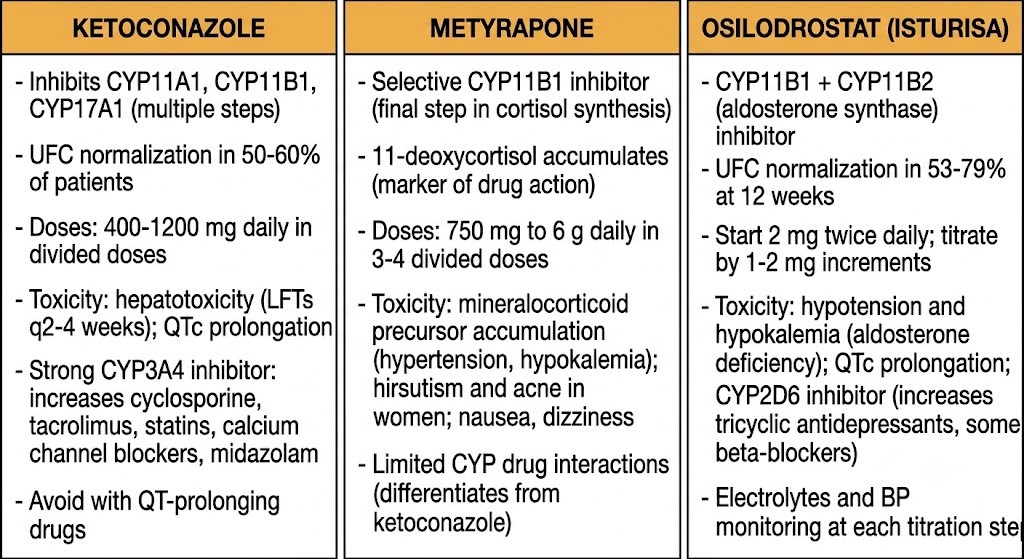
Ketoconazole is an imidazole antifungal that inhibits multiple adrenal cytochrome P450 enzymes — principally cytochrome P450 11A1 (cholesterol side-chain cleavage), cytochrome P450 11B1 (11-beta-hydroxylase), and cytochrome P450 17A1 (17-alpha-hydroxylase/17,20-lyase) — collectively reducing cortisol biosynthesis across multiple steps. It reduces urinary free cortisol in 50 to 60% of patients with Cushing disease at doses of 400 to 1,200 milligrams daily in divided doses. The principal clinical liabilities are hepatotoxicity (elevated liver enzymes in up to 20% of patients; severe hepatotoxicity in up to 3%), corrected QT interval prolongation via potassium channel (hERG channel) inhibition, and potent cytochrome P450 3A4 inhibition producing numerous drug interactions — dramatically increasing plasma concentrations of cyclosporine, tacrolimus, statins, calcium channel blockers, midazolam, and many others. Liver function test monitoring every 2 to 4 weeks during initiation and monthly thereafter is required.
Metyrapone is a selective inhibitor of cytochrome P450 11B1 (11-beta-hydroxylase), blocking the final step in cortisol synthesis. The upstream intermediate 11-deoxycortisol accumulates and is measurable as a surrogate marker of drug action. Oral bioavailability exceeds 80%, with peak effect within 2 hours. Usual dosing is 750 milligrams to 6 grams daily in three to four divided doses, titrated to normalize urinary free cortisol. Because the block is proximal to cytochrome P450 11B2 (aldosterone synthase), mineralocorticoid precursors accumulate, particularly 11-deoxycorticosterone, which can cause hypokalemia and hypertension. Additional adverse effects include hirsutism and acne in women (from androgenic precursor accumulation driven by increased adrenocorticotropic hormone stimulation above the block), nausea, dizziness, and headache. Metyrapone has limited significant cytochrome P450 drug interactions, differentiating it from ketoconazole.
Osilodrostat (Isturisa) is a newer oral cytochrome P450 11B1 inhibitor with additional cytochrome P450 11B2 (aldosterone synthase) inhibitory activity, approved for Cushing disease. Phase 3 trials demonstrated urinary free cortisol normalization in approximately 53 to 79% of patients at 12 weeks. Dosing starts at 2 milligrams twice daily, titrated upward by 1 to 2 milligram increments based on urinary free cortisol. Unlike metyrapone, osilodrostat also inhibits aldosterone synthesis, which can cause hypotension and hypokalemia through aldosterone deficiency; electrolyte and blood pressure monitoring is essential at each dose titration. Osilodrostat is metabolized by cytochrome P450 3A4 and is a moderate inhibitor of cytochrome P450 2D6, which can increase plasma concentrations of tricyclic antidepressants and certain beta-blockers. Corrected QT interval prolongation occurs at therapeutic doses and requires electrocardiogram monitoring.
Mitotane (o,p'-DDD) is an adrenolytic agent derived from the insecticide DDT that produces selective destruction of the adrenal cortex through cytotoxic mechanisms (formation of reactive acyl chloride intermediates that alkylate adrenocortical cell proteins), in addition to inhibiting multiple steroidogenic enzymes. Indicated primarily for adrenocortical carcinoma, it is also used in refractory Cushing disease. Administered orally in doses of 2 to 6 grams daily in three to four divided doses with fatty food (which substantially increases absorption). The effective plasma concentration range is 14 to 20 milligrams per liter and plasma level monitoring is required. Mitotane is a potent inducer of cytochrome P450 3A4 and cytochrome P450 2B6, accelerating metabolism of warfarin (requiring dose increases of 50% or more), glucocorticoids (requiring doubled or tripled replacement doses), and oral contraceptives. Because mitotane produces adrenal destruction, all patients require lifelong glucocorticoid and mineralocorticoid replacement therapy. Neurotoxic adverse effects at therapeutic concentrations include cerebellar ataxia, cognitive impairment, somnolence, and confusion.
Ketoconazole: strong cytochrome P450 3A4 inhibitor; dramatically increases cyclosporine, tacrolimus, statins, and many others; corrected QT interval prolongation. Avoid with other QT-prolonging drugs. Liver function tests every 2 to 4 weeks initially.
Osilodrostat: cytochrome P450 3A4 substrate; moderate cytochrome P450 2D6 inhibitor (increases tricyclic antidepressants, some beta-blockers). Corrected QT interval monitoring required. Electrolytes and blood pressure at each titration step.
Metyrapone: limited cytochrome P450 interactions; monitor for mineralocorticoid precursor-driven hypertension and hypokalemia; nausea common.
Mitotane: potent cytochrome P450 3A4 and cytochrome P450 2B6 inducer; warfarin doses must be substantially increased; glucocorticoid replacement doses must be doubled or tripled; oral contraceptive efficacy impaired. All steroidogenesis inhibitors share adrenal insufficiency risk — stress-dose hydrocortisone protocol and injectable hydrocortisone are essential.
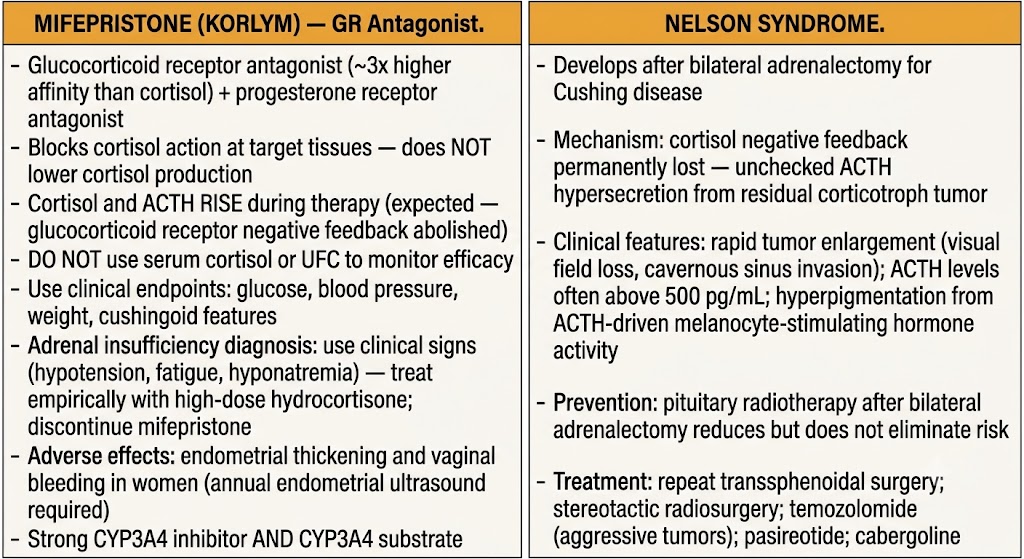
Mifepristone (Korlym) is a synthetic antiprogestin and glucocorticoid receptor antagonist approved for management of hyperglycemia in adults with Cushing syndrome who have failed surgery or are not surgical candidates. It binds the glucocorticoid receptor with approximately threefold higher affinity than cortisol and blocks glucocorticoid signaling at target tissues, reducing the metabolic and clinical manifestations of cortisol excess without reducing cortisol production itself. Because mifepristone does not lower cortisol production, serum cortisol and adrenocorticotropic hormone levels actually rise during therapy as hypothalamic and pituitary negative feedback is blocked. This is a critical monitoring point: cortisol and urinary free cortisol cannot be used to assess treatment adequacy or to diagnose adrenal insufficiency in patients on mifepristone. Clinical endpoints — blood glucose, blood pressure, weight, and cushingoid features — are used instead.
Mifepristone is also a potent progesterone receptor antagonist, driving its most limiting adverse effects: endometrial thickening, vaginal bleeding, and endometrial hyperplasia in women on estrogen; these require gynecological monitoring including annual endometrial ultrasound in all women. Mifepristone is extensively metabolized by cytochrome P450 3A4; strong cytochrome P450 3A4 inhibitors substantially increase mifepristone exposure and are contraindicated or require dose reduction. Mifepristone is itself a strong cytochrome P450 3A4 inhibitor at clinical doses, increasing the exposure of numerous co-administered drugs.
Nelson syndrome is the development of an aggressive, invasive adrenocorticotropic hormone-secreting corticotroph adenoma following bilateral adrenalectomy performed for refractory Cushing disease. When the adrenal glands are removed, cortisol production ceases and hypothalamic-pituitary negative feedback is permanently lost, driving unopposed adrenocorticotropic hormone hypersecretion from the residual corticotroph tumor. Without cortisol feedback the tumor can enlarge rapidly, producing visual field loss, cavernous sinus invasion, and extremely high adrenocorticotropic hormone levels (often above 500 picograms per milliliter). Hyperpigmentation from adrenocorticotropic hormone-driven melanocyte-stimulating hormone activity is a clinical hallmark. Pituitary radiotherapy administered after bilateral adrenalectomy before Nelson syndrome develops reduces but does not eliminate the risk. Once established, management options include repeat transsphenoidal surgery, stereotactic radiosurgery, temozolomide for aggressive tumors, and medical therapy including pasireotide and cabergoline.
Cortisol and adrenocorticotropic hormone rise during mifepristone therapy because glucocorticoid receptor blockade eliminates hypothalamic-pituitary negative feedback. A rising cortisol does not indicate treatment failure — it is the expected pharmacodynamic response. Do not use serum cortisol or urinary free cortisol to monitor mifepristone efficacy. Use clinical endpoints: glucose control, blood pressure, weight, and cushingoid features. For adrenal insufficiency diagnosis on mifepristone: use clinical signs (hypotension, fatigue, hyponatremia) rather than cortisol levels; treat empirically with high-dose hydrocortisone if clinically suspected, then discontinue mifepristone to restore normal feedback. Annual endometrial ultrasound required in all women.
Serum prolactin is measured every 3 months during cabergoline dose titration, then every 6 to 12 months once stable. Pituitary magnetic resonance imaging is performed every 1 to 2 years during active medical therapy (more frequently for macroprolactinomas during initial treatment). Gonadal function assessment — testosterone in men, menstrual regularity and estradiol in women — confirms resolution of hypogonadism. Bone mineral density by dual-energy X-ray absorptiometry is appropriate at baseline in patients with established hypogonadism, as hyperprolactinemia-driven sex steroid deficiency causes bone loss that reverses with successful treatment. Echocardiography is recommended at baseline before cabergoline initiation, particularly when doses are expected to exceed 2 milligrams per week.
Urinary free cortisol or late-night salivary cortisol is measured every 4 to 6 weeks during steroidogenesis inhibitor dose titration to guide dosing and detect over-treatment (adrenal insufficiency). Liver function tests are required every 2 to 4 weeks for ketoconazole during initiation, then monthly. Electrolytes (potassium and sodium) and blood pressure are monitored at each visit for all steroidogenesis inhibitors, with particular attention to hypokalemia (metyrapone, due to mineralocorticoid precursor accumulation) and to both hypokalemia and hypotension (osilodrostat, due to aldosterone synthase inhibition). Hemoglobin A1c and fasting glucose are monitored closely for pasireotide. Electrocardiogram is required for ketoconazole and osilodrostat. Pituitary magnetic resonance imaging every 6 to 12 months in active Cushing disease tracks tumor behavior during medical management. For all patients on steroidogenesis inhibitors: regular assessment of adrenal insufficiency symptoms and confirmation that stress-dose hydrocortisone prescription and injectable hydrocortisone are available.
Cabergoline (prolactinoma): prolactin every 3 months during titration, then q6–12 months; magnetic resonance imaging q1–2 years; echocardiogram at baseline and periodically if dose exceeds 2 milligrams per week.
Pasireotide (Cushing disease): urinary free cortisol q4–6 weeks during titration; hemoglobin A1c and fasting glucose at baseline, 1 to 3 months, then q6 months; magnetic resonance imaging q6–12 months.
Ketoconazole: urinary free cortisol q4–6 weeks; liver function tests q2–4 weeks initially then monthly; electrocardiogram; avoid QT-prolonging drugs.
Osilodrostat: urinary free cortisol; electrolytes and blood pressure at each titration; electrocardiogram; cytochrome P450 2D6 drug interactions (tricyclic antidepressants, beta-blockers).
Mifepristone: clinical endpoints only (glucose, blood pressure, weight); cortisol and urinary free cortisol are not informative; annual endometrial ultrasound in women.
Mitotane: plasma mitotane level (target 14–20 milligrams per liter); warfarin international normalized ratio q2 weeks until new stable dose; lifelong glucocorticoid and mineralocorticoid replacement; neurotoxicity assessment.
| Author / Organization | Title | Source |
|---|---|---|
| Melmed S, Casanueva FF, Hoffman AR, et al; Endocrine Society | Diagnosis and treatment of hyperprolactinemia: an Endocrine Society clinical practice guideline | J Clin Endocrinol Metab. 2011;96(2):273–288 |
| Casanueva FF, Molitch ME, Schlechte JA, et al | Guidelines of the Pituitary Society for the diagnosis and management of prolactinomas | Clin Endocrinol (Oxf). 2006;65(2):265–273 |
| Webster J, Piscitelli G, Polli A, Ferrari CI, Ismail I, Scanlon MF | A comparison of cabergoline and bromocriptine in the treatment of hyperprolactinemic amenorrhea | N Engl J Med. 1994;331(14):904–909 |
| Colao A, Di Sarno A, Cappabianca P, Di Somma C, Pivonello R, Lombardi G | Withdrawal of long-term cabergoline therapy for tumoral and nontumoral hyperprolactinemia | N Engl J Med. 2003;349(21):2023–2033 |
| Molitch ME | Pharmacologic resistance in prolactinoma patients | Pituitary. 2005;8(1):43–52 |
| Abs R, Verhelst J, Maiter D, et al | Cabergoline in the treatment of acromegaly: a study in 64 patients | J Clin Endocrinol Metab. 1998;83(2):374–378 |
| Gadelha MR, Bronstein MD, Brue T, et al; PAOLA study investigators | Pasireotide versus continued treatment with octreotide or lanreotide in patients with inadequately controlled acromegaly (PAOLA): a randomised, phase 3 trial | Lancet Diabetes Endocrinol. 2014;2(11):875–884 |
| Nieman LK, Biller BMK, Findling JW, et al; Endocrine Society | Treatment of Cushing's syndrome: an Endocrine Society clinical practice guideline | J Clin Endocrinol Metab. 2015;100(8):2807–2831 |
| Colao A, Petersenn S, Newell-Price J, et al; Pasireotide B2305 Study Group | A 12-month phase 3 study of pasireotide in Cushing's disease | N Engl J Med. 2012;366(10):914–924 |
| Pivonello R, De Martino MC, Cappabianca P, et al | The medical treatment of Cushing's disease: effectiveness of chronic treatment with the dopamine agonist cabergoline in patients unsuccessfully treated by surgery | J Clin Endocrinol Metab. 2009;94(1):223–230 |
| Castinetti F, Guignat L, Giraud P, et al | Ketoconazole in Cushing's disease: is it worth a try? | J Clin Endocrinol Metab. 2014;99(5):1623–1630 |
| Fleseriu M, Pivonello R, Young J, et al | Osilodrostat, a potent oral 11β-hydroxylase inhibitor: 22-week, prospective, phase II study in Cushing's disease | Pituitary. 2016;19(2):138–148 |
| Terzolo M, Angeli A, Fassnacht M, et al | Adjuvant mitotane treatment for adrenocortical carcinoma | N Engl J Med. 2007;356(23):2372–2380 |
| Fleseriu M, Biller BMK, Findling JW, Molitch ME, Schteingart DE, Gross C; SEISMIC Study Investigators | Mifepristone, a glucocorticoid receptor antagonist, produces clinical and metabolic benefits in patients with Cushing's syndrome | J Clin Endocrinol Metab. 2012;97(6):2039–2049 |
| Barber TM, Adams E, Ansorge O, Byrne JV, Karavitaki N, Wass JA | Nelson's syndrome | Eur J Endocrinol. 2010;163(4):495–507 |