Janus kinase (JAK) inhibitors are oral small molecules that interrupt cytokine signaling at the intracellular level by blocking the ATP-binding site of one or more JAK family members. Because more than fifty cytokines and growth factors converge on the JAK-STAT pathway, a single JAK inhibitor can simultaneously suppress multiple upstream inflammatory signals — an approach uniquely powerful but also uniquely consequential for safety.
The four JAK family members each associate constitutively with specific cytokine receptor subunits, so their inhibition profiles determine which cytokines are suppressed. JAK3 pairs exclusively with the common gamma chain (CD132), shared by the receptors for interleukin-2, interleukin-4, interleukin-7, interleukin-9, interleukin-15, and interleukin-21 — the entire common gamma chain cytokine family. JAK1 participates broadly: it pairs with the common gamma chain (alongside JAK3), with gp130 for interleukin-6 family signaling, and with type I and type II interferon receptors. JAK2 transduces signals from erythropoietin, thrombopoietin, growth hormone, granulocyte colony-stimulating factor, and interferon-gamma receptors, making it essential for hematopoiesis. TYK2 couples with receptors for interleukin-12, interleukin-23, and type I interferons.
The clinical consequence of JAK2 inhibition at therapeutic doses is suppression of erythropoietin and granulocyte colony-stimulating factor signaling, causing anemia and neutropenia — the primary hematological toxicities of JAK inhibitors that are more prominent with agents having stronger JAK2 activity.
Tofacitinib preferentially inhibits JAK1 and JAK3 and was the first JAK inhibitor approved (2012). It is approved for rheumatoid arthritis, psoriatic arthritis, ankylosing spondylitis, ulcerative colitis, and polyarticular juvenile idiopathic arthritis. Baricitinib preferentially inhibits JAK1 and JAK2; its approvals include rheumatoid arthritis, atopic dermatitis, and alopecia areata — for which it became the first approved systemic therapy, working by blocking JAK1/JAK2-mediated interferon-gamma and interleukin-15 signaling that drives autoimmune hair follicle destruction. Upadacitinib is the most selective JAK1 inhibitor in clinical use, with approximately 60-fold selectivity for JAK1 over JAK2, and carries the broadest indication set: rheumatoid arthritis, psoriatic arthritis, ankylosing spondylitis, atopic dermatitis, Crohn's disease, and ulcerative colitis. In the SELECT-COMPARE head-to-head trial in rheumatoid arthritis, upadacitinib 15 milligrams once daily was superior to adalimumab on ACR50 response rates at 26 weeks. Abrocitinib is a selective JAK1 inhibitor approved for moderate-to-severe atopic dermatitis; it produces rapid itch relief within days by blocking JAK1-dependent interleukin-31 signaling. Deucravacitinib selectively inhibits TYK2 through an allosteric mechanism distinct from all other JAK inhibitors and is covered in Section 2.
The ORAL Surveillance trial was a post-marketing safety study of tofacitinib conducted in patients with rheumatoid arthritis aged 50 or older with at least one cardiovascular risk factor, comparing tofacitinib 5 and 10 milligrams twice daily to a TNF inhibitor (adalimumab or etanercept). Results published in 2022 showed that tofacitinib failed non-inferiority for major adverse cardiovascular events (MACE) — defined as cardiovascular death, nonfatal myocardial infarction, and nonfatal stroke — compared to TNF inhibitors. Tofacitinib was also associated with higher rates of malignancy (particularly lung cancer and lymphoma), venous thromboembolism including deep vein thrombosis and pulmonary embolism, serious infections, and all-cause mortality.
The FDA responded with a class-wide black box warning applied to all approved JAK inhibitors covering: serious infections; malignancy; MACE; thrombosis; and mortality. JAK inhibitors are now restricted to use after TNF inhibitor failure in rheumatic indications (rheumatoid arthritis, psoriatic arthritis, ankylosing spondylitis), and guidelines recommend avoiding them in patients aged 65 or older, current or past smokers, those with established cardiovascular disease or prior malignancy, and those with prior venous thromboembolism — when alternatives exist. Herpes zoster reactivation is the most common infectious complication, occurring at two to four times the rate seen with biologic disease-modifying antirheumatic drugs; recombinant zoster vaccine (Shingrix) is strongly recommended before initiating any JAK inhibitor.
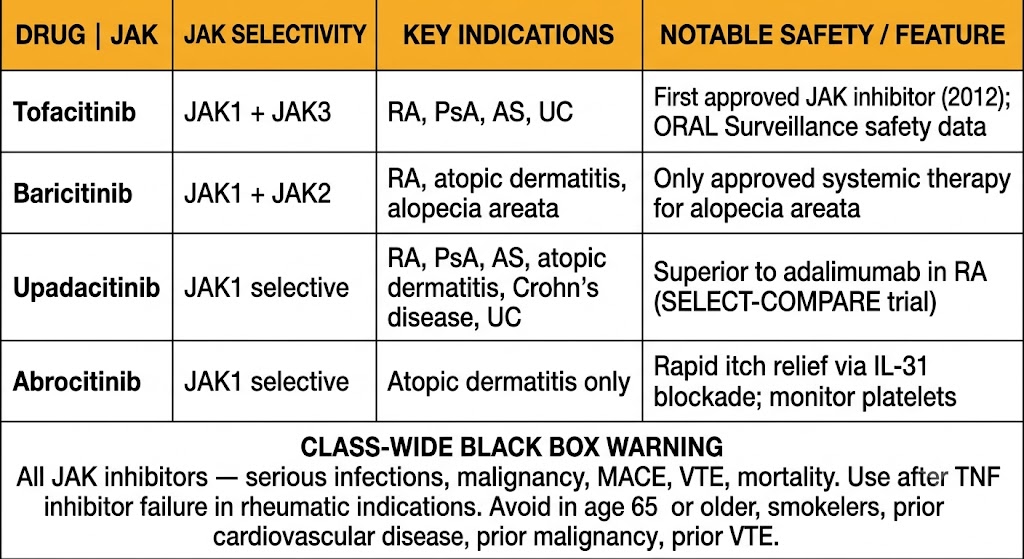
Based on ORAL Surveillance (tofacitinib vs. TNF inhibitor in high-cardiovascular-risk rheumatoid arthritis): serious infections including tuberculosis reactivation; malignancy including lung cancer and lymphoma; MACE (myocardial infarction, stroke, cardiovascular death); venous thromboembolism (deep vein thrombosis, pulmonary embolism); mortality. Restrict to use after TNF inhibitor failure in rheumatic indications. Avoid when possible in: age 65 or older, current or past smokers, established cardiovascular disease, prior malignancy, prior venous thromboembolism. Mandatory pre-treatment: TST or IGRA (tuberculosis), hepatitis B serology, complete blood count, fasting lipid panel. Shingrix strongly recommended before starting.
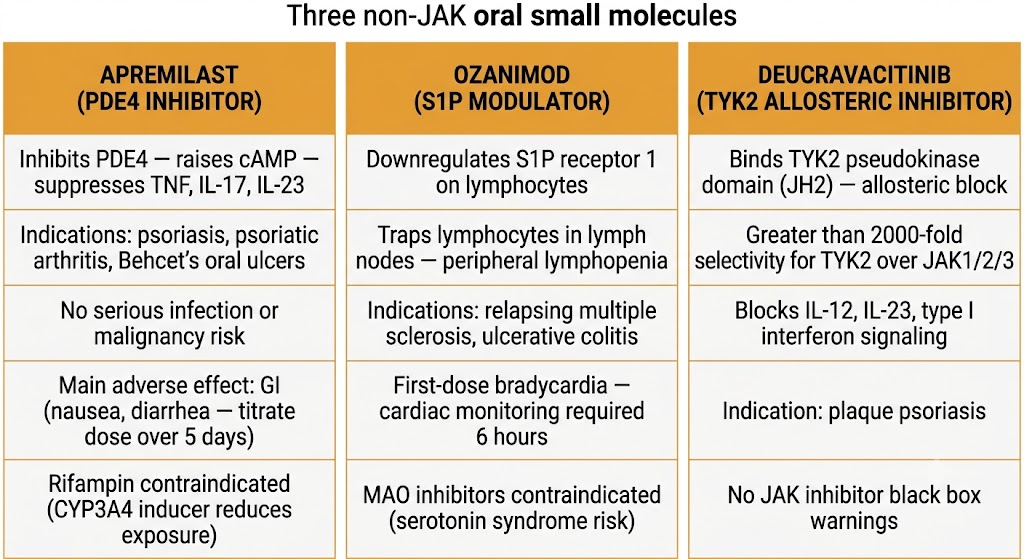
Several oral small molecules in immune-mediated disease act through mechanisms entirely distinct from JAK inhibition. These agents share the practical advantages of oral delivery and short half-lives but differ from JAK inhibitors in their mechanisms, safety profiles, and regulatory status — none carry the ORAL Surveillance-derived black box warnings.
Apremilast inhibits phosphodiesterase 4 (PDE4), the predominant phosphodiesterase isoenzyme in immune cells. PDE4 hydrolyzes cyclic AMP (cAMP) to inactive 5-AMP; its inhibition raises intracellular cAMP levels, activating protein kinase A and downstream pathways that suppress production of tumor necrosis factor-alpha, interleukin-17, interleukin-23, and interferon-gamma while increasing the anti-inflammatory cytokine interleukin-10. The mechanism produces anti-inflammatory but not broadly immunosuppressive effects. Apremilast is approved for moderate-to-severe plaque psoriasis, psoriatic arthritis, and oral ulcers associated with Behcet's disease. Its efficacy is more modest than biologics in psoriasis (PASI 75 response approximately 30 to 40% versus 60 to 80% for biologic agents) but it carries no serious infection, malignancy, or cardiovascular risk signals. The main adverse effects are gastrointestinal — nausea and diarrhea in up to 30% of patients in the first four to six weeks, managed with a five-day dose titration schedule at initiation. Apremilast is also metabolized by CYP3A4, so strong inducers such as rifampin reduce its exposure substantially and the combination is contraindicated.
Sphingosine-1-phosphate (S1P) is a bioactive lipid that maintains a plasma-to-lymph-node gradient driving lymphocyte egress from lymphoid organs into the bloodstream via S1P receptor 1 on lymphocyte surfaces. Ozanimod is a selective S1P receptor 1 and S1P receptor 5 modulator that causes internalization and downregulation of S1P receptor 1, functionally trapping mature lymphocytes within lymph nodes and Peyer's patches and thereby reducing lymphocyte trafficking to inflamed tissues. The resulting peripheral lymphopenia is dose-dependent and fully reversible upon discontinuation. Ozanimod is approved for relapsing multiple sclerosis and moderate-to-severe ulcerative colitis.
S1P modulators carry class-specific safety considerations. First-dose bradycardia and atrioventricular block can occur, requiring cardiac monitoring for at least six hours after the first dose in patients with pre-existing cardiac conduction abnormalities or concurrent antiarrhythmic use. Macular edema requires an ophthalmic examination before initiation and in any patient who develops visual symptoms. Coadministration with monoamine oxidase inhibitors is contraindicated due to risk of serotonin syndrome through ozanimod's active metabolites. Herpes zoster reactivation risk is increased and Shingrix vaccination is recommended before initiation.
Deucravacitinib represents a fundamentally distinct approach to JAK family inhibition. Rather than competing with ATP at the catalytic kinase domain (JH1) as conventional JAK inhibitors do, deucravacitinib binds the regulatory pseudokinase domain (JH2) of TYK2, stabilizing it in an autoinhibited conformation. The JH2 domains of the four JAK isoforms are substantially less conserved than their JH1 kinase domains, so this allosteric mechanism confers greater than 2,000-fold selectivity for TYK2 over JAK1, JAK2, and JAK3. By selectively inhibiting TYK2, deucravacitinib suppresses interleukin-12 and interleukin-23 signaling (driving Th1 and Th17 differentiation in psoriasis) and type I interferon signaling, without meaningfully affecting JAK1- or JAK2-dependent hematopoietic and metabolic functions. Deucravacitinib is approved for moderate-to-severe plaque psoriasis; in the POETYK PSO-1 and PSO-2 trials it achieved PASI 75 in approximately 58 to 62% of patients at week 16, significantly superior to apremilast, without the class-wide black box warnings of JAK inhibitors. It is positioned between apremilast and biologic agents for psoriasis and does not require prior TNF inhibitor failure.
Vedolizumab is a humanized monoclonal antibody — though administered parenterally, it is covered here because its gut-selective mechanism contrasts directly with the systemic oral agents used in inflammatory bowel disease. Vedolizumab blocks the alpha-4/beta-7 integrin heterodimer on lymphocytes, preventing binding to mucosal addressin cell adhesion molecule 1 on gut endothelium and selectively blocking lymphocyte trafficking into the gut lamina propria without affecting systemic lymphocyte migration. This gut-selective mechanism produces a favorable systemic safety profile with no meaningful systemic immunosuppression, no requirement for tuberculosis screening equivalent to TNF inhibitors, and no signals for increased malignancy or cardiovascular events. The trade-off is a slower onset of action — maximal benefit often not apparent until 12 to 14 weeks — making it less suitable when rapid response is needed. Vedolizumab is approved for moderate-to-severe ulcerative colitis and Crohn's disease and is preferred in older patients and those with prior malignancy or recurrent infections where systemic immunosuppression carries higher risk.
For treatment sequencing in ulcerative colitis, current guidelines position TNF inhibitors (infliximab, adalimumab, golimumab) or vedolizumab as first-line biologic options, with upadacitinib, tofacitinib, and ozanimod available after TNF inhibitor failure or for patients preferring oral therapy. Tofacitinib and upadacitinib act more rapidly than vedolizumab or ozanimod, making them preferred when urgency of response is high. In Crohn's disease, upadacitinib is the only approved JAK inhibitor; risankizumab and ustekinumab are biologic alternatives. Biologics and small molecules are not combined in clinical practice due to additive immunosuppression without established evidence of benefit.
Prefer oral small molecule: Patient declines injections; need rapid onset (hospitalized ulcerative colitis — tofacitinib or upadacitinib); preference for oral therapy. Prefer biologic over JAK inhibitor: Age 65 or older; high cardiovascular risk; personal history of malignancy; prior venous thromboembolism; heavy smoker; pregnancy planning (certolizumab pegol is preferred biologic). Prefer vedolizumab over JAK inhibitor in IBD: Older patients, prior malignancy, recurrent serious infections, or high cardiovascular risk — vedolizumab's gut-selective mechanism avoids systemic immunosuppression. Deucravacitinib niche: Psoriasis without the JAK inhibitor liability; oral alternative to interleukin-17 or interleukin-23 inhibitors; no prior TNF inhibitor failure required.
| Author / Organization | Title | Source |
|---|---|---|
| O'Shea JJ, Schwartz DM, Villarino AV, et al | The JAK-STAT pathway: impact on human disease and therapeutic intervention | Annu Rev Med. 2015;66:311-328 |
| Smolen JS, Genovese MC, Takeuchi T, et al | Safety profile of baricitinib in patients with active rheumatoid arthritis with over 2 years median time in treatment | J Rheumatol. 2019;46(1):7-18 |
| Fleischmann R, Pangan AL, Song IH, et al | Upadacitinib versus placebo or adalimumab in patients with rheumatoid arthritis and an inadequate response to methotrexate | Arthritis Rheumatol. 2019;71(11):1788-1800 |
| Ytterberg SR, Bhatt DL, Mikuls TR, et al | Cardiovascular and cancer risk with tofacitinib in rheumatoid arthritis | N Engl J Med. 2022;386(4):316-326 |
| Winthrop KL | The emerging safety profile of JAK inhibitors in rheumatic disease | Nat Rev Rheumatol. 2017;13(4):234-243 |
| Papp K, Reich K, Leonardi CL, et al | Apremilast, an oral phosphodiesterase 4 inhibitor, in patients with moderate to severe plaque psoriasis | J Am Acad Dermatol. 2015;73(1):37-49 |
| Sandborn WJ, Feagan BG, Wolf DC, et al | Ozanimod induction and maintenance treatment for ulcerative colitis | N Engl J Med. 2016;374(18):1754-1762 |
| Armstrong AW, Gooderham M, Warren RB, et al | Deucravacitinib versus placebo and apremilast in moderate to severe plaque psoriasis | J Am Acad Dermatol. 2023;88(1):29-39 |
| Feagan BG, Rutgeerts P, Sands BE, et al | Vedolizumab as induction and maintenance therapy for ulcerative colitis | N Engl J Med. 2013;369(8):699-710 |
| Sandborn WJ, Su C, Sands BE, et al | Tofacitinib as induction and maintenance therapy for ulcerative colitis | N Engl J Med. 2017;376(18):1723-1736 |
| Loftus EV Jr, Panes J, Lacerda AP, et al | Upadacitinib induction and maintenance therapy for Crohn's disease | N Engl J Med. 2023;388(21):1966-1980 |
| Vande Casteele N, Herfarth H, Katz J, Falck-Ytter Y, Singh S | American Gastroenterological Association Institute technical review on the role of therapeutic drug monitoring in the management of inflammatory bowel diseases | Gastroenterology. 2017;153(3):835-857 |