CHAPTER 13  ·  OPIOID PHARMACOLOGY

Section 1

Clinical Use of Opioid Analgesics

Acute pain, cancer pain, and the WHO analgesic ladder

Opioids are powerful analgesics but carry substantial risks. Rational prescribing requires matching the opioid agent, dose, route, and duration to the clinical context: acute pain, cancer pain, and chronic non-cancer pain each have different evidence bases, different risk-benefit profiles, and different guidelines governing appropriate opioid use.

Acute Pain

Opioids are appropriate for acute severe pain — postoperative pain, trauma, and pain from acute medical conditions such as renal colic — particularly when non-opioid analgesics are insufficient. The current standard is multimodal analgesia: combining opioids with acetaminophen, nonsteroidal anti-inflammatory drugs (when not contraindicated), and regional anesthetic techniques to achieve adequate pain control at lower individual doses of each agent. This approach reduces total opioid consumption and adverse effect burden compared to opioids as the sole analgesic.

For acute pain treated in the outpatient setting, prescriptions should be limited to the expected duration of severe pain — typically three to seven days — with specific instructions for tapering and guidance on safe disposal of unused medications. Overprescribing of acute opioids is a recognized entry point for long-term opioid use and opioid use disorder.

The World Health Organization Analgesic Ladder

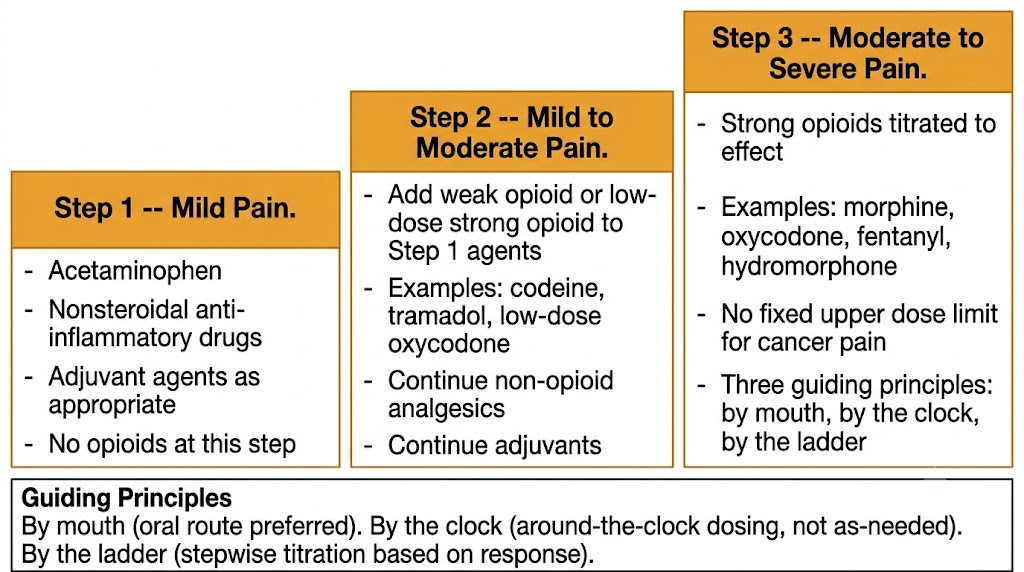
First published in 1986 for cancer pain management and subsequently applied broadly, the World Health Organization analgesic ladder organizes pain management in three steps based on pain severity. It provides a rational framework for analgesic selection and dose escalation.

Step 1

Mild Pain

  • Non-opioid analgesics
  • Acetaminophen
  • Nonsteroidal anti-inflammatory drugs
  • Adjuvant agents as appropriate

Step 2

Mild to Moderate Pain

  • Weak opioids or low-dose strong opioids
  • Added to non-opioid therapy from Step 1
  • Codeine, tramadol, low-dose oxycodone
  • Continue adjuvants

Step 3

Moderate to Severe Pain

  • Strong opioids titrated to effect
  • Morphine, oxycodone, fentanyl, hydromorphone
  • No fixed ceiling dose for cancer pain
  • Combined with non-opioids and adjuvants

The guiding principles of the World Health Organization ladder are often summarized as: by mouth (oral route preferred when possible), by the clock (around-the-clock dosing for persistent pain rather than as-needed dosing that allows pain to return before the next dose), and by the ladder (stepwise titration based on response). For cancer pain, there is no fixed upper dose limit — the appropriate dose is the lowest that provides adequate pain control with acceptable adverse effects.

Chronic Non-Cancer Pain

The role of opioids in chronic non-cancer pain — conditions such as chronic low back pain, fibromyalgia, and osteoarthritis — is substantially more limited and contested than their role in cancer pain. Long-term opioid therapy for chronic non-cancer pain carries risks of tolerance, physical dependence, opioid use disorder, and opioid-induced hyperalgesia that may outweigh the analgesic benefit, particularly when non-opioid alternatives (physical therapy, cognitive behavioral therapy, topical agents, antidepressants, anticonvulsants) have not been adequately tried. Current guidelines from the United States Centers for Disease Control and Prevention emphasize non-opioid therapies as first-line treatment for chronic pain and recommend reserving opioids for patients in whom the expected benefits outweigh risks, using the lowest effective dose and regularly reassessing the ongoing need.

Stepped ladder diagram showing the World Health Organization three-step analgesic ladder: Step 1 mild pain with non-opioids, Step 2 mild to moderate pain adding weak opioids, Step 3 moderate to severe pain with strong opioids, and a guiding principles box showing by mouth, by the clock, and by the ladder.

Figure 1. The World Health Organization analgesic ladder. Three steps guide analgesic selection based on pain severity, with strong opioids reserved for moderate to severe pain and no fixed dose ceiling for cancer pain. Figure generated by Gemini AI.


Section 2

Pharmacological Management of Opioid Use Disorder

Three approved medication approaches with distinct mechanisms and requirements

Opioid use disorder is a chronic neurobiological condition that responds to pharmacological treatment. Three medication classes are approved and supported by strong evidence: full mu agonist maintenance (methadone), partial mu agonist maintenance (buprenorphine), and opioid antagonist therapy (naltrexone). The choice between them depends on patient factors, clinical setting, and treatment goals. All three substantially reduce illicit opioid use, overdose deaths, and the harms associated with untreated opioid use disorder.

Methadone Maintenance

Methadone maintenance therapy uses daily oral methadone to eliminate withdrawal symptoms and opioid cravings through stable mu receptor occupancy. Because methadone is a full mu agonist, it satisfies the neuroadaptive state of physical dependence without producing the rapid peaks and troughs of short-acting illicit opioids. Its long half-life (24 to 36 hours) allows once-daily dosing and provides a stable pharmacological platform that reduces drug-seeking behavior.

In the United States, methadone for opioid use disorder can only be dispensed through federally licensed opioid treatment programs — specialized clinics with required counseling services and regulatory oversight. Patients typically attend the clinic daily for observed dosing initially, earning take-home doses as they demonstrate stability. This setting requirement distinguishes methadone from buprenorphine in terms of accessibility. Key monitoring requirements include electrocardiogram monitoring for QTc prolongation, particularly at higher doses and when methadone is combined with other medications that prolong the QTc interval.

Buprenorphine and Buprenorphine/Naloxone

Buprenorphine's partial mu agonism, ceiling effect on respiratory depression, and long duration of action make it well suited for opioid use disorder maintenance. As reviewed in Module 4, the combination product buprenorphine/naloxone (Suboxone) is the most commonly used formulation — taken sublingually, the naloxone component is minimally absorbed and does not interfere with buprenorphine's therapeutic effect, but deters injection misuse.

A landmark regulatory change removed the requirement for a special federal waiver (the Drug Addiction Treatment Act waiver) for prescribing buprenorphine for opioid use disorder. Any physician, nurse practitioner, or physician assistant with a standard Drug Enforcement Administration registration can now prescribe buprenorphine for opioid use disorder in an office-based setting. This change substantially increased access to treatment, particularly in primary care and rural settings where specialized addiction clinics were unavailable. Safe induction requires the patient to be in mild to moderate spontaneous withdrawal before the first dose, as reviewed in Module 4.

Extended-Release Naltrexone

Monthly extended-release injectable naltrexone blocks the rewarding effects of any opioid use during the treatment period. It has no abuse potential and no physical dependence liability. Its primary challenge is the requirement for complete opioid detoxification before initiation — a minimum of 7 to 10 days off short-acting opioids and longer for methadone. Patients who relapse to opioid use during the detoxification period before the first injection are at high risk, and the detoxification period itself carries elevated overdose risk. Once the injection is administered, the monthly formulation removes the daily adherence decision and is preferred over oral naltrexone for most patients.

Extended-release naltrexone is also approved for alcohol use disorder, making it an option for patients with co-occurring opioid and alcohol use disorders.

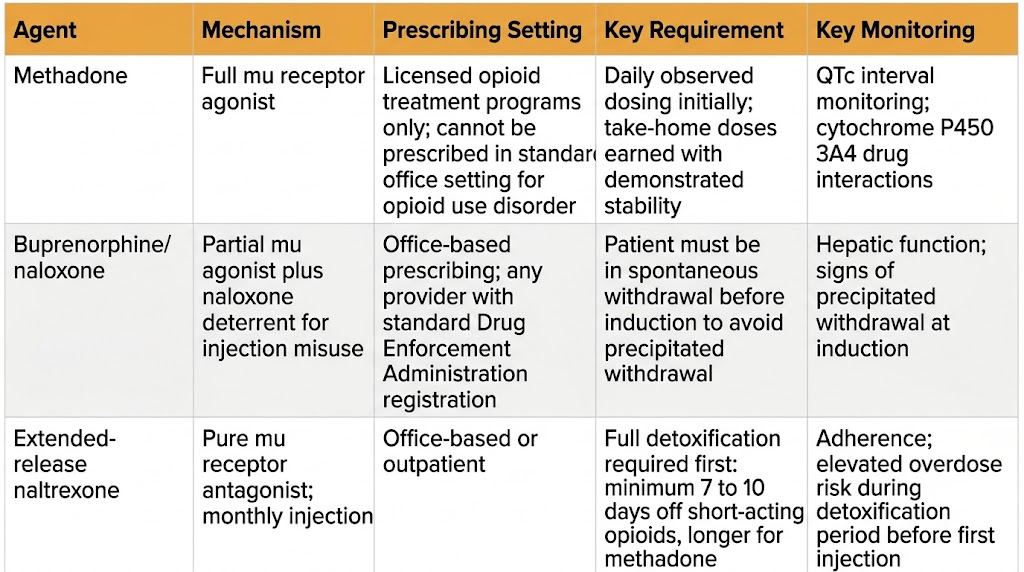
Medications for Opioid Use Disorder

Methadone

  • Full mu agonist
  • Once-daily oral dosing
  • Only through licensed opioid treatment programs
  • Monitor QTc interval
  • Long half-life: accumulation risk during initiation

Medications for Opioid Use Disorder

Buprenorphine/Naloxone

  • Partial mu agonist plus naloxone deterrent
  • Office-based prescribing — no waiver required
  • Sublingual daily dosing
  • Induction requires patient in spontaneous withdrawal
  • Long-acting injectable formulation available

Medications for Opioid Use Disorder

Extended-Release Naltrexone

  • Pure mu antagonist
  • Monthly intramuscular injection
  • Requires full detoxification first (7–10 days minimum)
  • No abuse potential or physical dependence
  • Also approved for alcohol use disorder
Reference table comparing the three medications for opioid use disorder: methadone as full mu agonist through licensed opioid treatment programs with QTc monitoring, buprenorphine/naloxone as partial mu agonist for office-based prescribing requiring spontaneous withdrawal before induction, and extended-release naltrexone as pure mu antagonist requiring full detoxification first.

Figure 2. The three approved medications for opioid use disorder compared across mechanism, prescribing setting, key requirements, and monitoring. Each has distinct access requirements and clinical prerequisites. Figure generated by Gemini AI.


Section 3

Opioids in Special Populations

Renal impairment, hepatic disease, elderly patients, and pregnancy

Several patient populations require specific modifications to opioid selection, dosing, or monitoring because of altered pharmacokinetics, heightened sensitivity to adverse effects, or unique clinical risks. These are high-yield clinical distinctions that appear frequently on examinations and in clinical practice.

Renal Impairment

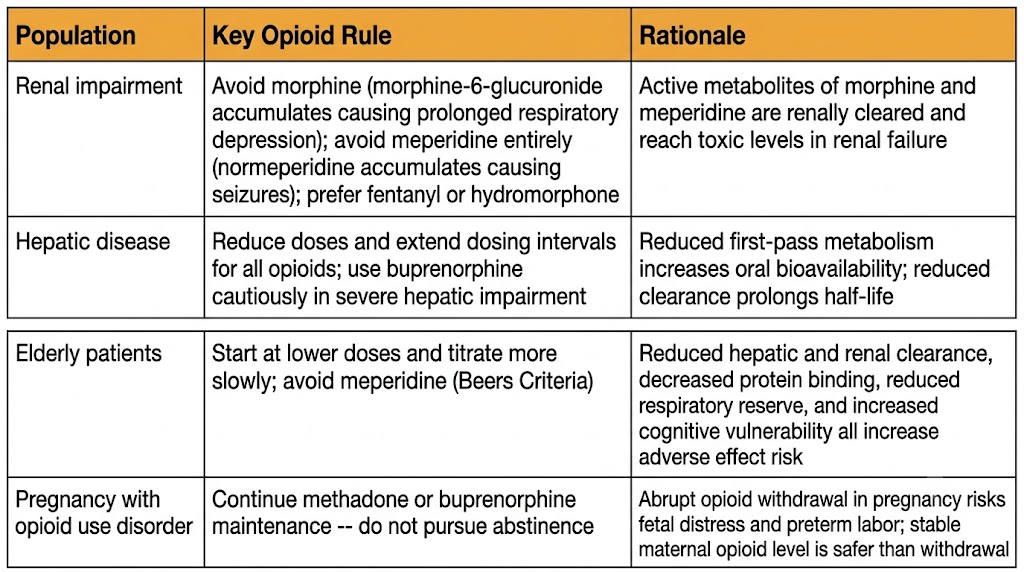
The most clinically important opioid consideration in renal impairment is the accumulation of active and neuroexcitatory metabolites that are renally cleared. Morphine should be used with caution or avoided in significant renal impairment because morphine-6-glucuronide accumulates and causes prolonged respiratory depression. Meperidine should be avoided entirely in renal impairment because normeperidine accumulates and causes seizures. Fentanyl and hydromorphone are generally preferred in renal impairment because their metabolites are less pharmacologically active and less likely to accumulate to toxic levels. Oxycodone requires dose reduction in renal impairment.

Hepatic Disease

Because virtually all opioids are hepatically metabolized, severe hepatic impairment reduces first-pass metabolism, slows clearance, and increases bioavailability of oral formulations. Dose reductions and extended dosing intervals are required. Buprenorphine undergoes extensive hepatic metabolism and should be used cautiously in patients with severe hepatic impairment; it is relatively contraindicated in patients with acute hepatitis or decompensated liver disease because of reports of hepatotoxicity at high doses. Methadone's complex pharmacokinetics are further complicated by hepatic disease.

Elderly Patients

Elderly patients are at heightened risk for opioid adverse effects for several reasons: reduced hepatic and renal clearance prolongs opioid half-lives; decreased protein binding increases free drug concentration; reduced respiratory reserve lowers the threshold for clinically significant respiratory depression; and age-related cognitive vulnerability increases the risk of opioid-induced delirium. The general principle is to start at lower doses and titrate more slowly in elderly patients. Meperidine is explicitly listed on the Beers Criteria of potentially inappropriate medications in older adults because of its neuroexcitatory metabolite normeperidine and should be avoided in this population.

Pregnancy and Neonatal Opioid Withdrawal Syndrome

All opioids cross the placenta and can produce neonatal respiratory depression at delivery, requiring neonatal monitoring and availability of naloxone. For pregnant women with opioid use disorder, methadone and buprenorphine maintenance are both recommended as preferred treatments — abrupt opioid withdrawal in pregnancy carries risks of fetal distress, preterm labor, and miscarriage that outweigh the risks of continued opioid maintenance. The goal is a stable maternal opioid level rather than abstinence.

Infants born to mothers maintained on opioids — or who used illicit opioids during pregnancy — will be physically dependent at birth and develop neonatal opioid withdrawal syndrome within 24 to 72 hours of delivery. The syndrome manifests as irritability, high-pitched crying, poor feeding, tremors, vomiting, diarrhea, and in severe cases seizures. Treatment involves supportive care and, when necessary, pharmacological management with oral morphine or methadone, with gradual weaning. Neonatal opioid withdrawal syndrome is not a contraindication to maternal opioid use disorder treatment — it is a manageable neonatal condition, and the risks of untreated maternal opioid use disorder are substantially greater.

Reference table showing opioid prescribing rules for four special populations: renal impairment requiring avoidance of morphine and meperidine, hepatic disease requiring dose reductions, elderly patients requiring lower starting doses and avoidance of meperidine per Beers Criteria, and pregnancy with opioid use disorder requiring continuation of methadone or buprenorphine maintenance.

Figure 3. Opioid prescribing rules for special populations. Metabolite accumulation in renal failure and fetal risk from maternal withdrawal are the two highest-yield clinical principles. Figure generated by Gemini AI.


Section 4

Opioid Stewardship

Responsible prescribing in the context of the opioid epidemic

Opioid stewardship refers to the systematic application of evidence-based practices to optimize opioid prescribing, minimize harm, and prevent diversion and misuse. Understanding its key components is expected of all clinicians who prescribe opioids.

Key Stewardship Practices

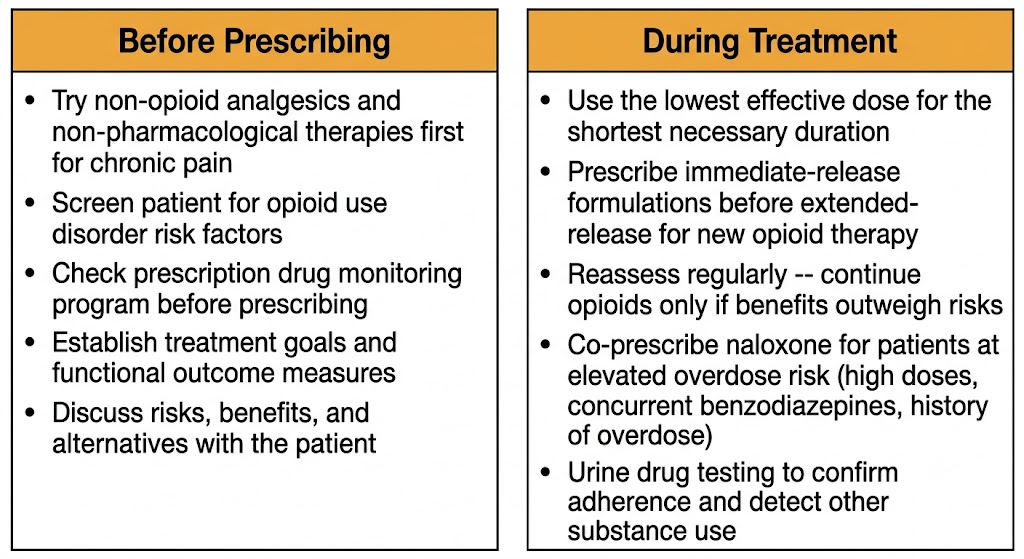
Before Prescribing

Assessment and Planning

  • Try non-opioid analgesics and non-pharmacological therapies first for chronic pain
  • Screen for opioid use disorder risk factors
  • Check prescription drug monitoring program before prescribing
  • Establish treatment goals and functional outcomes
  • Discuss risks, benefits, and alternatives with the patient

During Treatment

Monitoring and Adjustment

  • Use the lowest effective dose for the shortest necessary duration
  • Prescribe immediate-release formulations before extended-release for new opioid therapy
  • Reassess regularly — continue only if benefits outweigh risks
  • Urine drug testing to confirm adherence and detect other substance use
  • Co-prescribe naloxone for patients at elevated overdose risk
Naloxone Co-Prescribing

Co-prescribing naloxone alongside opioids for patients at elevated overdose risk is now standard of care in many clinical settings and is recommended by multiple professional organizations and national guidelines. High-risk groups include patients receiving high daily opioid doses, patients concurrently prescribed benzodiazepines or other central nervous system depressants, patients with history of overdose or substance use disorder, and patients with underlying respiratory disease. Intranasal naloxone spray is available for patient and bystander use without intravenous access, lowering the barrier to reversal in a community setting.

Chapter Summary: The Opioid Pharmacology Framework

Module 1 established the receptor pharmacology: mu, kappa, and delta receptors coupled to Gi/Go proteins, endogenous opioid peptides, and the distinction between tolerance, dependence, and addiction.

Module 2 covered the clinical pharmacology of opioid agonists: chemical families, pharmacokinetics, active metabolites, cytochrome P450 polymorphism, and individual drug profiles.

Module 3 addressed adverse effects, the overdose triad, and naloxone reversal — including the critical half-life mismatch that creates resedation risk.

Module 4 contrasted full agonists, partial agonists, mixed agonist-antagonists, and pure antagonists — with buprenorphine's ceiling effect and precipitated withdrawal risk as central concepts.

Module 5 translated the mechanistic foundation into clinical practice: the World Health Organization ladder, the three medications for opioid use disorder, special population considerations, and stewardship principles.
Two-panel stewardship diagram: Before Prescribing panel shows non-opioid alternatives first, risk screening, prescription drug monitoring program check, and patient discussion; During Treatment panel shows lowest effective dose, immediate-release before extended-release, regular reassessment, naloxone co-prescribing, and urine drug testing.

Figure 4. Opioid stewardship practices before and during prescribing. Naloxone co-prescribing for high-risk patients is now standard of care in many settings. Figure generated by Gemini AI.


Suggested References
Author / Organization Title Source
World Health Organization WHO guidelines for the pharmacological and radiotherapeutic management of cancer pain in adults and adolescents WHO. 2018
Dowell D, Haegerich TM, Chou R CDC guideline for prescribing opioids for chronic pain — United States, 2016 JAMA. 2016;315(15):1624–1645
Substance Abuse and Mental Health Services Administration Medications for Opioid Use Disorder: Treatment Improvement Protocol 63 SAMHSA. 2021
Mattick RP, Breen C, Kimber J, Davoli M Methadone maintenance therapy versus no opioid replacement therapy for opioid dependence Cochrane Database Syst Rev. 2009;(3):CD002209
Lee JD, Nunes EV, Novo P, et al. Comparative effectiveness of extended-release naltrexone versus buprenorphine-naloxone for opioid relapse prevention Lancet. 2018;391(10118):309–318
Patrick SW, Barfield WD, Poindexter BB Neonatal opioid withdrawal syndrome Pediatrics. 2020;146(5):e2020029074
Volkow ND, Frieden TR, Hyde PS, Cha SS Medication-assisted therapies — tackling the opioid-overdose epidemic N Engl J Med. 2014;370(22):2063–2066
American Geriatrics Society Beers Criteria Update Expert Panel American Geriatrics Society 2023 updated AGS Beers Criteria for potentially inappropriate medication use in older adults J Am Geriatr Soc. 2023;71(7):2052–2081