Introduction to Medical Pharmacology
Module 4 — Mixed Agonist-Antagonists, Partial Agonists, and Opioid Antagonists
Chapter 13 · Module 4 of 5Section 1
Ceiling effect, high receptor affinity, and precipitated withdrawal
Buprenorphine occupies a unique pharmacological niche among opioids. It is a partial agonist at the mu receptor and an antagonist at the kappa receptor, and these two properties together — combined with its unusually high receptor binding affinity — produce a clinical profile that is fundamentally different from full agonist opioids and that makes it valuable in both pain management and opioid use disorder treatment.
As a partial mu receptor agonist, buprenorphine activates the mu receptor but with submaximal intrinsic efficacy — it cannot produce the same degree of receptor activation as a full agonist even at saturating doses. This property creates a ceiling effect on respiratory depression: above a certain dose, increasing buprenorphine further does not produce additional respiratory suppression. This makes buprenorphine substantially safer than full agonist opioids in overdose, and it is the pharmacological basis for buprenorphine's favorable safety profile in opioid use disorder treatment compared to methadone.
The ceiling effect on respiratory depression does not mean a ceiling on analgesia at clinically used doses — buprenorphine produces meaningful analgesia across a wide dose range. However, patients who are fully tolerant to high doses of full agonist opioids may find buprenorphine's analgesic ceiling to be a limitation when it is used as the sole analgesic for severe pain.
Buprenorphine binds to the mu receptor with extremely high affinity — higher than morphine, oxycodone, fentanyl, or most other clinically used opioids. This means buprenorphine can displace full agonists that are already occupying mu receptors. In a patient who is physically dependent on a full agonist opioid, displacement of that agonist by buprenorphine removes the receptor activation that the patient's nervous system has come to require, immediately precipitating acute opioid withdrawal. This is called precipitated withdrawal, and it is more intense and more abrupt than the gradual withdrawal that occurs when an opioid wears off naturally.
Precipitated withdrawal is the primary reason that buprenorphine induction for opioid use disorder treatment requires careful timing. The patient must be in a state of mild to moderate spontaneous withdrawal — meaning the previously used full agonist has largely cleared from the receptors — before the first dose of buprenorphine is given. If buprenorphine is given while significant full agonist receptor occupancy remains, precipitated withdrawal will occur. Low Opioid Withdrawal Scale scores serve as a practical guide to safe induction timing.
In addition to partial mu agonism, buprenorphine is a kappa receptor antagonist. Kappa receptor activation produces dysphoria, so blocking kappa receptors has an antidysphoric and potentially antidepressant effect. This kappa antagonism is thought to contribute to buprenorphine's mood-stabilizing effects in opioid use disorder treatment, which go beyond simple suppression of withdrawal symptoms.
Buprenorphine is available in several formulations with different clinical applications. Sublingual and buccal films and tablets are used for both pain management and opioid use disorder treatment. The sublingual route bypasses first-pass hepatic metabolism, though bioavailability is variable. A combination product containing buprenorphine and naloxone (Suboxone) is the most widely used formulation for opioid use disorder treatment; the rationale for adding naloxone is discussed in Section 3. Long-acting injectable buprenorphine formulations provide monthly dosing for opioid use disorder treatment and improve adherence.
Precipitated Withdrawal: The Key Clinical Risk
Buprenorphine's high receptor affinity means it will displace full agonist opioids from mu receptors. If given to a physically dependent patient before the full agonist has adequately cleared, it precipitates severe acute withdrawal. This is not the same as natural withdrawal — it is immediate, intense, and can last hours. Safe induction requires the patient to be in mild to moderate spontaneous withdrawal before the first dose is administered.
Figure 1. The three defining properties of buprenorphine: partial mu agonism with ceiling effect on respiratory depression, very high receptor affinity enabling displacement of full agonists, and the resulting risk of precipitated withdrawal during induction. Figure generated by Gemini AI.
Section 2
Kappa agonism combined with mu antagonism or partial agonism
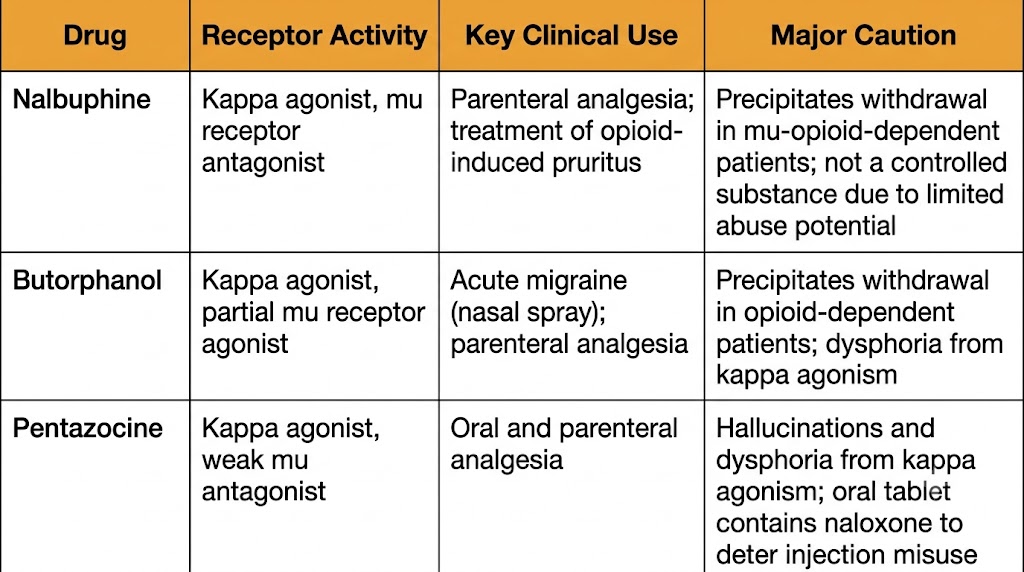
The mixed agonist-antagonist opioids — nalbuphine, butorphanol, and pentazocine — share a common pharmacological profile: they activate kappa receptors (producing spinal analgesia and sedation) while blocking or only partially activating mu receptors. This combination was originally developed with the hope of achieving analgesia without mu-mediated euphoria and addiction potential. The results were partially successful, but kappa agonism introduces its own adverse effect profile.
Nalbuphine is a kappa agonist and mu receptor antagonist. It produces analgesia through kappa receptor activation and has a ceiling effect on respiratory depression, similar to buprenorphine, though through a different mechanism. Because it blocks mu receptors, nalbuphine can precipitate withdrawal in patients who are physically dependent on full mu agonist opioids. It is used parenterally for moderate to severe pain and is sometimes used to treat opioid-induced pruritus because its mu antagonism partially reverses the centrally mediated itch without fully reversing analgesia. It is not a controlled substance in the United States due to its limited mu-mediated abuse potential.
Butorphanol is a kappa agonist and partial mu agonist. It is available as a nasal spray formulation in addition to injectable forms, making it useful for acute migraine treatment. Like nalbuphine, it can precipitate withdrawal in opioid-dependent patients. Butorphanol produces sedation and dysphoria through kappa agonism, which limits patient acceptance and repeat use.
Pentazocine is a kappa agonist and weak mu antagonist that was widely used before the current generation of mixed agonist-antagonists. It has significant psychotomimetic adverse effects — hallucinations, dysphoria, and bizarre ideation — from kappa agonism in limbic circuits, which has substantially reduced its clinical use. An oral formulation combined pentazocine with naloxone specifically to prevent intravenous misuse: when taken orally as intended, naloxone is not absorbed and does not interfere with pentazocine's analgesic effect; if injected, the naloxone blocks the opioid effect. This is the same rationale applied to the buprenorphine/naloxone combination used in opioid use disorder treatment.
Class Properties: Mixed Agonist-Antagonists
Analgesia: produced by kappa receptor agonism at spinal and supraspinal sites.
Dysphoria: also produced by kappa agonism in limbic circuits — an inherent liability of the class.
Precipitated withdrawal: all members can precipitate withdrawal in mu-opioid-dependent patients due to mu receptor antagonism or weak partial agonism.
Ceiling effect: limited respiratory depression compared to full mu agonists at equianalgesic doses.
Lower abuse potential than full mu agonists, but dependence does occur.
Figure 2. The three mixed agonist-antagonist opioids compared by receptor activity, clinical use, and major caution. All three can precipitate withdrawal in mu-opioid-dependent patients. Figure generated by Gemini AI.
Section 3
Naloxone and naltrexone: blocking the receptor without activating it
Pure opioid antagonists bind to mu, kappa, and delta receptors with high affinity but produce no receptor activation. They have no analgesic, euphoric, or respiratory depressant effects of their own. Their clinical utility derives entirely from their ability to block or reverse the effects of opioid agonists.
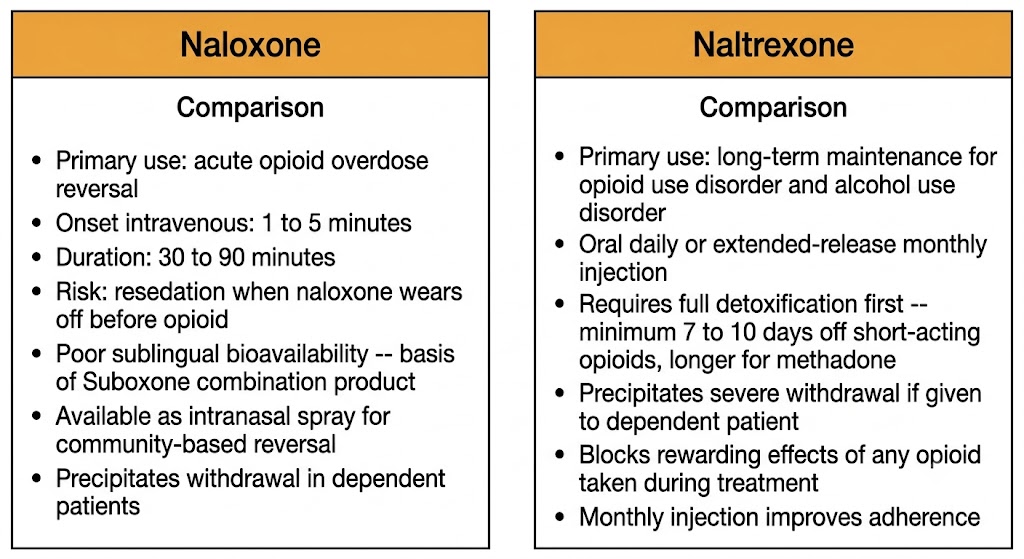
Naloxone is the primary agent for acute opioid overdose reversal, covered in detail in Module 3. Its key properties bear repeating in the context of this module: it is a pure competitive antagonist at mu, kappa, and delta receptors with rapid onset (1 to 5 minutes intravenously) and short duration (30 to 90 minutes). Its short duration relative to most opioids it reverses creates the risk of resedation.
The addition of naloxone to the buprenorphine/naloxone combination product (Suboxone) exploits naloxone's poor sublingual bioavailability. When Suboxone is taken sublingually as prescribed, the naloxone component is largely not absorbed and does not interfere with buprenorphine's therapeutic effect. If a person attempts to crush and inject the tablet, however, the naloxone is fully bioavailable via the intravenous route, precipitating immediate withdrawal in any opioid-dependent individual. This formulation strategy substantially reduces the diversion and injection misuse of buprenorphine.
Naltrexone is a pure opioid antagonist with a longer duration of action than naloxone, making it suitable for once-daily oral dosing or monthly extended-release injectable administration. Unlike naloxone, which is used primarily for acute overdose reversal, naltrexone is used for long-term maintenance treatment of both opioid use disorder and alcohol use disorder.
For opioid use disorder, naltrexone blocks the rewarding effects of any opioid taken on top of it, extinguishing the reinforcement that drives continued use. Its critical requirement is that the patient must be fully detoxified from opioids before starting naltrexone — typically a minimum of 7 to 10 days free of short-acting opioids and longer for methadone. If naltrexone is given to a patient with residual opioid dependence, it will precipitate severe withdrawal. There is no way to gradually introduce naltrexone as there is with buprenorphine induction.
Extended-release injectable naltrexone (given as a monthly intramuscular injection) substantially improves adherence compared to daily oral naltrexone, because the patient cannot choose to stop taking it on a day they want to use opioids. This formulation is preferred when patient engagement and adherence are concerns and when the patient has successfully completed detoxification.
Methylnaltrexone and naloxegol are peripherally restricted opioid antagonists designed to treat opioid-induced constipation without reversing central analgesia. They block peripheral mu receptors in the gut — restoring normal bowel motility — but do not cross the blood-brain barrier in meaningful amounts and therefore do not reverse the central analgesic or other central nervous system effects of opioids. These agents are used specifically for opioid-induced constipation in patients on chronic opioid therapy when standard laxatives have been insufficient.
Pure Antagonist
Naloxone
Pure Antagonist
Naltrexone
Figure 3. Naloxone versus naltrexone: two pure antagonists with different durations and clinical applications. Naloxone is for acute reversal; naltrexone is for long-term maintenance after full detoxification. Figure generated by Gemini AI.
Section 4
Full agonists, partial agonists, mixed agonist-antagonists, and pure antagonists side by side
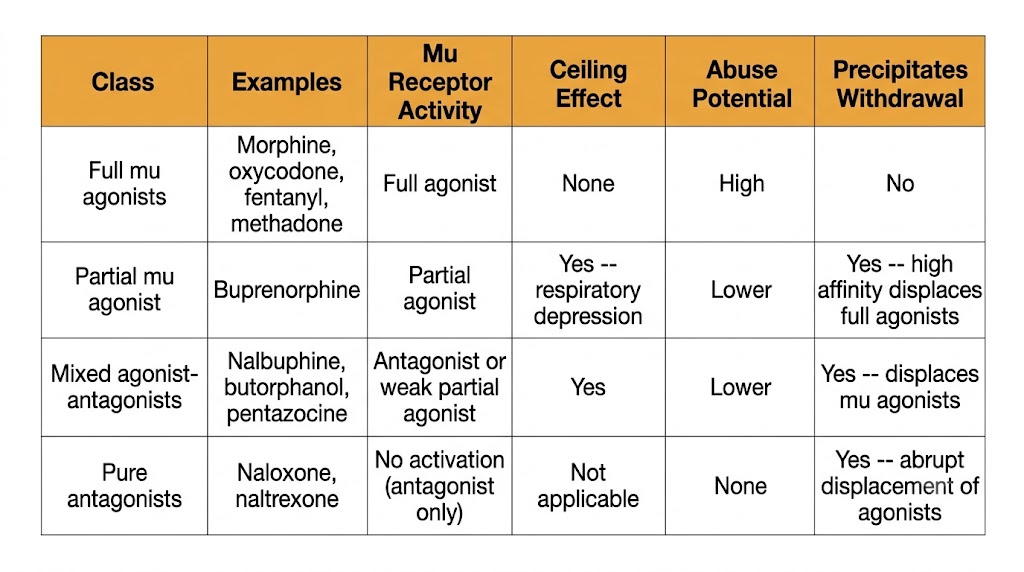
The distinctions between these drug classes are among the most frequently tested concepts in opioid pharmacology. The key differentiators are receptor activity, ceiling effects, abuse potential, and the risk of precipitated withdrawal.
A ceiling effect means that beyond a certain dose, increasing the drug further does not increase the response. Full mu agonists have no ceiling effect on either analgesia or respiratory depression — both increase proportionally with dose until death. Buprenorphine, as a partial mu agonist, has a ceiling effect on respiratory depression but not on analgesia at typical clinical doses. Mixed agonist-antagonists have a ceiling effect on both analgesia and respiratory depression through their limited mu activity. Pure antagonists produce no receptor activation — there is no dose-response relationship for pharmacological effect in the absence of an agonist.
Any drug that occupies mu receptors without fully activating them — whether a partial agonist like buprenorphine or an antagonist like naloxone or naltrexone — can precipitate withdrawal in a physically dependent patient by displacing the full agonist that was maintaining their neuroadaptive state. The intensity of precipitated withdrawal correlates with how rapidly and completely the full agonist is displaced, which is why drugs with very high mu receptor affinity (buprenorphine, naloxone) produce more abrupt and intense precipitated withdrawal than drugs with lower affinity.
High-Yield Summary: Four Drug Classes Compared
Full mu agonists (morphine, oxycodone, fentanyl, methadone): maximal analgesia, no ceiling on respiratory depression, high abuse potential, physical dependence with chronic use.
Partial mu agonist (buprenorphine): good analgesia, ceiling effect on respiratory depression, lower abuse potential, high receptor affinity means it displaces full agonists and precipitates withdrawal — timing of induction is critical.
Mixed agonist-antagonists (nalbuphine, butorphanol, pentazocine): kappa-mediated analgesia, ceiling on respiratory depression, dysphoria from kappa agonism, precipitate withdrawal in mu-dependent patients.
Pure antagonists (naloxone, naltrexone): no analgesia, no respiratory depression, block or reverse all opioid effects, precipitate withdrawal in dependent patients — naloxone for acute reversal, naltrexone for long-term maintenance.
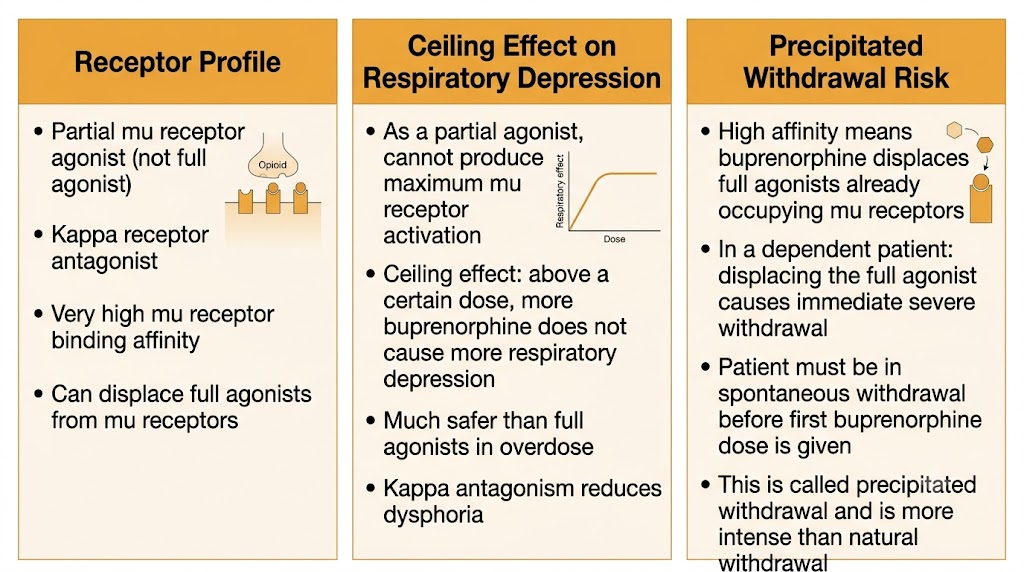
Figure 4. All four opioid drug classes compared across six pharmacological dimensions. The ceiling effect and precipitated withdrawal risk distinguish the non-full-agonist classes from full mu agonists. Figure generated by Gemini AI.
| Author / Organization | Title | Source |
|---|---|---|
| Lintzeris N, Nielsen S | Benzodiazepines, methadone and buprenorphine: interactions and clinical management | Am J Addict. 2010;19(1):59–74 |
| Comer SD, Sullivan MA, Yu E, et al. | Injectable, sustained-release naltrexone for the treatment of opioid dependence: a randomized, placebo-controlled trial | Arch Gen Psychiatry. 2006;63(2):210–218 |
| Mattick RP, Breen C, Kimber J, Davoli M | Buprenorphine maintenance versus placebo or methadone maintenance for opioid dependence | Cochrane Database Syst Rev. 2014;(2):CD002207 |
| Substance Abuse and Mental Health Services Administration | Medications for Opioid Use Disorder: Treatment Improvement Protocol 63 | SAMHSA. 2021 |
| Walsh SL, Preston KL, Stitzer ML, Cone EJ, Bigelow GE | Clinical pharmacology of buprenorphine: ceiling effects at high doses | Clin Pharmacol Ther. 1994;55(5):569–580 |
| Tompkins DA, Smith MT, Mintzer MZ, Strain EC | A double blind, within-subject comparison of spontaneous opioid withdrawal from buprenorphine versus morphine | J Pharmacol Exp Ther. 2014;348(2):217–226 |
| Pergolizzi JV, Raffa RB, Fleischer C, Labhsetwar S, Taylor R | Management of opioid-induced constipation in patients with chronic non-cancer pain | J Opioid Manag. 2015;11(5):417–430 |