How degeneration of a specific dopamine-producing nucleus produces the motor features of Parkinson's disease
Parkinson's disease is a progressive neurodegenerative disorder caused by the loss of dopamine-producing neurons in a specific region of the brainstem. Understanding which neurons are lost and where they project explains both why the disease produces its characteristic motor features and why restoring dopamine activity is the central goal of treatment.
The dopamine neurons that degenerate in Parkinson's disease are located in the substantia nigra pars compacta, a small nucleus in the midbrain. These neurons send axonal projections to the striatum — the caudate nucleus and putamen — forming the nigrostriatal pathway. This pathway is the primary dopaminergic input to the basal ganglia circuit that controls voluntary movement.
Under normal conditions, dopamine released in the striatum facilitates movement by enabling smooth, coordinated motor output. When the substantia nigra pars compacta loses 70 to 80 percent of its dopamine neurons — the threshold at which symptoms become clinically apparent — this facilitation is lost and motor control deteriorates.
A histological hallmark of Parkinson's disease is the presence of Lewy bodies — intraneuronal inclusions composed primarily of the protein alpha-synuclein — within the surviving neurons of the substantia nigra pars compacta. While their precise role in neurodegeneration remains under study, Lewy bodies are the pathological signature that confirms the diagnosis at autopsy and distinguish Parkinson's disease from other causes of parkinsonism.
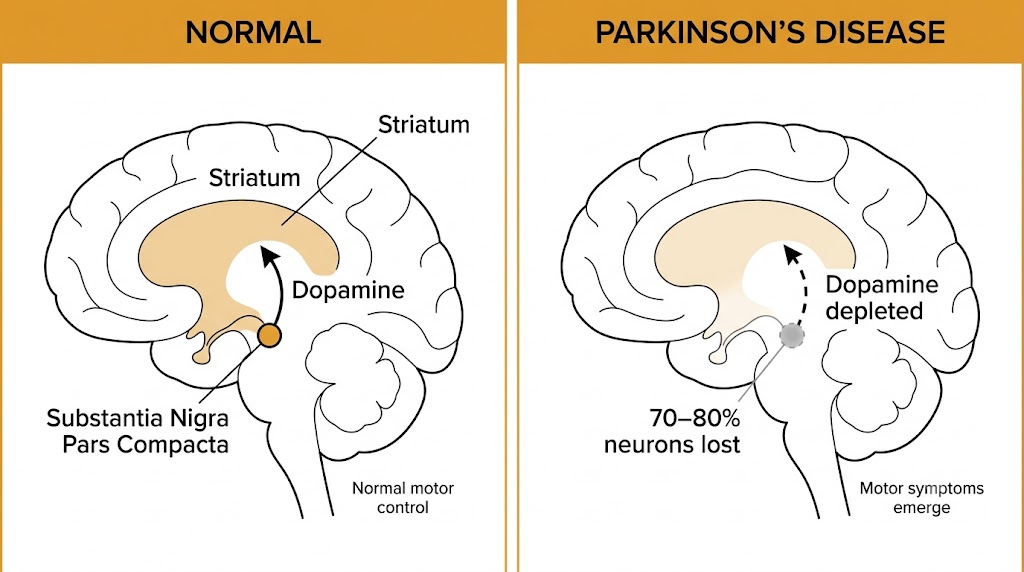
Parkinson's disease is asymptomatic during the early phase of dopamine neuron loss. Motor symptoms emerge only after 70 to 80 percent of nigrostriatal dopamine neurons have been lost. This large reserve capacity explains why the disease is far advanced by the time a patient first presents with tremor or slowness of movement.
How the loss of dopamine creates a relative excess of acetylcholine activity that drives tremor and rigidity
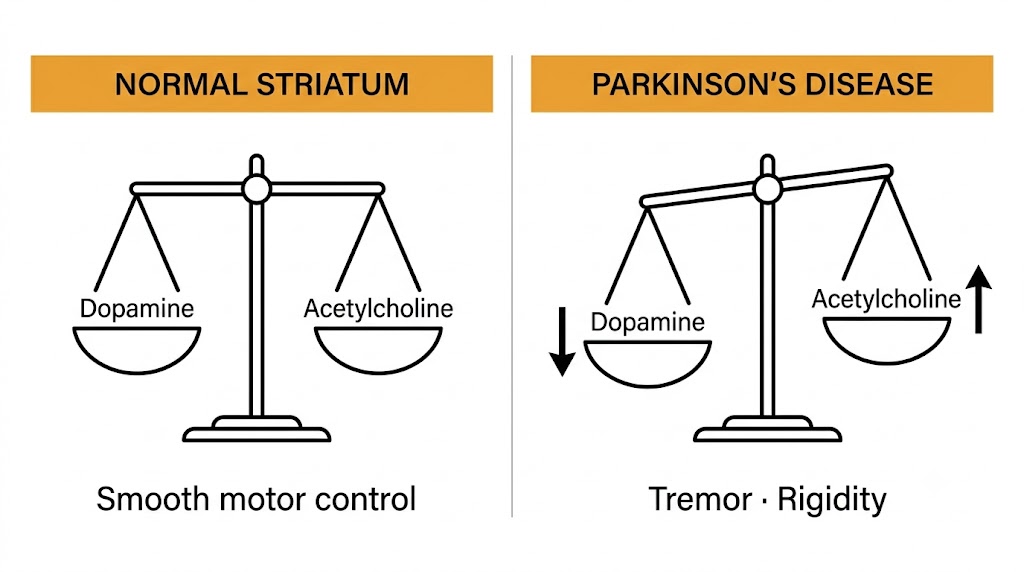
The striatum maintains a functional balance between two opposing neurotransmitter systems: dopamine, which is delivered by the nigrostriatal pathway, and acetylcholine, which is produced by interneurons intrinsic to the striatum itself. This balance governs the quality of motor output. Disrupting it in either direction produces movement problems.
In the healthy striatum, dopamine exerts an inhibitory modulatory influence that counterbalances the excitatory drive of striatal acetylcholine interneurons. The two systems together regulate the gain of motor circuits — dopamine suppresses unwanted movements while acetylcholine promotes the selection and initiation of intended ones. Together they allow smooth, purposeful motor activity.
When nigrostriatal dopamine input is lost, the acetylcholine system is left unopposed. The result is a relative excess of cholinergic activity within the striatum, even though acetylcholine production itself has not increased. This imbalance is particularly responsible for the tremor and rigidity seen in Parkinson's disease.
This concept directly explains one of the oldest pharmacological approaches to Parkinson's disease: blocking striatal acetylcholine receptors with anticholinergic drugs reduces the relative cholinergic excess and partially restores the balance. It also explains why drugs that restore dopamine activity — the mainstay of modern treatment — address the imbalance from the opposite direction.
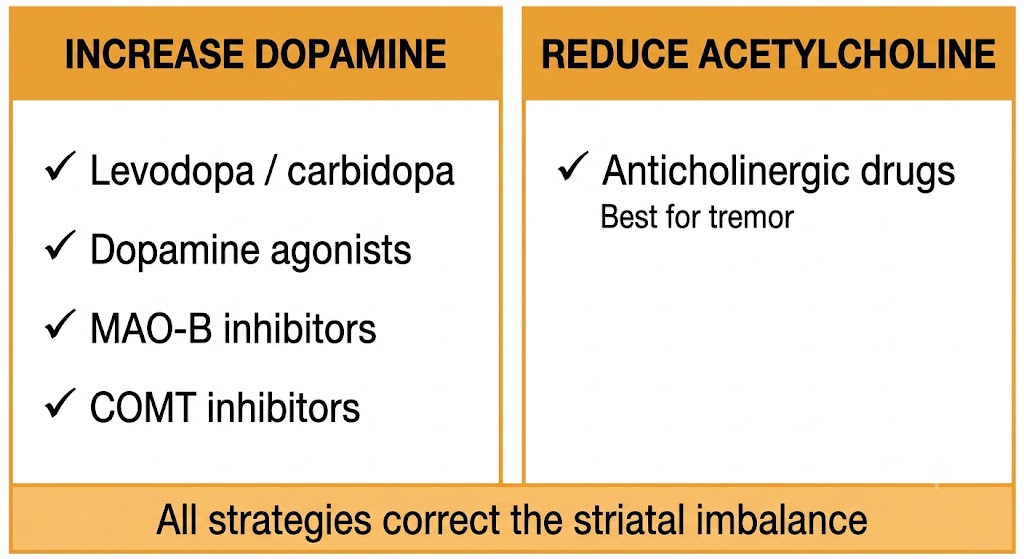
All pharmacological treatments for Parkinson's disease work by correcting the dopamine-acetylcholine imbalance in the striatum. They do so either by increasing dopaminergic tone (levodopa, dopamine agonists, enzyme inhibitors, amantadine) or by reducing cholinergic tone (anticholinergic drugs). Both strategies move the striatum back toward balance from opposite directions.
The four defining motor abnormalities that reflect loss of dopaminergic control of voluntary movement
Parkinson's disease produces four characteristic motor abnormalities that together constitute the classic clinical picture. These features appear when dopamine depletion in the nigrostriatal pathway crosses the symptom threshold. Recognizing them and understanding their mechanistic basis is essential for United States Medical Licensing Examination Step 1.
Tremor (resting) · Rigidity (cogwheel) · Akinesia or bradykinesia · Postural instability. The TRAP mnemonic captures all four cardinal features of Parkinson's disease in a testable sequence.
How each drug class addresses the dopamine-acetylcholine imbalance and the limits of what current therapy can achieve
No drug currently available slows or stops the degeneration of substantia nigra pars compacta neurons. All approved pharmacological treatments for Parkinson's disease are symptomatic — they compensate for dopamine deficiency or reduce cholinergic excess, providing functional benefit without altering the underlying disease course. Understanding this distinction is fundamental to counseling patients about realistic treatment expectations.
The dominant pharmacological strategy in Parkinson's disease is restoring dopamine activity in the striatum. Because dopamine itself cannot cross the blood-brain barrier, drugs must either provide a precursor that crosses and is converted to dopamine inside the brain, mimic dopamine by directly activating its receptors, or extend the activity of whatever dopamine remains by inhibiting the enzymes that break it down.
Levodopa — a dopamine precursor — is the most effective drug in this category and remains the cornerstone of Parkinson's disease pharmacotherapy. Dopamine agonists (pramipexole, ropinirole) activate dopamine receptors directly. Enzyme inhibitors — monoamine oxidase B inhibitors and catechol-O-methyltransferase inhibitors — prolong the effect of levodopa or endogenous dopamine by slowing its metabolism. Amantadine has a modest dopamine-releasing effect in addition to its primary mechanism. Each of these classes is covered in detail in subsequent modules.
Because Parkinson's disease creates a relative cholinergic excess in the striatum, blocking muscarinic receptors with anticholinergic drugs (benztropine, trihexyphenidyl) partially restores the neurotransmitter balance. This strategy is most effective for tremor and rigidity. It has little benefit for bradykinesia — the most disabling feature — and is poorly tolerated in elderly patients due to peripheral anticholinergic adverse effects and cognitive impairment risk.
All current Parkinson's disease drugs treat symptoms by correcting neurotransmitter imbalance. None has been proven to slow neurodegeneration in the substantia nigra pars compacta. Patients improve functionally, sometimes dramatically, but the underlying disease continues to progress. This explains why motor complications emerge over years of treatment even as individual drug doses are optimized.
| Author / Organization | Title | Source |
|---|---|---|
| Katzung BG, Trevor AJ | Basic and Clinical Pharmacology, 15th edition | McGraw-Hill, 2021 |
| Brunton LL, Knollmann BC | Goodman and Gilman's The Pharmacological Basis of Therapeutics, 13th edition | McGraw-Hill, 2018 |
| Le T, Bhushan V | First Aid for the USMLE Step 1 | McGraw-Hill, current edition |
| Poewe W et al. | Parkinson disease | Nature Reviews Disease Primers, 2017 |
| Obeso JA et al. | Past, present, and future of Parkinson's disease: A special essay on the 200th Anniversary of the Shaking Palsy | Movement Disorders, 2017 |