CHAPTER 18  ·  ANTIPARKINSON'S DISEASE DRUGS
Section 1

Why Levodopa and Not Dopamine

The blood-brain barrier problem and how levodopa solves it

Dopamine deficiency in the striatum is the central pharmacological problem in Parkinson's disease. The most direct solution would be to replace dopamine itself — but dopamine cannot be administered for this purpose because it does not cross the blood-brain barrier. Levodopa, the immediate metabolic precursor of dopamine, solves this problem by crossing into the brain and being converted to dopamine where it is needed.

The Blood-Brain Barrier Problem

The blood-brain barrier is formed by tight junctions between brain capillary endothelial cells, which prevent passive diffusion of most water-soluble molecules from the bloodstream into the brain. Dopamine is a charged, water-soluble catecholamine that cannot cross this barrier by passive diffusion. Giving dopamine intravenously raises plasma levels but produces no central effect — the drug stays in the periphery and never reaches the striatum.

Levodopa as the Solution

Levodopa (also called L-dopa) is the direct precursor of dopamine in the catecholamine biosynthesis pathway. Unlike dopamine, levodopa is a neutral amino acid. It crosses the blood-brain barrier via the large neutral amino acid transporter — the same carrier that moves phenylalanine, tyrosine, and other large amino acids from the bloodstream into the brain. Once inside the central nervous system, levodopa is converted to dopamine by the enzyme aromatic amino acid decarboxylase, which is present in dopaminergic neurons and in other brain cells.

The result is dopamine replenishment at the site where it is needed — the striatum — without the barrier problem that makes systemic dopamine administration ineffective.
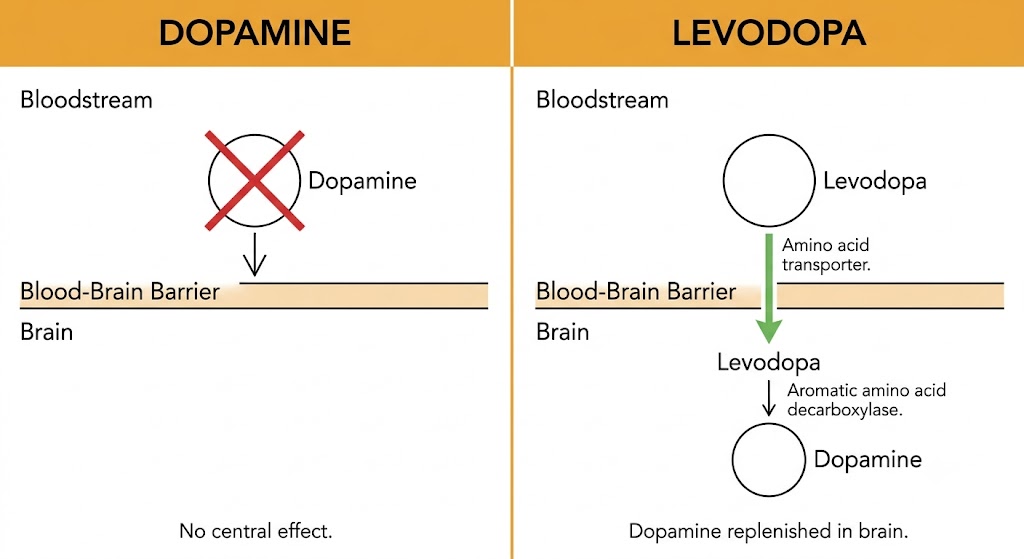
Two-panel diagram showing dopamine blocked at the blood-brain barrier on the left, and levodopa crossing via amino acid transporter and converting to dopamine inside the brain on the right.
Dopamine cannot cross the blood-brain barrier (left); levodopa crosses via the large neutral amino acid transporter and is converted to dopamine inside the brain (right). Figure generated by Gemini AI.
Mechanism in One Sentence

Levodopa crosses the blood-brain barrier via the large neutral amino acid transporter and is converted to dopamine inside the brain by aromatic amino acid decarboxylase — replenishing the striatal dopamine that Parkinson's disease has depleted.

Section 2

Carbidopa — The Peripheral Decarboxylase Inhibitor

How blocking peripheral conversion of levodopa makes treatment safer and more efficient

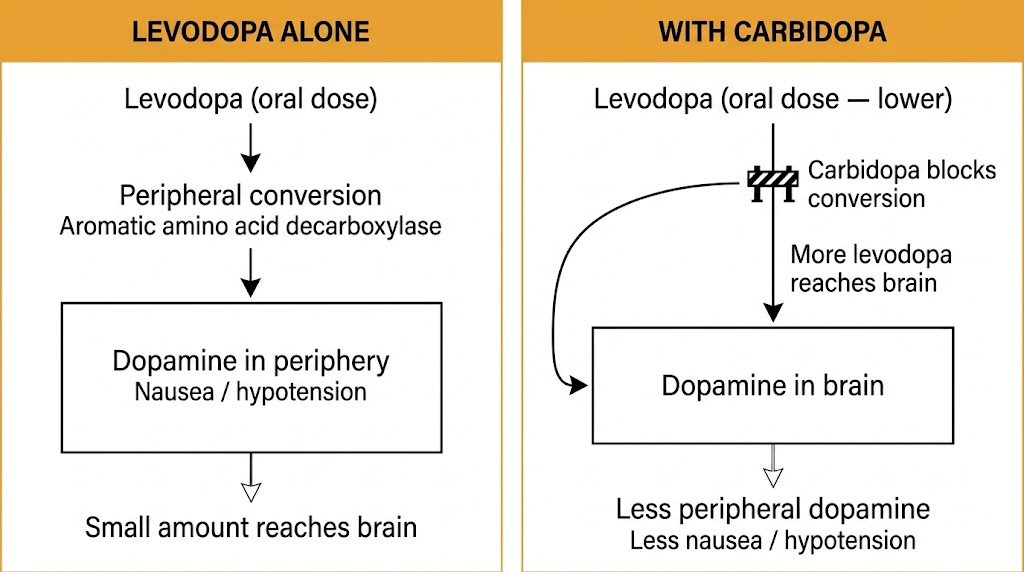
When levodopa is given alone, most of it is converted to dopamine in the peripheral tissues — the gut wall, liver, and other organs — before it ever reaches the brain. This peripheral conversion is both wasteful and harmful: it requires high doses of levodopa to achieve adequate brain levels, and the dopamine produced in the periphery causes significant adverse effects. Carbidopa solves this problem by blocking the conversion enzyme outside the brain.

Mechanism of Carbidopa

Carbidopa is an inhibitor of aromatic amino acid decarboxylase — the same enzyme that converts levodopa to dopamine. Critically, carbidopa does not cross the blood-brain barrier. It therefore inhibits the decarboxylase enzyme only in peripheral tissues, leaving the central nervous system enzyme fully active. The result is that levodopa passes through the periphery without being converted, reaches the brain in much higher concentrations, and is converted to dopamine where it is needed.

Benefits of the Combination

Adding carbidopa to levodopa produces three clinically important benefits. First, the required dose of levodopa is substantially reduced — typically by 75 percent — because more of each dose reaches the brain rather than being wasted in peripheral conversion. Second, nausea and vomiting are markedly reduced, because these adverse effects are caused by dopamine acting on receptors in the gut and in the chemoreceptor trigger zone, both of which are peripheral sites that carbidopa protects. Third, cardiovascular adverse effects including orthostatic hypotension and cardiac arrhythmias — also driven by peripheral dopamine — are reduced.

Two-panel flow diagram showing most levodopa converted to dopamine in the periphery when given alone, versus more levodopa reaching the brain when carbidopa blocks peripheral conversion.
Levodopa alone: most converted peripherally, little reaches the brain (left). With carbidopa blocking peripheral conversion: more levodopa reaches the brain at a lower dose (right). Figure generated by Gemini AI.
Always Given in Combination

Levodopa is never given alone in current clinical practice. It is always formulated with carbidopa as a fixed combination (carbidopa-levodopa). The combination allows effective brain dopamine replenishment at doses low enough to be tolerated. Carbidopa has no antiparkinsonian effect on its own — it acts solely by protecting levodopa from premature peripheral conversion.


Section 3

Therapeutic Effects and Clinical Use

Levodopa is the most effective drug available for Parkinson's disease — with important differences in response across the cardinal features

Levodopa-carbidopa is the single most effective pharmacological treatment for Parkinson's disease. No other drug produces as much functional improvement, and for many patients it restores near-normal motor function in the early years of treatment. The magnitude of the response, however, varies across the four cardinal motor features and diminishes over time as the disease progresses.

Differential Response Across Motor Features

Bradykinesia and rigidity respond best to levodopa — often dramatically so in early disease. Tremor also improves in most patients, though sometimes incompletely. Postural instability responds least well and may not improve meaningfully even at optimal doses. This differential pattern reflects the fact that bradykinesia and rigidity are most directly driven by striatal dopamine deficiency, while postural instability involves non-dopaminergic pathways that levodopa cannot address.

Short Half-Life and Dosing

Levodopa has a short plasma half-life of approximately one to two hours. In early disease, the brain can buffer this intermittent delivery because some dopamine storage capacity remains in surviving neurons. As the disease progresses and neuron loss advances, this buffering capacity is lost and patients begin to experience motor fluctuations tied directly to the rise and fall of plasma levodopa levels. This is the pharmacokinetic basis for the wearing-off phenomenon covered in Module 3.

Extended-release formulations of carbidopa-levodopa provide more sustained plasma levels and are used to reduce fluctuations, though they have less predictable absorption than immediate-release formulations.

Patient Selection

Levodopa-carbidopa is generally preferred as initial therapy in older patients with Parkinson's disease — typically those over 65 to 70 years of age — because it provides the greatest symptomatic benefit and older patients are less likely to develop the dyskinesias that complicate long-term levodopa use. In younger patients, dopamine agonists are often used first to delay the onset of levodopa-associated motor complications, with levodopa added when the agonist alone provides insufficient control.


Section 4

Adverse Effects and Contraindications

Peripheral dopamine effects in early treatment, and the motor and neuropsychiatric complications that emerge with long-term use

The adverse effects of levodopa-carbidopa fall into two categories: early effects related to peripheral dopamine activity, which carbidopa substantially reduces, and long-term effects that emerge after years of treatment and reflect changes in how the brain responds to dopamine stimulation.

Early Adverse Effects

Nausea and vomiting are the most common early adverse effects and result from dopamine stimulation of receptors in the gut and in the chemoreceptor trigger zone of the medulla, which lies outside the blood-brain barrier. Carbidopa substantially reduces this problem by preventing peripheral conversion, but nausea still occurs in some patients, particularly early in treatment. Taking the medication with food and starting at a low dose with gradual titration help minimize this effect.

Orthostatic hypotension occurs because peripheral dopamine causes vasodilation. Again, carbidopa reduces but does not eliminate this effect. Cardiac arrhythmias are uncommon with the combination but were more frequent when levodopa was used alone.

Long-Term Motor Complications

After several years of levodopa therapy, most patients develop motor complications including wearing-off (end-of-dose deterioration of motor control) and dyskinesias (involuntary movements at peak drug levels). These complications are covered in detail in Module 3. They represent the primary limitation of long-term levodopa use and drive much of the complexity of advanced Parkinson's disease management.

Neuropsychiatric Adverse Effects

Dopamine excess in mesolimbic and mesocortical pathways can produce hallucinations, vivid dreams, and in some patients frank psychosis. These effects are more common in older patients and those with preexisting cognitive impairment. Managing levodopa-induced psychosis without worsening motor symptoms is a significant clinical challenge addressed in Module 7.

Contraindication
Nonselective Monoamine Oxidase Inhibitors
  • Concurrent use risks hypertensive crisis
  • Peripheral dopamine accumulates when monoamine oxidase A and monoamine oxidase B are both inhibited
  • Washout period required before starting levodopa
  • Selective monoamine oxidase B inhibitors (selegiline, rasagiline) are used therapeutically — not contraindicated
Use With Caution
Psychiatric and Ocular Conditions
  • Psychotic disorders — dopamine excess may worsen psychosis
  • Narrow-angle glaucoma — mydriasis from dopaminergic effect may precipitate acute angle closure
  • Not absolutely contraindicated but requires careful monitoring

Suggested References
Author / Organization Title Source
Katzung BG, Trevor AJ Basic and Clinical Pharmacology, 15th edition McGraw-Hill, 2021
Brunton LL, Knollmann BC Goodman and Gilman's The Pharmacological Basis of Therapeutics, 13th edition McGraw-Hill, 2018
Le T, Bhushan V First Aid for the USMLE Step 1 McGraw-Hill, current edition
Poewe W et al. Parkinson disease Nature Reviews Disease Primers, 2017
Connolly BS, Lang AE Pharmacological treatment of Parkinson disease: a review JAMA, 2014