Why motor control that is stable in early disease becomes tied to each dose of levodopa over time
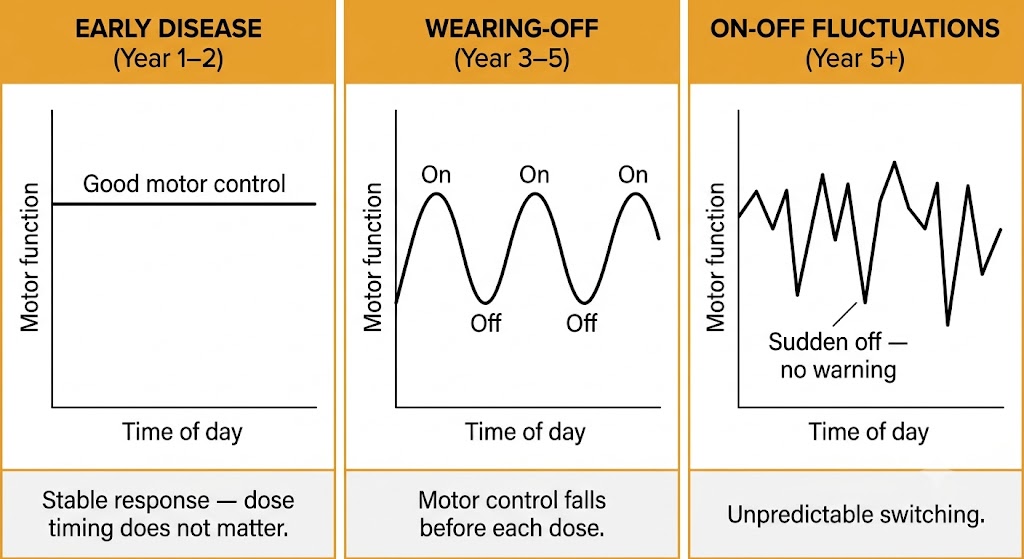
In the first years of levodopa therapy, most patients enjoy a stable, sustained motor response. A dose taken in the morning provides benefit that lasts well into the day, and the transition between doses is smooth. After three to five years of treatment, this stability begins to erode. Motor control deteriorates predictably toward the end of each dosing interval — a phenomenon called wearing-off, or end-of-dose deterioration.
Levodopa has a short plasma half-life of one to two hours. In early Parkinson's disease, enough dopaminergic neurons survive to store dopamine produced from each levodopa dose and release it slowly between doses. This storage capacity smooths out the peaks and troughs of levodopa plasma levels, providing a continuous dopamine signal to the striatum regardless of when the last dose was taken.
As the disease progresses, more dopaminergic neurons are lost. The storage and buffering capacity of the nigrostriatal system shrinks. Striatal dopamine levels now rise and fall in direct proportion to the plasma levodopa concentration. When the plasma level drops toward the end of a dosing interval, dopamine in the striatum drops with it — and motor control deteriorates. The patient can feel the dose wearing off, typically as a return of stiffness, slowness, or tremor that resolves with the next dose.
Wearing-off is predictable — patients learn to anticipate it before their scheduled next dose — and it is reversible with the next dose of levodopa. This predictability distinguishes wearing-off from the more unpredictable on-off fluctuations described in Section 2. The key Step 1 point is that wearing-off reflects the pharmacokinetic limitations of levodopa, not a change in drug efficacy at the receptor level.
Unpredictable switches between mobile and immobile states that emerge in advanced disease
As Parkinson's disease advances further, some patients develop motor fluctuations that are no longer tied to the timing of levodopa doses. Motor control can switch abruptly from a functional state — the "on" phase — to a severely impaired state — the "off" phase — with little warning and no clear relationship to when the last dose was taken. These on-off fluctuations represent a more severe form of motor instability than wearing-off and are harder to manage.
During an "on" phase, the patient has good motor function — often with levodopa-induced dyskinesias at peak drug effect. During an "off" phase, the patient may be nearly immobile, with severe rigidity, bradykinesia, and tremor. The switch between phases can occur within minutes and without a predictable trigger. The unpredictability is what makes on-off fluctuations particularly disabling — patients cannot reliably plan daily activities.
The mechanism is not fully understood but reflects both the pharmacokinetic instability of levodopa and changes in dopamine receptor sensitivity in the striatum that develop after years of pulsatile dopaminergic stimulation.
Freezing of gait is a sudden, transient inability to initiate or continue walking. The patient feels as though their feet are glued to the floor, particularly when approaching a doorway, turning, or navigating a crowd. Freezing is associated with off phases and with advanced disease. It is a major cause of falls and is poorly responsive to levodopa dose adjustments.
Wearing-off is predictable — it occurs toward the end of each dosing interval and resolves with the next dose. On-off fluctuations are unpredictable — they occur without clear relationship to dose timing. Both reflect loss of dopamine buffering capacity, but on-off fluctuations involve additional receptor-level changes that make the response to levodopa erratic rather than simply short-lived.
Involuntary movements that emerge as a complication of long-term levodopa exposure
Dyskinesias are involuntary, often writhing or jerking movements that develop in most patients after five or more years of levodopa therapy. They represent the opposite problem from wearing-off: instead of too little dopamine activity at the striatum, dyskinesias occur when dopamine stimulation is excessive or fluctuating. They are not the same as tremor — tremor is a feature of Parkinson's disease itself, while dyskinesias are a complication of its treatment.
The most common form occurs at peak plasma levodopa concentration — when striatal dopamine stimulation is at its highest. Movements are typically choreiform: flowing, dance-like, involuntary movements of the limbs, trunk, or face. They can range from mild and barely noticeable to severe and disabling. Many patients prefer mild peak-dose dyskinesias to the alternative of reducing the levodopa dose and spending more time in an off state.
A less common but more distressing pattern involves dyskinesias at both the rising and falling phases of plasma levodopa levels — the diphasic pattern. These movements tend to be more dystonic and violent than peak-dose dyskinesias and occur precisely when the plasma levodopa level is intermediate, neither at trough nor at peak. Diphasic dyskinesias are harder to manage because the therapeutic window between too little and too much levodopa has narrowed to the point that any dose produces dyskinesias on one side or immobility on the other.
Pharmacological approaches to smoothing levodopa response and reducing dyskinesias
Managing motor complications requires balancing two competing goals: providing enough levodopa to maintain motor function during off periods, while avoiding the excessive dopamine stimulation that produces dyskinesias. The available strategies work by either smoothing the delivery of dopaminergic stimulation to the striatum or by directly dampening dyskinetic movements.
The most straightforward approach to wearing-off is reducing the interval between levodopa doses — smaller, more frequent doses maintain more consistent plasma levels. Extended-release carbidopa-levodopa formulations provide more sustained drug delivery and are commonly used for this purpose, though their absorption is less predictable than immediate-release formulations.
Adding a monoamine oxidase B inhibitor (selegiline or rasagiline) prolongs the effect of each levodopa dose by slowing dopamine breakdown in the brain. Adding a catechol-O-methyltransferase inhibitor (entacapone or opicapone) extends levodopa's plasma half-life by blocking its peripheral metabolism, effectively converting each immediate-release dose into a longer-acting one. Adding a dopamine agonist provides more continuous receptor stimulation and reduces the total levodopa requirement. Each of these adjunctive strategies is covered in detail in subsequent modules.
Peak-dose dyskinesias can be reduced by lowering individual levodopa doses while compensating with adjunctive agents to maintain overall motor control. Amantadine is the only drug with established efficacy specifically for levodopa-induced dyskinesias — it reduces their severity through its action as an N-methyl-D-aspartate receptor antagonist in the striatum, dampening the excessive glutamatergic activity that contributes to dyskinetic movements. Amantadine is covered in detail in Module 6.
For patients with severe, refractory fluctuations and dyskinesias, continuous delivery of levodopa-carbidopa via intestinal gel infusion through a percutaneous gastrojejunostomy tube provides near-constant plasma levodopa levels, effectively eliminating the peaks and troughs that drive both wearing-off and peak-dose dyskinesias. This approach is reserved for advanced disease when oral optimization has failed.
All management strategies for motor complications share one goal: converting pulsatile dopaminergic stimulation into more continuous stimulation. The striatum responds better to a steady dopamine signal than to the sharp peaks and troughs that oral levodopa produces in advanced disease. Every adjunctive drug — monoamine oxidase B inhibitors, catechol-O-methyltransferase inhibitors, dopamine agonists — works in part by smoothing this signal.
| Author / Organization | Title | Source |
|---|---|---|
| Katzung BG, Trevor AJ | Basic and Clinical Pharmacology, 15th edition | McGraw-Hill, 2021 |
| Brunton LL, Knollmann BC | Goodman and Gilman's The Pharmacological Basis of Therapeutics, 13th edition | McGraw-Hill, 2018 |
| Le T, Bhushan V | First Aid for the USMLE Step 1 | McGraw-Hill, current edition |
| Connolly BS, Lang AE | Pharmacological treatment of Parkinson disease: a review | JAMA, 2014 |
| Bhidayasiri R, Truong DD | Motor complications in Parkinson disease: clinical manifestations and management | Journal of the Neurological Sciences, 2008 |