Introduction to Medical Pharmacology
The molecular basis of how drugs bind to receptors and initiate biological responses
Chapter 3 · Module 1 of 4 · PDYN-01Section 1
The four major receptor families and how each transduces a drug signal into a biological response
A receptor, in pharmacological terms, is a protein that a drug binds in order to produce its effect. Most drug receptors are located on the cell surface or inside the cell, and they fall into four major structural and functional families. Understanding which family a receptor belongs to tells you immediately how fast the drug will act, what signaling machinery it engages, and what kinds of pharmacological manipulation are possible.
G protein-coupled receptors are the largest and most pharmacologically important receptor family, accounting for roughly one-third of all approved medications. They span the cell membrane seven times and couple to intracellular G proteins that carry the signal forward. When a drug binds, the receptor changes shape and activates a G protein, which then modulates one or more second messenger systems inside the cell. The functional outcome depends on which G protein subtype is engaged: Gs proteins stimulate adenylyl cyclase, raising cyclic adenosine monophosphate levels; Gi proteins inhibit adenylyl cyclase, lowering cyclic adenosine monophosphate; and Gq proteins activate phospholipase C, generating diacylglycerol and inositol trisphosphate, which together release calcium from intracellular stores.
The onset of action through G protein-coupled receptors ranges from seconds to minutes, reflecting the time required to produce and accumulate enough second messenger to activate downstream kinases and ion channels. Clinically familiar drugs acting at this receptor family include beta-adrenergic agonists and antagonists, opioids, muscarinic agents, histamine antagonists, and dopamine agonists and antagonists used in neurological disease.
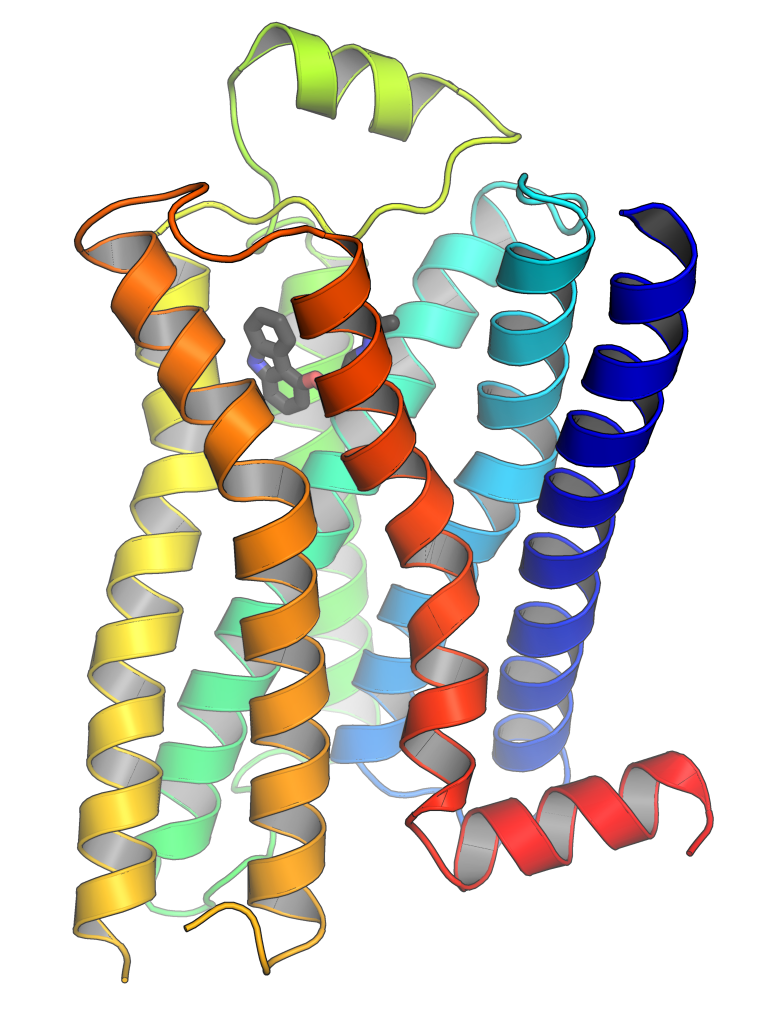
Ligand-gated ion channels, also called ionotropic receptors, are the fastest-acting receptor type. The ion channel pore and the drug-binding site are part of the same protein complex. When a drug binds, the channel opens within milliseconds, and ions flow across the membrane down their electrochemical gradients. No second messenger is required: ion flux is the signal. These receptors mediate rapid synaptic transmission throughout the nervous system.
Clinically important examples include the gamma-aminobutyric acid type A receptor, a chloride channel targeted by benzodiazepines and barbiturates; the nicotinic acetylcholine receptor at the neuromuscular junction, which is blocked by neuromuscular blocking drugs and activated by succinylcholine; and the N-methyl-D-aspartate receptor, which is blocked by ketamine. Because response occurs in milliseconds, this receptor class mediates the most rapid pharmacological effects in clinical medicine.
Enzyme-linked receptors are cell-surface proteins whose intracellular portion either contains enzymatic activity or directly recruits an enzyme when activated. The most important subclass is the receptor tyrosine kinase family, whose members respond to growth factors and hormones including insulin, epidermal growth factor, and vascular endothelial growth factor. When the ligand binds, two receptor molecules come together (dimerize), activating the intracellular kinase domains, which phosphorylate tyrosine residues on each other and on downstream signaling proteins. The resulting phosphorylation cascade regulates cell growth, metabolism, and survival.
Because enzyme-linked receptor signaling requires propagation of a phosphorylation cascade rather than direct ion flux, the onset of action is in the range of minutes to hours rather than milliseconds. The clinical relevance of this receptor class has grown substantially with the development of targeted kinase inhibitors in oncology, such as imatinib, which blocks the breakpoint cluster region-Abelson tyrosine kinase, and trastuzumab, which targets the human epidermal growth factor receptor 2.
Nuclear receptors are intracellular proteins that function as transcription factors. Because their ligands must be lipophilic enough to cross the cell membrane and reach the cytoplasm or nucleus, this receptor class is uniquely suited to lipid-soluble molecules: steroid hormones, thyroid hormone, vitamin D, and retinoic acid are all endogenous nuclear receptor ligands.
When a drug or hormone binds, the receptor-ligand complex enters the nucleus and binds to specific sequences on the genome called hormone response elements, activating or repressing transcription of target genes. The pharmacological effect depends on production of new proteins, which takes hours to days. This slow onset is clinically consequential: glucocorticoids require hours before anti-inflammatory effects are apparent, thyroid hormone replacement takes weeks to restore metabolic steady state, and the antiresorptive effects of estrogen on bone develop over months. The slow offset of these drugs is equally important, since newly synthesized proteins persist after the drug is cleared.
Receptor Class Summary
G protein-coupled receptors: onset seconds to minutes; second messenger (cyclic adenosine monophosphate, inositol trisphosphate/diacylglycerol, calcium); examples: beta-adrenergic agonists, opioids, muscarinic drugs.
Ligand-gated ion channels: onset milliseconds; direct ion flux; examples: benzodiazepines, barbiturates, succinylcholine, ketamine.
Enzyme-linked receptors (receptor tyrosine kinases): onset minutes to hours; tyrosine phosphorylation cascade; examples: insulin, imatinib, trastuzumab.
Nuclear receptors: onset hours to days; gene transcription, new protein synthesis; examples: glucocorticoids, thyroid hormone, estrogens, androgens.
Section 2
How tightly a drug binds to its receptor and what that means for clinical effect
A drug produces its effect only when it is bound to its receptor. The tightness of that binding — the affinity of the drug for its receptor — determines how much drug is needed to occupy a meaningful fraction of receptors, and how long the drug remains bound once it gets there. These two properties, potency and duration of receptor occupancy, translate directly into clinical dosing decisions.
Drug-receptor binding is reversible: the drug associates with the receptor and then dissociates from it. At any given drug concentration, the system reaches an equilibrium between bound and unbound drug. This equilibrium is described by the equilibrium dissociation constant, abbreviated Kd, which represents the drug concentration at which exactly half of the available receptors are occupied at equilibrium.
Kd is the standard measure of binding affinity, and the relationship between Kd and affinity is inverse: a lower Kd means higher affinity. A drug with a Kd of 1 nanomolar binds its receptor a thousand times more tightly than a drug with a Kd of 1 micromolar. High-affinity drugs achieve significant receptor occupancy at low plasma concentrations, which generally allows for lower doses. However, high affinity alone does not guarantee a larger pharmacological effect — the magnitude of effect depends on the drug's intrinsic ability to activate the receptor once bound, a distinct property addressed in the next section on agonism.
At any given drug concentration, the fraction of receptors occupied follows a predictable pattern. When the drug concentration equals the Kd, 50 percent of receptors are occupied. As drug concentration increases above the Kd, occupancy increases toward 100 percent, but the relationship is not linear — it is hyperbolic. On a standard concentration axis the curve rises steeply at first and then flattens as receptors become saturated. When plotted against the logarithm of drug concentration, the relationship takes on the familiar sigmoid shape used in dose-response graphs throughout pharmacology. This shape is important to recognize because it means that doubling the dose from near-zero has a large effect on occupancy, while doubling the dose when the receptor is already 80 or 90 percent occupied produces almost no additional occupancy.
Once a drug is bound to its receptor, the duration of that binding is governed by how quickly it dissociates. The dissociation rate constant describes how rapidly the drug leaves the receptor. A drug with a slow dissociation rate stays on its receptor for a long time, maintaining its pharmacological effect even as plasma drug concentrations fall. This is called receptor residence time, and it can be as important as plasma half-life in determining how long a drug's effect lasts.
The clinical relevance is clearest when comparing drugs within the same class. Tiotropium and ipratropium are both muscarinic receptor antagonists used in obstructive lung disease, but tiotropium dissociates from the muscarinic M3 receptor far more slowly than ipratropium does. This difference in receptor residence time, not simply affinity, is why tiotropium can be dosed once daily while ipratropium requires dosing several times per day.
At the extreme end, some drugs bind irreversibly — their dissociation rate is effectively zero because they form a covalent bond with the receptor. Aspirin acetylates cyclooxygenase enzymes covalently and permanently. The effect lasts not until aspirin is cleared from the plasma (which takes a few hours) but until the cell synthesizes new cyclooxygenase enzyme — which for platelets, which lack a nucleus and cannot synthesize new proteins, means the full platelet lifespan of seven to ten days.
Kd at a Glance
Kd = drug concentration at which 50 percent of receptors are occupied at equilibrium. Lower Kd = higher affinity. Kd governs how much drug is needed to achieve receptor occupancy. Duration of receptor binding is governed separately by the dissociation rate — slow dissociation means prolonged effect even after plasma drug levels fall. Irreversible binding (covalent) produces effects lasting until the receptor protein is replaced.
Section 3
How drugs that activate receptors differ in their ability to produce a maximal biological response
An agonist is a drug that binds to a receptor and activates it, producing a biological response. But not all agonists are equal: they differ in their intrinsic ability to activate the receptor once bound. This property — distinct from affinity — determines whether a drug can produce the full maximum response of the system, only a partial response no matter how much drug is present, or even a response in the direction opposite to activation.
A full agonist is a drug that, at high enough concentrations, produces the maximum response the receptor-effector system is capable of generating. The endogenous ligand is usually a full agonist for its own receptor. Morphine is a full agonist at the mu-opioid receptor. Epinephrine is a full agonist at adrenergic receptors. The defining feature is that the dose-response curve reaches a ceiling equal to the system maximum — Emax — given sufficient receptor occupancy.
A partial agonist binds to and activates the receptor but produces a submaximal response even when every available receptor is occupied. The maximum effect a partial agonist can produce — its ceiling effect — is less than the Emax of a full agonist at the same receptor. This ceiling is intrinsic to the drug, not a consequence of insufficient dose.
Partial agonism creates a dual pharmacological behavior that depends on context. When a partial agonist is given alone, it produces a net activating effect — it is, after all, activating receptors. But when given in the presence of a full agonist (including an endogenous one), the partial agonist competes for receptor occupancy and, because each partial agonist-occupied receptor generates less signal than a full agonist-occupied receptor would, the net result is reduced effect compared to the full agonist alone. In a high-agonist environment, partial agonists behave functionally as antagonists.
Buprenorphine illustrates this clinically. As a partial agonist at the mu-opioid receptor with very high affinity, it produces analgesia and reduces opioid craving. Its ceiling effect on respiratory depression is a meaningful safety advantage over full agonist opioids. Its high affinity means it binds tightly and displaces full agonist opioids from their receptors, which is the basis for using it in opioid use disorder — but also means that administering it to a patient with full agonist opioids still occupying receptors can precipitate withdrawal, because the partial agonist displaces the full agonist and delivers less total receptor activation.
Aripiprazole, an atypical antipsychotic, is a partial agonist at dopamine D2 receptors. In brain pathways where dopamine is overactive (mesolimbic pathways, which mediate psychotic symptoms), aripiprazole competes with dopamine and produces net dopamine blockade. In pathways where dopamine tone is low (mesocortical pathways, which mediate cognition), aripiprazole provides net agonist activity. This context-dependence is what distinguishes partial agonists from simple antagonists in clinical practice.
Some receptors, particularly G protein-coupled receptors, are not completely inactive in the absence of a ligand. They have a low level of spontaneous activity — constitutive activity — that produces measurable baseline signaling. A neutral antagonist blocks access of agonists to the receptor without changing this baseline constitutive activity. An inverse agonist, by contrast, binds the receptor and actively suppresses constitutive activity below the basal level, producing an effect in the direction opposite to an agonist.
Many drugs previously classified as simple antagonists are now recognized as inverse agonists. Beta-blockers such as metoprolol and carvedilol are inverse agonists at the beta-1 adrenergic receptor: they not only block catecholamine-stimulated activation but also suppress the constitutive receptor activity that is elevated in heart failure. This may contribute to the clinical benefit of beta-blockers in chronic heart failure beyond simple sympatholysis. For the purposes of clinical pharmacology at this level, the key distinction to carry forward is that inverse agonists suppress constitutive receptor activity, while neutral antagonists do not.
Partial Agonism in Context
Partial agonist used alone: produces submaximal receptor activation; useful when a ceiling effect is a safety advantage (buprenorphine: ceiling on respiratory depression).
Partial agonist in presence of full agonist: competes for receptors; each partial agonist-occupied receptor delivers less signal; net result is functional antagonism in high-agonist environments (aripiprazole in mesolimbic dopamine pathways; buprenorphine precipitating opioid withdrawal).
Inverse agonist: not merely blocking agonist access — actively reducing constitutive receptor activity below baseline. Many beta-blockers are inverse agonists.
Section 4
Competitive reversible, irreversible, and non-competitive antagonism — mechanisms and clinical consequences
Antagonists are drugs that block receptor activation without producing a response of their own. The type of antagonism — whether reversible or irreversible, competitive or non-competitive — determines whether the antagonist's effect can be overcome by increasing agonist concentration, and these distinctions have direct clinical consequences for dosing, overdose management, and drug choice.
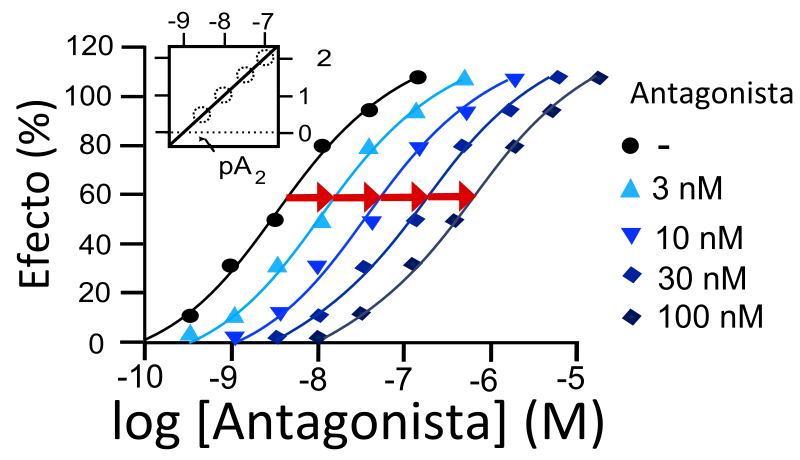
A competitive reversible antagonist binds to the same site on the receptor as the agonist and competes with it for occupancy. The key feature is reversibility: the antagonist can be displaced by increasing agonist concentration. At higher agonist concentrations, the agonist outcompetes the antagonist for receptor binding, and the full maximum effect can still be achieved. On a log dose-response graph, competitive reversible antagonism produces a parallel rightward shift of the agonist curve — the curve shifts right (more agonist is needed to produce the same effect) but the Emax remains unchanged. This shift is described as surmountable antagonism.
The clinical consequence is important: a patient who ingests an overdose of opioids can be treated with naloxone, a competitive reversible mu-opioid receptor antagonist. If the opioid dose is high enough, enough opioid molecules remain to displace naloxone and restore some agonist effect — which is why naloxone may need to be re-dosed in serious overdose, and why monitoring is essential even after apparent reversal. Beta-blockers are competitive reversible antagonists at adrenergic receptors, and their effects can be partially overcome by the very high catecholamine levels that occur in anaphylaxis or catecholamine administration.
An irreversible antagonist binds to the receptor so tightly — usually by forming a covalent bond — that the antagonist cannot be displaced by increasing agonist concentration. Once a receptor is bound by an irreversible antagonist, it is permanently inactivated. The consequence on the dose-response curve is different from competitive reversible antagonism: at first, when receptor reserve exists and enough unblocked receptors remain to generate a maximum response, the curve shifts right as with reversible antagonism. But as more receptors are permanently blocked, the Emax progressively falls, because the system can no longer recruit enough receptors to achieve a full response no matter how much agonist is present. This is insurmountable antagonism.
Phenoxybenzamine, an irreversible alpha-adrenergic receptor antagonist, is used before and during surgical removal of pheochromocytoma — a catecholamine-secreting adrenal tumor. The irreversible nature of blockade means that massive catecholamine surges released during tumor manipulation cannot overcome the antagonism, preventing the severe hypertensive crises that would otherwise occur. The duration of effect is determined by how long it takes cells to synthesize new adrenergic receptors — which takes days — rather than by phenoxybenzamine plasma levels, which is why the drug requires careful dosing well in advance of surgery.
Aspirin provides another example: it acetylates cyclooxygenase enzymes covalently and irreversibly. Because platelets lack a nucleus and cannot synthesize new cyclooxygenase, aspirin's antiplatelet effect lasts the entire lifespan of those platelets — seven to ten days — long after aspirin itself has been cleared from the circulation.
Non-competitive antagonists bind to a site on the receptor that is separate from the agonist's binding site. Because they do not compete for the same site, increasing agonist concentration does not displace them. The result is a reduction in the maximum response — depression of Emax — without a parallel rightward shift of the dose-response curve. The mechanism is that the receptor, when bound by the non-competitive antagonist, cannot transduce the agonist signal as effectively, even though agonist binding may still occur.
Allosteric modulation is a broader category that includes both negative and positive effects at these non-orthosteric sites. A drug that binds an allosteric site and reduces receptor responsiveness is acting as an allosteric inhibitor. A drug that binds an allosteric site and enhances receptor responsiveness to its endogenous agonist is acting as a positive allosteric modulator.
Benzodiazepines are positive allosteric modulators at the gamma-aminobutyric acid type A receptor. They bind a site on the receptor that is distinct from the gamma-aminobutyric acid binding site, and when gamma-aminobutyric acid is present, they enhance the frequency with which the chloride channel opens in response to that gamma-aminobutyric acid. The critical point is that benzodiazepines cannot open the chloride channel by themselves — they require gamma-aminobutyric acid to be present. This built-in ceiling on their effect is the pharmacological basis for the much higher safety margin of benzodiazepines compared to barbiturates, which can open the gamma-aminobutyric acid type A chloride channel directly at high concentrations, without requiring gamma-aminobutyric acid, and therefore carry a much higher risk of fatal respiratory depression in overdose.
Antagonism Type Determines Reversibility
Competitive reversible: parallel right shift of dose-response curve, Emax unchanged, surmountable — more agonist can overcome the block (naloxone can be displaced by excess opioid).
Irreversible: Emax progressively reduced with increasing antagonist exposure, insurmountable — no amount of agonist restores full response; duration set by receptor resynthesis, not drug clearance (phenoxybenzamine, aspirin).
Non-competitive/allosteric: Emax depressed, not surmountable by increasing agonist; benzodiazepines as positive allosteric modulators require gamma-aminobutyric acid co-presence (inherent ceiling), unlike barbiturates which can activate the receptor directly.
| Author / Organization | Title | Source |
|---|---|---|
| Overington JP, Al-Lazikani B, Hopkins AL | How many drug targets are there? | Nat Rev Drug Discov. 2006;5(12):993-996. |
| Gilman AG | G proteins: transducers of receptor-generated signals | Annu Rev Biochem. 1987;56:615-649. |
| Sieghart W | Structure, pharmacology, and function of GABA-A receptor subtypes | Adv Pharmacol. 2006;54:231-263. |
| Mangelsdorf DJ, Thummel C, Beato M, et al. | The nuclear receptor superfamily: the second decade | Cell. 1995;83(6):835-839. |
| Motulsky HJ, Mahan LC | The kinetics of competitive radioligand binding predicted by the law of mass action | Mol Pharmacol. 1984;25(1):1-9. |
| Copeland RA, Pompliano DL, Meek TD | Drug-target residence time and its implications for lead optimization | Nat Rev Drug Discov. 2006;5(9):730-739. |
| Stephenson RP | A modification of receptor theory | Br J Pharmacol Chemother. 1956;11(4):379-393. |
| Kenakin T | What is pharmacological affinity? Relevance to biased agonism and antagonism | Trends Pharmacol Sci. 2014;35(9):434-441. |
| Fudala PJ, Bridge TP, Herbert S, et al. | Office-based treatment of opiate addiction with a sublingual-tablet formulation of buprenorphine and naloxone | N Engl J Med. 2003;349(10):949-958. |
| Mailman RB | GPCR functional selectivity has therapeutic impact | Trends Pharmacol Sci. 2007;28(8):390-396. |
| Kenakin T | Functional selectivity and biased receptor signaling | J Pharmacol Exp Ther. 2011;336(2):296-302. |
| Furchgott RF | The use of beta-haloalkylamines in the differentiation of receptors and in the determination of dissociation constants of receptor-agonist complexes | Adv Drug Res. 1966;3:21-55. |