CHAPTER 25  ·  PULMONARY PHARMACOLOGY
Section 1

Airway Inflammation in Asthma and COPD: Why ICS Works Better in Asthma

The type 2 eosinophilic inflammation of asthma, the neutrophilic inflammation of COPD, and the mechanistic basis for differential glucocorticoid responsiveness

Inhaled corticosteroids are the cornerstone of asthma controller therapy but have a more limited role in COPD. This difference is not empirical — it is mechanistic. The two diseases are driven by fundamentally different inflammatory pathways, and glucocorticoids are far more potent suppressors of one than the other.

Asthma: Type 2 Eosinophilic Inflammation

Asthma is predominantly a type 2 immune-mediated disease. Inhaled allergens or other triggers cause airway epithelial cells to release interleukin-25, interleukin-33, and thymic stromal lymphopoietin, which activate type 2 innate lymphoid cells. These innate lymphoid cells produce interleukin-4, interleukin-5, and interleukin-13 independently of antigen stimulation. Interleukin-5 drives eosinophil maturation, recruitment, and survival; interleukin-4 and interleukin-13 promote IgE production, goblet cell metaplasia, and airway smooth muscle hyperresponsiveness; mast cell degranulation in response to allergen-IgE crosslinking releases histamine and cysteinyl leukotrienes, producing acute bronchoconstriction.

Inhaled corticosteroids suppress this cascade at its core. They reduce transcription of type 2 cytokine genes, suppress innate lymphoid cell activity, impair eosinophil survival, and stabilize mast cells. Because the driving pathology is cytokine-dependent and glucocorticoid-sensitive, inhaled corticosteroids produce large, consistent reductions in eosinophilic inflammation, exacerbation frequency, and airway hyperresponsiveness — making them first-line controller therapy for all but the mildest asthma.

COPD: Neutrophilic Inflammation and Glucocorticoid Resistance

COPD is driven by a distinctly different process — primarily neutrophilic and macrophage-mediated inflammation triggered by cigarette smoke and noxious particles. The characteristic cellular infiltrate includes neutrophils, macrophages, and CD8-positive cytotoxic T lymphocytes, with few eosinophils in most patients. Neutrophil recruitment is driven by interleukin-8 and leukotriene B4; macrophage-driven proteolytic destruction of alveolar walls underlies emphysema. These processes are far less sensitive to glucocorticoids than the type 2 eosinophilic response, predicting the consistently smaller effect size of inhaled corticosteroids in COPD.

A clinically important subset of COPD patients does have elevated blood eosinophils, and this subgroup derives substantially greater benefit from inhaled corticosteroids. Blood eosinophil count is now the standard biomarker for predicting inhaled corticosteroid benefit in COPD: counts of 300 cells per microliter or higher predict meaningful exacerbation reduction; counts below 100 cells per microliter predict little benefit and increased pneumonia risk. This eosinophil threshold-guided approach is embedded in current GOLD guidelines.

T2-High versus T2-Low Disease

T2-high disease (high eosinophils, elevated IgE or fractional exhaled nitric oxide) responds robustly to inhaled corticosteroids and to biologic agents targeting the type 2 pathway, regardless of whether the diagnosis is asthma or COPD.

T2-low disease (neutrophilic, low eosinophils) responds poorly to inhaled corticosteroids. Management centers on bronchodilators. Adding inhaled corticosteroids in T2-low COPD provides pneumonia risk without proportionate benefit.


Section 2

ICS Pharmacology: Glucocorticoid Receptor Mechanism and Agent Profiles

Transrepression versus transactivation, lipophilicity and airway retention, first-pass metabolism and systemic bioavailability, and the distinguishing features of fluticasone, budesonide, and ciclesonide

All inhaled corticosteroids act through the glucocorticoid receptor, but they differ substantially in receptor binding affinity, lipophilicity, and systemic bioavailability. These differences translate into meaningful differences in efficacy-to-safety ratio across available agents.

Glucocorticoid Receptor Mechanism

Inhaled corticosteroids bind the cytoplasmic glucocorticoid receptor, causing it to translocate to the nucleus and regulate gene transcription through two mechanisms. Transrepression — interaction with pro-inflammatory transcription factors including nuclear factor-kappa B and activator protein-1 — accounts for most anti-inflammatory benefit by blocking cytokine gene transcription. Transactivation — binding to glucocorticoid response elements — induces anti-inflammatory proteins but also drives most systemic adverse effects including glucose metabolism changes, bone loss, and hypothalamic-pituitary-adrenal axis suppression. The ratio of these two activities varies across agents and forms the basis for ongoing drug development aimed at maximizing transrepression while minimizing transactivation.
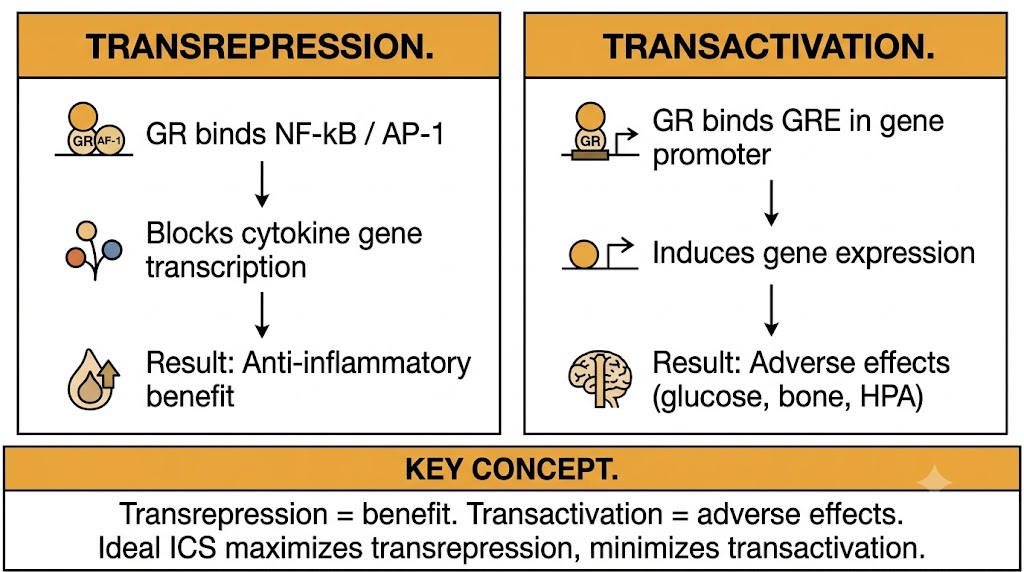
Two-panel diagram of glucocorticoid receptor mechanisms: left panel shows transrepression where GR binds NF-kB and AP-1 to block cytokine gene transcription producing anti-inflammatory benefit; right panel shows transactivation where GR binds GRE in gene promoter to induce gene expression producing adverse effects including glucose changes, bone loss, and HPA suppression. Shared key concept box states transrepression equals benefit and transactivation equals adverse effects.
Glucocorticoid receptor mechanisms: transrepression (anti-inflammatory benefit) versus transactivation (systemic adverse effects). Generated with Gemini AI for educational use.
Lipophilicity, Lung Retention, and First-Pass Metabolism

Lipophilicity is the most pharmacologically consequential property differentiating inhaled corticosteroid agents. Highly lipophilic agents dissolve into airway epithelial cell membranes, creating intracellular depots that sustain prolonged glucocorticoid receptor occupancy without requiring continuously high free drug concentrations. Fluticasone propionate and fluticasone furoate are the most lipophilic agents in clinical use, which explains their efficacy with once- or twice-daily dosing. Budesonide forms reversible fatty acid conjugates within airway cells — a chemically distinct mechanism of local retention.

Systemic bioavailability from swallowed drug (deposited in the oropharynx) is reduced by high hepatic first-pass extraction. Fluticasone propionate has approximately 99% first-pass extraction; budesonide approximately 90%. Both are therefore relatively systemic-safe even when oropharyngeal deposition is substantial. Ciclesonide and beclomethasone dipropionate are prodrugs activated by airway esterases; activation occurs primarily in the lower airways, reducing oropharyngeal deposition effects. Spacer use with pressurized metered-dose inhalers reduces oropharyngeal drug deposition and simultaneously improves lower airway deposition, providing a dual benefit for inhaled corticosteroid safety.

ICS Agent
Fluticasone Propionate / Furoate
  • Very high glucocorticoid receptor affinity
  • Very high lipophilicity — prolonged retention
  • ~99% first-pass extraction (low systemic bioavailability)
  • Pneumonia signal in COPD (propionate formulation)
ICS Agent
Budesonide
  • Intermediate lipophilicity
  • Fatty acid conjugation for airway retention
  • ~90% first-pass extraction
  • Preferred partner in SMART therapy (with formoterol)
Section 3

ICS Adverse Effects: Local and Systemic Risks

Oral candidiasis and dysphonia as local effects, hypothalamic-pituitary-adrenal axis suppression and bone density loss as systemic effects, and practical prevention strategies

Inhaled corticosteroid adverse effects span a spectrum from locally mediated oropharyngeal complications — common and largely preventable — to systemic effects that are dose-dependent and clinically significant primarily at higher doses.

Local Adverse Effects

Oral candidiasis is the most common local adverse effect. Topical glucocorticoids suppress local immune defenses in the oropharynx, reducing clearance of Candida albicans. Prevention is straightforward: rinsing the mouth with water and gargling after each inhaled corticosteroid dose, then spitting, removes deposited drug and substantially reduces incidence. Spacer use further reduces oropharyngeal deposition. Established oral candidiasis is treated with topical antifungals (clotrimazole or nystatin) or oral fluconazole for persistent cases.

Dysphonia (hoarseness) affects up to 30% of patients on regular inhaled corticosteroid therapy. The mechanism differs from oral candidiasis: dysphonia results from glucocorticoid-induced myopathy of the intrinsic laryngeal muscles rather than from surface drug deposition, so oropharyngeal rinsing does not reliably prevent it. Dose reduction, switching to a spacer, or choosing ciclesonide (with its lower oropharyngeal deposition) are the management options for susceptible patients, particularly professional voice users.

Systemic Adverse Effects

Hypothalamic-pituitary-adrenal axis suppression is the most clinically significant systemic adverse effect. Systemically absorbed inhaled corticosteroids suppress corticotropin-releasing hormone and adrenocorticotropic hormone secretion, reducing endogenous cortisol production. At standard low-to-medium doses, suppression is generally subclinical. At high doses — particularly above the equivalent of 1000 micrograms per day of fluticasone propionate — clinically meaningful suppression occurs, and patients face risk of secondary adrenal insufficiency during physiological stress such as surgery or major illness if inhaled corticosteroids are abruptly discontinued.

Bone mineral density reduction is a dose-dependent long-term effect. Glucocorticoids impair osteoblast function, increase osteoclast activity, and reduce intestinal calcium absorption. The magnitude is substantially smaller than with equivalent systemic corticosteroid doses, but patients on high-dose inhaled corticosteroids for prolonged periods — particularly postmenopausal women and older men — should have bone density monitored and receive supplemental calcium and vitamin D. Growth suppression in children has been demonstrated at approximately 1.2 centimeters of adult height reduction with budesonide in the Childhood Asthma Management Program trial, an effect that must be weighed against the developmental consequences of inadequately treated asthma.

Fluticasone Propionate Pneumonia Signal in COPD

Fluticasone propionate-containing combinations are associated with increased pneumonia incidence in COPD patients — demonstrated in the TORCH trial and multiple subsequent studies. This signal is attenuated or absent with budesonide-containing combinations. When inhaled corticosteroids are indicated in COPD, patient-specific pneumonia risk factors (prior pneumonia, low body mass index, severe airflow limitation) should influence the choice of inhaled corticosteroid agent.


Section 4

ICS/LABA Combinations and SMART Therapy

Molecular synergy between inhaled corticosteroids and long-acting beta-2 agonists, approved combination products, and the budesonide/formoterol SMART strategy

The pairing of inhaled corticosteroids and long-acting beta-2 agonists in fixed-dose combinations reflects pharmacological synergy at the molecular level, not merely the convenience of co-administration. These two drug classes interact at the glucocorticoid receptor and at the beta-2 adrenergic receptor in ways that enhance the effect of each.

Molecular Synergy

Inhaled corticosteroids upregulate beta-2 adrenergic receptor expression and inhibit receptor desensitization by suppressing the kinase responsible for receptor internalization. Conversely, long-acting beta-2 agonist-induced protein kinase A activation phosphorylates and activates the glucocorticoid receptor, enhancing its nuclear translocation and transcriptional activity. Both drug classes also cooperate to suppress the same pro-inflammatory transcription factors — nuclear factor-kappa B and activator protein-1 — through overlapping but distinct mechanisms, producing greater combined suppression than either drug achieves independently. The practical result is that an inhaled corticosteroid/long-acting beta-2 agonist combination provides equivalent anti-inflammatory control at a lower inhaled corticosteroid dose than inhaled corticosteroid monotherapy.

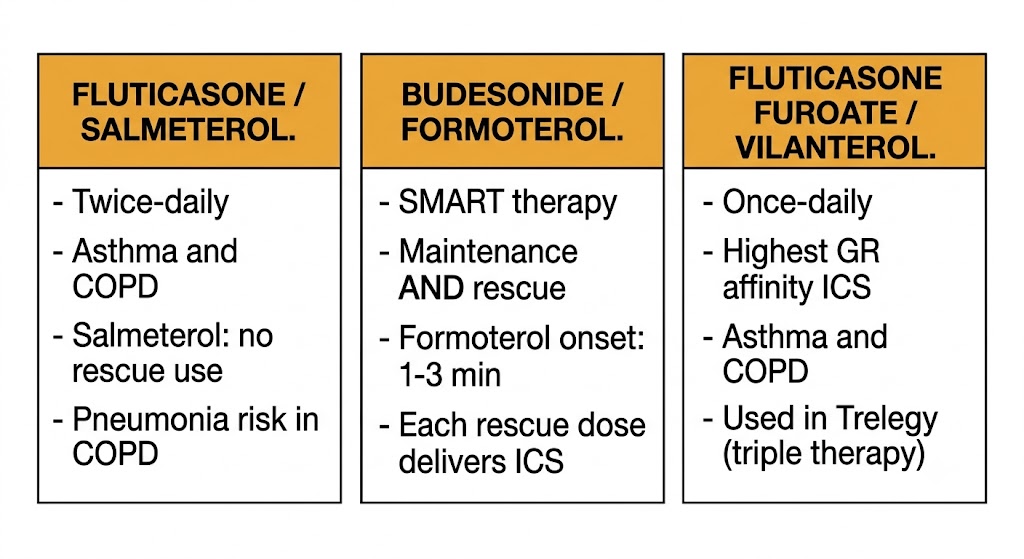
Three-panel comparison of ICS/LABA fixed-dose combinations: fluticasone/salmeterol (twice-daily, asthma and COPD, no rescue use, pneumonia risk in COPD); budesonide/formoterol (SMART therapy, maintenance and rescue, formoterol onset 1-3 minutes, each rescue dose delivers ICS); fluticasone furoate/vilanterol (once-daily, highest GR affinity ICS, asthma and COPD, used in Trelegy triple therapy).
ICS/LABA fixed-dose combinations: clinical distinctions and the SMART therapy concept. Generated with Gemini AI for educational use.
SMART Therapy: Single Maintenance and Reliever Therapy

SMART therapy uses budesonide/formoterol as both the scheduled daily maintenance inhaler and the as-needed rescue inhaler, replacing the traditional separate-inhaler approach. This strategy is uniquely possible with budesonide/formoterol because formoterol's rapid onset (1 to 3 minutes) allows it to serve as a rescue bronchodilator, while budesonide provides anti-inflammatory control with every dose — including rescue doses. Each additional inhalation during breakthrough symptoms delivers both bronchodilation and an anti-inflammatory controller dose.

The SYGMA 1 and SYGMA 2 trials demonstrated that as-needed budesonide/formoterol reduced severe exacerbations compared with as-needed short-acting beta-2 agonist alone and achieved non-inferiority to regular maintenance budesonide for exacerbation prevention, with approximately one-quarter the inhaled corticosteroid exposure. SMART cannot be implemented with salmeterol-containing combinations because salmeterol's slow onset (10 to 20 minutes) makes it unsuitable as a rescue agent.


Section 5

Triple Therapy and Eosinophil-Guided ICS Use in COPD

IMPACT and TRILOGY trial evidence, blood eosinophil thresholds for ICS benefit, the pneumonia trade-off, and step-up and step-down strategy in asthma and COPD

Triple therapy — inhaled corticosteroid/long-acting beta-2 agonist/long-acting muscarinic antagonist — represents the maximum pharmacological intensity of inhaled controller treatment. Rational use requires matching patients to this regimen based on exacerbation history and eosinophil biomarkers, and weighing the exacerbation reduction benefit against the pneumonia risk.

IMPACT and TRILOGY Trial Evidence

The IMPACT trial enrolled more than 10,000 patients with moderate-to-very-severe COPD and at least one exacerbation in the prior year, comparing single-inhaler triple therapy (fluticasone furoate/umeclidinium/vilanterol) against dual combinations. Triple therapy reduced moderate and severe exacerbations by 25% relative to long-acting beta-2 agonist/long-acting muscarinic antagonist and by 15% relative to inhaled corticosteroid/long-acting beta-2 agonist. However, confirmed pneumonia rates were higher in both fluticasone furoate-containing arms than in the bronchodilator-only arm. The TRILOGY trial confirmed a 23% exacerbation reduction with single-inhaler triple therapy over inhaled corticosteroid/long-acting beta-2 agonist dual therapy in severe COPD.

Eosinophil-Guided ICS Use in COPD

Blood eosinophil count is now the primary biomarker guiding inhaled corticosteroid decisions in COPD. Counts of 300 cells per microliter or higher predict consistent exacerbation-reduction benefit from inhaled corticosteroid-containing regimens and support triple therapy in patients with recurrent exacerbations on dual bronchodilator therapy. Counts between 100 and 300 cells per microliter suggest intermediate benefit; inhaled corticosteroid addition is considered individually based on exacerbation frequency and severity. Counts below 100 cells per microliter predict little if any benefit and carry increased pneumonia risk — inhaled corticosteroids should generally be withheld or withdrawn in this group.

Step-Up and Step-Down in Asthma

Step-up in asthma is triggered by persistent symptoms despite current therapy, one or more severe exacerbations in the past year, or reliever use more than twice weekly. Before stepping up, confirm the diagnosis, check inhaler technique, and assess adherence — these are the most common reasons for apparent treatment failure. Step-down should be considered after at least three months of sustained well-controlled asthma, beginning with inhaled corticosteroid dose reduction of approximately 25 to 50% before considering removal of add-on agents.

Eosinophil Thresholds for ICS in COPD

300 cells per microliter or higher: strong benefit from inhaled corticosteroid-containing regimens — triple therapy appropriate for recurrent exacerbators.

100–299 cells per microliter: intermediate benefit — consider inhaled corticosteroid addition individually based on exacerbation burden.

Below 100 cells per microliter: little benefit expected; increased pneumonia risk — avoid or withdraw inhaled corticosteroids.


Suggested References
Author / OrganizationTitleSource
Barnes PJCellular and molecular mechanisms of asthma and COPDClin Sci (Lond). 2017;131(13):1541–1558
Barnes PJInhaled corticosteroidsPharmaceuticals (Basel). 2010;3(3):514–540
Agusti A, Celli BR, Criner GJ, et alGlobal Initiative for Chronic Obstructive Lung Disease 2023 Report: GOLD executive summaryEur Respir J. 2023;61(4):2300239
Lipworth BJSystemic adverse effects of inhaled corticosteroid therapy: a systematic review and meta-analysisArch Intern Med. 1999;159(9):941–955
Pedersen SDo inhaled corticosteroids inhibit growth in children?Am J Respir Crit Care Med. 2001;164(4):521–535
Calverley PM, Anderson JA, Celli B, et alSalmeterol and fluticasone propionate and survival in chronic obstructive pulmonary diseaseN Engl J Med. 2007;356(8):775–789
Singh D, Papi A, Corradi M, et alSingle inhaler triple therapy versus inhaled corticosteroid plus long-acting beta2-agonist therapy for chronic obstructive pulmonary disease (TRILOGY)Lancet. 2016;388(10048):963–973
O'Byrne PM, FitzGerald JM, Bateman ED, et alInhaled combined budesonide-formoterol as needed in mild asthmaN Engl J Med. 2018;378(20):1865–1876
Lipson DA, Barnhart F, Brealey N, et alOnce-daily single-inhaler triple versus dual bronchodilator therapy in patients with COPDN Engl J Med. 2018;378(18):1671–1680
Reddel HK, Bacharier LB, Bateman ED, et alGlobal Initiative for Asthma Strategy 2021: executive summary and rationale for key changesAm J Respir Crit Care Med. 2022;205(1):17–35
Price D, Musgrave SD, Shepstone L, et alLeukotriene antagonists as first-line or add-on asthma-controller therapyN Engl J Med. 2011;364(18):1695–1707
Papi A, Brightling C, Pedersen SE, Reddel HKAsthmaLancet. 2018;391(10122):783–800