CHAPTER 25  ·  PULMONARY PHARMACOLOGY
Section 1

Methylxanthine Pharmacology: Mechanism, Pharmacokinetics, and Therapeutic Drug Monitoring

Phosphodiesterase inhibition and adenosine receptor antagonism as dual mechanisms, zero-order kinetics at therapeutic concentrations, the narrow therapeutic window, and aminophylline dosing equivalence

Theophylline is the oldest class of bronchodilator in clinical use. Although displaced from first-line therapy by safer agents, its narrow therapeutic window and complex pharmacokinetics make it one of the most consequential drugs to understand from a safety standpoint — and it retains a role in refractory disease and low-resource settings.

Dual Mechanism of Action

Theophylline produces bronchodilation through two complementary mechanisms. The primary mechanism at therapeutic concentrations is inhibition of phosphodiesterase 3 and phosphodiesterase 4 in airway smooth muscle and inflammatory cells. By blocking cyclic AMP degradation, theophylline raises intracellular cyclic AMP, activates protein kinase A, and produces bronchodilation — the same final pathway as beta-2 agonists, but reached via a different upstream target. Phosphodiesterase 4 inhibition in inflammatory cells adds a modest anti-inflammatory effect that is separate from bronchodilation.

The second mechanism is non-competitive antagonism of adenosine receptors — primarily A1 and A2B subtypes. Adenosine acting at A1 receptors promotes bronchoconstriction and acting at A2B receptors on mast cells triggers histamine release. Theophylline blockade of both contributes to bronchodilation and reduced mast cell degranulation at therapeutic concentrations. At higher concentrations, adenosine receptor antagonism also produces the cardiac and central nervous system toxicities that define theophylline's danger profile.

Pharmacokinetics and Therapeutic Drug Monitoring

Theophylline exhibits Michaelis-Menten (saturable, zero-order at therapeutic concentrations) kinetics, meaning that small increases in dose produce disproportionately large increases in plasma concentration once the metabolizing enzymes approach saturation. This non-linear relationship is the pharmacokinetic basis for theophylline's danger: a dose that is safe one day may become toxic the next if a drug interaction, illness, or change in smoking status alters clearance.

The therapeutic window is 10 to 20 micrograms per milliliter. Below 10 micrograms per milliliter, bronchodilatory efficacy is limited. Above 20 micrograms per milliliter, toxicity becomes likely. The margin between therapeutic and toxic concentrations is narrow enough that therapeutic drug monitoring is mandatory for any patient receiving scheduled theophylline. Aminophylline is the intravenous prodrug form — a theophylline-ethylenediamine salt that is approximately 80% theophylline by weight; doses are calculated accordingly.

Factors That Alter Theophylline Clearance

Clearance increases (lower levels): cigarette smoking (CYP1A2 induction), phenytoin, rifampin, high-protein diet.

Clearance decreases (higher levels, toxicity risk): ciprofloxacin and other fluoroquinolones, erythromycin, cimetidine, heart failure, liver disease, viral illness, cessation of smoking.

Any change in these factors requires prompt re-measurement of theophylline levels.


Section 2

Theophylline Toxicity: Organ System Effects and Clinical Management

Gastrointestinal, cardiac, and central nervous system manifestations of toxicity, the distinction between acute and chronic overdose, and management principles

Theophylline toxicity is a genuine clinical emergency. The organ system effects are predictable from its mechanisms — adenosine receptor antagonism and excessive cyclic AMP elevation — and range from the irritating to the life-threatening.

Toxicity Manifestations by System

Gastrointestinal effects are typically the earliest signs of rising theophylline levels: nausea, vomiting, and abdominal pain occur at concentrations only modestly above the therapeutic range and serve as warning symptoms. Central nervous system toxicity includes headache, irritability, and insomnia at moderate elevation, progressing to seizures at severely toxic concentrations. Theophylline-induced seizures are notoriously refractory to standard anticonvulsant therapy and carry high morbidity. Cardiac toxicity includes sinus tachycardia, atrial arrhythmias, and at very high concentrations, ventricular arrhythmias. The combination of seizures and cardiac arrhythmias at severely toxic levels makes theophylline overdose potentially fatal.

Chronic toxicity — slow accumulation from impaired clearance — can produce serious toxicity at lower absolute concentrations than acute single-dose overdose, because chronic exposure allows central nervous system sensitization to develop. A patient with a theophylline level of 25 micrograms per milliliter due to chronic accumulation from a drug interaction may be at greater seizure risk than an acute overdose patient at the same level. Management of severe toxicity includes activated charcoal (for gastrointestinal decontamination in acute ingestion), aggressive seizure management with benzodiazepines, cardiac monitoring, and hemodialysis for refractory life-threatening toxicity.
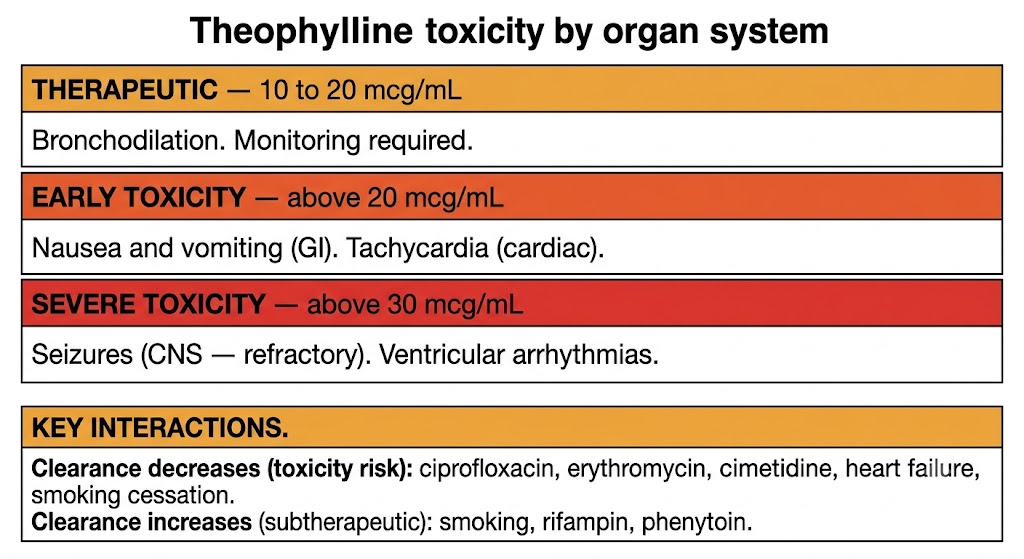
Theophylline toxicity by organ system shown in three escalating tiers: therapeutic range 10-20 mcg/mL with bronchodilation; early toxicity above 20 mcg/mL with nausea, vomiting, and tachycardia; severe toxicity above 30 mcg/mL with refractory seizures and ventricular arrhythmias. Key interactions box lists drugs that decrease clearance (toxicity risk) and increase clearance (subtherapeutic levels).
Theophylline toxicity: dose-dependent organ system effects and clinically important drug interactions. Generated with Gemini AI for educational use.
Theophylline Toxicity: High-Yield Points

Therapeutic window: 10 to 20 micrograms per milliliter. Non-linear kinetics mean small dose changes can cause large concentration changes near saturation.

Early toxicity: nausea and vomiting. Serious toxicity: seizures (refractory to standard anticonvulsants) and ventricular arrhythmias.

Chronic toxicity causes seizures at lower concentrations than acute overdose. Smoking cessation in a patient on theophylline is a common precipitant — CYP1A2 induction from smoking disappears, levels rise.

Section 3

The Leukotriene Pathway: Arachidonic Acid Metabolism and Airway Pathophysiology

Arachidonic acid release, 5-lipoxygenase and 5-lipoxygenase-activating protein, leukotriene A4 to cysteinyl leukotriene synthesis, and the bronchoconstrictor and pro-inflammatory actions of cysteinyl leukotrienes in asthma

Cysteinyl leukotrienes are among the most potent bronchoconstrictors produced in the human airway and are central mediators of both the early and late phases of the asthmatic response. Understanding their biosynthetic pathway directly maps to the two pharmacological targets available for leukotriene-modifying therapy.

Biosynthesis: From Arachidonic Acid to Cysteinyl Leukotrienes

Arachidonic acid is released from membrane phospholipids by phospholipase A2, which is activated in mast cells, eosinophils, and other inflammatory cells during allergen challenge or airway injury. Arachidonic acid is then metabolized through two competing pathways: the cyclooxygenase pathway produces prostaglandins and thromboxanes; the 5-lipoxygenase pathway produces leukotrienes. 5-lipoxygenase requires its activating protein (5-lipoxygenase-activating protein, FLAP) to function; FLAP anchors 5-lipoxygenase to the nuclear membrane and presents arachidonic acid to the enzyme. Inhibiting FLAP prevents 5-lipoxygenase from accessing its substrate — an alternative therapeutic target to direct enzyme inhibition.

5-lipoxygenase converts arachidonic acid to leukotriene A4, which is then conjugated with glutathione to form leukotriene C4. Sequential peptide cleavage produces leukotriene D4 and leukotriene E4 — together these three are the cysteinyl leukotrienes. Leukotriene D4 is the most potent bronchoconstrictor of the three and acts at CysLT1 receptors on airway smooth muscle to produce bronchoconstriction 100 to 1000 times more potently than histamine on a molar basis. Beyond bronchoconstriction, cysteinyl leukotrienes increase vascular permeability, stimulate mucus secretion, recruit eosinophils, and promote airway remodeling.


Section 4

Leukotriene Receptor Antagonists and Zileuton

Montelukast and zafirlukast as CysLT1 antagonists, zileuton as a 5-lipoxygenase inhibitor, clinical indications, the montelukast neuropsychiatric black box warning, and drug interactions

Leukotriene modifiers divide into two mechanistic classes: CysLT1 receptor antagonists that block the bronchoconstrictor effects of cysteinyl leukotrienes at their receptor, and 5-lipoxygenase inhibitors that prevent leukotriene synthesis entirely. Both classes are used as add-on controller therapy in asthma.

Leukotriene Receptor Antagonists: Montelukast and Zafirlukast

Montelukast and zafirlukast are selective competitive antagonists at the CysLT1 receptor on airway smooth muscle, blocking the bronchoconstriction, mucus secretion, and pro-inflammatory effects of leukotriene C4, D4, and E4. Both are orally administered and reduce airway inflammation, exacerbation frequency, and bronchial hyperresponsiveness in asthma. They are particularly effective in exercise-induced bronchoconstriction and in allergic rhinitis with coexistent asthma, where the leukotriene pathway is prominently activated. In aspirin-exacerbated respiratory disease, leukotriene receptor antagonists are a mainstay of management because the underlying pathophysiology involves excess leukotriene production.

Montelukast carries a black box warning for serious neuropsychiatric adverse effects including agitation, depression, suicidal ideation, and completed suicides, added by the FDA in 2020 based on post-marketing data. This warning applies to all patients but is of particular concern in pediatric patients, where montelukast is commonly prescribed. Prescribers must weigh this risk against benefit, especially in patients with pre-existing psychiatric conditions. The warning has led GINA guidelines to position leukotriene receptor antagonists as alternatives to low-dose inhaled corticosteroids rather than preferred first-line agents.

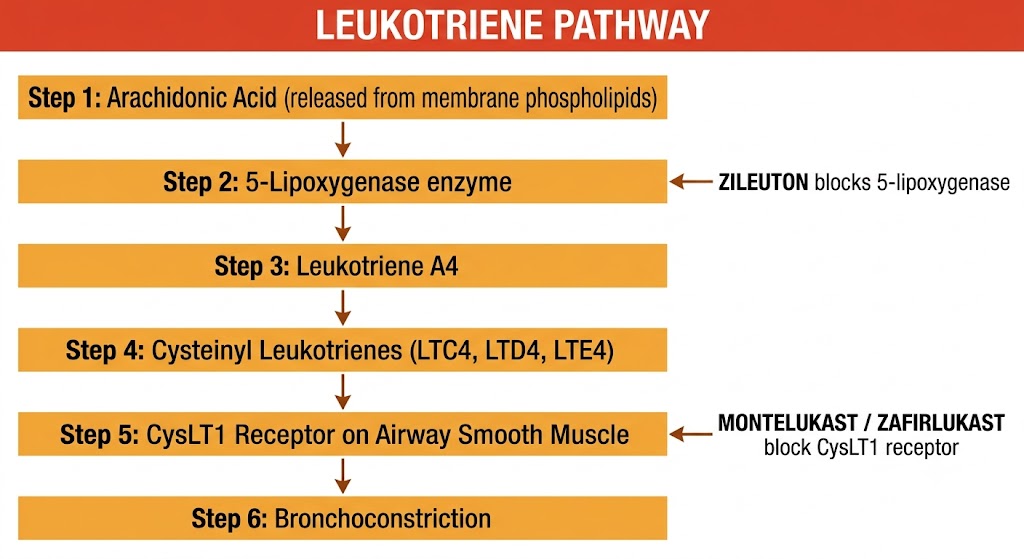
Leukotriene pathway flow diagram from arachidonic acid through 5-lipoxygenase to cysteinyl leukotrienes and CysLT1 receptor, with zileuton blocking 5-lipoxygenase at step 2 and montelukast and zafirlukast blocking the CysLT1 receptor at step 5.
Leukotriene biosynthesis pathway with drug intervention points: zileuton (5-lipoxygenase inhibitor) and montelukast/zafirlukast (CysLT1 receptor antagonists). Generated with Gemini AI for educational use.
Zileuton: 5-Lipoxygenase Inhibitor

Zileuton directly inhibits 5-lipoxygenase, preventing the conversion of arachidonic acid to leukotriene A4 and thereby blocking synthesis of all downstream leukotrienes, including both cysteinyl leukotrienes and leukotriene B4. This upstream blockade distinguishes zileuton from leukotriene receptor antagonists, which only block the receptor for cysteinyl leukotrienes. Zileuton is approved as add-on therapy in persistent asthma and requires four-times-daily dosing (an extended-release formulation allows twice-daily dosing), which reduces adherence compared with once-daily montelukast. Zileuton is a significant inhibitor of CYP1A2 and raises theophylline levels substantially; the combination requires theophylline dose reduction and monitoring. Hepatotoxicity is a class-specific concern with zileuton; liver function tests should be monitored periodically.

CysLT1 Antagonists
Montelukast / Zafirlukast
  • Block CysLT1 receptor on airway smooth muscle
  • Oral, once-daily (montelukast)
  • Effective in exercise-induced bronchoconstriction and allergic rhinitis
  • Black box warning: neuropsychiatric effects (montelukast)
5-LOX Inhibitor
Zileuton
  • Blocks 5-lipoxygenase — prevents all leukotriene synthesis
  • Four-times-daily dosing (adherence challenge)
  • Inhibits CYP1A2 — raises theophylline levels
  • Monitor liver function tests

Section 5

Mast Cell Stabilizers and Aspirin-Exacerbated Respiratory Disease

Cromolyn and nedocromil mechanisms and clinical limitations, and the pathophysiology and management of aspirin-exacerbated respiratory disease

Mast cell stabilizers were once widely used in asthma but have been largely supplanted by inhaled corticosteroids. Aspirin-exacerbated respiratory disease represents a distinct clinical syndrome where leukotriene pathway pharmacology is central to both pathophysiology and management.

Cromolyn and Nedocromil

Cromolyn sodium and nedocromil inhibit mast cell degranulation, preventing the release of histamine, cysteinyl leukotrienes, and other mediators in response to allergen challenge. Their precise molecular mechanism involves blockade of chloride channels in mast cell membranes, stabilizing the cell against activation signals. Both are inhaled agents with an excellent safety profile — they have no systemic adverse effects of significance — but require four-times-daily dosing and produce less anti-inflammatory efficacy than even low-dose inhaled corticosteroids. They are now rarely used in adults, with a residual role in children with mild asthma where parents are particularly concerned about corticosteroid adverse effects, and in exercise-induced bronchoconstriction prophylaxis when inhaled corticosteroids are not tolerated.

Aspirin-Exacerbated Respiratory Disease

Aspirin-exacerbated respiratory disease is a clinical triad of asthma, chronic rhinosinusitis with nasal polyposis, and hypersensitivity reactions to aspirin and other nonsteroidal anti-inflammatory drugs. The pathophysiology is pharmacological rather than immunological: inhibition of cyclooxygenase-1 by aspirin and nonsteroidal anti-inflammatory drugs blocks the prostaglandin E2 production that normally restrains leukotriene synthesis and mast cell activation. With prostaglandin E2 removed, arachidonic acid is shunted through the 5-lipoxygenase pathway, producing a surge of cysteinyl leukotrienes that triggers bronchoconstriction, nasal symptoms, and urticaria within 30 to 180 minutes of aspirin ingestion.

Because the reaction is pharmacological rather than IgE-mediated, it occurs with all cyclooxygenase-1 inhibitors and not just aspirin specifically. Acetaminophen at doses below 1 gram and celecoxib (a selective cyclooxygenase-2 inhibitor) at standard doses are generally safe alternatives. Management centers on nonsteroidal anti-inflammatory drug avoidance, nasal corticosteroids, leukotriene receptor antagonists (which blunt the leukotriene surge), and sinus surgery for polyp burden. Aspirin desensitization — performed at specialized centers — can allow aspirin tolerance in patients who require antiplatelet therapy for cardiovascular indications.

Aspirin-Exacerbated Respiratory Disease: Key Teaching Points

Triad: asthma + nasal polyps + aspirin/nonsteroidal anti-inflammatory drug sensitivity. Reaction is pharmacological (cyclooxygenase-1 inhibition), not IgE-mediated.

Safe analgesics: acetaminophen below 1 gram per dose; celecoxib at standard doses.

Treatment: avoid nonsteroidal anti-inflammatory drugs; leukotriene receptor antagonists are particularly effective because leukotriene excess is the direct mechanism of the reaction.


Suggested References
Author / OrganizationTitleSource
Barnes PJTheophyllineAm J Respir Crit Care Med. 2013;188(8):901–906
Hendeles L, Weinberger MTheophylline: a state of the art reviewPharmacotherapy. 1983;3(1):2–44
Shannon MLife-threatening events after theophylline overdose: a 10-year prospective analysisArch Intern Med. 1999;159(9):989–994
Zevin S, Benowitz NLDrug interactions with tobacco smoking: an updateClin Pharmacokinet. 1999;36(6):425–438
Samuelsson BLeukotrienes: mediators of immediate hypersensitivity reactions and inflammationScience. 1983;220(4597):568–575
Drazen JM, Israel E, O'Byrne PMTreatment of asthma with drugs modifying the leukotriene pathwayN Engl J Med. 1999;340(3):197–206
Clarridge K, Chin S, Eworuke E, Seymour SA boxed warning for montelukast: the FDA perspectiveJ Allergy Clin Immunol Pract. 2021;9(7):2638–2641
Wechsler ME, Garpestad E, Flier SR, et alPulmonary infiltrates, eosinophilia, and cardiomyopathy following corticosteroid withdrawal in patients with asthma receiving zafirlukastJAMA. 1998;279(6):455–457
Stevenson DD, Szczeklik AClinical and pathologic perspectives on aspirin sensitivity and asthmaJ Allergy Clin Immunol. 2006;118(4):773–786
Israel E, Reddel HKSevere and difficult-to-treat asthma in adultsN Engl J Med. 2017;377(10):965–976