CHAPTER 25  ·  PULMONARY PHARMACOLOGY
Section 1

Severe Asthma Phenotypes and Biomarkers

Type 2 high versus type 2 low disease, the three biomarkers guiding biologic eligibility, and the immunological basis for drug selection

Biologic agents for severe asthma are not broad-spectrum anti-inflammatory drugs — each targets a specific cytokine or receptor within a defined inflammatory pathway. Matching the right agent to the right patient requires identifying the dominant immunological phenotype, a determination guided by three measurable biomarkers.

Type 2 High Disease: The Treatable Target

Approximately 50 to 60 percent of patients with severe asthma have type 2 high (T2-high) disease, defined by activation of the type 2 helper T-cell cytokine axis and innate lymphoid cell type 2 signaling. The central cytokines are interleukin-4, interleukin-5, and interleukin-13. Interleukin-4 drives B-cell class switching to IgE production and promotes eosinophil recruitment. Interleukin-5 is the principal growth factor, maturation signal, and survival factor for eosinophils — the primary driver of blood and airway eosinophilia. Interleukin-13 induces goblet cell metaplasia, smooth muscle hyperresponsiveness, and subepithelial fibrosis. The three currently approved biologic targets — IgE, interleukin-5 (and its receptor), and the shared interleukin-4/interleukin-13 receptor subunit — all operate within this T2-high pathway.

Type 2 low disease encompasses patients whose severe asthma is driven by neutrophilic, non-eosinophilic, or poorly characterized mechanisms. No approved biologic agents are effective for type 2 low disease; these patients are managed with maximized conventional inhaled therapy and low-dose oral corticosteroids where necessary.

The Three Guiding Biomarkers

Blood eosinophil count is the most widely used biomarker. A count at or above 300 cells per microliter is the threshold most consistently associated with clinical response to anti-interleukin-5 agents; counts at or above 150 cells per microliter serve as lower-boundary eligibility criteria for some agents. Fractional exhaled nitric oxide reflects eosinophilic airway inflammation driven by interleukin-13 and interleukin-4; values at or above 25 parts per billion suggest T2-high inflammation, and values above 50 parts per billion predict stronger responses to interleukin-4/interleukin-13 pathway blockade. Serum total IgE is required for omalizumab dosing — the dosing table is defined by IgE level and body weight, and very high IgE values may fall outside the eligible range.

Biomarker-to-Drug Mapping

Elevated IgE (plus allergic sensitization) → omalizumab (anti-IgE).

Elevated blood eosinophils (≥300 cells/µL) → anti-interleukin-5 agents (mepolizumab, reslizumab, benralizumab).

Elevated fractional exhaled nitric oxide or eosinophils with co-existing atopic dermatitis or chronic rhinosinusitis with nasal polyps → dupilumab (anti-interleukin-4 receptor alpha).


Section 2

Anti-IgE Therapy: Omalizumab

Mechanism of IgE neutralization, dosing by IgE level and body weight, indications, and the anaphylaxis risk requiring supervised administration

Omalizumab was the first approved biologic for severe asthma and targets the upstream IgE-mediated allergic sensitization that initiates mast cell and basophil activation in allergic T2-high disease.

Mechanism

Omalizumab is a humanized monoclonal antibody that binds free IgE at the same site recognized by the high-affinity IgE receptor (FcεRI) on mast cells and basophils. By binding free IgE in circulation, omalizumab prevents IgE from attaching to mast cell surfaces. Without surface-bound IgE, allergen crosslinking cannot occur and mast cell degranulation is suppressed. A secondary effect is downregulation of FcεRI receptor expression on mast cells and basophils over weeks of treatment, further reducing the cellular sensitivity to any remaining IgE. Omalizumab does not displace IgE already bound to mast cell receptors.

Dosing, Indications, and Safety

Dosing is determined by both the baseline serum total IgE level and body weight, using a prescribing table that specifies subcutaneous doses of 150 to 375 mg every two to four weeks. Patients with IgE levels outside the table range (too low or too high) are not eligible. Omalizumab is approved for moderate-to-severe allergic asthma inadequately controlled on inhaled corticosteroids in patients aged six and older with confirmed allergic sensitization (positive skin test or in vitro reactivity to a perennial allergen) and a baseline IgE within the eligible range.

Anaphylaxis is the most important safety concern, occurring in approximately 0.1 to 0.2% of patients, most commonly within two hours of the first three injections. Omalizumab must be administered in a healthcare setting with observation for at least 30 minutes after each of the first three doses, and patients must be equipped with an epinephrine autoinjector. Delayed anaphylaxis beyond two hours has also been reported, albeit rarely.
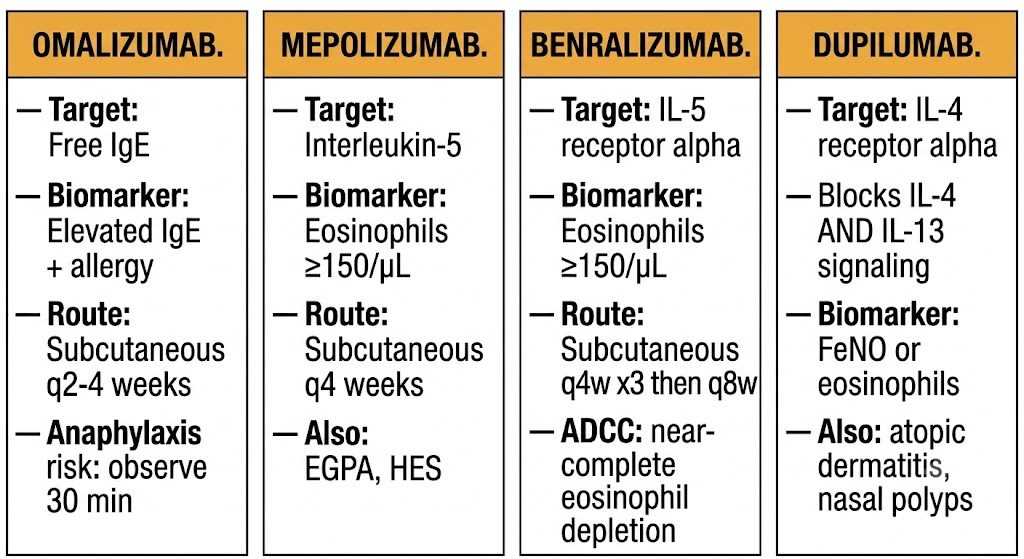
Four-panel comparison of biologic agents for severe asthma: omalizumab targeting free IgE, mepolizumab targeting interleukin-5, benralizumab targeting IL-5 receptor alpha with ADCC eosinophil depletion, and dupilumab targeting IL-4 receptor alpha to block both interleukin-4 and interleukin-13 signaling, with biomarkers, routes, and dosing frequencies for each.
Approved biologic agents for severe asthma: targets, biomarkers, routes, and key clinical distinctions. Generated with Gemini AI for educational use.

Section 3

Anti-IL-5 and Anti-IL-5 Receptor Alpha Agents

Mepolizumab and reslizumab as interleukin-5 neutralizers, benralizumab as an interleukin-5 receptor alpha antagonist with antibody-dependent cellular cytotoxicity, and the clinical distinctions between the three agents

Three biologic agents target the interleukin-5 pathway, which is the principal cytokine driver of eosinophil maturation, recruitment, and survival. They differ in their precise molecular targets, routes of administration, dosing intervals, and secondary mechanisms of eosinophil depletion.

Mepolizumab and Reslizumab: Interleukin-5 Neutralization

Mepolizumab and reslizumab are humanized monoclonal antibodies that bind interleukin-5 directly, preventing it from interacting with the interleukin-5 receptor on eosinophil precursors and mature eosinophils. By neutralizing interleukin-5, they reduce eosinophil production in the bone marrow, impair eosinophil recruitment to the airway, and reduce eosinophil survival — producing sustained reductions in blood and tissue eosinophil counts. Mepolizumab is given subcutaneously every four weeks and is approved for severe eosinophilic asthma in patients aged six and older with blood eosinophils at or above 150 cells per microliter. Reslizumab is given intravenously every four weeks and is approved for adults with blood eosinophils at or above 400 cells per microliter.

Benralizumab: Interleukin-5 Receptor Alpha Blockade and Cellular Cytotoxicity

Benralizumab differs from mepolizumab and reslizumab by targeting the interleukin-5 receptor alpha subunit on eosinophils and basophils rather than interleukin-5 itself. This distinction carries an important secondary mechanism: benralizumab is afucosylated (engineered to lack the fucose sugar on its Fc region), which dramatically enhances binding to FcγRIII on natural killer cells and macrophages, triggering antibody-dependent cellular cytotoxicity of eosinophils and basophils. The result is near-complete depletion of blood and tissue eosinophils — a more profound reduction than achieved by interleukin-5 neutralization alone. Benralizumab is given subcutaneously every four weeks for the first three doses, then every eight weeks, which is the most convenient dosing schedule in the anti-interleukin-5 class. It is approved for severe eosinophilic asthma in patients aged 12 and older.

Anti-IL-5
Mepolizumab
  • Binds interleukin-5 directly
  • Subcutaneous every 4 weeks
  • Eosinophils ≥150 cells/µL
  • Age ≥6 years
Anti-IL-5
Reslizumab
  • Binds interleukin-5 directly
  • Intravenous every 4 weeks
  • Eosinophils ≥400 cells/µL
  • Adults only
Anti-IL-5Rα
Benralizumab
  • Binds interleukin-5 receptor alpha
  • Subcutaneous; q4w ×3 then q8w
  • Near-complete eosinophil depletion
  • Age ≥12 years

Section 4

Anti-IL-4Rα Therapy: Dupilumab

Dual blockade of interleukin-4 and interleukin-13 signaling through the shared receptor subunit, approved indications beyond asthma, and the clinical profile in type 2 high disease

Dupilumab targets the broadest swath of the type 2 inflammatory pathway of any approved asthma biologic by blocking the receptor subunit shared by both interleukin-4 and interleukin-13 signaling — simultaneously interrupting IgE class switching, eosinophil recruitment, goblet cell metaplasia, and airway smooth muscle hyperresponsiveness.

Mechanism: Dual Cytokine Blockade

Dupilumab is a humanized monoclonal antibody that binds the interleukin-4 receptor alpha subunit, which is the shared component of both the type I interleukin-4 receptor (interleukin-4R alpha/gamma-c heterodimer, which mediates interleukin-4 signaling on hematopoietic cells) and the type II receptor (interleukin-4R alpha/interleukin-13R alpha-1 heterodimer, which mediates both interleukin-4 and interleukin-13 signaling on non-hematopoietic cells including airway epithelium and smooth muscle). By blocking interleukin-4 receptor alpha, dupilumab simultaneously prevents both interleukin-4 and interleukin-13 from signaling through their respective receptor complexes on airway structural cells. This dual blockade suppresses IgE production, reduces fractional exhaled nitric oxide (a marker of interleukin-13-driven eosinophilic inflammation), reduces goblet cell metaplasia, and improves airway smooth muscle hyperresponsiveness.

Indications and Clinical Profile

Dupilumab is approved for moderate-to-severe asthma as an add-on maintenance therapy in patients aged 6 and older with an eosinophilic phenotype or oral corticosteroid-dependent asthma. Unlike anti-interleukin-5 agents, dupilumab does not require a specific eosinophil threshold for eligibility — it is effective across a broader range of T2-high disease including patients whose dominant biomarker is elevated fractional exhaled nitric oxide rather than blood eosinophilia.

Dupilumab's therapeutic scope extends well beyond asthma: it is also approved for moderate-to-severe atopic dermatitis (its original indication), chronic rhinosinusitis with nasal polyps, eosinophilic esophagitis, and prurigo nodularis. This breadth reflects the central role of the interleukin-4/interleukin-13 axis across multiple type 2 inflammatory diseases. In patients with severe asthma who also have atopic dermatitis or chronic rhinosinusitis with nasal polyps — common comorbidities — dupilumab offers the advantage of treating all conditions with a single biologic. The most common adverse effects are injection site reactions and conjunctivitis; the conjunctivitis is particularly associated with atopic dermatitis dosing and is less prominent at asthma doses.


Section 5

Practical Prescribing: Patient Selection and Biologic Switching

Eligibility criteria, step-down of oral corticosteroids after biologic initiation, switching between biologics, and cost considerations

Biologic therapy is reserved for patients with severe asthma that remains uncontrolled on step 4 therapy — high-dose inhaled corticosteroid/long-acting beta-2 agonist — or who require maintenance oral corticosteroids. The practical decision framework centers on which biomarker is most elevated and what comorbidities are present.

Patient Selection Framework

All biologic candidates must have confirmed severe asthma (frequent exacerbations or oral corticosteroid dependence despite optimized inhaled therapy), confirmed T2-high phenotype by biomarker, and documented adherence and correct inhaler technique — the most common reasons patients appear refractory to conventional therapy. Once biologic therapy is initiated, a treatment trial of at least four to six months is required before assessing response, as eosinophil counts and exacerbation rates take time to stabilize at new baselines.

Biologic therapy produces substantial oral corticosteroid-sparing effects in patients who were previously corticosteroid-dependent. After initiating a biologic, oral corticosteroid doses should be tapered gradually over weeks to months, guided by symptom control and exacerbation frequency. The ability to reduce or eliminate oral corticosteroid exposure is one of the most clinically meaningful benefits of biologic therapy, given the cumulative toxicity of chronic oral corticosteroids.

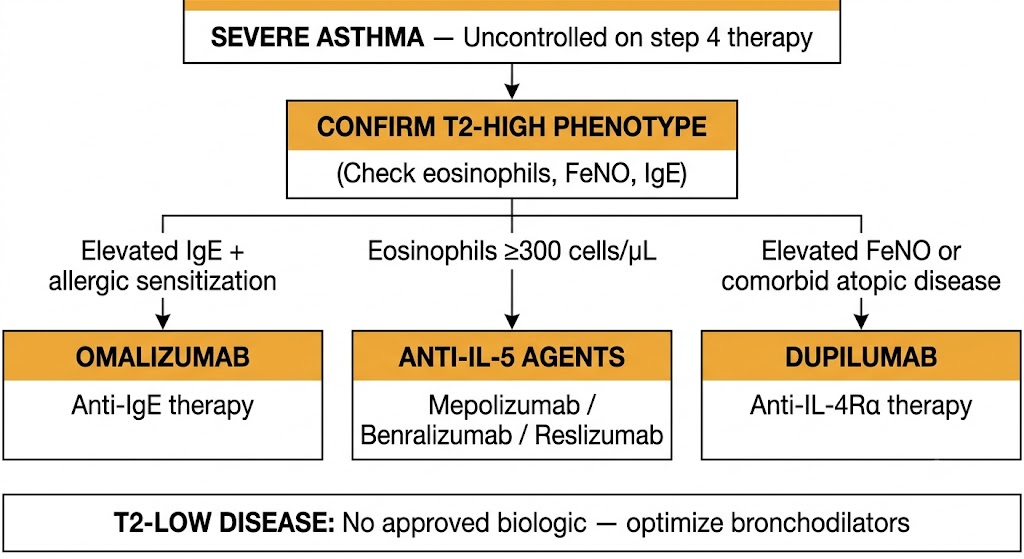
Decision flowchart for biologic selection in severe asthma showing three branches from confirmed T2-high phenotype: elevated IgE plus allergic sensitization leads to omalizumab, eosinophils 300 or more leads to anti-IL-5 agents including mepolizumab, benralizumab, and reslizumab, and elevated FeNO or comorbid atopic disease leads to dupilumab. A shared footer box states T2-low disease has no approved biologic and should be managed with optimized bronchodilators.
Biologic selection framework for severe asthma: biomarker-driven decision pathway. Generated with Gemini AI for educational use.
Switching and Combination Considerations

If response to an initial biologic is inadequate after a full trial period, switching to an agent targeting a different pathway is appropriate. A patient who fails anti-interleukin-5 therapy despite confirmed eosinophilia may respond to dupilumab, since the interleukin-4/interleukin-13 axis drives additional aspects of T2-high disease beyond eosinophil survival. Combination biologic therapy (two agents simultaneously) is not standard practice and is not reimbursed in most healthcare systems. Biologic agents are extremely expensive — typically tens of thousands of dollars annually — and require prior authorization demonstrating failure of conventional step-up therapy and confirmed biomarker eligibility.

Biologic Selection at a Glance

High IgE + allergic sensitization → omalizumab. Requires IgE within dosing table range and confirmed perennial allergen sensitization.

High eosinophils (≥300 cells/µL) → mepolizumab or benralizumab (subcutaneous); reslizumab (intravenous, eosinophils ≥400).

High fractional exhaled nitric oxide or multiple type 2 comorbidities (atopic dermatitis, nasal polyps) → dupilumab. No eosinophil threshold required.

T2-low disease → no approved biologic; optimize bronchodilator therapy.


Suggested References
Author / OrganizationTitleSource
Wenzel SEAsthma phenotypes: the evolution from clinical to molecular approachesNat Med. 2012;18(5):716–725
Holgate ST, Wenzel S, Postma DS, Weiss ST, Renz H, Sly PDAsthmaNat Rev Dis Primers. 2015;1:15025
Normansell R, Walker S, Milan SJ, Walters EH, Nair POmalizumab for asthma in adults and childrenCochrane Database Syst Rev. 2014;(1):CD003559
Humbert M, Beasley R, Ayres J, et alBenefits of omalizumab as add-on therapy in patients with severe persistent asthma (INNOVATE)Allergy. 2005;60(3):309–316
Cox L, Platts-Mills TA, Finegold I, et alJoint Task Force Report on omalizumab-associated anaphylaxisJ Allergy Clin Immunol. 2007;120(6):1373–1377
Ortega HG, Liu MC, Pavord ID, et alMepolizumab treatment in patients with severe eosinophilic asthmaN Engl J Med. 2014;371(13):1198–1207
Castro M, Zangrilli J, Wechsler ME, et alReslizumab for inadequately controlled asthma with elevated blood eosinophil countsLancet Respir Med. 2015;3(5):355–366
Bleecker ER, FitzGerald JM, Chanez P, et alEfficacy and safety of benralizumab for patients with severe asthma uncontrolled with high-dosage inhaled corticosteroids and long-acting beta2-agonists (SIROCCO)Lancet. 2016;388(10056):2115–2127
FitzGerald JM, Bleecker ER, Nair P, et alBenralizumab, an anti-interleukin-5 receptor alpha monoclonal antibody, as add-on treatment for patients with severe, uncontrolled, eosinophilic asthma (CALIMA)Lancet. 2016;388(10056):2128–2141
Wenzel S, Castro M, Corren J, et alDupilumab efficacy and safety in adults with uncontrolled persistent asthma despite use of medium-to-high-dose inhaled corticosteroids plus a long-acting beta2 agonistLancet. 2016;388(10039):31–44