Chapter 12  ·  Sedative-Hypnotic Drugs
Section 1

Introduction

Three mechanistically distinct alternatives to benzodiazepines for insomnia

The pharmacotherapy of insomnia has expanded considerably beyond benzodiazepines, driven by recognition of their limitations and by advances in understanding the neurobiology of sleep-wake regulation. Three mechanistically distinct drug classes have emerged as alternatives: the non-benzodiazepine hypnotics, known as Z-drugs, which retain gamma-aminobutyric acid type A receptor modulation but with claimed subunit selectivity; the melatonin receptor agonists, which exploit circadian rhythm pathways; and the orexin receptor antagonists, which target the wake-promoting orexin system. Each class carries a distinct pharmacological profile with meaningful clinical implications for drug selection, adverse effect management, and appropriate patient matching.

Current evidence-based guidelines consistently identify cognitive behavioral therapy for insomnia as first-line treatment for chronic insomnia disorder. Pharmacotherapy is indicated as adjunctive treatment when cognitive behavioral therapy is unavailable, has failed, or when rapid symptom control is needed. Among pharmacological options, agent selection is guided by the type of insomnia complaint (sleep-onset versus sleep-maintenance), comorbidities, polypharmacy risk, patient age, and abuse potential.


Section 2

Z-Drugs: Non-Benzodiazepine GABA-A Positive Allosteric Modulators

Zolpidem, zaleplon, and eszopiclone — mechanism, key distinctions, and safety concerns

The Z-drugs — zolpidem, zaleplon, and eszopiclone — are structurally unrelated to benzodiazepines but share the same benzodiazepine binding site on the gamma-aminobutyric acid type A receptor. Their principal claimed pharmacological distinction is relative selectivity for receptors containing the alpha-1 subunit, which mediates sedation, over alpha-2 and alpha-3 subunits that mediate anxiolysis and muscle relaxation. In practice, this selectivity is dose-dependent and partial, and the clinical separation from benzodiazepine-like effects is incomplete, particularly at higher doses.

Individual Agent Profiles
Z-Drug
Zolpidem
  • Most widely prescribed hypnotic in the United States
  • Immediate-release: onset 30 minutes, half-life 1.5–2.5 hours. Primarily for sleep-onset insomnia.
  • Extended-release: biphasic release for sleep-maintenance insomnia. Greater next-day sedation risk.
  • FDA revised standard dose in 2013: 5 mg for women, 5–10 mg for men. Women have higher and more prolonged plasma levels, causing next-morning driving impairment.
  • Metabolism: cytochrome P450 3A4 (primary). Strong inhibitors increase levels; inducers reduce efficacy.
Z-Drug
Zaleplon
  • Shortest half-life of the three Z-drugs: approximately 1 hour
  • Uniquely suited for sleep-onset insomnia and middle-of-the-night awakening when at least 4 hours of sleep time remain
  • Minimal next-day residual effect at recommended timing
  • No benefit for sleep-maintenance insomnia
  • Metabolized primarily by aldehyde oxidase (not cytochrome P450 3A4), making it less susceptible to cytochrome P450 drug interactions
Z-Drug
Eszopiclone
  • Longest half-life of the three Z-drugs: approximately 6 hours (extended to 9 hours in elderly patients)
  • Only Z-drug approved for both sleep-onset and sleep-maintenance insomnia
  • First hypnotic approved without restriction to short-term use, based on a 6-month efficacy trial
  • Distinctive adverse effect: metallic or bitter taste in 17–34% of patients, significantly affecting tolerability
  • Metabolized by cytochrome P450 3A4 and cytochrome P450 2E1
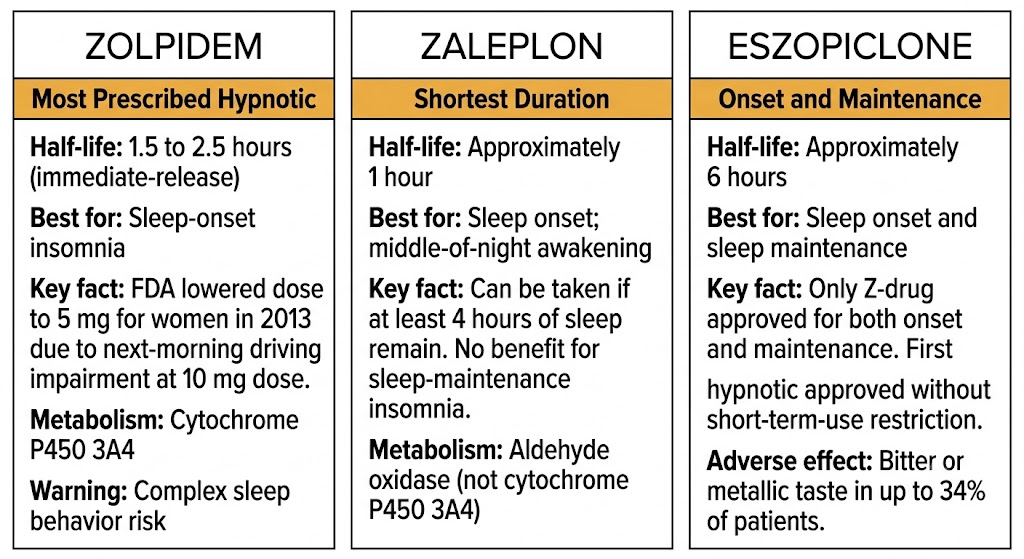
Three-panel diagram comparing the pharmacokinetic profiles of zolpidem, zaleplon, and eszopiclone.
Figure generated by Gemini AI.
Critical Safety Concerns

All Z-drugs are Schedule IV controlled substances with documented abuse and dependence potential. Physical dependence is less severe than with classical benzodiazepines but is clinically real. Rebound insomnia upon discontinuation is well-documented.

Boxed Warning: Complex Sleep Behaviors

In 2019, the FDA issued a boxed warning for all Z-drugs regarding complex sleep behaviors: sleepwalking, sleep-driving, and engaging in other activities while not fully awake with no memory of the event. These behaviors have resulted in serious injuries and deaths. Patients who experience any complex sleep behavior must immediately discontinue the medication. The FDA mandated that manufacturers add a contraindication for use in patients who have previously experienced complex sleep behaviors with any sedative-hypnotic.

Next-Day Impairment and Special Populations

All Z-drugs carry risk of next-morning cognitive and psychomotor impairment, particularly with higher doses, extended-release formulations, and in elderly patients. The 2013 FDA dose revision for zolpidem was driven specifically by driving simulation studies demonstrating impairment in women at standard 10-milligram doses. Any patient taking a Z-drug should be counseled that next-morning activities requiring full alertness, including driving, may be impaired.

All Z-drugs are included in the American Geriatrics Society Beers Criteria as medications to avoid in older adults due to increased sensitivity to central nervous system effects, elevated fall and fracture risk, and risk of cognitive impairment. If a hypnotic is necessary in an elderly patient, the lowest effective dose of a shorter-acting agent is preferred with explicit counseling on fall risk.

Section 3

Melatonin Receptor Agonists

Ramelteon and the circadian pharmacology of sleep-onset

Melatonin is secreted by the pineal gland in a circadian pattern under control of the suprachiasmatic nucleus. Secretion rises in the evening, peaks in the early morning hours, and declines toward morning. Its primary physiological role is as a temporal signal encoding darkness — it does not generate sleep directly but facilitates phase-setting of the sleep-wake cycle. Two receptor subtypes mediate its pharmacological effects: melatonin receptor type 1 suppresses alerting signals from the suprachiasmatic nucleus; melatonin receptor type 2 is involved in phase-shifting the circadian clock.

Ramelteon

Ramelteon is a selective agonist at melatonin receptor types 1 and 2 with substantially higher affinity for these receptors than endogenous melatonin. It has no affinity for gamma-aminobutyric acid type A receptors, serotonin receptors, dopamine receptors, opioid receptors, or any receptor through which classical central nervous system depressants act. This mechanistic distinction has important clinical consequences: ramelteon is not a controlled substance, has no established abuse or dependence potential, does not produce cognitive or psychomotor impairment at recommended doses, and does not carry the complex sleep behavior warning of Z-drugs.

Ramelteon is rapidly absorbed and undergoes extensive first-pass hepatic metabolism, primarily via the cytochrome P450 1A2 enzyme. Strong cytochrome P450 1A2 inhibitors — notably fluvoxamine — dramatically increase ramelteon plasma levels, and this combination is contraindicated. The dose is 8 milligrams taken 30 minutes before bedtime; it should not be taken with or immediately after a high-fat meal, which delays absorption.

Ramelteon is approved for sleep-onset insomnia. Clinical trials demonstrate consistent reductions in sleep-onset latency, with more modest effects on total sleep time and no significant benefit for sleep maintenance. Effect sizes for sleep onset are smaller than those for benzodiazepines and Z-drugs. Its primary niche is in patients where avoiding central nervous system depressant effects is paramount: elderly patients, those with substance use disorder history, patients already on other central nervous system depressants, and patients where a non-scheduled medication simplifies prescribing.

Clinical Niche: When to Choose Ramelteon

Ramelteon is the preferred pharmacological option when the clinical priority is avoiding central nervous system depression, dependence, or a scheduled drug. Key patient populations: elderly patients (not on the Beers Criteria), patients with a history of substance use disorder, patients already receiving multiple central nervous system depressants where adding a gamma-aminobutyric acid-active agent is unacceptable, and patients where insomnia is primarily a sleep-onset complaint. It is not the right choice for sleep-maintenance insomnia or when rapid, potent hypnotic effect is required.


Section 4

Orexin Receptor Antagonists

Suvorexant and lemborexant: blocking wake drive rather than enhancing sleep inhibition

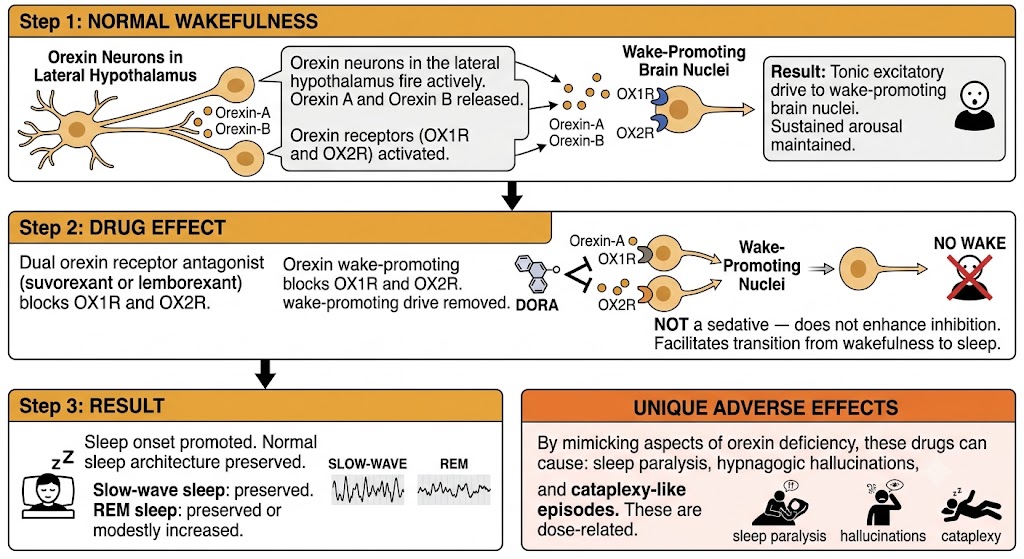
Orexins (also called hypocretins) are neuropeptides produced by neurons in the lateral hypothalamus. They act on two G-protein-coupled receptor subtypes — orexin receptor type 1 and orexin receptor type 2 — and serve as critical stabilizers of wakefulness. Orexinergic neurons provide tonic excitatory drive to monoaminergic and cholinergic wake-promoting nuclei throughout the brain. The clinical significance of this system was illuminated by the discovery that narcolepsy type 1 is caused by selective loss of orexinergic neurons, resulting in pathological intrusion of sleep states into wakefulness. This understanding validated the hypothesis that blocking orexin signaling would promote sleep by removing wake-promoting drive.

Mechanism: A Fundamentally Different Approach

Dual orexin receptor antagonists facilitate the transition from wakefulness to sleep by reducing arousal rather than by direct sedation or central nervous system depression. This is distinct from all prior hypnotics, which either enhance inhibitory gamma-aminobutyric acid signaling (benzodiazepines, Z-drugs, barbiturates) or attenuate circadian alerting signals (melatonin receptor agonists). The pharmacological consequence is that dual orexin receptor antagonists preserve normal sleep architecture, including slow-wave sleep and rapid eye movement sleep, whereas gamma-aminobutyric acid-targeting agents suppress both.

Flow diagram showing how dual orexin receptor antagonists promote sleep by removing orexin wake-promoting drive.
Figure generated by Gemini AI.
Individual Agents
Dual Orexin Receptor Antagonist
Suvorexant (Belsomra)
  • First orexin receptor antagonist approved by the FDA (2014)
  • Approved for sleep-onset and sleep-maintenance insomnia
  • Half-life approximately 12 hours. Metabolized by cytochrome P450 3A4. Strong inhibitors require dose reduction from 20 to 5 milligrams.
  • Standard dose: 10 milligrams at bedtime, maximum 20 milligrams
  • Preserves slow-wave sleep and rapid eye movement sleep; may modestly increase rapid eye movement sleep
  • Schedule IV controlled substance, though abuse liability appears lower than Z-drugs
Dual Orexin Receptor Antagonist
Lemborexant (Dayvigo)
  • FDA approved in 2019. Half-life approximately 17 hours — longer than suvorexant.
  • Doses: 5 milligrams (recommended starting dose) and 10 milligrams
  • In a randomized trial versus zolpidem extended-release, lemborexant demonstrated non-inferior efficacy for sleep onset and superior effects on sleep maintenance, with a more favorable next-morning driving safety profile
  • Greater next-day residual sedation risk at 10-milligram dose due to longer half-life
  • Metabolized primarily by cytochrome P450 3A4
Adverse Effects Unique to This Class

The adverse effects of dual orexin receptor antagonists are mechanistically consistent with orexin blockade mimicking aspects of narcolepsy physiology. Next-day somnolence is the most common adverse effect. Sleep paralysis, hypnagogic and hypnopompic hallucinations, and cataplexy-like episodes — sudden muscle weakness precipitated by strong emotion without loss of consciousness — have been reported at low but clinically significant frequency. These are dose-related and reflect incomplete orexin blockade producing transient features of narcolepsy. Mild worsening of sleep apnea has been reported; caution is warranted in patients with severe obstructive sleep apnea.


Section 5

Comparative Summary and Drug Selection

Matching hypnotic class to clinical situation

A 2022 network meta-analysis evaluating 30 different hypnotic agents across 154 randomized controlled trials provided the most rigorous comparative evidence to date. For sleep onset, benzodiazepines, Z-drugs (particularly eszopiclone and zolpidem), and suvorexant had the largest effect sizes. For sleep maintenance, suvorexant, eszopiclone, low-dose doxepin, and lemborexant demonstrated the strongest evidence. Ramelteon had the smallest effect size for sleep onset. For safety, ramelteon had the most favorable adverse effect profile, Z-drugs carried the greatest burden of next-day impairment and complex sleep behaviors, and dual orexin receptor antagonists occupied an intermediate position.

Drug Selection by Clinical Situation
Sleep-Onset Insomnia
First Choice by Situation
  • General adult: Zolpidem immediate-release or zaleplon for rapid onset with short duration
  • Elderly or substance use disorder history: Ramelteon — no dependence risk, not scheduled
  • Middle-of-the-night awakening with 4+ hours remaining: Zaleplon or sublingual low-dose zolpidem
  • Comorbid anxiety: Short-term benzodiazepine adjunction while starting a selective serotonin reuptake inhibitor
Sleep-Maintenance Insomnia
First Choice by Situation
  • General adult: Suvorexant or lemborexant — strongest evidence for wake-after-sleep-onset reduction
  • When sleep architecture preservation matters: Dual orexin receptor antagonists over gamma-aminobutyric acid-active agents
  • Combined onset and maintenance: Eszopiclone (approved for both) or dual orexin receptor antagonist
  • Comorbid depression: Low-dose doxepin (3–6 milligrams) — the only antidepressant with FDA approval specifically for insomnia
Populations Requiring Special Consideration

Obstructive sleep apnea: All hypnotics warrant caution. Gamma-aminobutyric acid-active agents reduce upper airway muscle tone and respiratory drive. Dual orexin receptor antagonists have a theoretically more favorable profile but are not exempt. If pharmacotherapy is used, verify adequate continuous positive airway pressure compliance and use the lowest effective dose.

Substance use disorder: Ramelteon is the safest option — no abuse potential, not scheduled. Low-dose doxepin is a reasonable second choice. Z-drugs and benzodiazepines should generally be avoided.

Post-traumatic stress disorder: Dual orexin receptor antagonists are emerging as an attractive option given their preservation of rapid eye movement sleep, which is often dysfunctional in post-traumatic stress disorder, and their lack of effect on trauma-related dream content.


Suggested References
Author / Organization Title Source
Sateia MJ, Buysse DJ, Krystal AD, et al.Clinical practice guideline for the pharmacological treatment of chronic insomnia in adultsJournal of Clinical Sleep Medicine, 2017; 13(2): 307-349
Sanna E, Busonero F, Talani G, et al.Comparison of the effects of zaleplon, zolpidem, and triazolam at various GABA-A receptor subtypesEuropean Journal of Pharmacology, 2002; 451(2): 103-110
US Food and Drug AdministrationFDA Drug Safety Communication: Risk of next-morning impairment after use of insomnia drugsFDA, January 10, 2013
Drover DRComparative pharmacokinetics and pharmacodynamics of short-acting hypnosedatives: zaleplon, zolpidem and zopicloneClinical Pharmacokinetics, 2004; 43(4): 227-238
US Food and Drug AdministrationFDA Drug Safety Communication: FDA adds boxed warning for risk of serious injuries caused by sleepwalking with certain prescription insomnia medicinesFDA, April 30, 2019
American Geriatrics Society2023 updated AGS Beers Criteria for potentially inappropriate medication use in older adultsJournal of the American Geriatrics Society, 2023; 71(7): 2052-2081
Kato K, Hirai K, Nishiyama K, et al.Neurochemical properties of ramelteon (TAK-375), a selective MT1/MT2 receptor agonistNeuropharmacology, 2005; 48(2): 301-310
Sakurai TThe neural circuit of orexin (hypocretin): maintaining sleep and wakefulnessNature Reviews Neuroscience, 2007; 8(3): 171-181
Herring WJ, Connor KM, Ivgy-May N, et al.Suvorexant in patients with insomnia: results from two 3-month randomized controlled clinical trialsBiological Psychiatry, 2016; 79(2): 136-148
Murphy P, Kumar D, Zammit G, et al.Safety of lemborexant versus placebo and zolpidem: effects on postural stability and cognitive performance in healthy older participantsJournal of Clinical Sleep Medicine, 2020; 16(5): 765-773