From barbiturates to modern intravenous sedatives: a mechanistic and clinical overview
Before benzodiazepines supplanted them in the 1960s and 1970s, barbiturates dominated sedative-hypnotic pharmacotherapy for nearly a century. Their displacement was driven by a narrow therapeutic index, profound respiratory depression, lethal toxicity in overdose, and severe dependence liability. Nevertheless, barbiturates retain well-defined clinical roles: phenobarbital remains a first-line agent for neonatal seizures and a critical option in refractory status epilepticus and sedative withdrawal; and phenobarbital loading for alcohol withdrawal is experiencing a significant evidence-based resurgence.
This module also covers buspirone — a mechanistically distinct anxiolytic with no sedative or dependence properties — and four intravenous sedative-hypnotics essential in contemporary hospital and procedural medicine: propofol, dexmedetomidine, ketamine, and etomidate. Understanding their distinct mechanisms, hemodynamic profiles, and adverse effects is fundamental for any clinician working in inpatient or procedural settings.
Mechanism, pharmacokinetics, clinical uses, and the critical cytochrome P450 induction problem
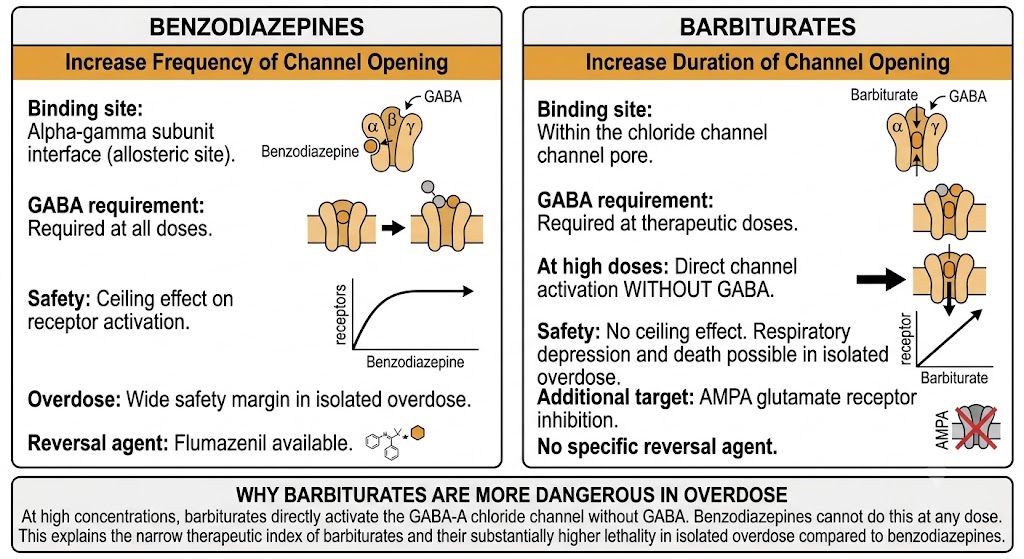
Barbiturates act at the gamma-aminobutyric acid type A receptor but at a site and by a mechanism distinct from benzodiazepines. This mechanistic difference explains both their greater clinical potency and their substantially higher toxicity in overdose.
Barbiturates bind within the chloride channel pore of the gamma-aminobutyric acid type A receptor and increase the duration of chloride channel opening, in contrast to benzodiazepines which increase the frequency of opening. At therapeutic concentrations, gamma-aminobutyric acid must be present for barbiturates to work. However, at supratherapeutic concentrations, barbiturates can directly activate the chloride channel without gamma-aminobutyric acid — a property benzodiazepines lack entirely. This direct channel activation underlies the profound, dose-dependent central nervous system depression of barbiturate toxicity: respiratory depression, cardiovascular collapse, and death. There is no ceiling on this effect.
Barbiturates also inhibit excitatory AMPA-type glutamate receptors, giving them a dual mechanism of enhancing inhibition and suppressing excitation. This dual action is particularly relevant in refractory status epilepticus, where gamma-aminobutyric acid type A receptor downregulation reduces benzodiazepine efficacy, but glutamate receptor antagonism provides an additional mechanism to terminate seizures.
Phenobarbital is the longest-acting barbiturate (half-life 80 to 120 hours) and the one with the broadest current clinical use. Its primary indications include neonatal seizures, where it remains first-line at most institutions; refractory status epilepticus, as a recognized third-line agent when benzodiazepines and second-line agents have failed; and alcohol and benzodiazepine withdrawal management, where fixed-dose intravenous phenobarbital loading is experiencing a clinical resurgence backed by prospective data showing reduced benzodiazepine requirements and lower rates of delirium tremens compared to benzodiazepine-only protocols.
The pharmacological rationale for phenobarbital in severe alcohol withdrawal is compelling: at high concentrations it directly activates gamma-aminobutyric acid type A channels, bypassing the receptor downregulation that limits benzodiazepine efficacy in severe withdrawal; it inhibits AMPA receptors, attenuating excitatory withdrawal pathophysiology; and its long half-life provides smooth, self-tapering coverage. Full discussion of withdrawal protocols is in Module 4.
Phenobarbital is one of the most potent inducers of hepatic cytochrome P450 enzymes in clinical use, inducing cytochrome P450 1A2, 2C9, 2C19, and 3A4, as well as P-glycoprotein. This produces clinically significant reductions in plasma levels of co-administered drugs including warfarin (reduced anticoagulation — monitor international normalized ratio closely), oral contraceptives (reduced efficacy — require alternative contraception), antiretroviral agents, and many other anticonvulsants. These interactions are bidirectional and require careful management whenever phenobarbital is started or stopped in a patient on polypharmacy.
Thiopental is an ultra-short-acting barbiturate with extremely high lipophilicity, producing unconsciousness within one arm-to-brain circulation time after intravenous administration. Its rapid offset is due to redistribution from the brain to peripheral tissues rather than metabolism. It has been largely supplanted by propofol for routine anesthesia induction and is no longer commercially available in the United States.
Pentobarbital retains two specific current applications: procedural sedation for pediatric diagnostic imaging, and pentobarbital coma for refractory intracranial hypertension in neurocritical care, where deep barbiturate sedation reduces cerebral metabolic demand and intracranial pressure. Pentobarbital coma requires continuous electroencephalogram monitoring for burst suppression titration, continuous hemodynamic monitoring, and mechanical ventilation.
A non-sedating anxiolytic with a mechanism entirely distinct from GABA-A modulators
Buspirone occupies a unique position in this chapter. It is not sedating, has no gamma-aminobutyric acid type A receptor activity, produces no dependence, and has no cross-tolerance with benzodiazepines or alcohol. It is grouped here because it is approved for generalized anxiety disorder and is frequently compared to benzodiazepines in that clinical context — but it is mechanistically and clinically a different category of drug.
Buspirone is a partial agonist at serotonin 5-HT1A receptors. In postsynaptic limbic areas it inhibits serotonergic activity; at presynaptic 5-HT1A autoreceptors it increases serotonin release by blocking autoinhibition. The net effect is anxiolysis through serotonergic modulation rather than gamma-aminobutyric acid inhibition. It also has dopamine D2 receptor antagonist activity at higher doses, which may contribute to some adverse effects.
Propofol, dexmedetomidine, ketamine, and etomidate: mechanisms and clinical distinctions
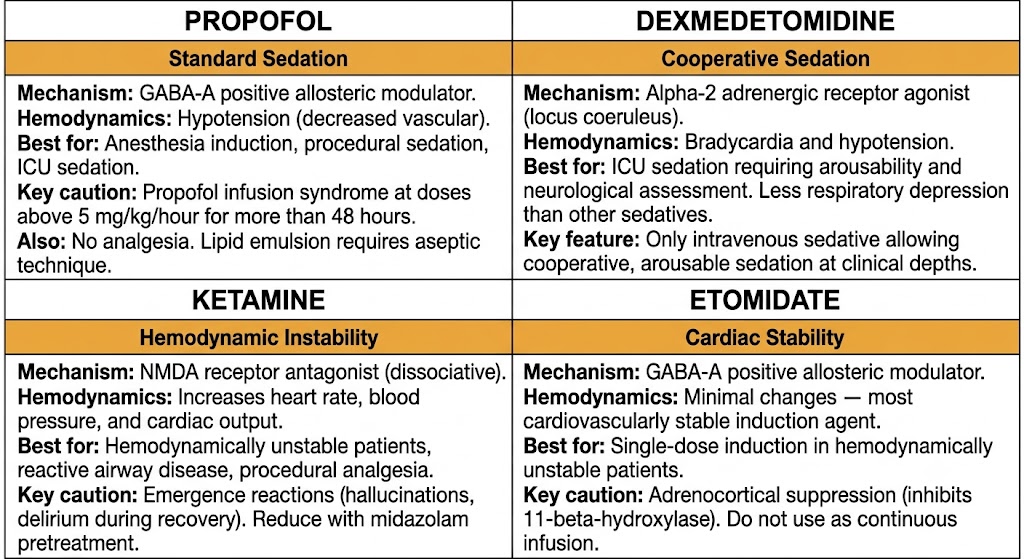
Four intravenous agents dominate procedural and critical care sedation. Each has a distinct mechanism, hemodynamic profile, and clinical niche. Matching the agent to the clinical situation requires understanding these distinctions at the pharmacological level.
Propofol is the most widely used intravenous sedative-hypnotic in contemporary clinical practice. Its mechanism is primarily positive allosteric modulation of the gamma-aminobutyric acid type A receptor, with possible additional effects at N-methyl-D-aspartate receptors and sodium channels. Its defining clinical properties are its extremely rapid onset (15 to 45 seconds intravenously), short context-sensitive half-life (approximately 2 to 24 minutes after short infusions, extending with prolonged use), and smooth, titratable control of sedation depth.
Propofol produces dose-dependent respiratory depression and apnea; airway management capability is mandatory whenever it is used. Hypotension is common, driven by decreased systemic vascular resistance and mild myocardial depression. Propofol is formulated in a lipid emulsion that supports microbial growth if strict aseptic technique is not maintained — contaminated infusions have caused serious infections and fatalities. Propofol provides no analgesia and must be combined with analgesics when pain management is required alongside sedation.
Propofol infusion syndrome is a rare but life-threatening complication of prolonged high-dose infusions, typically exceeding 48 hours at doses above 5 milligrams per kilogram per hour. It is characterized by severe metabolic acidosis, rhabdomyolysis, hyperkalemia, cardiac arrhythmias, renal failure, and potentially fatal cardiac collapse. The mechanism involves impaired mitochondrial fatty acid oxidation. Risk factors include high doses, prolonged use, critical illness (especially sepsis and traumatic brain injury), pediatric patients, and concurrent catecholamine or corticosteroid infusions. Total daily propofol dose must be tracked in intensive care unit patients and doses approaching the threshold require reassessment or transition to an alternative sedative.
Dexmedetomidine is a highly selective alpha-2 adrenergic receptor agonist that produces sedation, analgesia, and anxiolysis through a mechanism entirely distinct from gamma-aminobutyric acid modulation. It acts primarily on alpha-2 receptors in the locus coeruleus — the principal noradrenergic nucleus governing arousal — inhibiting norepinephrine release and reducing ascending arousal signaling to the cortex. The result is a sedative state that closely resembles natural sleep.
The defining clinical advantage of dexmedetomidine is that patients remain readily arousable and cooperative during sedation — neurological assessment and patient interaction are possible at sedation depths where propofol or benzodiazepines would render the patient unresponsive. It also produces significantly less respiratory depression than other sedatives, making it valuable when avoiding respiratory compromise is a priority. Primary adverse effects are bradycardia and hypotension from sympatholytic activity; transient hypertension may paradoxically occur with rapid loading due to peripheral alpha-2B receptor stimulation.
Ketamine is a dissociative anesthetic whose primary mechanism is non-competitive antagonism of N-methyl-D-aspartate glutamate receptors, blocking calcium influx through the open channel pore. Unlike all other intravenous sedatives, ketamine increases sympathetic tone by inhibiting neuronal catecholamine reuptake, producing increases in heart rate, blood pressure, and cardiac output. This makes it the induction agent of choice in hemodynamically compromised patients — hemorrhagic shock, severe bronchospasm, cardiac tamponade — where other agents would cause dangerous hypotension.
Ketamine produces a dissociative state with analgesia, amnesia, and sedation while maintaining airway protective reflexes (though this is not absolute, and airway management capability must always be available). Bronchodilation via its sympathomimetic effects makes it the agent of choice for procedural sedation in patients with severe reactive airway disease. At subanesthetic doses it provides potent analgesia useful in emergency and critical care settings. An important emerging application is treatment-resistant depression: intravenous ketamine infusions produce rapid antidepressant effects within hours — in contrast to the two to six week latency of conventional antidepressants — a clinically transformative property for acutely suicidal patients. Esketamine (the S-enantiomer) is available as an intranasal formulation for treatment-resistant depression, administered in a certified healthcare setting.
The most clinically problematic adverse effects are emergence reactions: vivid, often disturbing hallucinations and delirium during recovery, occurring in approximately 10 to 15 percent of patients at anesthetic doses. Pre-treatment or co-administration with midazolam substantially reduces their incidence. Ketamine also increases oral secretions; glycopyrrolate can be given prophylactically. Elevated intraocular pressure and relative contraindication in active psychosis or schizophrenia are additional considerations.
Etomidate is an imidazole-derived intravenous hypnotic that positively modulates the gamma-aminobutyric acid type A receptor. Its defining characteristic is exceptional hemodynamic stability — it produces minimal changes in heart rate, blood pressure, and cardiac output compared to all other induction agents, making it the preferred choice for hemodynamically unstable patients when ketamine is contraindicated.
Etomidate's most clinically significant adverse effect is adrenocortical suppression. It inhibits 11-beta-hydroxylase, the enzyme required for cortisol synthesis in the adrenal cortex, producing transient adrenal insufficiency lasting 12 to 24 hours after a single induction dose and substantially longer with continuous infusion. Continuous etomidate infusion for intensive care unit sedation has been abandoned because of this effect. The clinical significance of single-dose adrenal suppression in septic shock remains debated, and its use in rapid sequence intubation of septic patients continues to be evaluated. Myoclonus on induction (in 40 to 80 percent of patients) is reduced by benzodiazepine pretreatment. Etomidate is also the most emetogenic of the intravenous induction agents.
Choosing the right agent based on mechanism and hemodynamic profile
| Author / Organization | Title | Source |
|---|---|---|
| Brodie MJ, Kwan P | Current position of phenobarbital in epilepsy and its future | Epilepsia, 2012; 53(Suppl 8): 40-46 |
| Olsen RW, Li GD | GABA-A receptors as molecular targets of general anesthetics: identification of binding sites provides clues to allosteric modulation | Canadian Journal of Anesthesia, 2011; 58(2): 206-215 |
| Trinka E, Kalviainen R | 25 years of advances in the definition, classification and treatment of status epilepticus | Seizure, 2017; 44: 65-73 |
| Painter MJ, Scher MS, Stein AD, et al. | Phenobarbital compared with phenytoin for the treatment of neonatal seizures | New England Journal of Medicine, 1999; 341(7): 485-489 |
| Tidwell WP, Thomas TL, Pouliot JD, et al. | Treatment of alcohol withdrawal syndrome: phenobarbital versus CIWA-Ar protocol | American Journal of Critical Care, 2018; 27(6): 454-460 |
| Gammans RE, Stringfellow JC, Hvizdos AJ, et al. | Use of buspirone in patients with generalized anxiety disorder and coexisting depressive symptoms | Neuropsychobiology, 1992; 25(4): 193-201 |
| Krajcova A, Waldauf P, Andel M, Duska F | Propofol infusion syndrome: a structured review of experimental studies and 153 published case reports | Critical Care, 2015; 19(1): 398 |
| Wunsch H, Kahn JM, Kramer AA, Rubenfeld GD | Dexmedetomidine in the care of critically ill patients from 2001 to 2007: an observational cohort study | Anesthesiology, 2010; 113(2): 386-394 |
| Green SM, Roback MG, Kennedy RM, Krauss B | Clinical practice guideline for emergency department ketamine dissociative sedation: 2011 update | Annals of Emergency Medicine, 2011; 57(5): 449-461 |
| Bruder EA, Ball IM, Ridi S, et al. | Single induction dose of etomidate versus other induction agents for endotracheal intubation in critically ill patients | Cochrane Database of Systematic Reviews, 2015; (1): CD010225 |
| Devlin JW, Skrobik Y, Gelinas C, et al. | Clinical practice guidelines for the prevention and management of pain, agitation/sedation, delirium, immobility, and sleep disruption in adult patients in the ICU | Critical Care Medicine, 2018; 46(9): e825-e873 |