Chapter 12  ·  Sedative-Hypnotic Drugs
Section 1

Introduction

Integrating the neuroscience of sleep with the pharmacology of the entire drug class

The preceding four modules examined the major sedative-hypnotic drug classes in sequence. This final module provides the integrative framework that unifies them. It covers the neurobiology of sleep regulation — the circuits, the two-process model, and the orexin system as master arousal switch — and then applies this framework to explain why each drug class produces distinct effects on sleep architecture. A systematic comparative pharmacology summary, an insomnia treatment algorithm grounded in current guidelines, and the clinical positioning of benzodiazepines in anxiety disorders complete the chapter.


Section 2

The Neurobiology of Sleep

Sleep architecture, the two-process model, and the orexin flip-flop switch

Normal sleep is not a uniform state but a dynamic cycle of physiologically distinct stages repeating in an approximately 90-minute rhythm throughout the night. Understanding this architecture, and the forces that regulate it, explains why different hypnotic drugs produce different clinical effects.

Sleep Stage Architecture

Sleep is divided into non-rapid eye movement sleep and rapid eye movement sleep. Non-rapid eye movement sleep has three stages: N1 (light sleep, about 5 percent of total sleep time), N2 (intermediate sleep with sleep spindles and K-complexes, about 50 percent of total sleep time), and N3 (slow-wave or deep sleep, about 15 to 20 percent of total sleep time). N3 is the most physically restorative stage — it is when growth hormone is predominantly secreted and declarative memory consolidation occurs through hippocampal-cortical dialogue. Rapid eye movement sleep, characterized by desynchronized brain activity resembling wakefulness plus skeletal muscle atonia and vivid dreaming, constitutes about 20 to 25 percent of total sleep time and occurs predominantly in the latter half of the night. Rapid eye movement sleep serves emotional memory consolidation and emotional processing functions. Pharmacological suppression of either N3 or rapid eye movement sleep has functional consequences beyond subjective sleep quality, which is why sleep architecture effects of drug classes matter clinically.

The Two-Process Model of Sleep Regulation

Sleep timing and depth are governed by the interaction of two independent processes. Process S (homeostatic sleep pressure) accumulates during wakefulness, driven by progressive buildup of adenosine in the basal forebrain — a byproduct of neuronal energy metabolism. The longer and more intensely one has been awake, the greater the homeostatic sleep drive and the more deep N3 sleep generated at the next sleep onset. During sleep, adenosine is cleared and Process S decays. Caffeine works by competitively blocking adenosine receptors, opposing this homeostatic drive.

Process C (the circadian alerting signal) is generated by the suprachiasmatic nucleus of the hypothalamus — the brain's master circadian clock. It rises throughout the day, peaks in the early evening to maintain wakefulness against rising sleep pressure, then falls sharply to open the circadian gate for sleep onset. The suprachiasmatic nucleus entrains to the light-dark cycle via the retinohypothalamic tract and communicates timing to the body primarily through melatonin secretion from the pineal gland — which is why ramelteon, a melatonin receptor agonist, promotes sleep onset by reinforcing this circadian signal rather than by direct sedation.
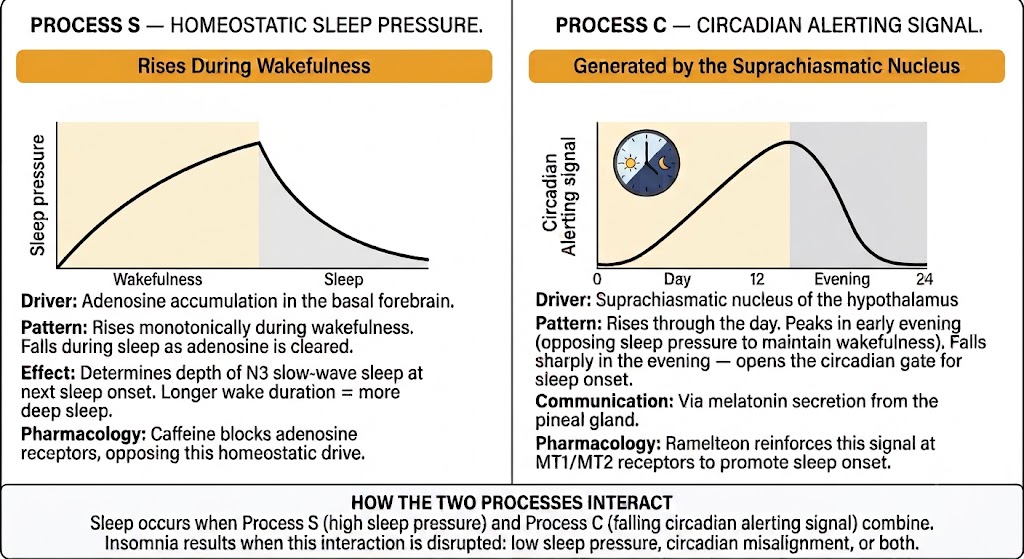
Two-panel diagram showing Process S homeostatic sleep pressure and Process C circadian alerting signal and how their interaction governs sleep timing.
Figure generated by Gemini AI.
The Orexin Flip-Flop Switch

The orexin (hypocretin) system provides a third regulatory layer that stabilizes the boundary between wakefulness and sleep. Orexinergic neurons of the lateral hypothalamus are active during wakefulness and provide tonic excitatory drive to all major arousal nuclei — the locus coeruleus (norepinephrine), dorsal raphe (serotonin), tuberomammillary nucleus (histamine), and basal forebrain (acetylcholine). This maintains consolidated wakefulness. During sleep, ventrolateral preoptic area neurons inhibit these arousal nuclei, and reciprocal inhibition between the sleep and wake systems creates a flip-flop switch — generating rapid, stable transitions between states rather than gradual drifts.

Loss of orexinergic neurons in narcolepsy type 1 destabilizes this switch, producing pathological intrusions of sleep into wakefulness (cataplexy, sleep paralysis, hypnagogic hallucinations). Dual orexin receptor antagonists (suvorexant and lemborexant) therapeutically reduce orexin wake-drive to facilitate sleep onset — without broadly suppressing the sleep-generating machinery, which is why they preserve normal sleep architecture.
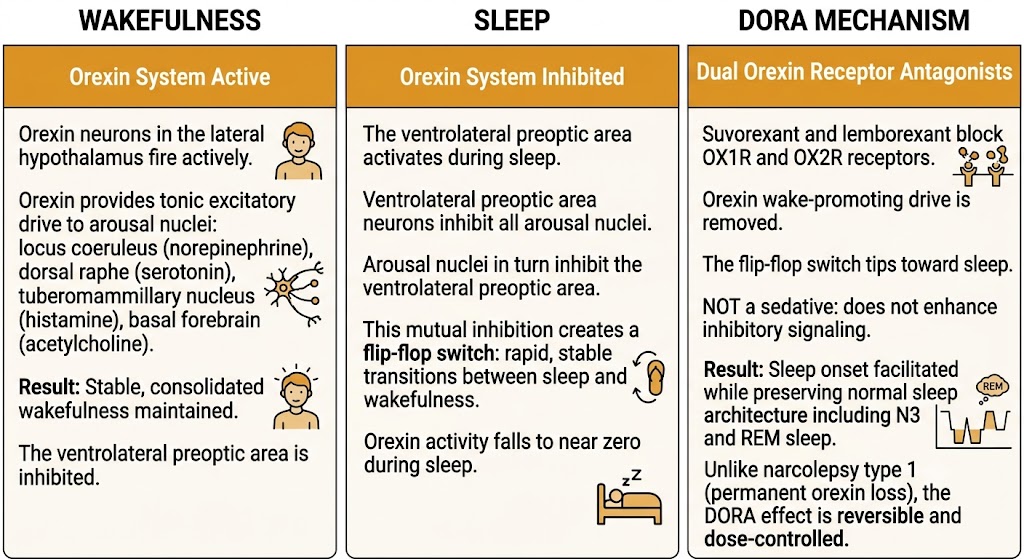
Three-panel diagram showing the orexin flip-flop switch between wakefulness and sleep, and how dual orexin receptor antagonists act on it.
Figure generated by Gemini AI.

Section 3

Sleep Architecture Effects by Drug Class

Why patients on different agents report different sleep quality despite similar total sleep times

Every sedative-hypnotic drug class alters sleep architecture in ways that follow directly from its mechanism of action. Understanding these class-specific effects explains why sleep quality and sleep quantity are not the same thing, and provides the mechanistic rationale for agent selection when restorative sleep is the therapeutic priority.

Most Disruptive
Benzodiazepines
  • Suppress N3 slow-wave sleep — the most physically restorative stage
  • Suppress rapid eye movement sleep
  • Increase N2 spindle-rich sleep — registers as sleep but lacks restorative properties
  • Patients frequently feel unrefreshed despite prolonged total sleep time
  • On discontinuation: rebound N3 and rapid eye movement sleep, with vivid disturbing dreams that reinforce continued use
Moderately Disruptive
Z-Drugs
  • Less N3 suppression than benzodiazepines at standard doses due to alpha-1 receptor selectivity
  • Rapid eye movement sleep largely preserved at therapeutic doses
  • Architecture advantage diminishes at higher doses, with extended-release formulations, and in elderly patients
  • Eszopiclone produces more N3 suppression than zolpidem due to less alpha-1 selectivity
Architecture Preserving
Melatonin Receptor Agonists
  • No significant disruption of N3 or rapid eye movement sleep at therapeutic doses
  • Mechanism is circadian phase-setting, not direct neuronal inhibition
  • Trade-off: weakest hypnotic efficacy of any class
  • Primary effect is modest reduction in sleep-onset latency (10 to 20 minutes)
Best Architecture Profile
Dual Orexin Receptor Antagonists
  • Preserve N3 slow-wave sleep
  • May modestly increase rapid eye movement sleep — the opposite of benzodiazepines
  • Most closely resemble natural, unmedicated sleep stage composition
  • Mechanism: reduce orexin wake-drive without suppressing sleep-generating machinery
  • Preferred when sleep quality and restorative function are primary goals
Barbiturates and Propofol: Most Profound Suppression

Barbiturates produce the most profound and indiscriminate suppression of all sleep stages, including complete rapid eye movement sleep suppression at anesthetic doses. Propofol-induced sedation generates some features resembling N2/N3 non-rapid eye movement sleep on electroencephalogram but lacks cyclic sleep architecture and completely suppresses rapid eye movement sleep. Intensive care unit patients maintained on propofol infusions accumulate profound rapid eye movement sleep debt, which may contribute to post-intensive care unit cognitive and emotional sequelae including post-traumatic stress disorder — consistent with the known role of rapid eye movement sleep in emotional memory processing.


Section 4

Comparative Pharmacology: All Classes Side by Side

Mechanism, dependence, overdose risk, sleep architecture, and clinical niche across the full drug class

Drug Class Mechanism Dependence / Schedule Overdose Risk Sleep Architecture Clinical Niche
Benzodiazepines GABA-A positive allosteric modulator; alpha-1, 2, 3, 5 subunits; increases frequency of chloride channel opening High; physical dependence within weeks; Schedule IV Moderate alone; amplified by opioid/alcohol co-ingestion; flumazenil reversal available Suppresses N3 and rapid eye movement; increases N2 spindles Acute seizures, alcohol withdrawal, procedural sedation; second-line for anxiety and insomnia
Z-Drugs GABA-A positive allosteric modulator; relative alpha-1 selectivity at standard doses Lower than benzodiazepines but real; Schedule IV Similar to benzodiazepines; flumazenil reverses; boxed warning for complex sleep behaviors Less N3 suppression than benzodiazepines; rapid eye movement largely preserved Short-term insomnia; zolpidem for sleep onset; eszopiclone for onset and maintenance
Melatonin receptor agonists (ramelteon) MT1/MT2 receptor agonist in suprachiasmatic nucleus; circadian phase-setting None established; not scheduled Minimal; no central nervous system depression at therapeutic doses No disruption; normal stage distribution preserved Sleep-onset insomnia; preferred in elderly and substance use disorder history; circadian rhythm disorders
Dual orexin receptor antagonists (suvorexant, lemborexant) OX1R/OX2R competitive antagonist; removes orexin wake-promoting drive Lower than Z-drugs; Schedule IV Low compared to GABA-active agents; unique adverse effects: cataplexy-like episodes, sleep paralysis Best preservation of N3 and rapid eye movement; may increase rapid eye movement Sleep-onset and maintenance insomnia; preferred when sleep quality matters; post-traumatic stress disorder
Barbiturates (phenobarbital) GABA-A pore binding; increases duration of channel opening; direct activation at high doses; inhibits AMPA receptors High; Schedule II (most) or IV (phenobarbital) High; no ceiling effect; no reversal agent; narrow therapeutic index Profound suppression of rapid eye movement; N3 suppressed at sedating doses Neonatal seizures, refractory status epilepticus, alcohol/benzodiazepine withdrawal; no role in general insomnia
Buspirone Serotonin 5-HT1A partial agonist; no GABA-A activity None; not scheduled Minimal No disruption; not a hypnotic Generalized anxiety disorder long-term management; onset delayed 1 to 4 weeks; not for acute anxiety or insomnia

Section 5

Insomnia: Diagnosis and Treatment Algorithm

Applying pharmacological knowledge to clinical drug selection

Insomnia disorder is defined by dissatisfaction with sleep quality or quantity — difficulty initiating sleep, maintaining sleep, or early morning awakening — occurring at least three nights per week for at least three months, causing daytime impairment, despite adequate opportunity for sleep. The treatment algorithm follows a logical sequence from non-pharmacological first-line care through targeted pharmacological selection based on the type of complaint.

Step 1: Cognitive Behavioral Therapy for Insomnia — Always First

Current guidelines from the American Academy of Sleep Medicine and the American College of Physicians consistently endorse cognitive behavioral therapy for insomnia as first-line treatment for chronic insomnia disorder, superior to pharmacotherapy in head-to-head trials and the only treatment with durable effects after discontinuation. It addresses the perpetuating factors — conditioned arousal, sleep-incompatible behaviors, and cognitive hyperarousal — that maintain chronic insomnia independently of the original precipitant. Pharmacotherapy is indicated when cognitive behavioral therapy is unavailable, has failed, or when rapid symptom control is needed as a bridge.

Step 2: Pharmacological Selection by Complaint Type
Sleep-Onset Insomnia
Primary complaint: difficulty falling asleep
  • First choice (general adult): Zolpidem immediate-release or zaleplon — rapid onset, short duration, less architecture disruption than benzodiazepines
  • Elderly or substance use disorder history: Ramelteon — no dependence, not scheduled, not on Beers Criteria
  • Middle-of-night awakening with 4+ hours remaining: Zaleplon or sublingual low-dose zolpidem
  • When avoiding scheduled drugs: Ramelteon (modest efficacy) or low-dose doxepin if sleep maintenance also needed
Sleep-Maintenance Insomnia
Primary complaint: waking during the night
  • First choice: Suvorexant or lemborexant — strongest evidence for reducing wake-after-sleep-onset; best sleep architecture preservation
  • Alternative: Eszopiclone — only Z-drug approved for maintenance; 6-month efficacy data
  • Comorbid depression: Low-dose doxepin (3 to 6 milligrams) — only antidepressant FDA-approved specifically for insomnia at sub-antidepressant doses
  • Avoid: Zolpidem immediate-release and zaleplon — too short-acting for maintenance complaints
Special Population Considerations

Section 6

Benzodiazepines in Anxiety Disorders

The clinical role of benzodiazepines within the broader landscape of anxiety pharmacotherapy

Benzodiazepines produce rapid, reliable anxiolysis across all anxiety disorder categories. However, their role in anxiety pharmacotherapy has shifted substantially — they are now second-line agents for most chronic anxiety indications, reserved for specific short-term or adjunctive roles while non-addictive treatments provide primary management.

Current Role: When Benzodiazepines Are Appropriate
Why Benzodiazepines Are Not First-Line for Chronic Anxiety

Tolerance to anxiolytic effects develops over weeks to months of regular use, requiring dose escalation for maintained effect. Physical dependence develops within weeks, producing a withdrawal syndrome that can mimic the original anxiety disorder and complicate both assessment and tapering. Chronic use is associated with cognitive impairment, psychomotor slowing, and — in elderly patients — falls, fractures, and possible dementia association. Selective serotonin reuptake inhibitors and serotonin-norepinephrine reuptake inhibitors provide durable anxiolytic effects without tolerance, dependence, or cognitive burden, and are recommended as first-line pharmacotherapy for generalized anxiety disorder, panic disorder, social anxiety disorder, and post-traumatic stress disorder by all major guidelines.

Buspirone: The Long-Term Alternative

Buspirone is a reasonable long-term alternative for generalized anxiety disorder in patients where benzodiazepine dependence is a concern. It produces anxiolysis through serotonin 5-HT1A partial agonism without sedation, cognitive impairment, or dependence. Its critical limitation is the one to four week onset delay — it cannot substitute for a benzodiazepine acutely, and patients switching from benzodiazepines must be tapered off separately, as buspirone has no cross-tolerance with the gamma-aminobutyric acid type A system and will not prevent withdrawal.


Suggested References
Author / Organization Title Source
Hobson JASleep is of the brain, by the brain and for the brainNature, 2005; 437(7063): 1254-1256
Borbely AA, Daan S, Wirz-Justice A, Deboer TThe two-process model of sleep regulation: a reappraisalJournal of Sleep Research, 2016; 25(2): 131-143
Kato K, Hirai K, Nishiyama K, et al.Neurochemical properties of ramelteon (TAK-375), a selective MT1/MT2 receptor agonistNeuropharmacology, 2005; 48(2): 301-310
Sakurai TThe neural circuit of orexin (hypocretin): maintaining sleep and wakefulnessNature Reviews Neuroscience, 2007; 8(3): 171-181
Sanna E, Busonero F, Talani G, et al.Comparison of the effects of zaleplon, zolpidem, and triazolam at various GABA-A receptor subtypesEuropean Journal of Pharmacology, 2002; 451(2): 103-110
Herring WJ, Connor KM, Ivgy-May N, et al.Suvorexant in patients with insomnia: results from two 3-month randomized controlled clinical trialsBiological Psychiatry, 2016; 79(2): 136-148
Wunsch H, Kahn JM, Kramer AA, Rubenfeld GDDexmedetomidine in the care of critically ill patients from 2001 to 2007Anesthesiology, 2010; 113(2): 386-394
Sateia MJ, Buysse DJ, Krystal AD, et al.Clinical practice guideline for the pharmacological treatment of chronic insomnia in adultsJournal of Clinical Sleep Medicine, 2017; 13(2): 307-349
Baldwin DS, Anderson IM, Nutt DJ, et al.Evidence-based pharmacological treatment of anxiety disordersJournal of Psychopharmacology, 2014; 28(5): 403-439
American Geriatrics Society2023 updated AGS Beers Criteria for potentially inappropriate medication use in older adultsJournal of the American Geriatrics Society, 2023; 71(7): 2052-2081