Calcitonin gene-related peptide is a 37-amino-acid neuropeptide released from trigeminal sensory nerve endings. It is the most important vasoactive peptide in migraine pathophysiology — elevated in venous blood during migraine attacks, responsible for meningeal vasodilation and neurogenic inflammation, and the target of the most significant advance in migraine therapeutics in decades.
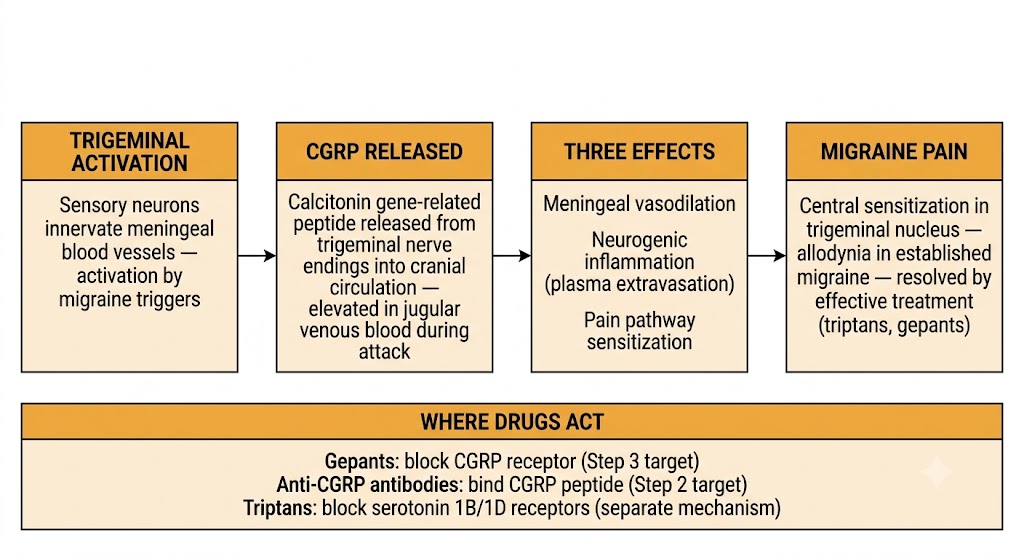
Calcitonin gene-related peptide is produced from the same gene as calcitonin through alternative messenger RNA splicing in neurons. It is abundantly expressed in the trigeminal sensory neurons that innervate the meningeal blood vessels — specifically the dural arteries — and in sensory fibers throughout the cranial vasculature. At baseline, calcitonin gene-related peptide is present at low concentrations. During a migraine attack, it is released in large quantities from activated trigeminal nerve terminals and from the trigeminal ganglion into the cranial circulation.
The landmark observation establishing calcitonin gene-related peptide as the key migraine mediator was made by Goadsby and Edvinsson in 1990: calcitonin gene-related peptide levels were significantly elevated in external jugular venous blood during spontaneous migraine attacks and normalized with effective triptan treatment. This direct correlation between calcitonin gene-related peptide release and migraine pain — and its resolution with treatment — established the peptide as both a biomarker and a therapeutic target.
Released calcitonin gene-related peptide acts on its receptors in the meningeal vasculature and trigeminal system to produce three effects that sustain and amplify migraine pain. First, it produces potent vasodilation of meningeal arteries, increasing blood flow and vessel distension that stimulates meningeal pain afferents. Second, it promotes neurogenic inflammation in the dura — increased vascular permeability, plasma protein extravasation, and mast cell degranulation — which sensitizes the local nociceptors. Third, calcitonin gene-related peptide acts centrally in the trigeminal nucleus caudalis to sensitize second-order neurons, contributing to the central sensitization that characterizes established migraine, including allodynia.
The importance of calcitonin gene-related peptide in migraine is underscored by pharmacological proof: intravenous infusion of calcitonin gene-related peptide reliably provokes migraine-like headache in migraine-prone individuals but not in healthy controls, demonstrating that the peptide is not merely a correlate of migraine but an active mediator.
The calcitonin gene-related peptide receptor is an unusual structure — a heterodimer requiring two proteins to form a functional receptor. Its Gs-coupled signaling produces potent vasodilation not only in the meningeal vasculature but throughout the body, which raised cardiovascular safety concerns about blocking it long-term that took years of clinical trial data to address.
The calcitonin gene-related peptide receptor is formed by a non-covalent complex of two proteins: the calcitonin receptor-like receptor (a seven-transmembrane G protein-coupled receptor) and receptor activity-modifying protein 1 (a single-pass transmembrane protein required for cell surface expression and ligand binding specificity). Neither protein forms a functional calcitonin gene-related peptide receptor alone; both must be co-expressed. This unusual two-component architecture is shared by several related receptors in the calcitonin family and has implications for drug selectivity: gepants that block the receptor must accommodate both components, while antibodies can target either the peptide itself or the receptor.
Calcitonin gene-related peptide receptor activation couples to Gs, increasing intracellular cyclic adenosine monophosphate, which activates protein kinase A and relaxes vascular smooth muscle. The result is vasodilation — calcitonin gene-related peptide is in fact one of the most potent vasodilators of the cerebral and coronary vasculature known. This vasodilatory effect is not limited to meningeal arteries; calcitonin gene-related peptide receptors are expressed on coronary arteries, where calcitonin gene-related peptide plays a role in physiological vasodilation and in the vasodilatory response to coronary ischemia.
The coronary expression of calcitonin gene-related peptide receptors was the basis for concern when the first calcitonin gene-related peptide-blocking drugs were developed: might blocking calcitonin gene-related peptide-mediated coronary vasodilation increase the risk of myocardial ischemia, particularly in patients with known coronary artery disease? This question drove extensive cardiovascular safety evaluation in the clinical trials of gepants and monoclonal antibodies, discussed in Section 5.
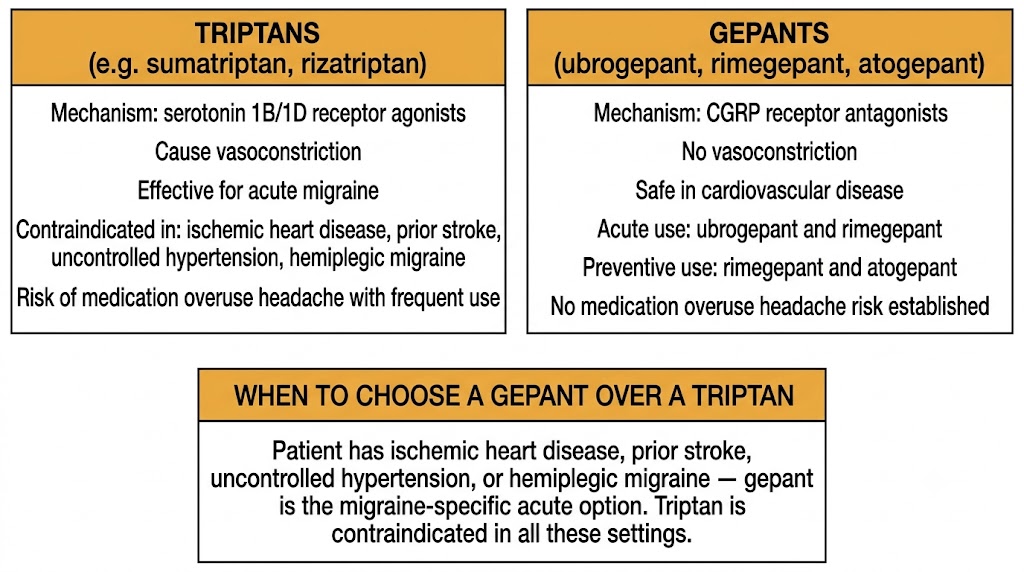
Gepants are orally administered small molecules that competitively block the calcitonin gene-related peptide receptor. Unlike triptans — which work partly through serotonin 1B/1D receptor-mediated vasoconstriction — gepants produce no vasoconstriction, making them the first migraine-specific drugs that can be safely used in patients with established cardiovascular disease or uncontrolled hypertension.
Gepants compete with calcitonin gene-related peptide at the receptor binding site, blocking the vasodilatory and neuroinflammatory signaling that sustains migraine pain. Because they do not activate serotonin 1B receptors on coronary or cerebrovascular smooth muscle, they do not produce the vasoconstriction that contraindications triptans in patients with ischemic heart disease, prior stroke, uncontrolled hypertension, and hemiplegic or basilar migraine. This cardiovascular safety profile represents a genuine clinical advance for the substantial minority of migraine patients who have these comorbidities and have been unable to take triptans safely.
Gepants also show no signal for medication overuse headache — the phenomenon where frequent use of acute migraine treatments (most prominently opioids, but also triptans and nonsteroidal anti-inflammatory drugs at high frequency) paradoxically increases headache days through central sensitization. This makes gepants potentially suitable for patients with high-frequency migraine who would otherwise be at risk for overuse with other acute agents.
Three gepants are approved in the United States. Ubrogepant is approved for acute treatment of migraine and is taken at headache onset; it has no approved preventive indication. Rimegepant has a dual approval — it is effective for acute treatment and, when taken every other day, reduces monthly migraine days as a preventive therapy. Atogepant is approved exclusively for preventive treatment, taken daily or every other day to reduce monthly migraine frequency.
All gepants are substrates of cytochrome P450 3A4, and some are also inhibitors. Strong cytochrome P450 3A4 inhibitors (such as ketoconazole or clarithromycin) significantly raise gepant plasma levels, requiring dose reduction or avoidance. Strong cytochrome P450 3A4 inducers (such as rifampin) substantially reduce gepant efficacy. Gepants are contraindicated in severe hepatic impairment. No vasoconstrictor adverse effects have been identified in clinical trials.
Four monoclonal antibodies targeting the calcitonin gene-related peptide pathway are approved for migraine prevention in adults with episodic or chronic migraine. All are used exclusively for prevention — none is effective for acute migraine treatment — and all reduce monthly migraine days by approximately 50 percent or more in clinical responders. Their long half-lives, derived from antibody pharmacokinetics, allow monthly or quarterly dosing, improving adherence compared to daily oral preventives.
The four antibodies divide into two groups by mechanism. Erenumab targets the calcitonin gene-related peptide receptor — specifically the receptor activity-modifying protein 1 subunit — and is the only approved antibody that blocks the receptor rather than the peptide. Fremanezumab, galcanezumab, and eptinezumab all target calcitonin gene-related peptide itself, binding the peptide and preventing it from reaching and activating its receptor. In clinical practice, the choice between receptor-targeting and peptide-targeting antibodies has not been shown to produce meaningfully different outcomes; both approaches reduce migraine frequency similarly.
Three of the four antibodies are administered by subcutaneous self-injection: erenumab and galcanezumab monthly, fremanezumab either monthly or quarterly (a quarterly high-dose option). Eptinezumab is unique in being administered as a quarterly intravenous infusion given over 30 minutes, which suits patients who prefer clinic-administered treatment or who have difficulty with self-injection. The long dosing intervals of all four agents reflect the prolonged plasma half-lives of immunoglobulin G antibodies (approximately 28 days for the subcutaneous agents), which allow sustained calcitonin gene-related peptide pathway blockade between doses.
The monoclonal antibodies are generally well tolerated. Injection site reactions — redness, swelling, and tenderness at the subcutaneous injection site — are the most common adverse effect across all three subcutaneous agents. Erenumab has a distinctive adverse effect not shared by the peptide-targeting antibodies: constipation, occurring in approximately 3 to 4 percent of patients, and in rare cases severe enough to require hospitalization. The mechanism is thought to involve calcitonin gene-related peptide receptor blockade in the enteric nervous system, where calcitonin gene-related peptide normally promotes intestinal motility.
Clinical response to monoclonal antibodies typically becomes apparent within the first month of treatment. Patients who do not respond to one agent in the class sometimes respond to another — there is no strong evidence for cross-resistance within the class. For patients who fail two or more calcitonin gene-related peptide-targeting antibodies, switching to a non-calcitonin gene-related peptide preventive (topiramate, valproate, beta blockers, amitriptyline) or combining with a gepant is reasonable.
Because calcitonin gene-related peptide is a vasodilator expressed in coronary arteries and plays a role in the ischemic preconditioning response, blocking it raised theoretical concerns about myocardial ischemia risk. Available clinical trial data have not confirmed an increased cardiovascular event rate with gepants or monoclonal antibodies, but important gaps in the evidence remain.
Calcitonin gene-related peptide is released from sensory fibers in the coronary circulation during myocardial ischemia and acts as a local vasodilator that partially compensates for reduced coronary flow. Animal models of myocardial infarction showed that calcitonin gene-related peptide blockade increased infarct size under ischemic conditions. This mechanistic concern led regulatory agencies to require extensive cardiovascular safety data before approving calcitonin gene-related peptide-targeting drugs.
The available clinical trial data — from programs spanning several years and tens of thousands of patient-months of exposure — have not demonstrated an increased rate of major adverse cardiovascular events (myocardial infarction, stroke, or cardiovascular death) with gepants or calcitonin gene-related peptide monoclonal antibodies compared to placebo. However, patients with recent myocardial infarction, prior stroke, or unstable angina were excluded from the pivotal trials, so the safety of these drugs in patients with active cardiovascular disease remains incompletely characterized. Current guidelines recommend caution in this population and recommend discussing the benefit-risk balance individually.
Gepants and monoclonal antibodies serve complementary roles in migraine management. For acute treatment, gepants are the calcitonin gene-related peptide-specific option; monoclonal antibodies have no acute efficacy. For prevention, both gepants (rimegepant, atogepant) and monoclonal antibodies are effective. The choice depends on patient preference and clinical factors: monoclonal antibodies offer monthly or quarterly dosing with no daily pill burden, which improves adherence in some patients, while gepants offer oral self-administration without injections and the additional option of using the same agent for both acute and preventive treatment (rimegepant).
For patients with cardiovascular disease who cannot take triptans, gepants for acute treatment are the preferred calcitonin gene-related peptide-based option. For patients with multiple prior preventive medication failures, the calcitonin gene-related peptide monoclonal antibodies have shown efficacy even in treatment-refractory populations, and trying a second antibody after failure of the first is reasonable before abandoning the class.
Triptans (sumatriptan, rizatriptan, etc.): serotonin 1B/1D receptor agonists; produce vasoconstriction; effective acutely; contraindicated in ischemic heart disease, prior stroke, uncontrolled hypertension, hemiplegic migraine; risk of medication overuse headache with frequent use.
Gepants: calcitonin gene-related peptide receptor antagonists; no vasoconstriction; effective acutely (ubrogepant, rimegepant) and preventively (rimegepant, atogepant); can be used in patients with cardiovascular disease; no established medication overuse headache risk.
Anti-calcitonin gene-related peptide monoclonal antibodies: preventive only; monthly or quarterly dosing; no acute efficacy; well tolerated; erenumab may cause constipation.
| Author / Organization | Title | Source |
|---|---|---|
| Edvinsson L, Haanes KA, Warfvinge K, Krause DN | CGRP as the target of new migraine therapies — successful translation from bench to clinic | Nat Rev Neurol. 2018;14(6):338–350 |
| Goadsby PJ, Edvinsson L, Ekman R | Vasoactive peptide release in the extracerebral circulation of humans during migraine headache | Ann Neurol. 1990;28(2):183–187 |
| Goadsby PJ, Holland PR, Martins-Oliveira M, Hoffmann J, Schankin C, Akerman S | Pathophysiology of migraine: a disorder of sensory processing | Physiol Rev. 2017;97(2):553–622 |
| Hay DL, Garelja ML, Poyner DR, Walker CS | Update on the pharmacology of calcitonin/CGRP family of peptides: IUPHAR review 25 | Br J Pharmacol. 2018;175(1):3–17 |
| Deen M, Correnti E, Kamm K, et al | Blocking CGRP in migraine patients — a review of pros and cons | J Headache Pain. 2017;18(1):96 |
| Lipton RB, Dodick DW, Ailani J, et al | Effect of ubrogepant vs placebo on pain and the most bothersome associated symptom in the acute treatment of migraine: the ACHIEVE II randomized clinical trial | JAMA. 2019;322(19):1887–1898 |
| Croop R, Lipton RB, Kudrow D, et al | Oral rimegepant for preventive treatment of migraine: a phase 2/3, randomised, double-blind, placebo-controlled trial | Lancet. 2021;397(10268):51–60 |
| Ailani J, Lipton RB, Goadsby PJ, et al | Atogepant for the preventive treatment of migraine | N Engl J Med. 2021;385(8):695–706 |
| Ashina M, Goadsby PJ, Reuter U, et al | Long-term efficacy and safety of erenumab in migraine prevention: results from a 5-year, open-label treatment phase | Eur J Neurol. 2021;28(5):1716–1725 |
| Ailani J, Burch RC, Robbins MS; Board of Directors of the American Headache Society | The American Headache Society Consensus Statement: update on integrating new migraine treatments into clinical practice | Headache. 2021;61(7):1021–1039 |