CHAPTER 24  ·  VASOACTIVE PEPTIDE PHARMACOLOGY
Section 1
Brain Natriuretic Peptide and NT-proBNP in Heart Failure Diagnosis
How to use brain natriuretic peptide and NT-proBNP to diagnose acute heart failure, the diagnostic thresholds, what causes false elevations and false low values, and why sacubitril-valsartan patients require NT-proBNP instead

Brain natriuretic peptide and its inactive amino-terminal cleavage fragment NT-proBNP are the most clinically useful laboratory biomarkers of ventricular wall stress. Released by ventricular cardiomyocytes in proportion to filling pressure and wall tension, they rise in heart failure, can be measured rapidly from a venous blood sample, and have well-validated thresholds that distinguish cardiac from non-cardiac dyspnea in the emergency setting.

Diagnostic Thresholds and Clinical Use

In a patient presenting with acute dyspnea, a brain natriuretic peptide level above 100 pg/mL substantially increases the probability of acute heart failure as the cause of symptoms, while a value below 50 pg/mL makes heart failure unlikely. Values between 50 and 100 pg/mL are a gray zone requiring clinical judgment and additional assessment. For NT-proBNP, the threshold supporting acute heart failure diagnosis is above 300 pg/mL in the acute setting; age-stratified higher thresholds are used in some guidelines for patients over 50 or 75 years, reflecting the normal age-related rise in NT-proBNP levels.

Beyond diagnosis, both peptides correlate with heart failure severity — higher levels reflect greater ventricular wall stress, higher filling pressures, and worse prognosis. Serial measurement is used to assess treatment response: a fall in brain natriuretic peptide or NT-proBNP with diuresis and heart failure therapy confirms hemodynamic improvement and predicts better outcomes at discharge. Rising levels during an admission or after discharge signal inadequate decongestion or clinical deterioration.

False Elevations and False Low Values

Two conditions commonly produce falsely elevated brain natriuretic peptide levels that do not reflect primary cardiac dysfunction. Renal impairment raises brain natriuretic peptide (and particularly NT-proBNP, which relies heavily on renal clearance) because the peptide accumulates as glomerular filtration rate declines; the diagnostic thresholds must be interpreted cautiously in patients with significant chronic kidney disease. Atrial fibrillation with rapid ventricular rate also elevates brain natriuretic peptide through increased atrial and ventricular wall stress independent of systolic dysfunction.

Two conditions produce falsely low brain natriuretic peptide values that can lead to underdiagnosis of heart failure. Obesity suppresses brain natriuretic peptide secretion and clearance through mechanisms not fully understood, but the effect is clinically significant — obese patients with heart failure may have brain natriuretic peptide levels in the normal range despite elevated filling pressures. Sacubitril-valsartan (neprilysin inhibition) raises brain natriuretic peptide by preventing its degradation, so brain natriuretic peptide values in these patients reflect drug effect rather than disease severity and cannot be used diagnostically. NT-proBNP is not a neprilysin substrate and remains interpretable in patients taking sacubitril-valsartan, making it the biomarker of choice in this population.

Causes of False Elevation
BNP Falsely High
  • Renal impairment — reduced peptide clearance
  • Atrial fibrillation with rapid ventricular response
  • Pulmonary embolism — right ventricular strain
  • Sepsis — myocardial depression
Causes of False Low Value
BNP Falsely Low
  • Obesity — suppressed secretion and clearance
  • Sacubitril-valsartan use — neprilysin inhibition raises BNP artifactually; use NT-proBNP instead
  • Flash pulmonary edema (very acute) — levels may not yet have risen

Section 2
Nesiritide: Recombinant Brain Natriuretic Peptide in Acute Decompensated Heart Failure
What nesiritide is, how it produces natriuresis and vasodilation, what the ASCEND-HF trial showed about its clinical utility, and why it remains a second-line option behind diuretics

Nesiritide is a recombinant form of human brain natriuretic peptide administered intravenously for acute decompensated heart failure. By exogenously supplying the endogenous natriuretic peptide, it augments the compensatory natriuretic peptide response that the failing heart generates but cannot sustain at adequate levels. Its clinical role has been defined — and limited — by the results of the ASCEND-HF trial.

Mechanism and Administration

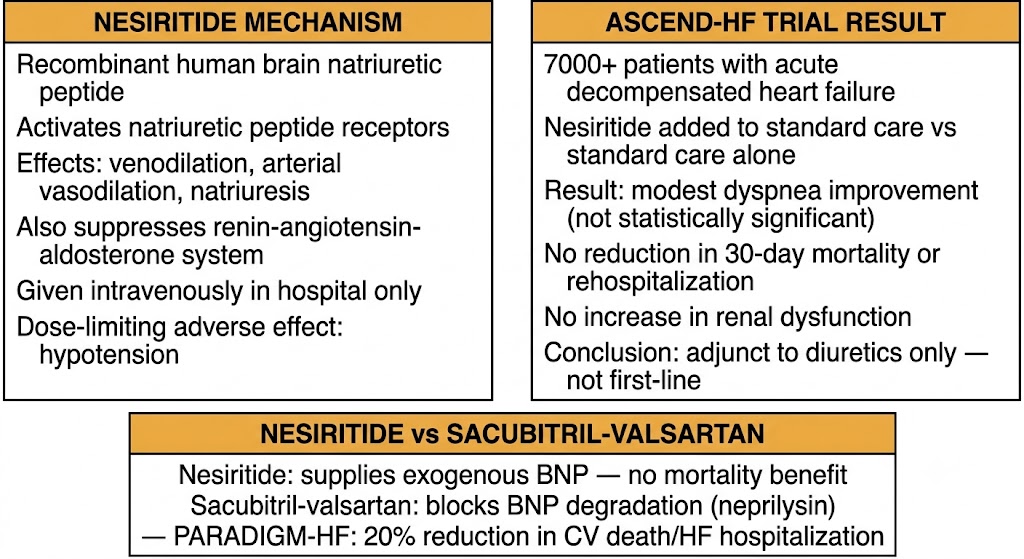
Nesiritide activates natriuretic peptide receptors on vascular smooth muscle, renal tubular cells, and cardiac fibroblasts, producing three simultaneous effects: venous and arterial vasodilation (reducing both preload and afterload), natriuresis and diuresis (reducing volume overload), and suppression of the renin-angiotensin-aldosterone system and sympathetic nervous system activity. These effects are mechanistically complementary to intravenous diuretics, which reduce volume but do not directly reduce vascular resistance. Nesiritide is given as an intravenous bolus followed by a continuous infusion, typically in an inpatient setting.

ASCEND-HF Trial and Current Clinical Role

The ASCEND-HF trial enrolled over 7,000 patients with acute decompensated heart failure and compared nesiritide added to standard care versus standard care alone. Nesiritide produced a modest improvement in patient-reported dyspnea at 6 and 24 hours — the primary endpoint — but this improvement did not reach statistical significance. There was no reduction in 30-day mortality or rehospitalization rates. Nesiritide did not increase renal dysfunction compared to placebo in ASCEND-HF, resolving an earlier concern from smaller studies, but neither did it improve renal outcomes.

The clinical implication is that nesiritide is not a replacement for intravenous loop diuretics, which remain the first-line treatment for acute decompensated heart failure with volume overload. Nesiritide may have a role as an adjunct to diuretics in selected patients with predominantly vasodilatory hemodynamics (elevated filling pressures with low systemic vascular resistance) or in patients with diuretic resistance. Hypotension is the most common dose-limiting adverse effect and requires careful blood pressure monitoring and dose titration.

Two-panel diagram of nesiritide. Left panel shows nesiritide mechanism as recombinant human brain natriuretic peptide that activates natriuretic peptide receptors producing venodilation, arterial vasodilation, natriuresis, and renin-angiotensin-aldosterone system suppression, given intravenously in hospital with hypotension as dose-limiting adverse effect. Right panel shows ASCEND-HF trial result: over 7000 patients, nesiritide produced modest dyspnea improvement that was not statistically significant, no mortality or rehospitalization reduction, and no renal dysfunction increase, concluding it is an adjunct to diuretics only. Shared panel compares nesiritide supplying exogenous brain natriuretic peptide with no mortality benefit versus sacubitril-valsartan blocking brain natriuretic peptide degradation with 20 percent mortality reduction in PARADIGM-HF.
Nesiritide mechanism and ASCEND-HF trial result, with comparison to sacubitril-valsartan. Generated with Gemini AI for educational use.
Nesiritide in Context

Nesiritide is often tested in contrast to sacubitril-valsartan (Module 2). Both target the natriuretic peptide system, but through opposite mechanisms: sacubitril-valsartan raises endogenous natriuretic peptide levels by blocking their degradation (neprilysin inhibition), while nesiritide supplies exogenous recombinant brain natriuretic peptide directly. Sacubitril-valsartan has demonstrated mortality benefit (PARADIGM-HF) and is used for chronic heart failure prevention. Nesiritide has no mortality benefit (ASCEND-HF) and is used only for acute decompensated heart failure symptom management as an adjunct to diuretics.


Section 3
Substance P and NK1 Receptors: Aprepitant and Fosaprepitant in Chemotherapy-Induced Nausea and Vomiting
Substance P as the mediator of delayed chemotherapy-induced nausea, the NK1 receptor in the brainstem vomiting center, aprepitant and fosaprepitant mechanisms and regimens, and their cytochrome P450 interactions

Substance P is a neuropeptide that mediates the delayed phase of chemotherapy-induced nausea and vomiting — the nausea occurring 24 to 120 hours after chemotherapy administration. Blocking its NK1 receptor in the brainstem, combined with serotonin type 3 receptor antagonism and dexamethasone, constitutes the current standard three-drug antiemetic regimen for highly emetogenic chemotherapy.

Substance P and the Emetic Pathway

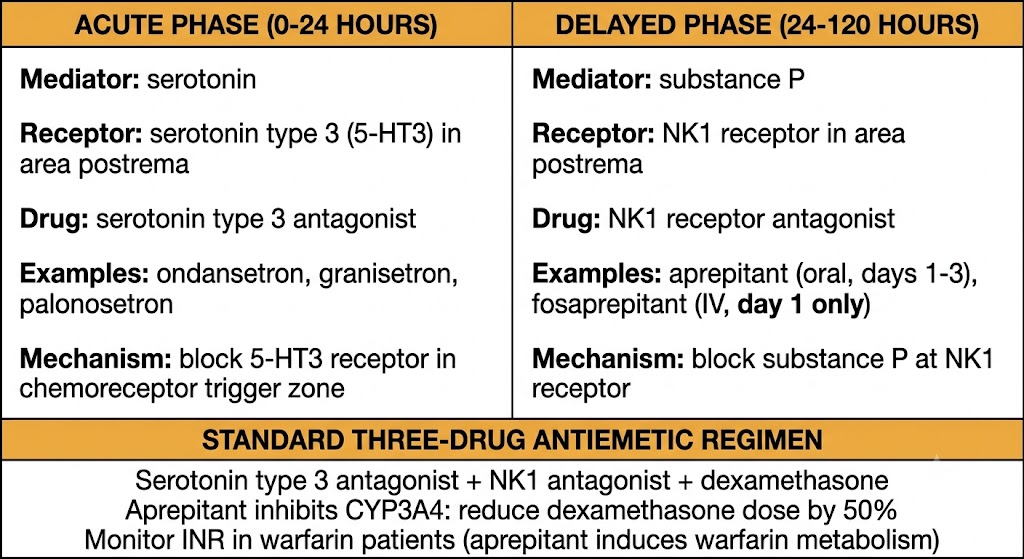
Substance P is an 11-amino-acid neuropeptide released from enteric neurons and sensory afferents in the gastrointestinal tract during chemotherapy-induced mucosal injury, and from brainstem neurons in response to circulating emetic signals reaching the area postrema. Substance P binds NK1 receptors in the area postrema (the chemoreceptor trigger zone) and in the nucleus tractus solitarius, activating the central pattern generator for vomiting. The delayed phase of chemotherapy-induced nausea — which begins approximately 24 hours after chemotherapy and peaks at 48 to 72 hours — is driven predominantly by substance P and NK1 receptor signaling rather than by serotonin, which mediates the acute phase (0 to 24 hours). This mechanistic distinction explains why serotonin type 3 receptor antagonists (ondansetron, granisetron) alone do not adequately control delayed nausea and why adding an NK1 antagonist significantly improves delayed nausea control in highly and moderately emetogenic chemotherapy regimens.

Aprepitant and Fosaprepitant

Aprepitant is an orally administered selective NK1 receptor antagonist that penetrates the central nervous system and blocks substance P binding at the area postrema and nucleus tractus solitarius. It is given on day 1 of chemotherapy (at a higher dose) and days 2 and 3 (at a lower dose) as part of a three-drug antiemetic regimen that also includes a serotonin type 3 receptor antagonist and dexamethasone. The three-drug combination addresses all three major emetic pathways: serotonin (acute phase), substance P (delayed phase), and the corticosteroid anti-inflammatory mechanism that reduces prostaglandin-mediated nausea.

Fosaprepitant is a water-soluble phosphate prodrug of aprepitant that can be administered as a single intravenous dose on day 1 of chemotherapy, replacing the three-day oral aprepitant course in patients who cannot take oral medications. After intravenous administration, fosaprepitant is rapidly converted to aprepitant by plasma phosphatases.

Drug Interactions

Aprepitant is a moderate inhibitor and an inducer of cytochrome P450 3A4, producing a biphasic interaction pattern: it initially inhibits cytochrome P450 3A4 (raising levels of substrates for 3 to 5 days) and then induces it (reducing levels of substrates over the following week). The most clinically consequential interaction is with dexamethasone — a cytochrome P450 3A4 substrate — which is co-administered in the antiemetic regimen. Aprepitant raises dexamethasone plasma levels by approximately 2-fold; standard antiemetic regimens account for this by prescribing reduced dexamethasone doses when aprepitant is included. Aprepitant also induces warfarin metabolism (reducing anticoagulant effect) and interacts with oral contraceptives; patients on warfarin require international normalized ratio monitoring in the week following aprepitant use.

Two-panel diagram of chemotherapy-induced nausea and vomiting phases. Left panel shows the acute phase from 0 to 24 hours mediated by serotonin at serotonin type 3 receptors in the area postrema, treated with serotonin type 3 antagonists such as ondansetron, granisetron, and palonosetron. Right panel shows the delayed phase from 24 to 120 hours mediated by substance P at NK1 receptors in the area postrema, treated with NK1 receptor antagonists including aprepitant orally on days 1 to 3 and fosaprepitant intravenously on day 1 only. Shared panel below shows the standard three-drug antiemetic regimen combining serotonin type 3 antagonist, NK1 antagonist, and dexamethasone, with notes that aprepitant inhibits CYP3A4 requiring 50 percent dexamethasone dose reduction and that warfarin international normalized ratio must be monitored.
Chemotherapy-induced nausea and vomiting: acute serotonin-mediated and delayed substance P-mediated phases, with standard three-drug antiemetic regimen. Generated with Gemini AI for educational use.
Standard Antiemetic Regimen
Three-Drug Combination for Highly Emetogenic Chemotherapy
  • Serotonin type 3 receptor antagonist (ondansetron, granisetron, palonosetron) — controls acute phase (0 to 24 hours)
  • NK1 receptor antagonist (aprepitant or fosaprepitant) — controls delayed phase (24 to 120 hours)
  • Dexamethasone — broad anti-nausea effect across both phases; reduce dose when given with aprepitant (cytochrome P450 3A4 inhibition doubles dexamethasone levels)
  • Aprepitant: oral, days 1 to 3; fosaprepitant: single intravenous dose on day 1 only
  • Monitor international normalized ratio if patient is on warfarin — aprepitant induces warfarin metabolism

Section 4
Integrative Vasoactive Peptide Framework and Clinical Decision Matrix
How the six vasoactive peptide systems covered in this chapter relate to each other, the unifying pharmacological principles across the class, and a clinical decision matrix organizing drug choices by indication

The six vasoactive peptide systems covered in this chapter — the renin-angiotensin-aldosterone cascade, natriuretic peptides, endothelin, vasopressin, calcitonin gene-related peptide, and substance P — are not isolated topics. They share structural principles, interact at the level of cardiovascular regulation, and their drugs often appear together in clinical vignettes precisely because the conditions they treat (heart failure, hypertension, migraine, pulmonary arterial hypertension) involve multiple peptide systems simultaneously.

Unifying Principles Across Vasoactive Peptide Pharmacology

Three principles apply across nearly all vasoactive peptide drug classes. First, blocking a peptide system that is pathologically overactivated is therapeutic, but blocking the same system in a context where it is providing compensatory support is harmful. The clearest example is angiotensin-converting enzyme inhibition in bilateral renal artery stenosis, where angiotensin II is maintaining glomerular filtration rate; the same mechanism that is protective in heart failure causes acute kidney injury when the compensatory role is removed. The same logic applies to vasopressin blockade (beneficial in syndrome of inappropriate antidiuretic hormone secretion, dangerous if vasopressin is maintaining blood pressure), endothelin antagonism (beneficial in pulmonary arterial hypertension, irrelevant or potentially harmful in acute hemodynamic instability), and calcitonin gene-related peptide antagonism (beneficial in migraine, uncertain in active myocardial ischemia).

Second, vasoactive peptide systems are counter-regulatory pairs. The renin-angiotensin-aldosterone system (vasoconstrictive, sodium-retaining) is physiologically opposed by the natriuretic peptide system (vasodilatory, natriuretic). Endothelin-1 (vasoconstrictive, proliferative) is opposed by endothelial nitric oxide and prostacyclin. Vasopressin V1 vasoconstriction (pressor) is opposed by V2-mediated natriuretic peptide release and by the aquaretic response itself. Understanding these pairs helps predict what happens when one side of the pair is pharmacologically amplified or blocked.

Third, most vasoactive peptide drug interactions are pharmacodynamic rather than pharmacokinetic. Adding an angiotensin-converting enzyme inhibitor to an angiotensin receptor blocker produces additive angiotensin II suppression, not altered drug levels (with the exception of sacubitril-valsartan, where the angioedema risk is mechanistic). Adding aprepitant to dexamethasone produces a pharmacokinetic interaction (cytochrome P450 3A4 inhibition), but the combination of a serotonin type 3 receptor antagonist with aprepitant produces pharmacodynamic complementarity rather than interaction.

Clinical Decision Matrix: Target Selection by Indication

The following matrix organizes the chapter's pharmacological targets by their primary clinical indications. It is organized to support rapid review for examination purposes.

Heart Failure with Reduced Ejection Fraction
Vasoactive Peptide Targets in Heart Failure Management
  • Block renin-angiotensin-aldosterone: angiotensin-converting enzyme inhibitor or angiotensin receptor blocker — mortality benefit (CONSENSUS, SOLVD, CHARM)
  • Amplify natriuretic peptides + block AT1: sacubitril-valsartan — superior to angiotensin-converting enzyme inhibitor alone (PARADIGM-HF); replaces, does not add to, angiotensin-converting enzyme inhibitor
  • Exogenous natriuretic peptide: nesiritide — vasodilation and natriuresis for acute decompensation; no mortality benefit (ASCEND-HF)
  • Diagnose and monitor: brain natriuretic peptide / NT-proBNP — use NT-proBNP (not brain natriuretic peptide) in patients on sacubitril-valsartan
Hypertension and Renal Protection
Vasoactive Peptide Targets in Hypertension
  • Angiotensin-converting enzyme inhibitors — first-line in diabetic nephropathy with proteinuria; preferred in post-myocardial infarction and heart failure
  • Angiotensin receptor blockers — use when cough or angioedema precludes angiotensin-converting enzyme inhibitor
  • Direct renin inhibitor (aliskiren) — monotherapy only; do not combine with angiotensin-converting enzyme inhibitor or angiotensin receptor blocker in diabetes or renal impairment
Pulmonary Arterial Hypertension
Vasoactive Peptide Targets in Pulmonary Arterial Hypertension
  • Endothelin receptor antagonists — all three agents (bosentan, ambrisentan, macitentan) reduce pulmonary vascular resistance and improve exercise capacity
  • Combine with phosphodiesterase-5 inhibitor (sildenafil, tadalafil) for additive benefit — standard guideline recommendation
  • Key safety rule: all endothelin receptor antagonists are absolutely contraindicated in pregnancy
Migraine
Vasoactive Peptide Targets in Migraine
  • Gepants (ubrogepant, rimegepant, atogepant) — calcitonin gene-related peptide receptor antagonists; acute and/or preventive; safe in cardiovascular disease
  • Anti-calcitonin gene-related peptide monoclonal antibodies (erenumab, fremanezumab, galcanezumab, eptinezumab) — preventive only; monthly or quarterly; erenumab targets receptor, others target peptide
  • Choose gepant over triptan when patient has ischemic heart disease, prior stroke, uncontrolled hypertension, or hemiplegic migraine
Hyponatremia and Water Balance
Vasopressin System Targets
  • Vaptans (tolvaptan oral, conivaptan intravenous) — V2 antagonism → aquaresis; for euvolemic and hypervolemic hyponatremia; tolvaptan hepatotoxicity warning; 36-hour washout not needed (no bradykinin system involvement)
  • Desmopressin — V2 agonist; central diabetes insipidus, nocturnal enuresis, mild hemophilia A and type 1 von Willebrand disease
  • Correction rate limit: maximum 8 to 10 mEq/L per 24 hours for chronic hyponatremia (osmotic demyelination syndrome risk)
Suggested References
Author / Organization Title Source
Maisel AS, Krishnaswamy P, Nowak RM, et al Rapid measurement of B-type natriuretic peptide in the emergency diagnosis of heart failure N Engl J Med. 2002;347(3):161–167
Heidenreich PA, Bozkurt B, Aguilar D, et al 2022 AHA/ACC/HFSA guideline for the management of heart failure J Am Coll Cardiol. 2022;79(17):e263–e421
McMurray JJV, Packer M, Desai AS, et al Angiotensin-neprilysin inhibition versus enalapril in heart failure (PARADIGM-HF) N Engl J Med. 2014;371(11):993–1004
O'Connor CM, Starling RC, Hernandez AF, et al Effect of nesiritide in patients with acute decompensated heart failure (ASCEND-HF) N Engl J Med. 2011;365(1):32–43
Burnett JC Jr, Kao PC, Hu DC, et al Atrial natriuretic peptide elevation in congestive heart failure in the human Science. 1986;231(4742):1145–1147
Hesketh PJ, Kris MG, Basch E, et al Antiemetics: American Society of Clinical Oncology clinical practice guideline update J Clin Oncol. 2017;35(28):3240–3261
Navari RM, Aapro M Antiemetic prophylaxis for chemotherapy-induced nausea and vomiting N Engl J Med. 2016;374(14):1356–1367
Kemp CD, Conte JV The pathophysiology of heart failure Cardiovasc Pathol. 2012;21(5):365–371
Packer M, McMurray JJV, Desai AS, et al Angiotensin receptor neprilysin inhibition compared with enalapril on the risk of clinical progression in surviving patients with heart failure Circulation. 2015;131(1):54–61
Rademaker MT, Richards AM Cardiac natriuretic peptides for cardiac health Clin Sci (Lond). 2005;108(1):23–36