Chapter 1: General Principles: Overview and Introduction
 |
 |
 |
 |
-
 The shape of the drug is an important
factor in defining the nature of the drug-receptor
interaction.
The shape of the drug is an important
factor in defining the nature of the drug-receptor
interaction.
-
The three-dimensional shape of the drug is thought to interact with a complementary structural binding region of the receptor, typically a protein.
-
The specific nature of the interaction defines whether the drug acts as an agonist promoting a change in cellular function or as an antagonist which blocks the receptor usually resulting in no direct biological effect.
-
-
For example, let's consider acetylcholine or a synthetic analogue bethanechol (Urecholine).
-
Interaction of these molecules with receptor (nicotinic or muscarinic cholinergic receptor) causes a physiological response -- a decrease in heartbreak for instance.
-
By contrast, a muscarinic antagonist such as atropine may bind even more tightly than acetylcholine to muscarinic receptor but causes no direct effect.
-
However, following administration of antagonist a biological response may be observed as a result of receptor blockade.
-
-
-
A clinical example would be bradycardia following acute myocardial infarction.
-
Bradycardia in this context might be due to excessive parasympathetic (cholinergic) tone and might cause unacceptably low cardiac output or predispose tomore serious arrhythmias.
-
Administration of atropine, by blocking the muscarinic receptor blunts the action of acetylcholine and accordingly may reverse bradycardia.
-
-
-
-
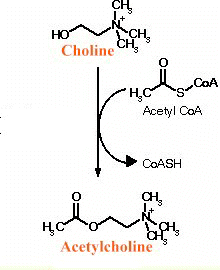
Now let us consider the specific example,acetylcholine, as the 2D planar structure:
-

-
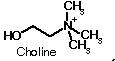
On the left side of the molecule note the quaternary (always positively charged) nitrogen, which is part of the choline component of acetylcholine.
-
-
The synthesis of acetylcholine proceeds by combination of choline and acetate (as Acetyl-CoA)-see below
-
-
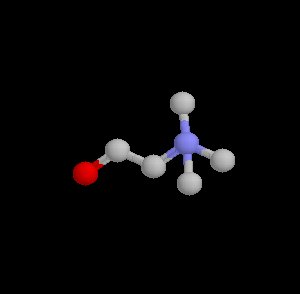
Now consider the 3-D structure of choline.
-
By convention, nitrogen atoms are blue, oxygen red and carbon gray.
-
-
-
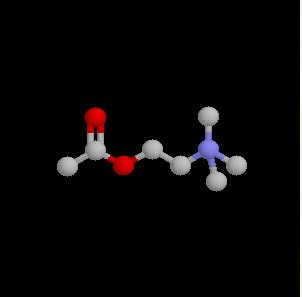
Similarly we can examine interactively the 3-D structure of acetylcholine:
-
-
Note above the presence of an "ester" linkage [O in red] between the choline moiety and the seal group.
-
This ester bond is susceptible to hydrolysis, i.e. breakage which may be catalyzed by esterases (acetylcholinesterase is an example).
-
Acetycholine:
-
-
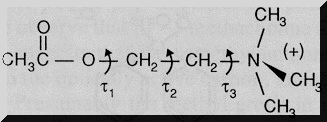
Although acetylcholine is depicted as a "static" molecule in terms of internal rotation,, acetylcholine and many other drugs exhibit free rotation around internal bonds.
-
For acetylcholine,tau1, tau2, tau3, represent torsion angles and refer to the degree of twist around these bonds of free rotation.
-
-
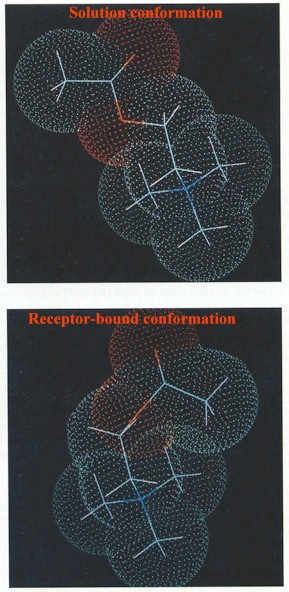
Specific additional analysis is required to determine which three-dimensional form of acetylcholine appears to be preferred for binding to the cholinergic receptor.
-
The configuration of acetylcholine and solution is quite different than the configuration when bound to the nicotinic cholinergic receptor.
-
-
-
-
Above figures adapted from Principles of Drug Action: The Basis of Pharmacology, Third Edition, edited by William . B. Pratt and Palmer Taylor, Churchill Livingston, New York, 1990. pp 20-23. Above Acetylcholine conformation figure -- original work: Behling, RW, Yamane T, Gavon G, Jelinski LW: Conformation of Acetylcholine Bound to the Nicotinic Acetylcholine Receptor. Proc Natl Acad Sci USA 85:6721, 1988.
-
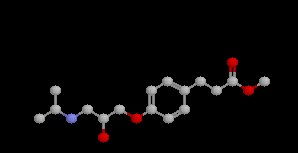
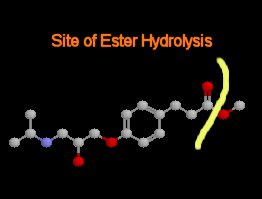
Some short-acting pharmacological agents are in fact short-acting because they are rapidly hydrolyzed at an ester linkage.
-
Ester-type local anesthetics
-
Esmolol (Brevibloc)
-
Remifentanil (Ultiva).
-
-
-
-
The biological action acetylcholine is terminated by hydrolysis, catalyzed by the enzyme acetylcholinesterase.
-
The overall reaction is shown below:
-
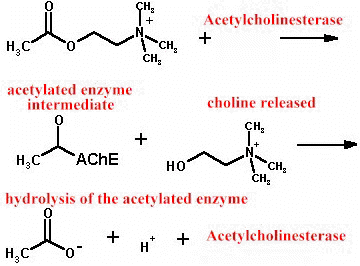
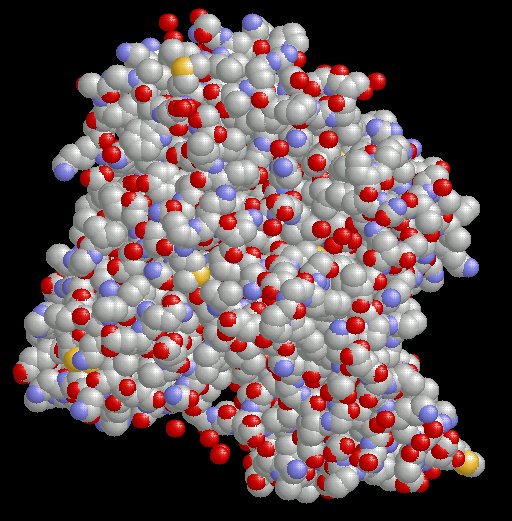
Acetylcholinesterase itself is a large, complex protein which has its primary catalytic function the extremely rapid hydrolysis of the neurotransmitter acetylcholine.
-
Acetylcholinesterase
-
Acetylcholinesterase
-
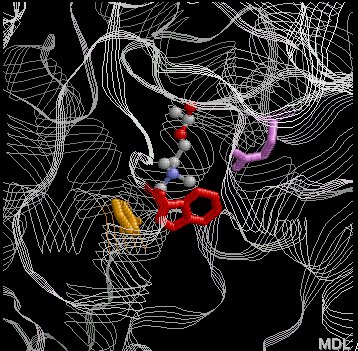
The image above illustrates the relationship between the very small molecule, acetylcholine, and its specific interaction within the very large molecule, acetylcholinesterase.
-
This image illustrates how the neurotransmitter acetylcholine represented above the in ball-and-stick form is recognized by specific amino acids within acetylcholinesterase's active site.
-
The positive charge of acetylcholine (due to the permanently positive quaternary nitrogen) interacts with tryptophan-84 (Trp-84) and phenylalanine-330 (Phe-330), through cationic (+ charged)- π-electron interactions}
-
This part of the acetylcholinesterase molecule is referred to as the "aromatic gorge"
-
The negatively charged amino acid, glutamatic acid-199 (Glu-199) is thought to interact with acetylcholine through ionic-type interactions
-
This image was created by Dr. Ricky Cox in the Department of Chemistry, Murray State University as part of research into the role of noncovalent Interactions in ligand-protein interactions. Image used with permission.
-
|
|
|
|
|
|
|