|
|
|
|


|
|
|
Medical Pharmacology Chapter 16: Pharmacology of Antipsychotics Drugs
|
|
|
|
|
|
|
What factors predict better recovery from first-episode psychosis?
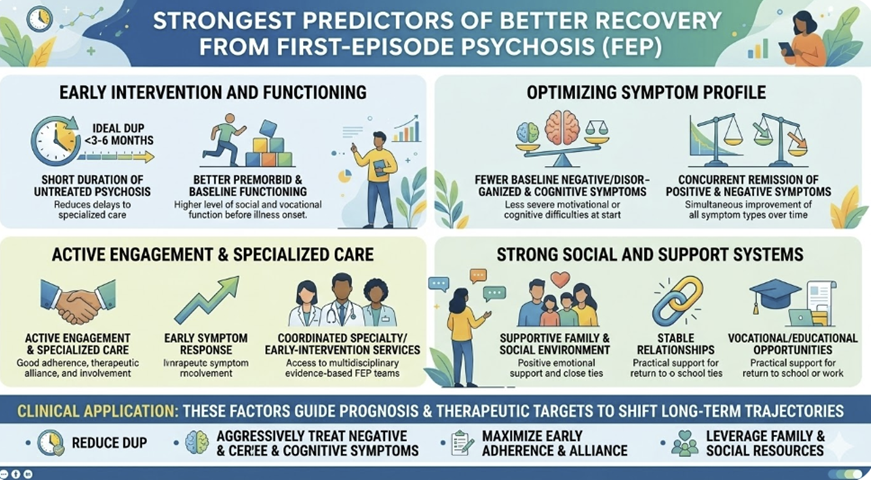
Several early-course and contextual factors consistently predict better recovery after a first‑episode psychosis (FEP), especially when recovery is defined as both sustained symptom remission and good social/occupational functioning.
The most robust predictors across systematic reviews and long‑term cohort studies are shorter duration of untreated psychosis, better premorbid and early functioning, fewer negative/cognitive symptoms, and strong engagement with treatment and family support.1,2,3,4,5
Duration of untreated psychosis (DUP)
Shorter DUP is one of the most consistent predictors of better outcome, both clinically and functionally.2,4,6,7,8,9
A large meta‑analysis of FEP found that shorter DUP independently predicted better functional recovery, even when sociodemographic and baseline clinical variables were controlled.1
A broad systematic review of remission and recovery in FEP concluded that DUP is among the most frequently replicated predictors of both symptomatic remission and global recovery.2
Prospective work in early psychosis services shows that patients with DUP less than about 3 months have significantly greater improvements in functioning (employment/education status and Global Assessment of Functioning) at 6–12 months than those with longer DUP, with a persistent functional gap over time.6,8
Neuroimaging and follow‑up data suggest that longer DUP is associated with more pronounced gray matter loss and worse long‑term outcomes, reinforcing the pathophysiologic plausibility of DUP as a prognostic marker.7,8
Premorbid and early-course functioning
Baseline and pre‑illness functioning consistently forecast later recovery trajectories.1,2,4,5,9,10
Systematic reviews indicate that better premorbid social and academic functioning and higher baseline global functioning are reliably associated with better long‑term functional outcomes.1,3
In the OPUS 10‑year cohort, full recovery (symptomatic plus psychosocial) was achieved in 14% of patients, and multivariable models showed that baseline predictors (including functioning) accounted for a meaningful portion of variance in recovery.11
A 10‑year FEP study of schizophrenia spectrum disorders found that the group achieving clinical recovery had significantly better premorbid academic adjustment and higher baseline functioning than the treatment‑resistant group.5
Early global functioning during the first year after onset (e.g., ability to maintain work/school, relationships) also predicts later recovery; poor early functional course tends to herald more chronic disability.3,4,5
 Considering
premorbid and early functioning as baseline: the better the social and
role functioning before and immediately after onset, the greater the
probability of later recovery.
Considering
premorbid and early functioning as baseline: the better the social and
role functioning before and immediately after onset, the greater the
probability of later recovery.
Symptom profile: negative, disorganized, and cognitive dimensions
The
type and severity of symptoms, especially negative and disorganized
features, are more helpful in determining prognosis than raw positive
symptoms at baseline.1,2,4,5,11,12
|
|
Functional recovery meta‑analysis found that, beyond duration of untreated psychosis (DUP), cognitive variables and concurrent remission of positive and negative symptoms were independently related to better long‑term functioning.1
Across
multiple first-episode psychosis (FEP) groups, more severe baseline
negative symptoms (avolition, alogia, blunted affect) predict lower odds
of both remission and functional recovery at follow‑up.2,4,5,12
In the 10‑year schizophrenia spectrum FEP study, those who became treatment‑resistant had significantly higher baseline negative and disorganized symptom scores, whereas the recovery group had fewer such symptoms.5
Cognitive impairments (in attention, working memory, executive function) measured early in the course are repeatedly associated with poorer social and occupational outcomes, even when psychosis itself remits.1,12
In contrast, initial severity of positive symptoms alone is an inconsistent predictor once DUP and other factors are accounted for, emphasizing that “how” the illness presents (negative/cognitive load, disorganization) matters more than “how loud” the positive symptoms are at intake.1,11,12
Treatment engagement and early response
How patients engage with treatment and respond in the first 1–3 years has strong prognostic value.2,3,4,5,12
Systematic reviews note that adherence to antipsychotic treatment and consistent participation in early intervention or coordinated specialty care are associated with higher remission and recovery rates.2,4,12
In first-episode psychosis (FEP) groups,, robust early reduction of positive symptoms and attainment of remission within the first year predict better long‑term clinical and functional outcomes, whereas persistent early psychosis suggests relapsing or treatment‑resistant potentialities.4,5,11
A prospective study of clinical and personal recovery dimensions in FEP found that stronger alliance with services and active participation in psychosocial interventions were associated with better personal recovery (subjective well‑being, empowerment) as well as symptom outcomes.3
 By
contrast, gaps in care, frequent non‑adherence, and early
discontinuation of treatment are robustly linked to relapse,
hospitalizations, and lower likelihood of later recovery.
By
contrast, gaps in care, frequent non‑adherence, and early
discontinuation of treatment are robustly linked to relapse,
hospitalizations, and lower likelihood of later recovery.
Early
treatment response and sustained engagement are dynamic predictors.
Furthermore, the clinical state can be influenced by means of psychoeducation, alliance building, side‑effect management, and family work.
Social context and family environment
Recovery from first-episode psychosis (FEP) is notably shaped by the social environment, including family relationships and broader support systems.2,3,4,12
A 3‑year FEP outcome study identified family intimacy (supportive, low‑conflict relationships) as an independent predictor of full recovery alongside shorter DUP and higher physical activity.4
Systematic reviews highlight that being in a stable relationship, having a supportive family, and stronger social networks are associated with better long‑term functioning and recovery.2,3,5
Employment
or being in education at baseline or early in care predicts better later
functioning and higher odds of meeting recovery criteria that include
independent living and work/study roles.1,3,12
These findings appear in accord with clinical trial data indicating that family psychoeducation* and supported employment/education programs improve functional outcomes, effectively turning social context into a modifiable prognostic factor.
*Psychoeducation is a structured, evidence-based therapeutic approach that teaches individuals and their families about mental health conditions, symptoms, and treatments.
This approach combines education with emotional support and skill-building to improve coping mechanisms, enhance treatment adherence, reduce stigma, and foster recovery.13,14,15
 |
|
|
|
|
|
|
 |
|
DISCLAIMER
|