|
|
|
|


|
|
|
Medical Pharmacology Chapter 16: Pharmacology of Antipsychotics Drugs
|
|
|
|
|
|
|
First Generation Antipsychotic Medications
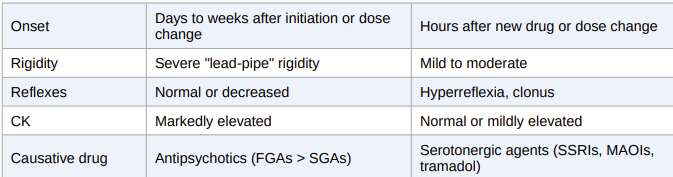
Neuroleptic Malignant Syndrome (NMS)
 Neuroleptic
malignant syndrome is a rare but potentially fatal idiosyncratic
reaction to antipsychotic medications, first described systematically by
Caroff and Mann in 1993.11
Neuroleptic
malignant syndrome is a rare but potentially fatal idiosyncratic
reaction to antipsychotic medications, first described systematically by
Caroff and Mann in 1993.11
Neuroleptic malignant syndrome (https://en.wikipedia.org/wiki/Neuroleptic_malignant_syndrome)
Neuroleptic malignant syndrome is characterized by:
(1) hyperthermia (temperatures often exceeding 40°C)
(2) severe "lead-pipe" rigidity
(3) altered consciousness ranging from confusion to coma, and
(4) autonomic instability consisting of diaphoresis, tachycardia, labile blood pressure).
Rhabdomyolysis with elevated creatine kinase (CK), often dramatically elevated above 1,000 U/L represents a noteworthy laboratory finding.
 Rhabdomyolysis may lead to acute renal failure.
Rabdomyolysis (https://en.wikipedia.org/wiki/Rhabdomyolysis)
NMS occurs in approximately 0.2% of patients treated with antipsychotics, with mortality rates historically around 10–20%, reduced with earlier recognition and treatment.
Risk
factors include rapid dose escalation, high-potency First-generation
antipsychotics (FGAs), parenteral administration, dehydration, and
concurrent lithium use.
Management requires:
Immediate antipsychotic discontinuation,
Intensive supportive care including cooling measures and
Aggressive hydrationand consideration of dantrolene sodium (a muscle relaxant) or dopamine agonists such as bromocriptine.
Antipsychotic rechallenge should be deferred for at least two weeks after full resolution, with careful selection of a lower-potency agent or an Second Generation Antipsychotic (SGA).
 |
 |
|
|
|
|
|
|
 |
|
DISCLAIMER
|