|
|
|
|


|
|
|
Medical Pharmacology Chapter 16: Pharmacology of Antipsychotics Drugs
|
|
|
|
|
|
|
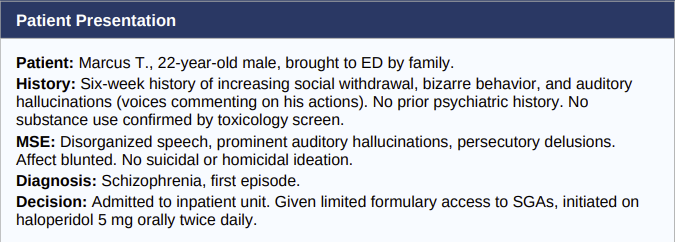
Case 1: First-Episode Psychosis with Acute Extrapyramidal Symptoms (EPS)
|
|
Clinical Course
On day 2, Marcus develops acute neck stiffening and difficulty opening his jaw, with upward deviation of his eyes, a presentation consistent with oculogyric crisis and torticollis.
He is visibly distressed and agitated.
Discussion Questions 1.
1. What is the diagnosis?
What pharmacological mechanism explains this presentation?
2. What is the appropriate immediate treatment?
3. How should the antipsychotic regimen be modified going forward?
4. What preventive measures could have been implemented at the time of haloperidol initiation
Teaching Points
Diagnosis
Acute dystonic reaction (oculogyric crisis + torticollis) secondary to haloperidol which is a high-potency FGA with high D2 affinity and correspondingly high EPS risk.
Treatment
Administer diphenhydramine IM (or benztropine IM/IV) immediately.
Relief is typically rapid (within 15–30 minutes).
Oral continuation of the anticholinergic for 2–3 days to prevent recurrence.
Regimen modification
Consider dose reduction of haloperidol, switching to a lower potency FGA (e.g., perphenazine), or switching to an SGA with a lower EPS profile.
Given that this is first-episode psychosis, SGAs are generally preferred per current guidelines.
Prevention
In young male patients receiving high-potency FGAs, prophylactic benztropine is a reasonable precaution during initiation, though prophylactic anticholinergics are not universally recommended.
Key principle
First-episode psychosis patients are particularly sensitive to EPS.
The APA 2021 guideline recommends that first-episode patients be treated in coordinated specialty care programs where close monitoring and individualized medication management are available.
|
|
|
|
|
|
 |
|
DISCLAIMER
|