|
|
|
|


|
|
|
Medical Pharmacology Chapter 16: Pharmacology of Antipsychotics Drugs
|
|
|
|
|
|
|
Prognostic Aspects of Psychosis in Bipolar Disorder
Prognostic Significance of Psychosis Within BD
| |
Not all bipolar disorder is clinically equivalent with respect to psychosis.
The presence of psychotic features within a bipolar episode carries independent prognostic weight beyond the diagnosis of BD itself.
McLean-Harvard First-Episode Mania Study
(Tohen M Zarate Jr C Hennen J Khalsa H-M Strakowski S Gebre-Medhil P Salvatore P Baldessarini R The McLean-Harvard First-Episode Mania Study: prediction of recovery and first recurrence. Am J Psychiatry. 2003 December;160(12). https://pubmed.ncbi.nlm.nih.gov/14638578/)
 This
work represents an important study of first-episode studies in BD,
reported that psychotic features during a first manic episode were
associated with:
This
work represents an important study of first-episode studies in BD,
reported that psychotic features during a first manic episode were
associated with:
(1) A longer time to symptomatic remission,
(2) Greater risk of mood-incongruent psychosis portending a worse trajectory, and
(3) Higher rates of subsequent subsequent episodes.17
 Patients with BD who have psychotic features are more likely to require
longer hospitalizations, have higher rates of treatment resistance,
experience more frequent recurrences, and show poorer functional
recovery between episodes compared to patients with BD without
psychosis.5
Patients with BD who have psychotic features are more likely to require
longer hospitalizations, have higher rates of treatment resistance,
experience more frequent recurrences, and show poorer functional
recovery between episodes compared to patients with BD without
psychosis.5
Mood-congruent psychosis (i.e. psychotic features aligning with patients current emotional state) manifesting as grandiose delusions during mania, or delusions of guilt and worthlessness during depression generally carries a more favourable prognosis within Bipolar Disorder.
Such symptoms typically resolve with mood stabilisation.
Mood-incongruent psychosis, particularly features such as thought insertion or passivity phenomena, appears to be associated with a more severe illness course, greater cognitive impairment, and closer proximity to the schizoaffective or schizophrenia end of the spectrum. 6,18
Episode Recurrence and Chronicity
Bipolar disorder is a recurrent illness.
The STEP-BD and longitudinal registry studies from Denmark and Sweden converge on the finding that the majority of Bipolar Disorder patients. perhaps 75%–90%, will experience at least one additional mood episode following a first hospitalization.
Episode frequency tends to increase over the early years of illness before potentially stabilizing in some patients.19
Psychotic features during episodes are associated with a higher overall episode burden.
A prognostic consideration is between episode (interepisodic) functional impairment.
Even in the absence of frank psychosis or acute mood episodes, patients with BD, especially those with psychotic BD, often show persistent subthreshold or minor mood symptoms, anxiety, and cognitive difficulties that limit occupational and social functioning.20
Excess mortality in Bipolar Disorder (BD) approximates two- to three-fold above general-population rates, paralleling schizophrenia in magnitude though differing in cause distribution.21
Suicide is a particularly prominent driver: approximately 25–50% of BD patients attempt suicide at some point, and 8–19% die by suicide, representing a 20- to 30-fold elevation over population base rates
This suicide rate is one of the highest suicide-associated risks in any psychiatric condition.16,21
Cardiovascular mortality is also substantially elevated, driven by the metabolic adverse effects of mood stabilizers, lifestyle factors, and the direct physiological effects of mood dysregulation on autonomic function and inflammatory cascades.
Psychotic features within BD may further elevate suicide risk during depressive and mixed phases, particularly in the context of command auditory hallucinations or delusions of catastrophe.
First, the overall course and disability associated with schizophrenia tends to be more severe, more persistent, and more refractory to treatment than that associated with psychotic BD in population-level analyses.
Second, the distinction in outcome is not absolute but probabilistic and overlapping noting that patients with severe, treatment-resistant, psychotic BD may have outcomes worse than patients with schizophrenia who have access to excellent care, good premorbid functioning, and strong social support.
The concept of a 'schizo-bipolar' spectrum reflects the reality that some patients occupy an intermediate zone where prognostic predictions based purely on DSM or ICD category are imprecise.
Third, the timing and relationship of psychosis to the illness course differs substantially.
In schizophrenia, psychosis is the defining and often primary illness dimension; in BD, psychosis is episodically superimposed on a fundamentally mood-driven illness trajectory.
This difference has practical implications:
In BD, aggressive mood stabilization can in many cases resolve psychosis without requiring ongoing antipsychotic therapy, whereas in schizophrenia, indefinite antipsychotic maintenance is generally indicated.22
Fourth, the rate of incomplete between episode recovery differs noting that truly complete symptomatic remission by Andreasen criteria is achieved by less than half of schizophrenia patients and maintained over time by only a minority23. [Andreasen N Carpenter Jr W Kane J Lasser R Marder S Weinberger D Remission in Schizophrenia: Proposed Criteria and Rationale for Consensus. Reviews and Overviews. The American Journal of Psychiatry. March 1 2005. https://psychiatryonline.org/doi/full/10.1176/appi.ajp.162.3.441]
In psychotic BD, full interepisodic remission is achievable in a substantially larger proportion of patients, particularly with first episodes and mood-congruent psychosis. (mood congruent: psychotic features that align with the patient's emotional state).
Neurocognitive Impairment in Schizophrenia
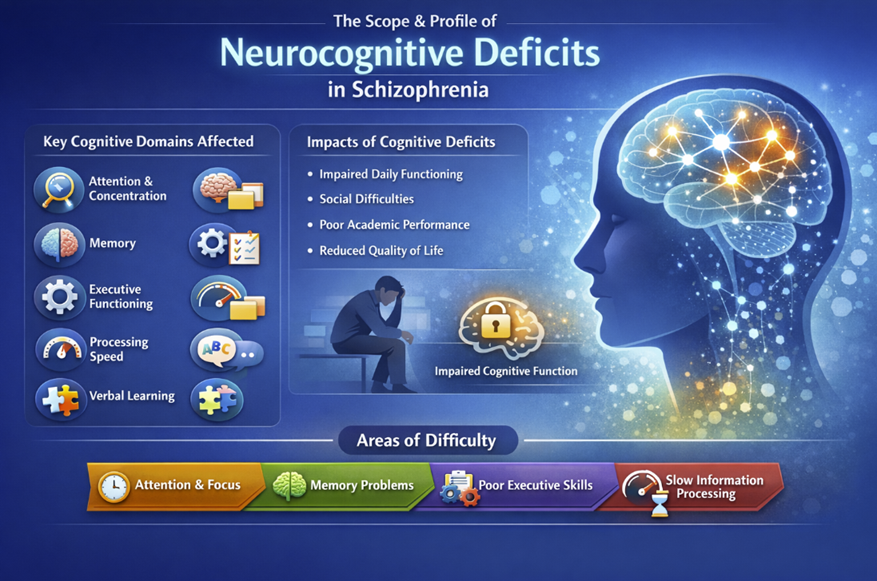
Scope and Profile of Cognitive Deficits
Neurocognitive
impairment is one of the most robust and treatment-resistant
features of schizophrenia.
Meta-analytic reviews establish that schizophrenia is associated with a broad, generalised cognitive impairment affecting nearly all tested domains, with an overall effect size of approximately 1.0–1.5 standard deviations below healthy comparison subjects.24
A comprehensive meta-analysis of first-episode schizophrenia evaluated eight cognitive domains including processing speed, attention, working memory, verbal learning, visual learning, reasoning and problem solving, social cognition, and general cognitive ability.
Deficits were present even at illness onset, before prolonged antipsychotic exposure could confound the picture.25
Processing speed and verbal learning/memory tend to show the most robust impairments.
Working memory defined as the ability to hold and manipulate information over brief intervals, is profoundly impaired and has attracted particular interest given its dependence on prefrontal cortical function and its links to symptoms of disorganization and functional disability.26
Social cognition, encompassing emotion recognition, theory of mind, and social perception, is increasingly recognized as an important and partially dissociable cognitive domain in schizophrenia, with direct links to social functional outcomes.27
|
|
 |
Prognostic Aspects of Psychosis in Bipolar Disorder
State vs. Trait, Progression, and Pre-Morbid Features
A key insight from longitudinal research is that the cognitive deficits of schizophrenia are largely trait features often presenting before illness onset, remaining relatively stable across the illness course, and not primarily driven by acute psychotic state.24,28
Studies of premorbid functioning using military conscript registries and prospective high-risk cohorts demonstrate that individuals who later develop schizophrenia show subtle cognitive deficits in childhood and adolescence, years or even decades before the first psychotic episode.29
Schaefer and colleagues provided a particularly comprehensive analysis demonstrating global cognitive impairment consistent in effect size across decades of study and across world regions.
This
study concluded that the cognitive signature of schizophrenia
reflects core, culture-independent disease biology rather than
treatment artifact.30
Antipsychotic medications have modest and inconsistent effects on cognition:
Frst-generation antipsychotics may mildly impair processing speed through extrapyramidal mechanisms,.
Second-generation antipsychotics may produce modest improvements in some domains, though the clinical magnitude of these differences is small.32
Cognitive
deficits in schizophrenia remain largely unresponsive to
currently available pharmacotherapy and represent a major
unmet treatment need.
|
|
|
|
|
|
 |
|
DISCLAIMER
|