Introduction to Medical Pharmacology
Module 6 — Atrial Fibrillation: Rate Control, Rhythm Control, and Cardioversion
AARR · Module 6 of 9Section 1
How three landmark trials shaped the atrial fibrillation management framework
The central pharmacologic decision in atrial fibrillation management is whether to focus on controlling the ventricular rate while accepting the ongoing arrhythmia, or to restore and maintain sinus rhythm. Two decades of trial evidence have refined this choice from a simple binary into a nuanced, patient-specific decision.
The Atrial Fibrillation Follow-up Investigation of Rhythm Management trial (2002) randomized over 4,000 patients — mostly older with high stroke risk — to rate control versus rhythm control. There was no difference in overall mortality at five years. Rhythm control was associated with more hospitalizations and drug adverse effects. The key lesson: the drugs available at the time for rhythm control carried enough toxicity and limitations to offset any benefit from restoring sinus rhythm.
The Rate Control versus Electrical Cardioversion trial (2002) similarly showed non-inferiority of rate control for a composite of cardiovascular outcomes in patients with persistent atrial fibrillation. Together with the Atrial Fibrillation Follow-up Investigation of Rhythm Management trial, it established rate control as a reasonable default strategy for many patients.
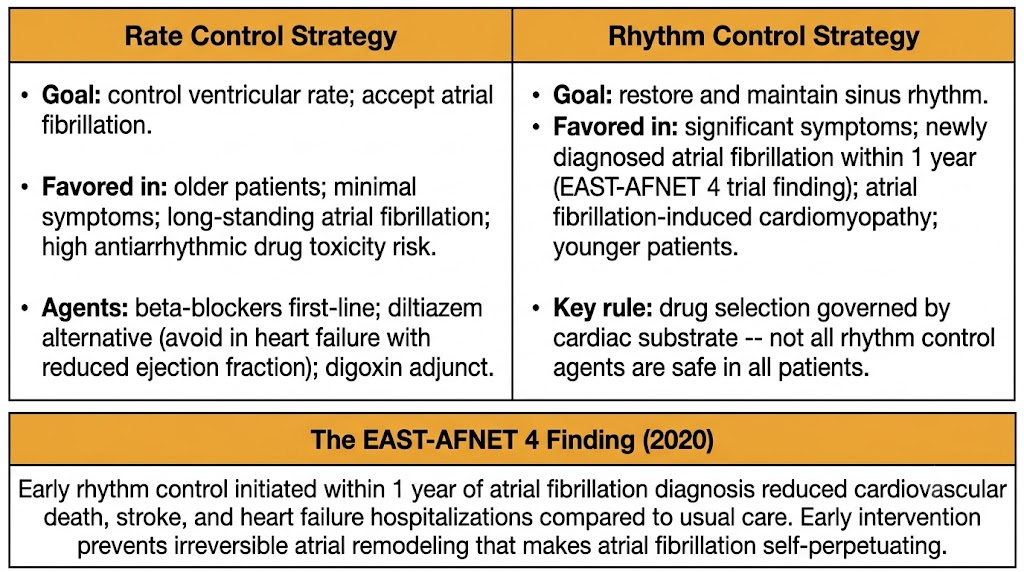
The Early Rhythm Control in Atrial Fibrillation trial (2020) reframed the question by focusing on newly diagnosed atrial fibrillation. Patients diagnosed within the preceding year who received early rhythm control — with either antiarrhythmic drugs or catheter ablation — had fewer cardiovascular events including death, stroke, and heart failure hospitalizations compared to those managed with usual care. The mechanism is that early rhythm control, initiated before sustained atrial remodeling becomes irreversible, prevents the structural and electrical changes that make atrial fibrillation self-perpetuating.
Rate control alone is reasonable for older patients with minimal symptoms, long-standing persistent atrial fibrillation where remodeling is established, and patients at high risk from antiarrhythmic drug toxicity. The target resting heart rate for rate control is below 110 beats per minute as an initial goal, with tighter control pursued in symptomatic patients.
Rhythm control is preferred — and increasingly favored early — for patients with significant symptoms despite adequate rate control, newly diagnosed atrial fibrillation (within the past year, consistent with the Early Rhythm Control in Atrial Fibrillation trial finding), atrial fibrillation-induced cardiomyopathy (where rhythm control may reverse left ventricular dysfunction), and younger patients where long-term maintenance of sinus rhythm is feasible. Patient preference, after informed discussion of the options and their realistic success rates, is a valid driver of this decision in either direction.
Section 2
Controlling ventricular response while accepting atrial fibrillation
Rate control reduces the ventricular response to atrial fibrillation to a level that relieves symptoms and prevents tachycardia-induced cardiomyopathy. The agent chosen depends primarily on the patient's left ventricular function and comorbidities.
Beta-blockers are first-line for ventricular rate control in atrial fibrillation across most clinical settings. They are particularly effective during sympathetic activation — exercise, post-surgical atrial fibrillation, thyrotoxicosis — where digoxin fails. Intravenous metoprolol or esmolol achieves rapid rate slowing in hemodynamically stable patients. For patients with heart failure with reduced ejection fraction, beta-blockers remain first-line for rate control because carvedilol, metoprolol succinate, and bisoprolol carry proven mortality benefit in that population.
Diltiazem and verapamil are effective alternatives when beta-blockers are contraindicated (severe reactive airway disease, certain bradyarrhythmias). Diltiazem is preferred for sustained rate control because of its less pronounced negative inotropic effect and its availability as a continuous intravenous infusion. Both agents are contraindicated in heart failure with reduced ejection fraction — their negative inotropic effect worsens hemodynamics in that population.
Digoxin provides vagotonic rate slowing that is effective at rest but largely lost during physical activity or any sympathetic activation. It is used as an adjunct when beta-blockers or calcium channel blockers alone do not achieve adequate rate control, particularly in sedentary patients or those with heart failure with reduced ejection fraction where it can be combined safely with beta-blockers.
Rate Control in Wolff-Parkinson-White with Atrial Fibrillation
All atrioventricular nodal blocking agents — beta-blockers, calcium channel blockers, digoxin, adenosine — are contraindicated in pre-excited atrial fibrillation in Wolff-Parkinson-White syndrome. Treatment is intravenous procainamide or urgent electrical cardioversion.
Section 3
The cardiac substrate — not the arrhythmia alone — determines which rhythm control agents are safe
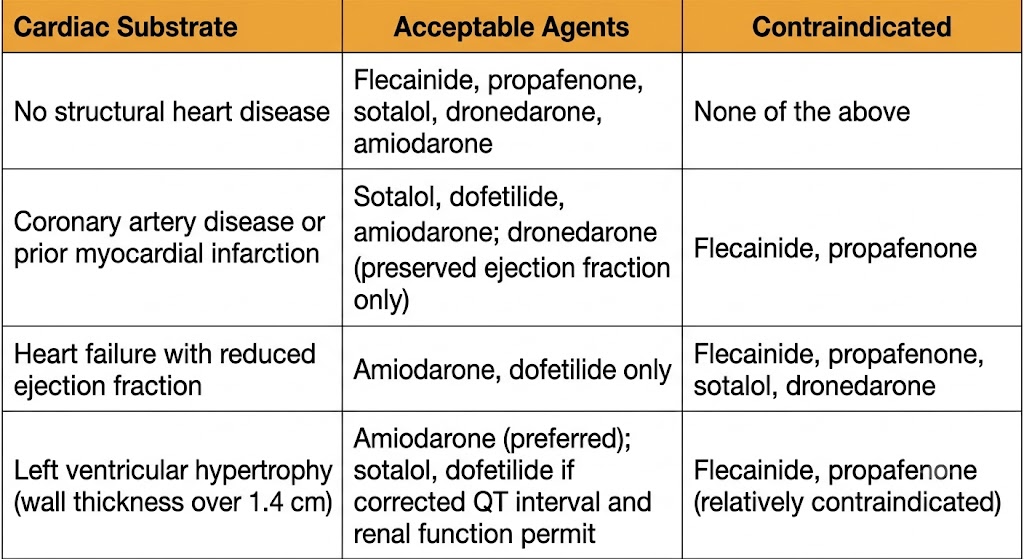
Rhythm control requires restoring and maintaining sinus rhythm with antiarrhythmic drugs. The choice of drug is governed almost entirely by the patient's cardiac substrate — the presence, type, and severity of structural heart disease. The safety constraints from prior modules (Cardiac Arrhythmia Suppression Trial, Andromeda, Pallas) apply directly here.
In patients without structural heart disease, the full range of rhythm control agents is pharmacologically available. Flecainide and propafenone are first-line choices for younger patients with high symptom burden — they are highly effective for paroxysmal atrial fibrillation and require a concurrent atrioventricular nodal blocking agent to prevent 1:1 atrial flutter conduction. Sotalol is an alternative with combined rate-slowing and rhythm control properties but requires corrected QT interval monitoring and in-hospital initiation. Dronedarone is acceptable in paroxysmal or persistent atrial fibrillation with preserved ejection fraction. Amiodarone is the most effective agent but reserved for refractory cases due to its cumulative toxicity burden.
Flecainide and propafenone are contraindicated — the Cardiac Arrhythmia Suppression Trial established that Class Ic agents increase mortality in patients with structural heart disease from prior myocardial infarction. Sotalol, dofetilide, and amiodarone are the agents of choice. Dronedarone is acceptable if ejection fraction is preserved and there has been no recent heart failure hospitalization.
This is the most pharmacologically restricted population. Only amiodarone and dofetilide have demonstrated safety — both have trial evidence showing they do not increase mortality in patients with reduced ejection fraction. Flecainide, propafenone, sotalol, and dronedarone are all contraindicated or carry mortality signals in this population. Catheter ablation is increasingly preferred as first-line rhythm control for symptomatic atrial fibrillation with heart failure with reduced ejection fraction.
Class Ic agents are relatively contraindicated in significant left ventricular hypertrophy (wall thickness greater than 1.4 centimeters) because altered conduction and interstitial fibrosis create a proarrhythmic substrate. Amiodarone is the preferred agent. Sotalol and dofetilide are alternatives depending on corrected QT interval and renal function.
Section 4
Terminating atrial fibrillation acutely with antiarrhythmic drugs
Pharmacologic cardioversion is most effective for recent-onset atrial fibrillation (less than 48 hours duration). Success rates decline substantially for atrial fibrillation of longer duration, where electrical cardioversion is more reliable. The same anticoagulation principles apply to both pharmacologic and electrical cardioversion.
The pill-in-the-pocket strategy allows selected patients to self-administer a single oral dose of flecainide or propafenone at the onset of a symptomatic atrial fibrillation episode, achieving cardioversion at home within two to six hours in the majority of cases. This strategy is appropriate only for patients with paroxysmal atrial fibrillation, no structural heart disease, a normal baseline electrocardiogram, and demonstrated tolerance after a supervised in-hospital test dose.
A concurrent atrioventricular nodal blocking agent — a beta-blocker or diltiazem taken 30 to 60 minutes before the flecainide or propafenone dose — is mandatory to prevent paradoxical 1:1 atrial flutter conduction. Patients must be instructed to seek emergency care if the arrhythmia does not terminate within six hours, or if new symptoms develop.
Ibutilide given intravenously is effective for acute pharmacologic cardioversion of recent-onset atrial fibrillation and atrial flutter. It is particularly effective for atrial flutter, which responds at higher rates than atrial fibrillation due to its more organized re-entrant substrate. Continuous monitoring for at least four hours after administration is mandatory because of the 4 to 8 percent torsades de pointes risk. Electrolyte correction before administration is essential.
Oral dofetilide achieves cardioversion over 24 to 48 hours during mandatory in-hospital initiation, simultaneously establishing maintenance therapy once sinus rhythm is restored. This combined approach is particularly efficient in patients with heart failure with reduced ejection fraction where amiodarone toxicity is a long-term concern.
Intravenous amiodarone is less effective than ibutilide or Class Ic agents for acute cardioversion but provides simultaneous ventricular rate slowing, making it useful when both rate control and rhythm control are priorities. It is also the preferred choice for cardioversion in patients with structural heart disease where other agents are contraindicated.
Section 5
The 48-hour rule, atrial stunning, and long-term stroke risk assessment
Cardioversion of atrial fibrillation — whether pharmacologic or electrical — carries a risk of systemic thromboembolism from dislodgement of thrombus that may have formed in the left atrial appendage during the arrhythmia. Anticoagulation management is inseparable from cardioversion planning.
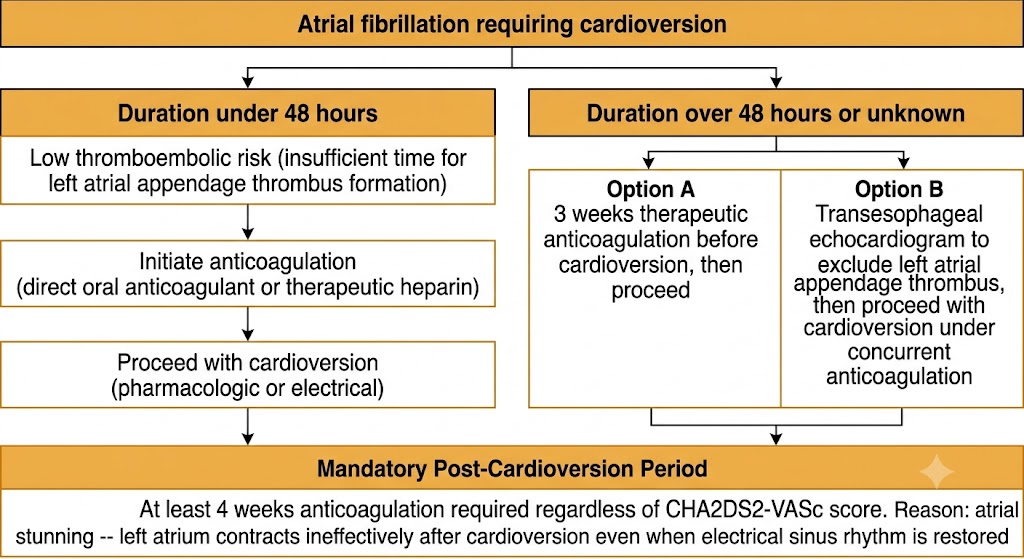
Atrial fibrillation of definite onset within the preceding 48 hours carries low immediate thromboembolic risk — there has been insufficient time for left atrial appendage thrombus to form and organize. In this window, cardioversion may proceed after initiating anticoagulation without requiring weeks of pre-cardioversion treatment.
However, post-cardioversion anticoagulation for at least four weeks is mandatory regardless of the CHA2DS2-VASc score, because of atrial stunning — a state of mechanical dysfunction that persists in the left atrium after cardioversion even when sinus rhythm has been electrically restored. During this period, the atrium contracts ineffectively and thromboembolic risk remains elevated until mechanical function fully recovers.
When atrial fibrillation duration exceeds 48 hours or is unknown, two strategies are accepted before cardioversion. The first is delayed cardioversion after at least three weeks of therapeutic anticoagulation, followed by at least four weeks post-cardioversion. The second is early cardioversion guided by transesophageal echocardiography to exclude left atrial appendage thrombus, allowing prompt cardioversion under concurrent anticoagulation without the three-week wait, followed by at least four weeks post-cardioversion. The four-week post-cardioversion anticoagulation period is required for both strategies because of atrial stunning.
The decision to continue anticoagulation beyond the mandatory four weeks depends on ongoing stroke risk, assessed using the CHA2DS2-VASc score. The score assigns points for: congestive heart failure or reduced left ventricular function, hypertension, age 75 or older (two points), diabetes mellitus, prior stroke or transient ischemic attack (two points), vascular disease, age 65 to 74, and female sex. Higher scores correspond to higher annual stroke risk.
Current guidelines recommend anticoagulation for men with a score of two or more and women with a score of three or more (the female sex point alone does not meet the treatment threshold). Direct oral anticoagulants — apixaban, rivaroxaban, dabigatran, and edoxaban — are preferred over warfarin for most patients with non-valvular atrial fibrillation because of superior or equivalent efficacy with lower bleeding risk in large randomized trials. Warfarin remains indicated for valvular atrial fibrillation (mechanical prosthetic valves, moderate-to-severe mitral stenosis) and in patients with severe renal impairment or other direct oral anticoagulant contraindications.
| Author / Organization | Title | Source |
|---|---|---|
| Wyse DG, Waldo AL, DiMarco JP, et al | A comparison of rate control and rhythm control in patients with atrial fibrillation (AFFIRM) | N Engl J Med. 2002;347(23):1825–1833 |
| Van Gelder IC, Hagens VE, Bosker HA, et al | A comparison of rate control and rhythm control in patients with recurrent persistent atrial fibrillation (RACE) | N Engl J Med. 2002;347(23):1834–1840 |
| Kirchhof P, Camm AJ, Goette A, et al | Early rhythm-control therapy in patients with atrial fibrillation (EAST-AFNET 4) | N Engl J Med. 2020;383(14):1305–1316 |
| Joglar JA, Chung MK, Armbruster AL, et al | 2023 ACC/AHA/ACCP/HRS guideline for the diagnosis and management of atrial fibrillation | J Am Coll Cardiol. 2024;83(1):109–279 |
| January CT, Wann LS, Calkins H, et al | 2019 AHA/ACC/HRS focused update of the 2014 guideline for management of patients with atrial fibrillation | J Am Coll Cardiol. 2019;74(1):104–132 |
| Capucci A, Villani GQ, Aschieri D, Rosi A, Piepoli MF | Oral amiodarone increases the efficacy of direct-current cardioversion in restoration of sinus rhythm in patients with chronic atrial fibrillation | Eur Heart J. 2000;21(1):66–73 |
| Torp-Pedersen C, Moller M, Bloch-Thomsen PE, et al | Dofetilide in patients with congestive heart failure and left ventricular dysfunction (DIAMOND-CHF) | N Engl J Med. 1999;341(12):857–865 |
| Lip GY, Nieuwlaat R, Pisters R, Lane DA, Crijns HJ | Refining clinical risk stratification for predicting stroke and thromboembolism in atrial fibrillation using a novel risk factor-based approach: the Euro Heart Survey on atrial fibrillation | Chest. 2010;137(2):263–272 |
| Hindricks G, Potpara T, Dagres N, et al | 2020 ESC Guidelines for the diagnosis and management of atrial fibrillation | Eur Heart J. 2021;42(5):373–498 |
| Marrouche NF, Brachmann J, Andresen D, et al | Catheter ablation for atrial fibrillation with heart failure (CASTLE-AF) | N Engl J Med. 2018;378(5):417–427 |
| Stiell IG, Sivilotti MLA, Taljaard M, et al | Electrical versus pharmacological cardioversion for emergency department patients with acute atrial fibrillation (RAFF2) | Lancet. 2020;395(10221):339–349 |