Introduction to Medical Pharmacology
Module 7 — Ventricular Arrhythmias: Ventricular Tachycardia, Ventricular Fibrillation, and Sudden Cardiac Death Prevention
AARR · Module 7 of 9Section 1
Procainamide first-line, amiodarone alternative, cardioversion for the unstable patient
The first decision in sustained monomorphic ventricular tachycardia is hemodynamic status. An unstable patient -- with hypotension, altered consciousness, pulmonary edema, or active ischemia -- requires immediate synchronized direct-current cardioversion regardless of any drug. In the hemodynamically stable patient, pharmacologic termination is the first-line approach.
Intravenous procainamide is the guideline-preferred pharmacologic agent for hemodynamically stable monomorphic ventricular tachycardia. Its Class Ia mechanism slows conduction through the re-entrant circuit and prolongs refractoriness, terminating scar-mediated ventricular tachycardia by achieving bidirectional block within the circuit. It is more effective than amiodarone for acute termination of ventricular tachycardia in comparative studies.
Procainamide is contraindicated when the corrected QT interval exceeds 500 milliseconds before administration and should be used with caution in patients with significant left ventricular dysfunction, because its negative inotropic effect and vasodilatory properties can precipitate hemodynamic compromise in a poorly compensated ventricle.
Intravenous amiodarone is an acceptable alternative for stable ventricular tachycardia and is preferred over procainamide when significant structural heart disease or severely impaired left ventricular function is present. Its multi-channel mechanism (Classes I through IV) provides broad efficacy across ventricular tachycardia substrates with less hemodynamic risk than procainamide in the severely impaired ventricle. It is also guideline-supported for ventricular tachycardia that is refractory to initial procainamide therapy.
The Hemodynamic Threshold is Absolute
If a patient with ventricular tachycardia is hemodynamically unstable at any point during pharmacologic management -- hypotension developing, consciousness deteriorating -- stop drug therapy and proceed immediately to synchronized direct-current cardioversion. Drug therapy does not take priority over cardioversion in an unstable patient.
Section 2
Drugs are adjuncts to defibrillation -- they do not replace shocks
Pulseless ventricular tachycardia and ventricular fibrillation are treated within the Advanced Cardiac Life Support shockable rhythm algorithm. Defibrillation is the primary intervention. Pharmacologic therapy is adjunctive -- drugs improve defibrillation success and reduce arrhythmia recurrence but do not terminate ventricular fibrillation on their own.
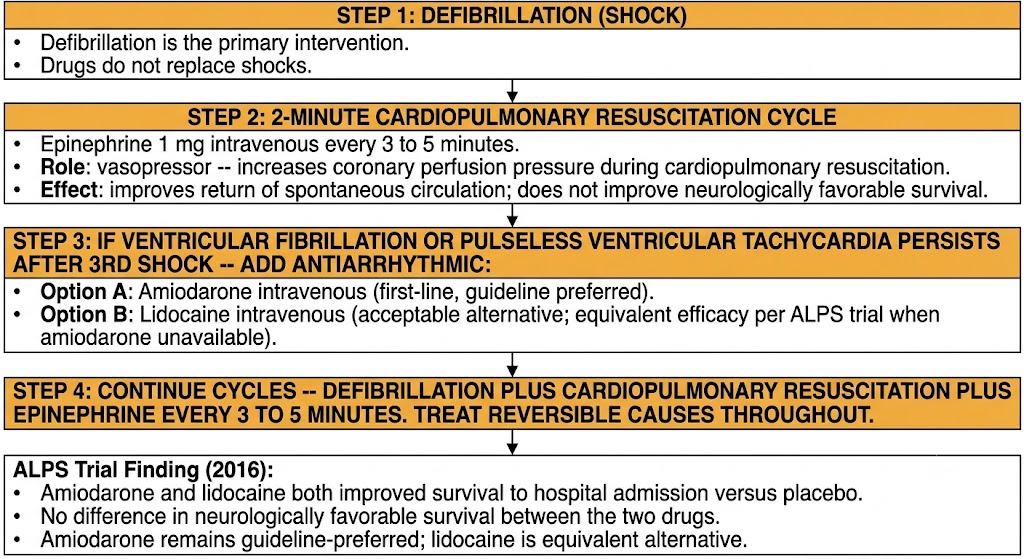
Epinephrine is given every 3 to 5 minutes throughout cardiac arrest. Its primary role is vasopressor: alpha-1 receptor-mediated vasoconstriction increases aortic diastolic pressure during cardiopulmonary resuscitation, improving coronary and cerebral perfusion pressure and thereby increasing the probability of successful defibrillation. Epinephrine improves return of spontaneous circulation and short-term survival but has not been shown to improve neurologically favorable survival to discharge in large randomized trials.
For ventricular fibrillation or pulseless ventricular tachycardia that remains refractory after at least two defibrillation attempts, an antiarrhythmic drug is added. The Amiodarone, Lidocaine, or Placebo Study compared these options in over 3,000 patients with out-of-hospital cardiac arrest and found that both amiodarone and lidocaine improved survival to hospital admission compared to placebo, but neither improved neurologically favorable survival to discharge in the overall population. The two active drugs were equivalent to each other.
The practical conclusion from the ALPS trial is that amiodarone and lidocaine have equivalent efficacy for shock-refractory ventricular fibrillation. Amiodarone remains the guideline-preferred first-line antiarrhythmic agent; lidocaine is an acceptable alternative when amiodarone is unavailable or contraindicated.
Section 3
Brugada syndrome, long QT syndrome, and catecholaminergic polymorphic ventricular tachycardia -- distinct drug strategies for each
Inherited channelopathies cause sudden cardiac death in structurally normal hearts, particularly in young patients. Each syndrome has a distinct arrhythmia trigger, a specific pharmacologic treatment, and a list of drugs that are specifically dangerous and must be avoided. The drug avoidance rules are as clinically important as the treatment rules.
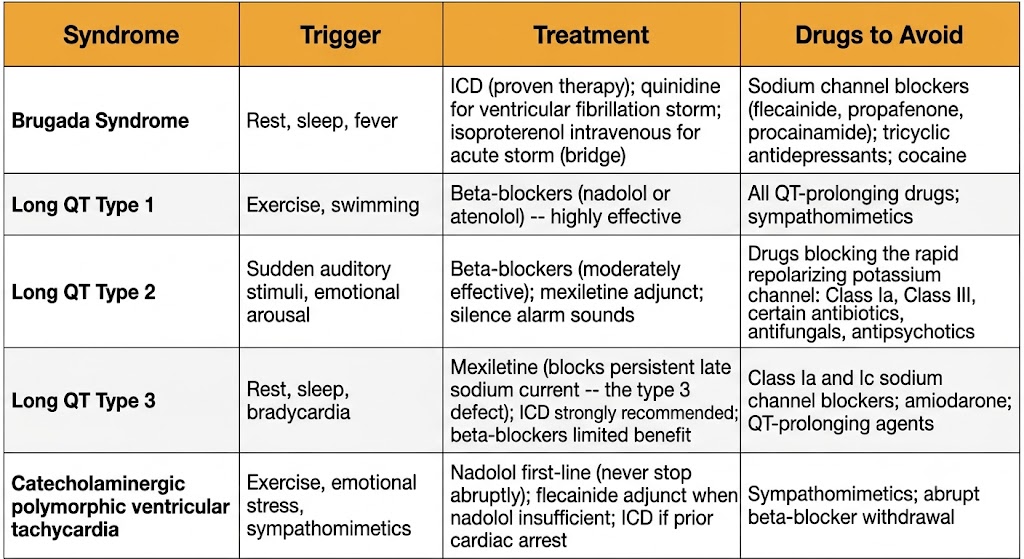
Brugada syndrome causes ventricular fibrillation in structurally normal hearts, characteristically during rest, sleep, or fever. The electrocardiogram shows the distinctive coved-type ST elevation in leads V1 through V3. The arrhythmia mechanism involves abnormal repolarization in the right ventricular outflow tract that creates re-entrant ventricular fibrillation.
The implantable cardioverter-defibrillator is the only proven mortality-reducing therapy in symptomatic Brugada syndrome. Quinidine is the pharmacologic treatment of choice for ventricular fibrillation storms and for reducing implantable cardioverter-defibrillator shock frequency -- its mechanism blocks the transient outward potassium current that drives the abnormal repolarization. Isoproterenol (intravenous) is used as a bridge therapy during acute ventricular fibrillation storms while quinidine is being initiated.
Drugs that must be avoided in Brugada syndrome include sodium channel blockers -- specifically Class Ic agents (flecainide, propafenone) and Class Ia agents (procainamide, ajmaline). These drugs worsen the underlying channel defect and can precipitate fatal ventricular fibrillation. Tricyclic antidepressants and cocaine also unmask or worsen the pattern.
Long QT syndrome is caused by mutations that delay cardiac repolarization, producing QT prolongation and susceptibility to torsades de pointes. The three common subtypes differ in their trigger and pharmacologic response.
Long QT syndrome type 1 is triggered by exercise and swimming. Beta-blockers are highly effective -- nadolol or atenolol at maximally tolerated doses substantially reduce syncopal episodes and sudden death risk. Avoid all QT-prolonging drugs.
Long QT syndrome type 2 is triggered by sudden auditory stimuli and emotional arousal. Beta-blockers are moderately effective. Environmental modification (silencing alarm sounds) specifically addresses the trigger. Mexiletine may provide adjunctive benefit. Critically, avoid all drugs that block the rapid repolarizing potassium channel -- this is the precise channel deficient in type 2, so any further blockade dramatically worsens QT prolongation. This includes Class Ia and Class III antiarrhythmics, certain antibiotics, antifungals, and antipsychotics.
Long QT syndrome type 3 is triggered by rest and sleep -- the opposite of type 1. The defect causes persistent inward sodium current during the action potential plateau, prolonging repolarization independent of heart rate. Beta-blockers have limited efficacy because the mechanism is not sympathetically driven. Mexiletine, which blocks the persistent late sodium current responsible for the type 3 defect, is the rational pharmacologic adjunct and shortens QT in responsive patients.
Catecholaminergic polymorphic ventricular tachycardia causes bidirectional or polymorphic ventricular tachycardia triggered exclusively by catecholamine surges -- exercise, emotional stress, or exogenous sympathomimetics. The heart is structurally normal and the resting electrocardiogram is normal.
Nadolol is first-line -- non-selective beta-blockade at the highest tolerated dose, never discontinued abruptly. Flecainide is added as an adjunct when nadolol alone is insufficient, reducing arrhythmia burden through a mechanism that stabilizes the calcium release channels responsible for the triggered activity. The combination of nadolol plus flecainide is more effective than either drug alone in refractory cases. Sympathomimetic drugs and abrupt beta-blocker withdrawal must be avoided.
Section 4
The ICD is the primary tool -- pharmacology is adjunctive
Sudden cardiac death prevention is the central goal of long-term ventricular arrhythmia management. Understanding what drugs can and cannot accomplish in this context is one of the highest-yield teaching points in the chapter.
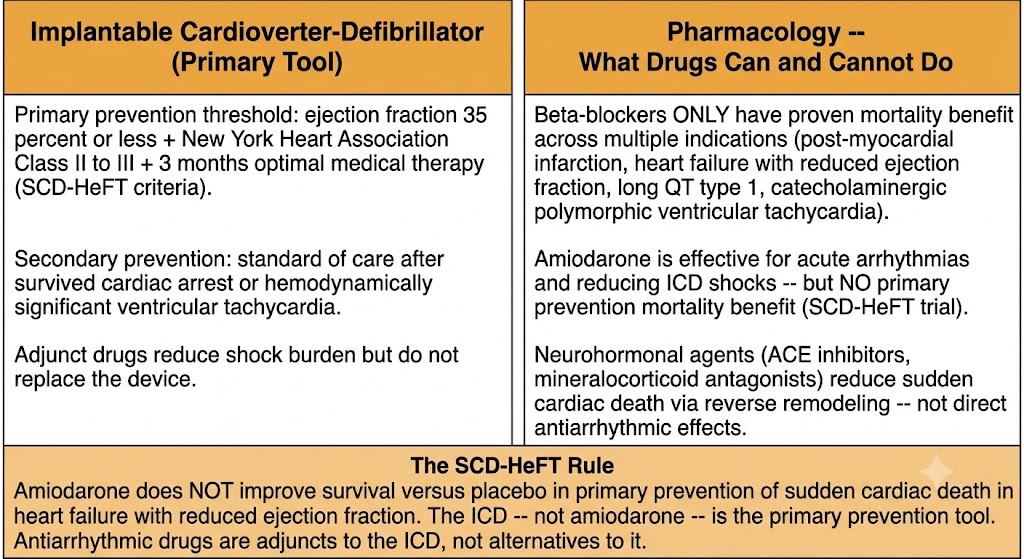
The implantable cardioverter-defibrillator is the only intervention proven to reduce sudden cardiac death in primary prevention populations. The core eligibility threshold from the Sudden Cardiac Death in Heart Failure Trial is ejection fraction 35 percent or less with New York Heart Association Class II or III symptoms despite at least three months of optimal guideline-directed medical therapy. The three-month waiting period is essential: beta-blockers and neurohormonal agents produce substantial reverse remodeling with ejection fraction improvement in many patients, and implantable cardioverter-defibrillator implantation before this recovery period overestimates who truly needs the device long-term.
Secondary prevention -- implantable cardioverter-defibrillator after a survived cardiac arrest or hemodynamically significant sustained ventricular tachycardia -- is established as the standard of care, with device therapy superior to antiarrhythmic drugs alone for reducing total mortality.
Beta-blockers are the only antiarrhythmic drug class with robust proven mortality benefit across multiple indications: post-myocardial infarction, heart failure with reduced ejection fraction, long QT syndrome type 1, and catecholaminergic polymorphic ventricular tachycardia. They are first-line in all of these populations.
Amiodarone is highly effective for terminating acute ventricular arrhythmias and for reducing implantable cardioverter-defibrillator shock frequency in recipients with frequent events. However, the Sudden Cardiac Death in Heart Failure Trial definitively established that amiodarone provides no primary prevention mortality benefit compared to placebo in patients with heart failure with reduced ejection fraction. This is a critical teaching point: amiodarone's efficacy for treating arrhythmias does not translate into a survival advantage when used as a primary prevention strategy. Antiarrhythmic drugs are adjuncts to the implantable cardioverter-defibrillator, not alternatives to it.
Neurohormonal agents -- beta-blockers, angiotensin-converting enzyme inhibitors, angiotensin receptor blockers, mineralocorticoid receptor antagonists -- reduce sudden cardiac death in heart failure with reduced ejection fraction not through direct ion channel effects but by reversing adverse cardiac remodeling and preventing the fibrosis and scar formation that create re-entrant ventricular tachycardia substrate. These agents are the pharmacologic foundation of primary prevention.
Section 5
Adjunctive drug therapy in ICD recipients and management of the most severe arrhythmia emergency
In patients with an implantable cardioverter-defibrillator, antiarrhythmic drugs serve as adjuncts to reduce ventricular tachycardia and ventricular fibrillation burden, decrease shock frequency, and improve quality of life. Drugs do not replace the device but can substantially reduce the number of painful shocks a patient receives.
Beta-blockers are first-line adjunct therapy in all implantable cardioverter-defibrillator recipients with structural heart disease. They reduce sympathetically triggered ventricular tachycardia and ventricular fibrillation, lower shock frequency, and carry independent mortality benefit in heart failure with reduced ejection fraction. Maximally tolerated doses should be achieved before adding other antiarrhythmic agents.
When beta-blocker therapy alone is insufficient, amiodarone combined with beta-blockade is the most effective pharmacologic strategy for reducing implantable cardioverter-defibrillator shock burden. Sotalol is an alternative with combined Class II and III activity and lower toxicity than amiodarone but is less effective. Catheter ablation of the ventricular tachycardia substrate is increasingly preferred as the definitive strategy to reduce shock burden while minimizing chronic amiodarone exposure and its cumulative toxicity.
Electrical storm is defined as three or more separate episodes of sustained ventricular tachycardia or ventricular fibrillation within 24 hours, each requiring intervention. It is a life-threatening emergency. The pharmacologic approach requires simultaneous rhythm control and urgent sympathetic suppression.
Intravenous amiodarone is the cornerstone of acute electrical storm management. Intravenous beta-blockade is mandatory and urgent -- catecholamine surge perpetuates electrical storm through triggered activity and shortened refractory periods, and intravenous metoprolol or esmolol infusion directly interrupts this cycle. This combination of amiodarone plus aggressive intravenous beta-blockade is the standard initial pharmacologic approach. Deep sedation further reduces catecholamine drive. Reversible precipitants -- hypokalemia, hypomagnesemia, myocardial ischemia, and proarrhythmic drug changes -- must be identified and corrected urgently.
In Brugada-related ventricular fibrillation storm specifically, isoproterenol infusion is the acute treatment of choice, suppressing the re-entrant mechanism through a distinct pathway, while quinidine is initiated for longer-term pharmacologic control.
| Author / Organization | Title | Source |
|---|---|---|
| Priori SG, Blomstrom-Lundqvist C, Mazzanti A, et al | 2015 ESC Guidelines for the management of patients with ventricular arrhythmias and the prevention of sudden cardiac death | Eur Heart J. 2015;36(41):2793–2867 |
| Marill KA, deSouza IS, Nishijima DK, et al | Amiodarone or procainamide for the termination of sustained stable ventricular tachycardia: an historical multicenter comparison | Acad Emerg Med. 2010;17(3):297–306 |
| Panchal AR, Bartos JA, Cabanas JG, et al | Part 3: Adult basic and advanced life support: 2020 American Heart Association guidelines for cardiopulmonary resuscitation and emergency cardiovascular care | Circulation. 2020;142(16 Suppl 2):S366–S468 |
| Kudenchuk PJ, Brown SP, Daya M, et al | Amiodarone, lidocaine, or placebo in out-of-hospital cardiac arrest (ALPS) | N Engl J Med. 2016;374(18):1711–1722 |
| Bardy GH, Lee KL, Mark DB, et al | Amiodarone or an implantable cardioverter-defibrillator for congestive heart failure (SCD-HeFT) | N Engl J Med. 2005;352(3):225–237 |
| Connolly SJ, Dorian P, Roberts RS, et al | Comparison of beta-blockers, amiodarone plus beta-blockers, or sotalol for prevention of shocks from implantable cardioverter defibrillators: the OPTIC study | JAMA. 2006;295(2):165–171 |
| Eifling M, Razavi M, Massumi A | The evaluation and management of electrical storm | Tex Heart Inst J. 2011;38(2):111–121 |
| Nademanee K, Taylor R, Bailey WE, Rieders DE, Kosar EM | Treating electrical storm: sympathetic blockade versus advanced cardiac life support-guided therapy | Circulation. 2000;102(7):742–747 |
| Priori SG, Wilde AA, Horie M, et al | HRS/EHRA/APHRS expert consensus statement on the diagnosis and management of patients with inherited primary arrhythmia syndromes | Heart Rhythm. 2013;10(12):1932–1963 |
| Schwartz PJ, Moss AJ, Vincent GM, Crampton RS | Diagnostic criteria for the long QT syndrome: an update | Circulation. 1993;88(2):782–784 |
| Moss AJ, Zareba W, Hall WJ, et al | Prophylactic implantation of a defibrillator in patients with myocardial infarction and reduced ejection fraction (MADIT II) | N Engl J Med. 2002;346(12):877–883 |