The Sequenced Treatment Alternatives to Relieve Depression trial is the empirical foundation for clinical antidepressant decision-making. By following real-world patients with major depressive disorder through multiple sequential treatment steps, it established what clinicians and patients can realistically expect from antidepressant therapy — and what to do when the first treatment does not produce remission.
The Sequenced Treatment Alternatives to Relieve Depression trial enrolled over 4,000 adult outpatients with major depressive disorder across 41 clinical sites, using measurement-based care with validated symptom scales. All patients began with citalopram at Step 1. Those who did not achieve remission moved through subsequent steps involving switches to alternative antidepressants, augmentation strategies, or combination regimens.
The most clinically important finding: only approximately one-third of patients (37 percent) achieved remission at Step 1. This is not a failure of the drug — it is the expected pharmacological reality of major depressive disorder. Cumulative remission across all four steps reached approximately 67 percent, but remission rates declined with each successive step (Step 1: 37 percent; Step 2: 31 percent; Step 3: 14 percent; Step 4: 13 percent), and critically, patients who required more steps to achieve remission were far less likely to sustain remission during follow-up.
The Sequenced Treatment Alternatives to Relieve Depression trial established four clinical principles that remain the foundation of antidepressant prescribing. First, remission — not merely response — is the treatment target; patients who achieve partial response without remission have substantially higher relapse rates and continued functional impairment. Second, approximately two-thirds of patients will require more than one treatment step, making a prospective plan for next-step treatment an essential component of initial prescribing. Third, each step produces progressively lower remission rates and shorter durations of sustained remission — making optimization of the first treatment step (adequate dose, adequate duration) the highest-priority intervention before switching. Fourth, comorbid anxiety disorders, present in over half of trial participants, substantially reduce the probability of remission at Step 1 and should inform initial agent selection.
An adequate antidepressant trial is treatment at a therapeutic dose for sufficient duration to assess efficacy — generally four to six weeks at a dose within the established therapeutic range. Premature switching before four weeks at adequate dose misses patients who would have achieved remission with more time. Waiting beyond eight to twelve weeks without meaningful improvement, without optimizing the dose, constitutes an unnecessarily prolonged course of ineffective treatment. The clinical algorithm derived from the Sequenced Treatment Alternatives to Relieve Depression trial: initiate at lowest effective dose, titrate to target within two to four weeks if tolerated, reassess at four weeks, optimize dose if partial response, and if no response at four to six weeks at therapeutic dose — switch, augment, or combine, guided by the patient's partial versus no response and clinical urgency.
Only one-third of patients achieve remission on the first antidepressant. The clinical response to this reality is a systematic, prospectively planned sequential treatment strategy — not reactive switching driven by frustration. Persistence through a structured sequence, with optimization at each step, maximizes cumulative remission rates. Premature switching before completing an adequate trial discards potentially effective treatments.
Augmentation means adding a second agent to a partially effective primary antidepressant to convert partial response into remission. The rationale for any augmentation strategy should be pharmacological: what mechanism is the primary antidepressant not providing, and how does the augmenting agent supply it? Augmentation is distinct from switching (abandoning the primary agent entirely) and from combining (using two antidepressants of different classes).
Atypical antipsychotics have the strongest evidence base of any augmentation class, with Food and Drug Administration-approved indications for adjunctive use in major depressive disorder for aripiprazole, quetiapine extended-release, brexpiprazole, and cariprazine when added to antidepressants in patients with inadequate response. The mechanistic rationale differs by agent. Aripiprazole is a dopamine D2 partial agonist and serotonin-1A partial agonist; its augmenting effect is attributed to partial restoration of dopaminergic tone in the prefrontal cortex — particularly relevant for residual anhedonia, low motivation, and cognitive slowing. Quetiapine at low doses (25 to 200 mg) augments primarily through serotonin-2A antagonism and histamine H1 blockade, improving sleep and reducing anxiety rather than through dopamine blockade. Brexpiprazole combines dopamine D2 partial agonism with serotonin-1A partial agonism and serotonin-2A antagonism, with more favorable rates of akathisia than aripiprazole.
The shared adverse effect burden of atypical antipsychotic augmentation includes weight gain (most prominent with quetiapine, less with aripiprazole and brexpiprazole), metabolic effects, and long-term risks of tardive dyskinesia requiring informed consent and periodic neurological monitoring.
Lithium augmentation has the longest historical evidence base in augmentation pharmacology, with controlled trials supporting its use when added to tricyclic antidepressants and selective serotonin reuptake inhibitors. The mechanism is incompletely understood but likely involves enhancement of serotonergic neurotransmission — lithium increases serotonin synthesis and release and may sensitize postsynaptic serotonin-1A receptors. Effective augmenting plasma concentrations (0.6 to 1.0 milliequivalents per liter) require the same monitoring infrastructure as lithium for any indication: baseline renal and thyroid function, regular serum concentration monitoring, and hydration counseling. Lithium's narrow therapeutic index and the monitoring burden have made it less commonly used in contemporary practice relative to atypical antipsychotics, despite its extensive evidence base.
Bupropion augmentation of selective serotonin reuptake inhibitors was included as a Sequenced Treatment Alternatives to Relieve Depression Step 2 option and is widely used in primary care. The pharmacological rationale is straightforward: bupropion blocks the norepinephrine and dopamine reuptake transporters without serotonergic activity, adding noradrenergic and dopaminergic enhancement to the primary serotonin transporter blockade of the selective serotonin reuptake inhibitor. Residual symptoms of fatigue, hypersomnia, anhedonia, cognitive slowing, and low motivation after selective serotonin reuptake inhibitor treatment are more closely linked to insufficient noradrenergic and dopaminergic tone than to insufficient serotonergic tone — bupropion directly addresses this gap. Bupropion augmentation also mitigates serotonin transporter inhibitor-induced sexual dysfunction through dopaminergic activity. The key pharmacokinetic caution: bupropion is a potent cytochrome P450 2D6 inhibitor, which raises plasma concentrations of selective serotonin reuptake inhibitors metabolized by this isoform.
Buspirone, a serotonin-1A partial agonist, was the other augmentation option at Sequenced Treatment Alternatives to Relieve Depression Step 2. Its proposed augmenting mechanism involves direct engagement of serotonin-1A autoreceptors — accelerating or enhancing the autoreceptor desensitization that is required before full antidepressant response develops. Buspirone augmentation is most rationally applied when residual anxiety is a prominent feature of the partial response. It produces no dependence, no withdrawal, and no respiratory depression — advantages over benzodiazepines in anxious patients.
Triiodothyronine (T3) augmentation was a Sequenced Treatment Alternatives to Relieve Depression Step 3 option with a signal of efficacy in small trials. The mechanism likely involves thyroid hormone's role in regulating central noradrenergic and serotonergic receptor sensitivity — even subclinical hypothyroidism within the normal reference range can blunt antidepressant response. Triiodothyronine is preferred over thyroxine (T4) for augmentation because it does not require peripheral conversion to the active form.
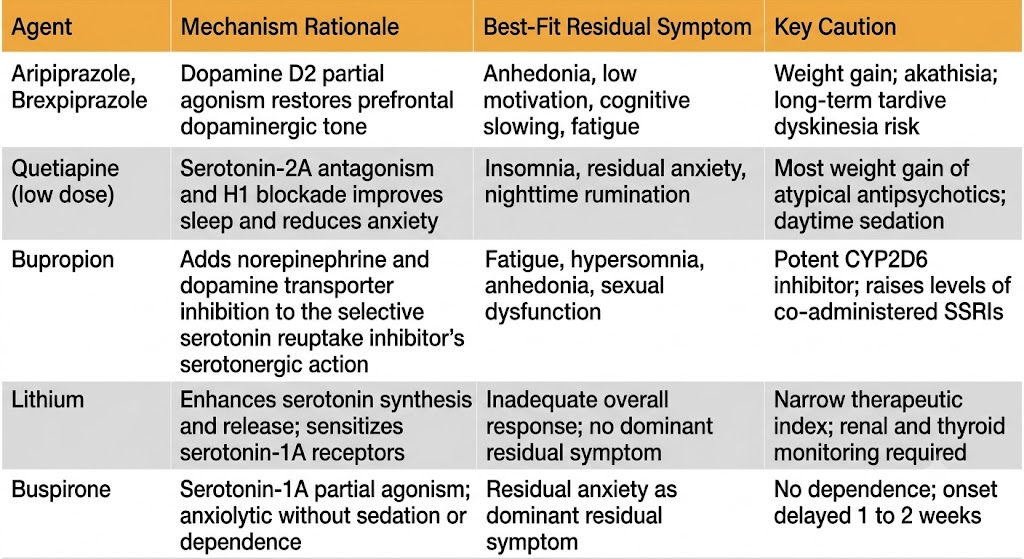
Fatigue, anhedonia, cognitive slowing, low motivation: bupropion (norepinephrine and dopamine) or aripiprazole/brexpiprazole (dopamine partial agonism). Residual anxiety and insomnia: quetiapine low dose (serotonin-2A antagonism, sedation) or buspirone (serotonin-1A agonism). Inadequate overall response with no clear residual pattern: lithium, aripiprazole, or brexpiprazole. Sexual dysfunction from selective serotonin reuptake inhibitor: bupropion. The augmenting pharmacology should address a mechanism the primary antidepressant is not covering.
Treatment-resistant depression is the term applied when major depressive disorder fails to respond to adequate pharmacological treatment. Before concluding that a patient has true treatment-resistant depression, pseudo-resistance — apparent treatment failure caused by correctible factors — must be systematically excluded. When true treatment-resistant depression is established, somatic interventions beyond pharmacotherapy become part of the treatment plan.
The most widely used operational definition is failure to achieve an adequate response — at least 50 percent reduction in validated symptom scores — after two or more adequate antidepressant trials of different classes at therapeutic doses for sufficient duration (four to eight weeks). This is the definition used for the Food and Drug Administration approval of esketamine.
Pseudo-resistance must be excluded before this label is applied. Pseudo-resistance encompasses apparent treatment failure caused by inadequate dosing, insufficient trial duration, poor medication adherence, unrecognized cytochrome P450 2D6 ultra-rapid metabolizer status (producing subtherapeutic plasma concentrations at standard doses), or unaddressed comorbidities that prevent antidepressant response: hypothyroidism, sleep apnea, substance use disorders, untreated anxiety disorders, and chronic pain. A systematic checklist approach before concluding treatment-resistant depression includes confirming adequate dose, confirming adherence, and assessing for each of these comorbidities explicitly.
Bipolar depression deserves special attention as a cause of apparent treatment-resistant depression. Bipolar disorder — particularly bipolar type II — may present without obvious hypomanic episodes that the patient recognizes as abnormal. Antidepressant monotherapy in bipolar depression can produce mood destabilization, cycle acceleration, and mixed states that appear as antidepressant treatment failure. Every patient with apparent treatment-resistant depression should be explicitly screened for bipolar features with a structured mood history and validated screening instrument. If bipolar disorder is identified, the treatment strategy changes completely — mood stabilization with lithium, lamotrigine, quetiapine, or lurasidone becomes the primary pharmacological goal.
Electroconvulsive therapy remains the most effective acute antidepressant intervention available, with remission rates of 50 to 70 percent in treatment-resistant depression populations — substantially higher than pharmacological alternatives at the same stage of treatment resistance. It is particularly indicated in severe or life-threatening depression (psychotic features, refusal to eat or drink, imminent suicidal risk), in pregnant patients for whom pharmacological risk is unacceptable, and in patients with known prior response to electroconvulsive therapy. The mechanism overlaps substantially with antidepressant drug action — electroconvulsive therapy increases brain-derived neurotrophic factor expression, normalizes hypothalamic-pituitary-adrenal axis activity, and produces receptor adaptations similar to those seen with chronic antidepressant pharmacotherapy. The primary limitation is cognitive adverse effects — anterograde and retrograde memory impairment during the acute treatment course — which typically resolve within six months.
Repetitive transcranial magnetic stimulation applies alternating magnetic fields to the scalp overlying the left dorsolateral prefrontal cortex, generating focal currents that increase excitability in a region that is characteristically hypoactive in major depressive disorder. The Food and Drug Administration has cleared transcranial magnetic stimulation for major depressive disorder in patients who have failed one prior antidepressant trial — a lower treatment resistance threshold than electroconvulsive therapy. Response rates are approximately 50 to 60 percent, with remission rates of approximately 30 to 37 percent — lower than electroconvulsive therapy but produced without cognitive side effects, anesthesia, or hospitalization. Transcranial magnetic stimulation and antidepressant pharmacotherapy appear synergistic, with continuation of medications during and after the transcranial magnetic stimulation course associated with better durability of response.
Confirm adequate dosing and full trial duration for each prior antidepressant. Confirm adherence. Assess for hypothyroidism, sleep apnea, substance use, and untreated anxiety. Screen explicitly for bipolar disorder using structured instruments. Only after ruling out pseudo-resistance is true treatment-resistant depression appropriately diagnosed — the distinction fundamentally changes the treatment approach.
Achieving remission is the acute treatment goal, but preventing relapse and recurrence is the long-term pharmacological imperative. Antidepressants do not cure major depressive disorder the way an antibiotic cures an infection — they suppress active episodes and reduce the probability of relapse and recurrence while they are being taken. Understanding this distinction is fundamental to informed consent and to duration-of-treatment decisions.
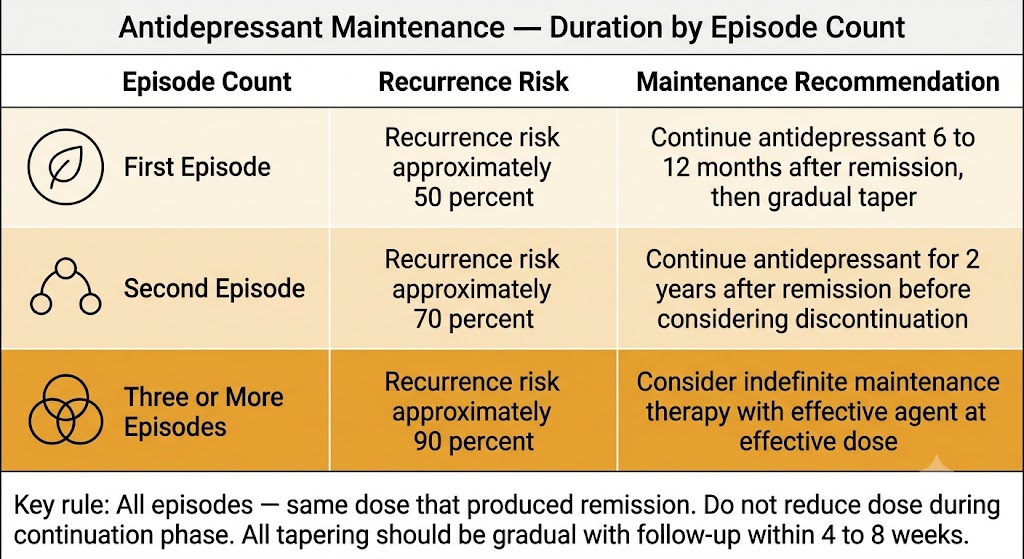
The continuation phase encompasses the period from acute remission through the natural duration of the depressive episode — typically six to twelve months following remission. Early discontinuation of effective antidepressant treatment within this window results in relapse rates of approximately 50 percent within six months, because the underlying biological episode has not yet run its natural course. The drug does not shorten the episode; it suppresses its manifestation. Premature discontinuation removes the pharmacological protection while the biological substrate of the episode is still active.
Current guidelines universally recommend continuing the effective antidepressant at the same dose that produced remission for at least six to twelve months following remission before considering dose reduction or discontinuation. The same dose that produced remission should be maintained throughout — dose reduction during the continuation phase increases relapse risk without reducing adverse effects sufficiently to justify the tradeoff in most patients.
Following the continuation phase, the decision to enter long-term maintenance or to taper and discontinue depends on the patient's individual recurrence risk. The number of prior episodes is the most important predictor: after one episode, recurrence risk is approximately 50 percent; after two episodes, approximately 70 percent; after three or more episodes, approximately 90 percent. These rates provide the pharmacological basis for episode-based duration guidelines.
Guidelines recommend considering indefinite maintenance therapy in patients with three or more lifetime depressive episodes, a history of severe or suicidal episodes, a chronic course without full interepisode recovery, or a strong family history of recurrent major depressive disorder. In all cases, the same agent and dose that produced the most recent remission is recommended for maintenance — switching during the maintenance phase introduces pharmacological risk without demonstrated benefit.
Residual symptoms after apparent remission are among the most powerful predictors of subsequent relapse — patients with residual symptoms have two to three times the relapse rate of those achieving complete symptomatic remission. Monitoring with validated symptom instruments at regular intervals during the maintenance phase enables early detection of subsyndromal symptom return. Any breakthrough symptoms in patients on adequate maintenance antidepressant doses should trigger systematic reassessment: confirm dose adequacy, assess for new psychosocial stressors, evaluate comorbidities, and consider augmentation or the addition of structured psychotherapy.
First episode: continue antidepressant for six to twelve months after remission, then consider gradual taper. Second episode: continue for two years after remission before considering discontinuation. Three or more episodes, or history of severe or suicidal episodes: indefinite maintenance with the effective agent at the effective dose. All discontinuation should be gradual with a systematic tapering plan and scheduled follow-up within four to eight weeks of dose reduction.
| Author / Organization | Title | Source |
|---|---|---|
| Rush AJ, Trivedi MH, Wisniewski SR, et al. | Acute and longer-term outcomes in depressed outpatients requiring one or several treatment steps: a STAR*D report | Am J Psychiatry. 2006;163(11):1905–1917 |
| Trivedi MH, Rush AJ, Wisniewski SR, et al. | Evaluation of outcomes with citalopram for depression using measurement-based care in STAR*D: implications for clinical practice | Am J Psychiatry. 2006;163(1):28–40 |
| Nelson JC, Papakostas GI | Atypical antipsychotic augmentation in major depressive disorder: a meta-analysis of placebo-controlled randomized trials | Am J Psychiatry. 2009;166(9):980–991 |
| Bauer M, Bschor T, Pfennig A, et al. | World Federation of Societies of Biological Psychiatry guidelines for biological treatment of unipolar depressive disorders in primary care | World J Biol Psychiatry. 2007;8(2):67–104 |
| Trivedi MH, Fava M, Wisniewski SR, et al. | Medication augmentation after the failure of SSRIs for depression | N Engl J Med. 2006;354(12):1243–1252 |
| Ruhe HG, van Rooijen G, Spijker J, et al. | Staging methods for treatment resistant depression: a systematic review | J Affect Disord. 2012;137(1–3):35–45 |
| Strawbridge R, Young AH, Cleare AJ | Biomarkers for depression: recent insights, current challenges and future prospects | Neuropsychiatr Dis Treat. 2017;13:1245–1262 |
| Ghaemi SN, Boiman EE, Goodwin FK | Diagnosing bipolar disorder and the effect of antidepressants: a naturalistic study | J Clin Psychiatry. 2000;61(10):804–808 |
| UK ECT Review Group | Efficacy and safety of electroconvulsive therapy in depressive disorders: a systematic review and meta-analysis | Lancet. 2003;361(9360):799–808 |
| Lefaucheur JP, Aleman A, Baeken C, et al. | Evidence-based guidelines on the therapeutic use of repetitive transcranial magnetic stimulation: an update (2014–2018) | Clin Neurophysiol. 2020;131(2):474–528 |
| DeRubeis RJ, Siegle GJ, Hollon SD | Cognitive therapy versus medication for depression: treatment outcomes and neural mechanisms | Nat Rev Neurosci. 2008;9(10):788–796 |
| Geddes JR, Carney SM, Davies C, et al. | Relapse prevention with antidepressant drug treatment in depressive disorders: a systematic review | Lancet. 2003;361(9358):653–661 |
| Kupfer DJ | Long-term treatment of depression | J Clin Psychiatry. 1991;52(suppl):28–34 |
| Judd LL, Paulus MJ, Schettler PJ, et al. | Does incomplete recovery from first lifetime major depressive episode herald a chronic course of illness? | Am J Psychiatry. 2000;157(9):1501–1504 |