CHAPTER 37  ·  ANTIFUNGAL AGENTS
Section 1

Shared Mechanism and Second-Generation Advances

CYP51 inhibition revisited, and the structural changes that expand mold coverage

Voriconazole, posaconazole, and isavuconazole share the same fundamental mechanism as fluconazole and itraconazole — inhibition of fungal cytochrome P450 51 (CYP51), the lanosterol 14-alpha-demethylase encoded by ERG11 in Candida species and cyp51A and cyp51B in Aspergillus species. What distinguishes the second-generation agents are structural modifications to the azole scaffold that increase binding affinity for CYP51 in mold pathogens, particularly Aspergillus fumigatus and the Mucorales, while altering the interaction with human cytochrome P450 enzymes in ways that differ meaningfully among the three agents.

Fungistatic Mechanism and Its Immunological Implication

Like all azoles, the extended-spectrum agents are fungistatic rather than fungicidal. Ergosterol depletion impairs growth and division but does not produce the rapid membrane disruption of polyenes. In profoundly neutropenic or T-cell-depleted patients, azole therapy controls but does not eradicate infection; immune reconstitution is essential for cure. This is the pharmacological basis for the prolonged treatment durations used in hematologic malignancy and transplant settings — therapy continues until immunosuppression resolves, not until a fixed endpoint.

Overview of the Three Agents

Voriconazole, approved in 2002, became standard of care for invasive aspergillosis after demonstrating superior outcomes over amphotericin B deoxycholate in a landmark randomized trial. It offers broad mold coverage with high oral bioavailability but has non-linear pharmacokinetics, significant interpatient variability, and a toxicity profile requiring systematic monitoring. Posaconazole, approved in 2006, is defined primarily by its prophylaxis role in the highest-risk immunocompromised populations and by its activity against the Mucorales — a gap in voriconazole spectrum. Isavuconazole, approved in 2015, offers equivalent efficacy to voriconazole for invasive aspergillosis with a more favorable tolerability profile, simpler pharmacokinetics, and Mucorales coverage comparable to posaconazole.


Section 2

Voriconazole

Non-linear pharmacokinetics, CYP2C19 polymorphism, visual and hepatic toxicity, and clinical indications

Voriconazole is the cornerstone of therapy for invasive aspergillosis and an important agent for several other mold and yeast infections. Its clinical use is complicated by non-linear pharmacokinetics, substantial interpatient variability driven by genetic polymorphism in the primary metabolizing enzyme, and a toxicity profile that requires systematic monitoring.

Oral Bioavailability and Absorption

Voriconazole has oral bioavailability of approximately 96 percent under fasting conditions, one of its major advantages over itraconazole. It must be taken on an empty stomach because high-fat meals reduce the area under the concentration-time curve (AUC) by approximately 24 percent — a clinically meaningful reduction that is a practical source of subtherapeutic concentrations even when doses appear appropriate. The intravenous (IV) formulation uses sulfobutylether-beta-cyclodextrin (SBECD) as a solubilizing vehicle. SBECD accumulates in renal insufficiency and is renally excreted; when creatinine clearance falls below 50 mL/min, the IV formulation should be switched to oral voriconazole to avoid SBECD accumulation.

Non-Linear Pharmacokinetics and CYP2C19 Polymorphism

Voriconazole exhibits non-linear pharmacokinetics because its primary metabolizing enzyme, hepatic cytochrome P450 2C19 (CYP2C19), becomes saturated at therapeutic doses. Modest dose increases therefore produce disproportionately large increases in plasma exposure. CYP2C19 is genetically polymorphic: poor metabolizers (PM), who carry two loss-of-function alleles, achieve plasma concentrations four to five times higher than normal metabolizers at the same dose; ultrarapid metabolizers (UM) achieve concentrations up to 50 percent lower. The PM phenotype occurs in approximately three to five percent of European and African populations and 15 to 20 percent of Asian populations — a clinically decisive difference. CYP2C19 is also inhibited by proton pump inhibitors such as omeprazole, further complicating concentration prediction from dose alone.

Drug Interactions

Voriconazole is a potent inhibitor of CYP2C19, CYP2C9, and CYP3A4, making it one of the most interaction-prone drugs in clinical medicine. Key interactions include: tacrolimus and cyclosporine concentrations increased substantially, requiring 50 to 67 percent dose reductions; sirolimus concentrations increased so dramatically that the combination is contraindicated; warfarin augmented through CYP2C9 inhibition of S-warfarin metabolism, requiring close international normalized ratio (INR) monitoring. Strong CYP inducers — rifampin, phenytoin, carbamazepine, long-acting barbiturates, efavirenz — reduce voriconazole concentrations to subtherapeutic levels and are contraindicated or require extraordinary dose adjustment. St. John's wort is also contraindicated.

Antifungal Spectrum

Voriconazole covers Aspergillus species including Aspergillus terreus, which is resistant to amphotericin B. It is active against most Candida species, Scedosporium apiospermum, and Fusarium species. The major gap is the Mucorales — Rhizopus, Mucor, Lichtheimia — against which voriconazole has no meaningful activity. Clinical experience showed that voriconazole prophylaxis in hematology patients was associated with breakthrough mucormycosis, reinforcing that voriconazole must never be relied on for empirical coverage where Mucorales risk exists.

Toxicity

Three dominant toxicities define voriconazole. Visual disturbances — transient changes in visual acuity, color perception, and photopsia — occur in 20 to 30 percent of patients, beginning within 30 minutes of each dose and resolving within 30 minutes. They are not associated with permanent visual damage with short-term use, but persistent symptoms warrant ophthalmologic evaluation. Hepatotoxicity, manifesting as elevation of liver enzymes, occurs in 5 to 15 percent of patients and is the most common reason for discontinuation. Phototoxic skin reactions with even brief sun exposure occur with prolonged use and are associated in rare cases with squamous cell carcinoma and melanoma, requiring sun protection counseling and annual dermatologic surveillance. Neuropsychiatric effects including hallucinations and encephalopathy occur, particularly at supratherapeutic plasma concentrations.
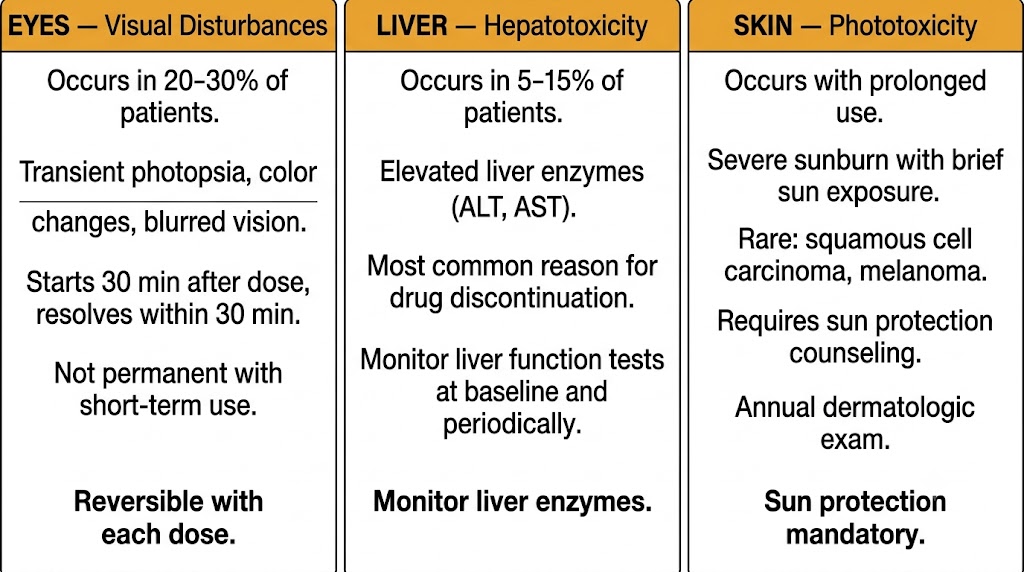
Three-panel organ system diagram showing voriconazole toxicities: left panel (Eyes) shows visual disturbances occurring in 20 to 30 percent of patients with transient photopsia and color changes starting 30 minutes after each dose and resolving within 30 minutes; center panel (Liver) shows hepatotoxicity in 5 to 15 percent with elevated liver enzymes and need for periodic monitoring; right panel (Skin) shows phototoxicity with prolonged use, risk of squamous cell carcinoma and melanoma, requiring sun protection and annual dermatologic exam.
Voriconazole toxicity profile by organ system: visual disturbances, hepatotoxicity, and phototoxicity. Gemini-generated figure.
Voriconazole Key Hazards

CYP2C19 poor metabolizer phenotype — 15 to 20 percent in Asian patients: concentrations four to five times higher at standard doses; therapeutic drug monitoring (TDM) is mandatory for all patients. Tacrolimus and cyclosporine: reduce dose 50 to 67 percent at initiation; sirolimus: contraindicated. Rifampin, phenytoin, carbamazepine: avoid — reduce voriconazole to subtherapeutic. IV formulation: switch to oral if creatinine clearance falls below 50 mL/min (SBECD vehicle accumulates). Long-term use: sun protection mandatory; annual dermatologic exam. No Mucorales coverage: never use for suspected mucormycosis.

Section 3

Posaconazole

Formulation pharmacology, Mucorales activity, and prophylaxis evidence in high-risk populations

Posaconazole occupies a distinctive clinical niche defined by its role as the preferred prophylactic antifungal in the highest-risk immunocompromised populations and by its spectrum extending to the Mucorales — a group for which most other azoles have no activity.

Formulations and Absorption

Three posaconazole formulations exist: oral suspension, delayed-release (DR) tablets, and an IV solution also formulated with SBECD. The oral suspension is highly dependent on food intake and gastric acidity; administration with a high-fat meal increases AUC approximately fourfold compared to fasting, and four-times-daily dosing with meals or nutritional supplements is required to achieve reliable plasma concentrations. These requirements make the suspension problematic in the highest-risk patients — those who are nil per os, have mucositis, or have gastrointestinal graft-versus-host disease (GVHD) — precisely the patients who need reliable antifungal prophylaxis most. The delayed-release tablet provides substantially improved and consistent oral bioavailability through a pH-dependent polymer matrix releasing drug in the small intestine; once-daily dosing achieves approximately 2.5-fold higher plasma concentrations than the suspension. The IV formulation bypasses oral absorption entirely and is appropriate when oral intake is not reliable. The delayed-release tablet is the preferred oral formulation in current practice.

Spectrum and Mucorales Activity

Posaconazole shares the broad Aspergillus spectrum of voriconazole and extends coverage to include the Mucorales — Rhizopus, Mucor, Lichtheimia, and Cunninghamella — making it the only oral azole with meaningful anti-Mucorales activity. It also covers most Candida species, the dimorphic fungi, Fusarium species, and dermatophytes.

Prophylaxis Evidence

Posaconazole is standard of care for antifungal prophylaxis in two high-risk populations. First, patients receiving remission-induction or re-induction chemotherapy for acute myeloid leukemia (AML) or myelodysplastic syndrome (MDS) have prolonged profound neutropenia and high risk for invasive Aspergillus and Mucorales infections. The pivotal randomized trial by Cornely et al. demonstrated that posaconazole suspension significantly reduced invasive fungal infections and improved overall survival compared to fluconazole or itraconazole prophylaxis. Second, hematopoietic stem cell transplant (HSCT) recipients with GVHD receiving high-dose immunosuppression represent the second canonical indication; posaconazole reduced invasive fungal infections compared to fluconazole in the randomized trial by Ullmann et al. TDM is recommended, particularly when the suspension is used, with a target trough above 0.7 mg/L for prophylaxis and above 1.0 mg/L for treatment.

Drug Interactions

Posaconazole is a potent inhibitor of CYP3A4 but does not significantly inhibit CYP2C19 or CYP2C9, distinguishing it from voriconazole. Calcineurin inhibitor doses must be reduced 50 to 75 percent at posaconazole initiation with daily trough monitoring. Sirolimus is contraindicated. Proton pump inhibitors and histamine-2 receptor antagonists reduce suspension absorption significantly by raising gastric pH; this interaction does not affect the delayed-release tablet or IV formulation. CYP3A4 inducers including rifampin reduce posaconazole concentrations significantly; this combination is contraindicated. As with voriconazole IV, the IV posaconazole formulation carries the same SBECD accumulation concern in renal insufficiency.


Section 4

Isavuconazole

Prodrug pharmacology, linear kinetics, QT shortening, and Mucorales coverage

Isavuconazole, the most recently approved extended-spectrum triazole, has gained rapid adoption in many centers due to more predictable pharmacokinetics, reduced drug interaction burden compared to voriconazole, absence of the SBECD vehicle in its IV formulation, and a tolerability profile that avoids the visual and photosensitivity toxicities that complicate long-term voriconazole use.

Prodrug and Formulation

Isavuconazole is marketed as isavuconazonium sulfate, a water-soluble prodrug rapidly hydrolyzed by plasma esterases after oral or IV administration to release the active isavuconazole. The prodrug design eliminates the need for SBECD in the IV formulation — a meaningful advantage in patients with renal insufficiency who cannot safely receive SBECD-containing IV formulations. Oral bioavailability is approximately 98 percent with no significant food effect, pharmacokinetically superior to both voriconazole (requires fasting) and posaconazole suspension (requires high-fat meal).

Linear Pharmacokinetics and Half-Life

Unlike voriconazole, isavuconazole exhibits linear (first-order) pharmacokinetics — plasma concentrations increase proportionally with dose, making pharmacokinetic prediction more reliable. The terminal half-life is approximately 130 hours (five to six days), the longest of the extended-spectrum triazoles, allowing once-daily maintenance dosing. A loading regimen is essential to achieve therapeutic concentrations rapidly in acute infection because steady state without loading takes approximately three weeks.

Drug Interactions and QT Effect

Isavuconazole inhibits CYP3A4 with somewhat lower potency than voriconazole or posaconazole. Calcineurin inhibitor concentrations are elevated but typically to a lesser degree than with the other extended-spectrum agents; the magnitude of tacrolimus dose reduction required is often smaller. Sirolimus still requires careful TDM. Strong CYP3A4 inducers are contraindicated. A clinically distinctive feature is that isavuconazole shortens the corrected QT interval (QTc) rather than prolonging it — the opposite of most other antifungals and many drugs in general. This is an advantage in patients with baseline QTc prolongation but also a diagnostic signal: QTc shortening on a new electrocardiogram (ECG) in a patient on isavuconazole may indicate supratherapeutic concentrations.

Spectrum and Clinical Evidence

The antifungal spectrum covers Aspergillus species (including Aspergillus terreus), most Candida species, the Mucorales, and the dimorphic fungi. The SECURE trial — a randomized, double-blind, non-inferiority study — demonstrated that isavuconazole was non-inferior to voriconazole for all-cause mortality at day 42 in invasive mold disease, with a significantly better tolerability profile: fewer visual adverse effects, less hepatotoxicity, and fewer skin reactions. A single-arm mucormycosis study (VITAL) demonstrated outcomes comparable to a historical amphotericin B cohort, supporting the mucormycosis approval. Isavuconazole lacks reliable activity against Scedosporium prolificans and some rare non-fumigatus Aspergillus species.

When to Prefer Isavuconazole Over Voriconazole

Prefer isavuconazole when: renal insufficiency precludes IV voriconazole (SBECD accumulation) and oral absorption is unreliable; baseline QTc prolongation makes further QTc-prolonging drugs hazardous; patient is at high risk for voriconazole photosensitivity or long-term skin toxicity; suspected or confirmed mucormycosis where oral Mucorales coverage is desired; simpler pharmacokinetics and no food effect are operationally important. Voriconazole retains advantages in central nervous system (CNS) aspergillosis (higher published cerebrospinal fluid (CSF) penetration data) and where lower cost is a priority if generic voriconazole is available.


Section 5

Resistance and Therapeutic Drug Monitoring

Environmental azole resistance in Aspergillus and TDM targets for the extended-spectrum agents

Azole resistance in Aspergillus fumigatus has emerged as a global public health problem driven by mechanisms that differ from Candida resistance and that reflect environmental exposure to agricultural azole fungicides rather than prior medical azole therapy.

Environmental Azole Resistance in Aspergillus fumigatus

The most clinically and epidemiologically important resistance mechanism in Aspergillus fumigatus is a 34-base-pair tandem repeat insertion in the cyp51A promoter combined with a leucine-to-histidine substitution at codon 98 — designated TR34/L98H. This combined mutation confers high-level pan-azole resistance (resistant to voriconazole, itraconazole, and posaconazole simultaneously) and has been detected in environmental soil, compost, and flower bulbs across Europe, Asia, Africa, and North America. The environmental origin reflects selective pressure from agricultural use of demethylase inhibitor (DMI) fungicides, which share the same CYP51 target as medical azoles. Patients who develop this resistance pattern predominantly have not received prior medical azole therapy, confirming environmental exposure as the primary driver. A second mutation, TR46/Y121F/T289A, confers voriconazole-specific resistance without cross-resistance to itraconazole. Azole-resistant Aspergillus infections carry substantially higher mortality than susceptible infections. Resistance testing is recommended for all invasive Aspergillus isolates in centers where resistance prevalence exceeds approximately five to ten percent.

Therapeutic Drug Monitoring

TDM measures drug concentrations to verify that dosing achieves target exposure ranges associated with efficacy while avoiding supratherapeutic concentrations linked to toxicity. TDM delivers the greatest clinical benefit when a drug has a narrow therapeutic index, high interpatient pharmacokinetic variability, non-linear pharmacokinetics, and demonstrable exposure-response relationships for both efficacy and toxicity. Voriconazole satisfies all four criteria. Trough concentrations measured at steady state — day five to seven of therapy — should target 1.0 to 5.5 mg/L. Concentrations below 1.0 mg/L correlate with treatment failure; concentrations above 5.5 mg/L correlate with neurotoxicity, hepatotoxicity, and visual adverse effects. TDM should be repeated after any dose change, addition of an interacting drug, or change in hepatic function.

Posaconazole TDM is most important when the suspension is used. Target troughs are above 0.7 mg/L for prophylaxis and above 1.0 mg/L for treatment. For the delayed-release tablet, TDM is still advisable in patients with gastrointestinal dysfunction or significant drug interactions. Isavuconazole TDM is not standardized; monitoring is primarily directed at detecting very low concentrations in patients receiving CYP3A4 inducers or supratherapeutic concentrations in those receiving strong CYP3A4 inhibitors.


Section 6

Clinical Positioning

Indication-driven agent selection across invasive aspergillosis, mucormycosis, and prophylaxis

Translating the pharmacological differences among voriconazole, posaconazole, and isavuconazole into prescribing decisions requires integrating spectrum, pharmacokinetics, toxicity, interaction profile, and formulation practicalities with the specific clinical scenario.

Invasive Aspergillosis

Voriconazole and isavuconazole are both established as first-line therapy for invasive pulmonary aspergillosis in immunocompromised hosts. The SECURE trial established non-inferiority of isavuconazole, and either agent is appropriate as first-line. For CNS aspergillosis, voriconazole remains preferred based on higher published CSF penetration data and extensive clinical experience; isavuconazole is a reasonable alternative when voriconazole is not tolerated. Posaconazole is not first-line for primary treatment of established invasive aspergillosis and is reserved primarily for salvage therapy.

Invasive Mucormycosis

Liposomal amphotericin B remains the preferred primary treatment for mucormycosis given its superior fungicidal activity. Both posaconazole and isavuconazole have demonstrated Mucorales activity and are approved for mucormycosis. They are appropriate for patients who cannot tolerate liposomal amphotericin B, or as step-down oral therapy following initial amphotericin B induction once clinical stabilization is achieved. Oral step-down with an extended-spectrum azole after amphotericin B induction has become standard practice in many centers managing mucormycosis in hematology and transplant patients. Voriconazole must not be used for mucormycosis.

Antifungal Prophylaxis

Posaconazole is the preferred agent for prophylaxis in high-risk populations: AML and MDS patients receiving remission-induction chemotherapy, and HSCT recipients with GVHD requiring high-dose corticosteroids or calcineurin inhibitors. The evidence base from randomized trials is strongest for posaconazole in these settings. Voriconazole prophylaxis has been used in some centers for allogeneic HSCT recipients but is not approved for this indication and carries higher drug interaction burden. Isavuconazole has not been studied in large randomized prophylaxis trials and is not a standard prophylaxis agent on current evidence.

Transplant Drug Interaction Management

When starting any extended-spectrum azole in a transplant patient receiving calcineurin inhibitors, the calcineurin inhibitor dose must be proactively reduced before the azole reaches steady state. A pragmatic approach: reduce tacrolimus to approximately one-third of its usual dose when starting voriconazole or posaconazole, and to approximately one-half with isavuconazole, then titrate based on daily tacrolimus troughs for the first week. Failure to preemptively reduce calcineurin inhibitor doses when azoles are started is a recognized cause of preventable nephrotoxicity and neurotoxicity in transplant recipients. Sirolimus is contraindicated with voriconazole and posaconazole and requires careful TDM with isavuconazole.

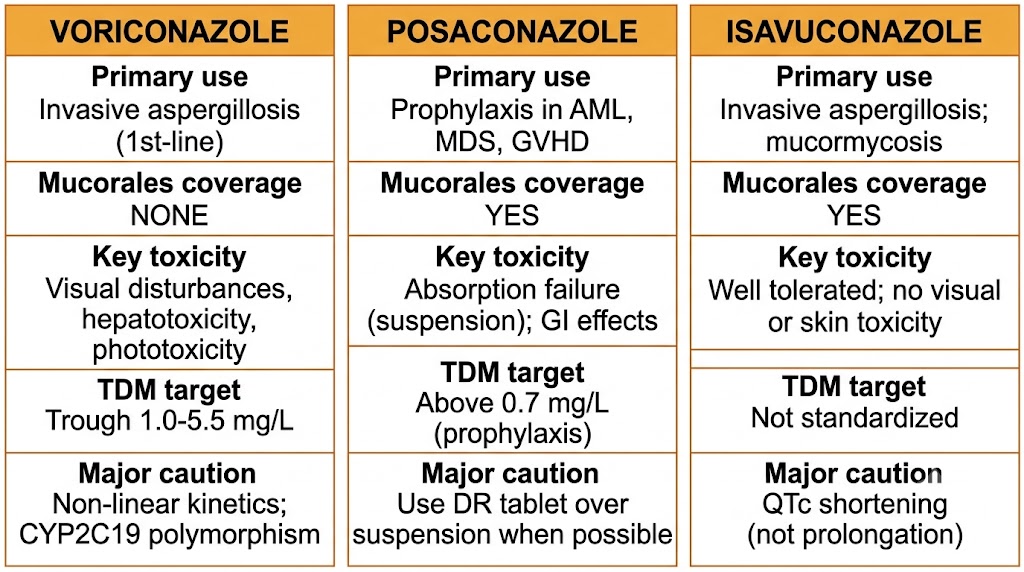
Three-panel comparison of voriconazole, posaconazole, and isavuconazole across five rows: primary use, Mucorales coverage (voriconazole none; posaconazole and isavuconazole yes), key toxicity, TDM target, and major caution.
Extended-spectrum azole comparison: voriconazole, posaconazole, and isavuconazole across key clinical properties. Gemini-generated figure.
Module 3 Summary — Extended-Spectrum Azoles

All three agents inhibit fungal CYP51; all are fungistatic. Voriconazole: first-line for invasive aspergillosis; non-linear pharmacokinetics; CYP2C19 PM phenotype causes toxicity; visual, hepatic, and photosensitivity toxicity; TDM target 1.0 to 5.5 mg/L; no Mucorales coverage. Posaconazole: preferred prophylaxis for AML, MDS, and GVHD post-HSCT; delayed-release tablet preferred over suspension; TDM target above 0.7 mg/L (prophylaxis) or 1.0 mg/L (treatment); only oral azole with Mucorales activity. Isavuconazole: non-inferior to voriconazole for aspergillosis; linear pharmacokinetics; no SBECD vehicle; approved for mucormycosis; QTc shortening not prolongation; favorable tolerability. TR34/L98H Aspergillus fumigatus mutation: pan-azole resistance from environmental fungicide exposure — test all invasive Aspergillus isolates.

Suggested References
Author / Organization Title Source
White TC, Marr KA, Bowden RA Clinical, cellular, and molecular factors that contribute to antifungal drug resistance Clin Microbiol Rev. 1998;11(2):382-402
Groll AH, Piscitelli SC, Walsh TJ Clinical pharmacology of systemic antifungal agents: a comprehensive review of agents in clinical use, current investigational compounds, and putative targets for antifungal drug development Adv Pharmacol. 1998;44:343-500
Saravolatz LD, Johnson LB, Kauffman CA Voriconazole: a new triazole antifungal agent Clin Infect Dis. 2003;36(5):630-637
Dolton MJ, Ray JE, Chen SC, Ng K, Pont L, McLachlan AJ Multicenter study of voriconazole pharmacokinetics and therapeutic drug monitoring Antimicrob Agents Chemother. 2012;56(9):4793-4799
Patterson TF, Thompson GR, Denning DW, et al. Practice guidelines for the diagnosis and management of aspergillosis: 2016 update by the Infectious Diseases Society of America Clin Infect Dis. 2016;63(4):e1-e60
Cornely OA, Maertens J, Winston DJ, et al. Posaconazole vs. fluconazole or itraconazole prophylaxis in patients with neutropenia N Engl J Med. 2007;356(4):348-359
Ullmann AJ, Lipton JH, Vesole DH, et al. Posaconazole or fluconazole for prophylaxis in severe graft-versus-host disease N Engl J Med. 2007;356(4):335-347
Schmitt-Hoffmann A, Roos B, Maares J, et al. Multiple-dose pharmacokinetics and safety of the new antifungal triazole BAL4815 after intravenous infusion and oral administration of its prodrug, BAL8557, in healthy volunteers Antimicrob Agents Chemother. 2006;50(1):286-293
Maertens JA, Raad II, Marr KA, et al. Isavuconazole versus voriconazole for primary treatment of invasive mould disease caused by Aspergillus and other filamentous fungi (SECURE): a phase 3, randomised-controlled, non-inferiority trial Lancet. 2016;387(10020):760-769
Sanglard D, Odds FC Resistance of Candida species to antifungal agents: molecular mechanisms and clinical consequences Lancet Infect Dis. 2002;2(2):73-85
Arendrup MC, Patterson TF Multidrug-resistant Aspergillus versus other pathogens: are we heading toward a pan-azole-resistant world? Med Mycol. 2017;55(1):3-9