CHAPTER 10 ยท CONGESTIVE HEART FAILURE

Section 1

Introduction

The use of beta-blockers in heart failure is one of the more striking reversals in clinical pharmacology. For decades, beta-blockers were considered dangerous in heart failure, since blocking the heart sympathetic drive seemed certain to worsen an already weak pump. The recognition that this sympathetic activation was itself harmful, rather than protective, in chronic heart failure overturned that thinking and made beta-blockade one of the four pillars of guideline-directed medical therapy introduced in Module 1. Only three beta-blockers, carvedilol, metoprolol succinate, and bisoprolol, have been proven to reduce mortality in heart failure with reduced ejection fraction. No other beta-blocker should be substituted for this indication, even within the same drug class.


Section 2

Rationale for Beta-Blockade — A Counterintuitive History

Why slowing down an already weak heart turns out to help, rather than harm, patients with chronic heart failure.

The Physiological Paradox

As described in Module 1, the sympathetic nervous system is chronically activated in heart failure with reduced ejection fraction, and the degree of activation correlates with how sick the patient is. In the short term, this activation supports the circulation by increasing heart rate and contractility. The intuitive conclusion was that blocking this support with a beta-blocker would be dangerous.

The problem is that this activation, while helpful acutely, becomes directly harmful when sustained over months and years. Chronic catecholamine exposure injures heart muscle cells, reduces the heart own responsiveness to further sympathetic signaling, and promotes dangerous arrhythmias. A failing heart driven this way is being pushed harder by the very system that is wearing it out.

The Pharmacological Solution

Beta-blockers help in heart failure not by improving pump function right away, in fact, they are negative inotropes and can transiently worsen contractility when first started, but by interrupting the chronic toxic effect of sympathetic overactivation. Over weeks to months, blocking the beta-1 receptor allows the heart to partially recover its sensitivity to adrenergic signaling, slows the heart rate to allow more time for the ventricle to fill, and reduces the harmful downstream hormonal activation described in Module 1.

The clinical result is that ejection fraction, which can transiently dip when a beta-blocker is first started, typically improves significantly after three to six months of continued therapy. This delayed improvement is the reverse remodeling effect introduced in Module 1, and it is one of the clearest demonstrations that chronic neurohormonal activation, not just hemodynamics, drives heart failure progression.
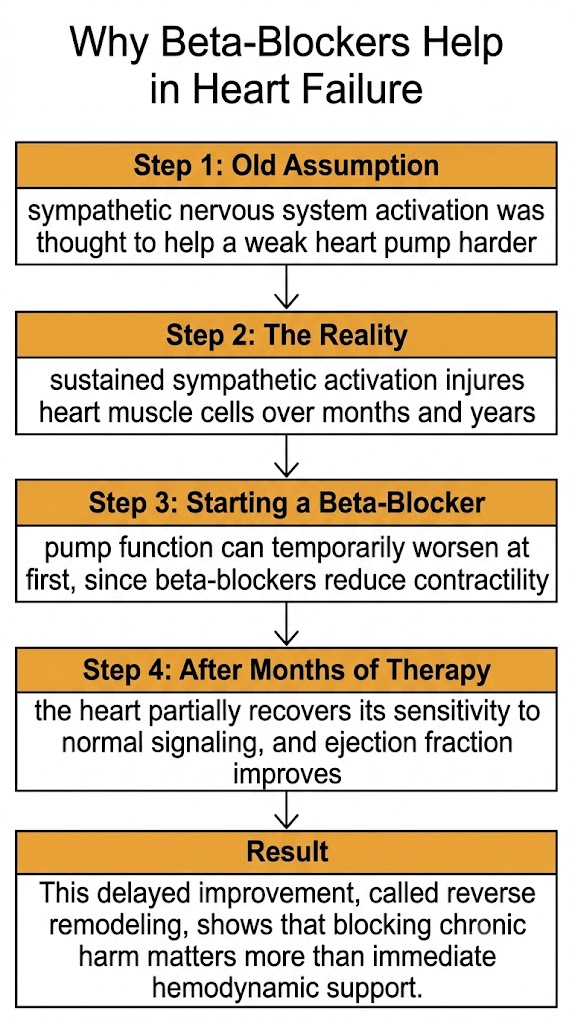
A vertical flow diagram showing how beta-blockers can transiently worsen heart pumping when first started, but improve ejection fraction over months by blocking the chronic harm of sustained sympathetic nervous system activation.
Beta-blockers help heart failure not through immediate hemodynamic support but by interrupting chronic harm, producing delayed improvement in heart function over months. Figure generated by Gemini AI.

Section 3

The Three Approved Agents

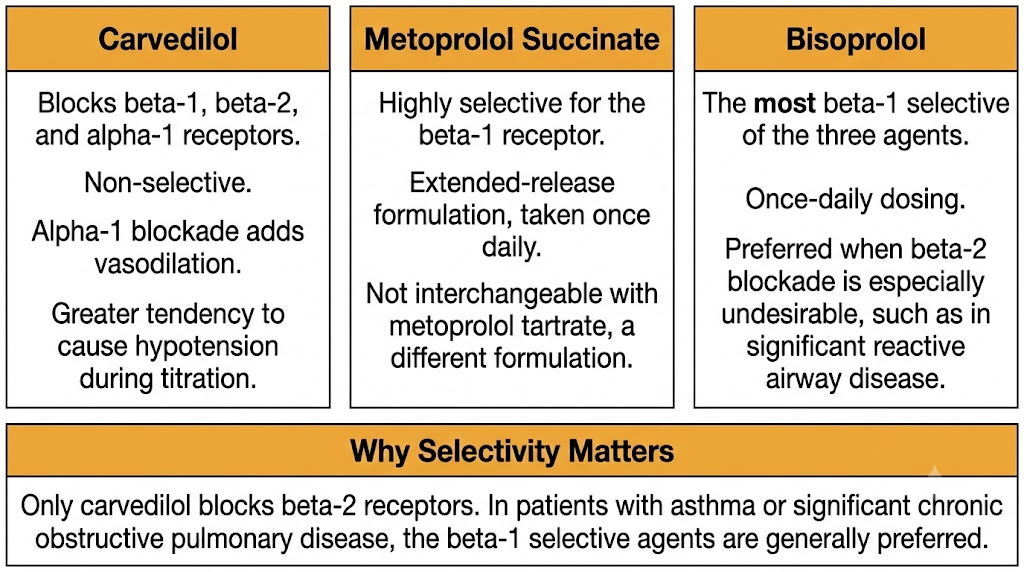
Only carvedilol, metoprolol succinate, and bisoprolol have proven mortality benefit in heart failure with reduced ejection fraction. They are not interchangeable with other beta-blockers used for different indications.

Non-Selective Plus Alpha-1

Carvedilol

  • Blocks beta-1, beta-2, and alpha-1 receptors
  • Alpha-1 blockade adds vasodilation
  • Greater tendency to cause hypotension during titration

Beta-1 Selective

Metoprolol Succinate

  • Extended-release formulation, once daily
  • Not interchangeable with metoprolol tartrate, a different salt form not proven effective in heart failure

Most Beta-1 Selective

Bisoprolol

  • Once-daily dosing
  • Preferred choice when beta-2 blockade is particularly undesirable, such as significant reactive airway disease

Practical Selection Point

All three agents are started at a low dose and increased gradually as tolerated. The most clinically useful distinction among them is receptor selectivity: carvedilol non-selective beta-2 blockade carries a higher theoretical risk of bronchospasm, so the beta-1 selective agents, bisoprolol in particular, are generally preferred in patients with significant asthma or chronic obstructive pulmonary disease, while all three remain reasonable choices in most patients.

A three-panel comparison diagram of carvedilol, metoprolol succinate, and bisoprolol, showing that carvedilol is non-selective with added alpha-1 blockade while metoprolol succinate and bisoprolol are beta-1 selective.
The three proven heart failure beta-blockers differ in receptor selectivity, which guides the choice of agent in patients with coexisting lung disease. Figure generated by Gemini AI.

Section 4

Practical Use

Beta-blockers should only be started in a patient who is clinically stable and free of active fluid overload. Starting a beta-blocker during an episode of acute decompensated heart failure can worsen the patient hemodynamics, since the drug negative inotropic effect is most pronounced before the beneficial neurohormonal effects have had time to develop.

A Common Mistake to Avoid

In a patient who is already taking a chronic beta-blocker and is hospitalized for worsening heart failure, the default approach is to continue the beta-blocker, at a reduced dose if needed, rather than stopping it outright. Abruptly stopping a beta-blocker in this setting can cause rebound sympathetic activation, increasing the risk of arrhythmia and short-term harm. The beta-blocker is only withheld if the patient requires intravenous inotropic support or is in cardiogenic shock.

Suggested References
Author / Organization Title Source
Bristow MRTreatment of chronic heart failure with beta-adrenergic receptor antagonists: a convergence of receptor pharmacology and clinical cardiologyCirc Res. 2011;109(10):1176-1194
Heidenreich PA, Bozkurt B, Aguilar D, et al2022 AHA/ACC/HFSA guideline for the management of heart failureJ Am Coll Cardiol. 2022;79(17):e263-e421
Cohn JN, Levine TB, Olivari MT, et alPlasma norepinephrine as a guide to prognosis in patients with chronic congestive heart failureN Engl J Med. 1984;311(13):819-823
Packer M, Coats AJ, Fowler MB, et alEffect of carvedilol on survival in severe chronic heart failure (COPERNICUS)N Engl J Med. 2001;344(22):1651-1658
MERIT-HF Study GroupEffect of metoprolol CR/XL in chronic heart failure: Metoprolol CR/XL Randomised Intervention Trial in Congestive Heart Failure (MERIT-HF)Lancet. 1999;353(9169):2001-2007
CIBIS-II Investigators and CommitteesThe Cardiac Insufficiency Bisoprolol Study II (CIBIS-II): a randomised trialLancet. 1999;353(9146):9-13
Poole-Wilson PA, Swedberg K, Cleland JG, et alComparison of carvedilol and metoprolol on clinical outcomes in patients with chronic heart failure in the Carvedilol Or Metoprolol European Trial (COMET)Lancet. 2003;362(9377):7-13
McDonagh TA, Metra M, Adamo M, et al2021 ESC guidelines for the diagnosis and treatment of acute and chronic heart failureEur Heart J. 2021;42(36):3599-3726