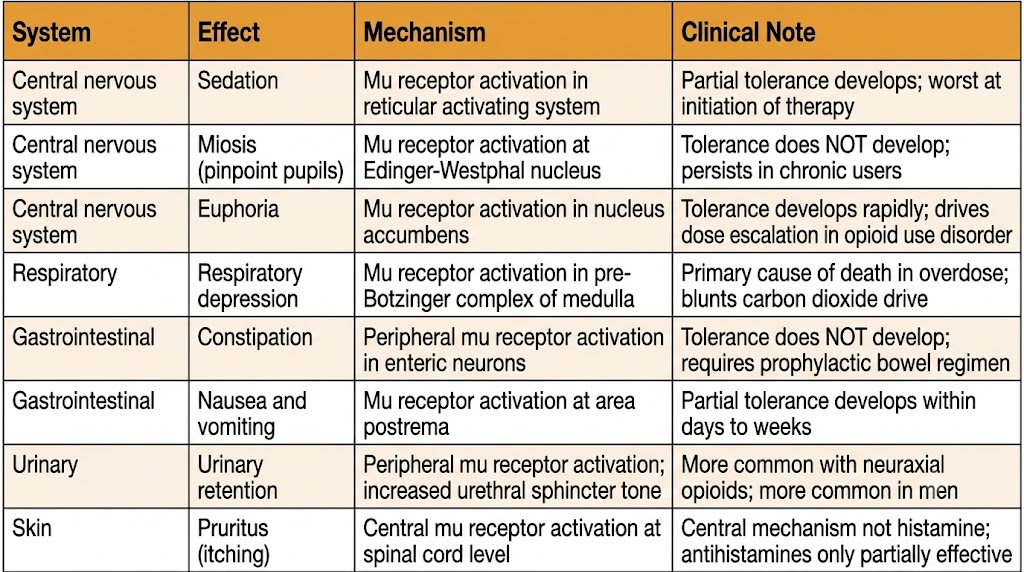
Figure 1. Opioid adverse effects organized by organ system. Tolerance does not develop to constipation or miosis, which persist throughout the course of chronic opioid therapy. Figure generated by Gemini AI.
Introduction to Medical Pharmacology
Module 3 — Adverse Effects, Tolerance, and Opioid Overdose
Chapter 13 · Module 3 of 5Section 1
Predictable extensions of receptor pharmacology across organ systems
The adverse effects of opioids are not random or idiosyncratic — they are predictable consequences of activating mu, kappa, and delta receptors throughout the body. The same receptor distribution that makes opioids powerful analgesics guarantees that systemic administration will produce effects far beyond the intended site of pain modulation. Understanding which effect is mediated by which receptor and at which site is the key to anticipating, recognizing, and managing opioid toxicity.
Sedation is one of the most common central nervous system adverse effects, resulting from mu receptor activation in the thalamus, locus coeruleus, and reticular activating system. Sedation is most pronounced at initiation of therapy and after dose increases, and patients should be advised against driving or operating machinery until stable on their current dose. Partial tolerance to sedation develops over days to weeks with continued use.
Miosis — constriction of the pupils — results from mu receptor activation at the Edinger-Westphal nucleus of the oculomotor complex, producing parasympathetic stimulation of the pupillary sphincter. Pinpoint pupils (1 to 2 mm) are a reliable clinical sign of opioid effect and, unlike most other opioid central nervous system effects, tolerance to miosis does not substantially develop with chronic use. A patient on long-term opioid therapy will retain constricted pupils indefinitely.
Euphoria is produced by mu receptor activation in mesolimbic circuits, particularly the nucleus accumbens. The pleasurable effect drives reinforced drug-seeking and is the primary neurobiological basis of opioid misuse. Tolerance to euphoria develops relatively rapidly, which contributes to dose escalation in opioid use disorder.
Respiratory depression is the most dangerous adverse effect of opioids and the primary cause of death in overdose. Mu receptor activation in brainstem respiratory control centers — particularly the pre-Botzinger complex in the ventrolateral medulla — reduces the respiratory rate and blunts the normal drive to breathe in response to rising carbon dioxide levels. The carbon dioxide response curve is shifted rightward, meaning the body tolerates higher carbon dioxide levels before triggering a breath.
Partial tolerance to respiratory depression does develop with chronic opioid use, which is why patients on stable long-term opioid therapy can tolerate doses that would be dangerous in an opioid-naive individual. However, this tolerance is incomplete and can be overwhelmed by dose increases, by combination with other central nervous system depressants (particularly benzodiazepines and alcohol), or by sleep, which independently reduces the arousal response to hypercapnia.
Constipation is the most common persistent adverse effect of chronic opioid therapy. It is mediated by mu receptor activation in enteric neurons of the gastrointestinal tract, which reduces propulsive motility, increases tonic segmental contraction, and prolongs intestinal transit time. Unlike most other opioid adverse effects, tolerance to constipation does not develop with continued use — a patient on long-term opioid therapy will experience ongoing constipation regardless of how long they have been on the medication. Prophylactic bowel regimens are standard of care for any patient starting regular opioid therapy.
Nausea and vomiting result from mu receptor activation in the area postrema — the chemoreceptor trigger zone in the brainstem that lies outside the blood-brain barrier. Opioids stimulate this area directly, producing nausea particularly in ambulatory patients. Partial tolerance to nausea develops within days to weeks.
Delayed gastric emptying occurs through peripheral mu receptor effects on gastric smooth muscle, prolonging the time for oral medications and food to leave the stomach. This can affect the absorption of other oral drugs taken concurrently.
Urinary retention results from increased tone of the urethral sphincter and detrusor relaxation through peripheral mu receptor activation. It is more common with neuraxial (epidural and intrathecal) opioid administration than with systemic use and is more pronounced in men.
Pruritus (itching) is a common adverse effect, particularly with neuraxial opioids. It is mediated centrally through mu receptor activation in the spinal cord rather than through histamine release, which is why antihistamines are only partially effective. Low-dose naloxone infusions or the mu antagonist nalbuphine can provide relief without fully reversing analgesia.
Biliary spasm results from contraction of the sphincter of Oddi, increasing biliary duct pressure. This is relevant in patients with biliary colic, where opioid-induced sphincter spasm can worsen pain despite the systemic analgesic effect.
Tolerance Develops To Some Effects But Not Others
Tolerance develops to: analgesia, euphoria, sedation, respiratory depression, nausea.
Tolerance does NOT develop to: constipation, miosis.
A patient on stable chronic opioid therapy will retain pinpoint pupils and persistent constipation indefinitely, even if their analgesic effect has partially diminished and they report feeling alert.
Figure 1. Opioid adverse effects organized by organ system. Tolerance does not develop to constipation or miosis, which persist throughout the course of chronic opioid therapy. Figure generated by Gemini AI.
Section 2
When opioids paradoxically increase pain sensitivity
Opioid-induced hyperalgesia is a paradoxical state in which opioid exposure causes increased sensitivity to painful stimuli — meaning the drug intended to treat pain makes pain worse. It is an important clinical phenomenon to recognize because it is frequently misidentified as tolerance, leading to dose escalation that further worsens the problem.
Tolerance and opioid-induced hyperalgesia are both associated with diminishing pain control over time, but they have opposite responses to dose changes. With tolerance, the analgesic effect is reduced at the current dose, but increasing the dose restores pain control. With opioid-induced hyperalgesia, dose escalation worsens pain rather than improving it — the patient becomes more sensitive to pain the more opioid they receive. A paradoxical improvement in pain following dose reduction is a hallmark of opioid-induced hyperalgesia and distinguishes it from tolerance.
Opioid-induced hyperalgesia is also characterized by spread of pain beyond the original injury site, increased sensitivity to non-painful stimuli (allodynia), and pain that is diffuse rather than localized. These features reflect central sensitization — a state of heightened excitability in pain-processing pathways driven by chronic opioid exposure — rather than progression of the underlying painful condition.
Management of opioid-induced hyperalgesia typically involves gradual opioid dose reduction or rotation to a different opioid. Methadone has theoretical advantages in this setting because its N-methyl-D-aspartate receptor antagonist activity may help reverse central sensitization, and it is sometimes used as a rotation target when opioid-induced hyperalgesia is suspected. Non-opioid analgesics and adjuvants that address central sensitization — including ketamine, certain antidepressants, and anticonvulsants — may be incorporated into the treatment plan.
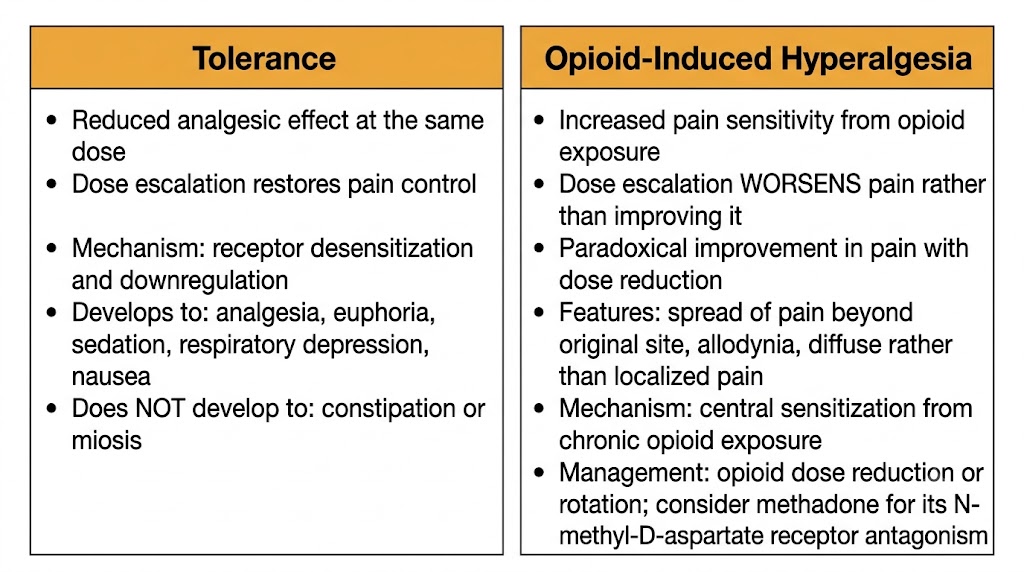
Figure 2. Tolerance versus opioid-induced hyperalgesia. The critical distinguishing feature is the response to dose escalation: tolerance improves with higher doses, while opioid-induced hyperalgesia worsens. Figure generated by Gemini AI.
Section 3
Recognizing the classic triad and understanding the limits of reversal
Opioid overdose is a life-threatening emergency that kills primarily through respiratory depression. Recognizing the classic overdose presentation and understanding how to reverse it — and the important limitations of reversal agents — is essential clinical knowledge.
The classic presentation of opioid overdose consists of three findings that reflect extreme mu receptor activation at brainstem and midbrain sites:
Sign 1
Coma
Sign 2
Miosis
Sign 3
Respiratory Depression
The absence of miosis in an obtunded patient should prompt consideration of co-ingestion with agents that cause pupillary dilation — such as cocaine, amphetamines, or anticholinergic drugs — which can mask the opioid-induced constriction. Mixed overdoses are common in the current illicit drug supply, where fentanyl is frequently found in combination with stimulants and sedatives.
The immediate priority in opioid overdose is airway management and ventilatory support. Bag-mask ventilation with supplemental oxygen should be initiated immediately for any patient with inadequate respiratory effort. Positioning to prevent aspiration and maintenance of airway patency take precedence even before pharmacological reversal. In the prehospital setting, naloxone administration by bystanders or first responders using naloxone nasal spray has become a critical public health intervention, with widespread distribution programs aimed at reducing overdose mortality in communities with high rates of illicit opioid use.
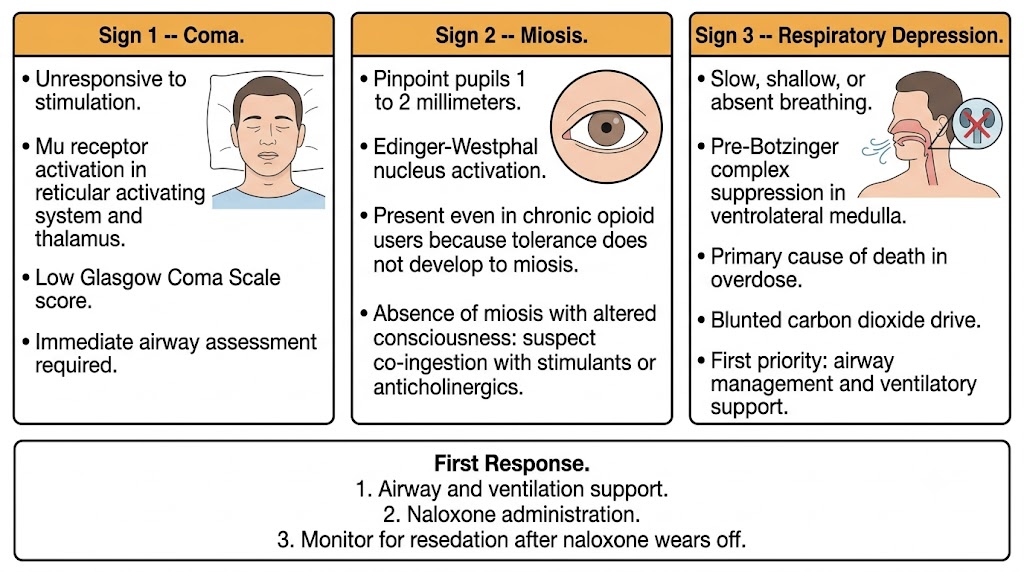
Figure 3. The opioid overdose triad: coma, miosis, and respiratory depression. Absent miosis in an obtunded patient suggests co-ingestion. Airway management precedes pharmacological reversal. Figure generated by Gemini AI.
Section 4
Mechanism, clinical use, and the critical limitation of half-life mismatch
Naloxone is a pure competitive opioid antagonist that reverses all three components of the overdose triad within minutes of administration. Understanding both its power and its limitations — particularly its short duration of action relative to most opioids it reverses — is essential for safe clinical use.
Naloxone binds with high affinity to mu, kappa, and delta opioid receptors and competitively displaces opioid agonists from these sites without activating the receptor. Because it has no intrinsic agonist activity, it produces no analgesia, sedation, or euphoria on its own. In an opioid-dependent patient, abrupt displacement of opioids from receptors precipitates acute withdrawal syndrome — agitation, diaphoresis, tachycardia, hypertension, vomiting, and diarrhea — which is distressing but not life-threatening in otherwise healthy individuals.
Naloxone is available in several formulations. Intravenous administration provides the most rapid onset (1 to 5 minutes) and allows precise titration of dose. Intramuscular and subcutaneous routes provide somewhat slower onset but are useful when intravenous access is unavailable. Intranasal naloxone spray has become the primary formulation used by laypersons and first responders for community-based overdose reversal, because it requires no needles or special training and can be administered to an unresponsive victim without establishing intravenous access.
The most important pharmacological limitation of naloxone is that its duration of action (30 to 90 minutes) is shorter than the duration of action of most opioids it reverses. This creates a serious clinical risk: a patient who appears to have been successfully reversed — alert and breathing after naloxone administration — may relapse into respiratory depression and coma as the naloxone wears off while the precipitating opioid remains active. This phenomenon is called resedation.
Resedation risk is highest when the precipitating opioid is long-acting or highly potent — including extended-release oral opioids, transdermal fentanyl, and methadone. A patient reversed from methadone overdose with a single naloxone dose requires hours of observation and may need repeated naloxone doses or a continuous naloxone infusion. The clinical rule is: naloxone reversal does not end the emergency. The patient must be monitored for the full duration of action of the precipitating opioid, not just until they wake up.
In patients who are opioid-dependent and receiving opioids for pain management, naloxone should be titrated carefully to restore adequate breathing without fully precipitating withdrawal. The goal is restoration of ventilation, not full reversal of all opioid effect. Dilute naloxone given in small incremental doses avoids sudden precipitation of severe withdrawal while correcting life-threatening respiratory depression. In a patient with no opioid tolerance who is found unresponsive with suspected overdose, a full reversal dose can be given without concern for precipitating withdrawal, since the acute life threat outweighs the discomfort of withdrawal.
Naloxone Pharmacology at a Glance
Mechanism: Pure competitive mu, kappa, and delta receptor antagonist. No intrinsic agonist activity.
Onset (intravenous): 1 to 5 minutes.
Duration: 30 to 90 minutes — shorter than most opioids it reverses.
Key risk: Resedation after naloxone wears off while precipitating opioid remains active.
In dependent patients: Precipitates acute withdrawal. Titrate carefully — restore breathing, not full reversal.
Available formulations: Intravenous, intramuscular, subcutaneous, intranasal spray.
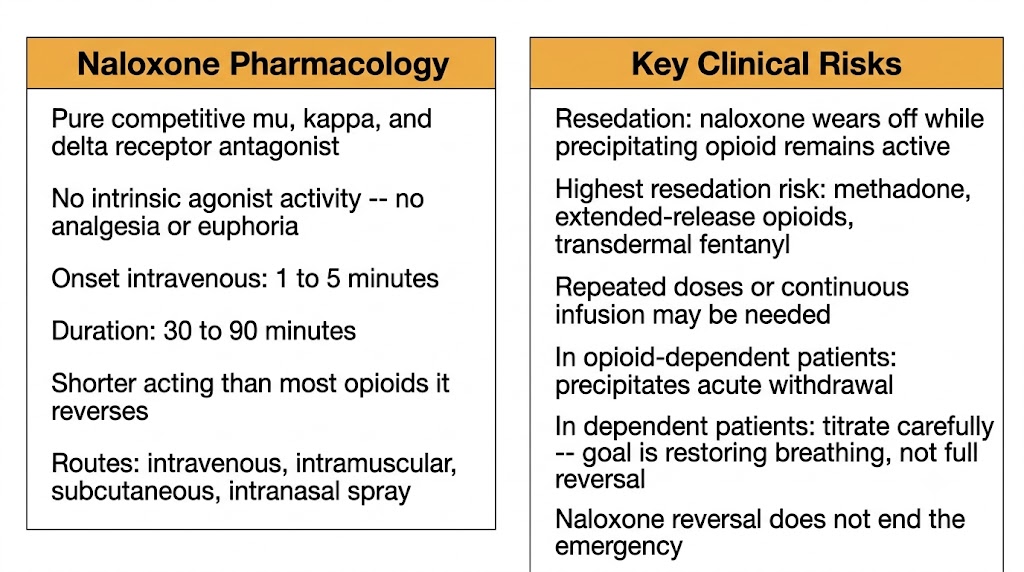
Figure 4. Naloxone pharmacology and clinical risks. The duration of naloxone action (30 to 90 minutes) is shorter than most opioids it reverses, making resedation a critical monitoring concern. Figure generated by Gemini AI.
| Author / Organization | Title | Source |
|---|---|---|
| Pattinson KT | Opioids and the control of respiration | Br J Anaesth. 2008;100(6):747–758 |
| Swegle JM, Logemann C | Management of common opioid-induced adverse effects | Am Fam Physician. 2006;74(8):1347–1354 |
| Lee M, Silverman SM, Hansen H, Patel VB, Manchikanti L | A comprehensive review of opioid-induced hyperalgesia | Pain Physician. 2011;14(2):145–161 |
| Boyer EW | Management of opioid analgesic overdose | N Engl J Med. 2012;367(2):146–155 |
| Moss RB, Carlo DJ | Higher doses of naloxone are needed in the synthetic opioid era | Subst Abuse Treat Prev Policy. 2019;14(1):6 |
| Dahan A, Aarts L, Smith TW | Incidence, reversal, and prevention of opioid-induced respiratory depression | Anesthesiology. 2010;112(1):226–238 |
| Chu LF, Angst MS, Clark D | Opioid-induced hyperalgesia in humans: molecular mechanisms and clinical considerations | Clin J Pain. 2008;24(6):479–496 |