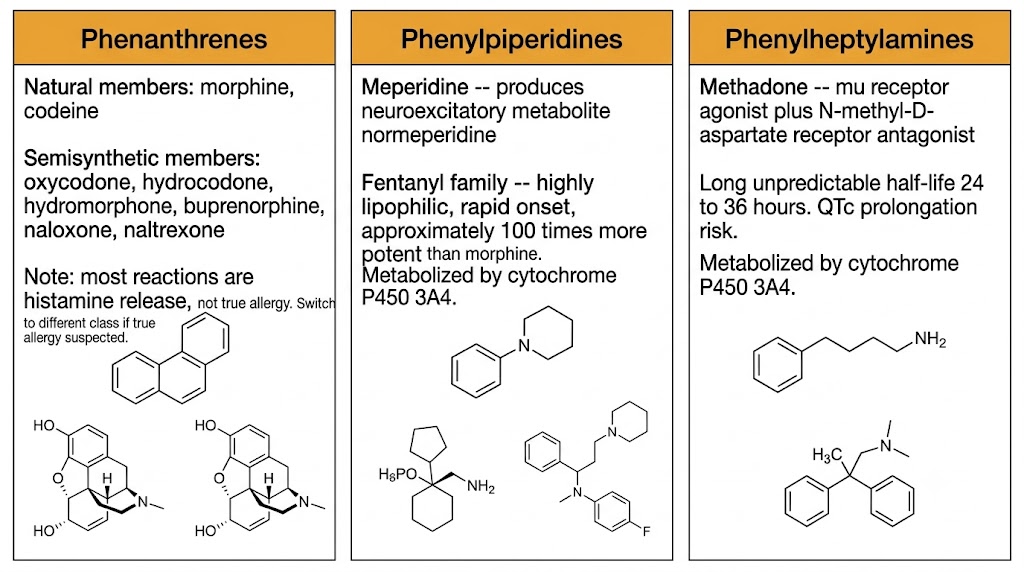
Figure 1. The three major opioid chemical families and their key members. Chemical class predicts metabolic pathways, active metabolite formation, and cross-reactivity patterns. Figure generated by Gemini AI.
Introduction to Medical Pharmacology
Module 2 — Opioid Agonists: Classification, Pharmacokinetics, and Drug Profiles
Chapter 13 · Module 2 of 5Section 1
Three major structural families with distinct clinical implications
Opioid analgesics are organized into chemical families based on their structural scaffold. This classification matters clinically because shared structure predicts metabolic pathways, active metabolite formation, and cross-reactivity patterns. Most clinical opioids belong to one of three main families.
The phenanthrenes are the oldest and largest opioid family, encompassing the naturally occurring opium alkaloids and their semisynthetic derivatives. Naturally occurring phenanthrenes include morphine and codeine. Semisynthetic phenanthrenes derived from morphine or thebaine include hydromorphone, oxymorphone, oxycodone, hydrocodone, buprenorphine, nalbuphine, naloxone, and naltrexone. Most reported opioid allergies within this class represent pharmacological histamine release rather than true immune-mediated hypersensitivity. When genuine allergy is suspected, switching to a structurally unrelated class is appropriate.
The phenylpiperidines include meperidine and the fentanyl family — fentanyl, sufentanil, alfentanil, and remifentanil. High lipophilicity is a shared feature of the fentanyl congeners, accounting for their rapid onset of action and short duration after a single dose. Fentanyl is approximately 100 times more potent than morphine by weight and is used extensively for procedural analgesia, intraoperative use, and transdermal chronic pain management. Illicit fentanyl and its analogs have driven the current overdose epidemic due to their extreme potency and variable concentration in counterfeit drug supplies.
Methadone is the primary clinical agent in this family. It is pharmacologically distinct from other opioids in two important ways: it is a full mu receptor agonist with an unusually long and unpredictable half-life (24 to 36 hours or longer), and it also blocks N-methyl-D-aspartate receptors, which may contribute to its efficacy in neuropathic pain. Methadone's long half-life makes it effective for once-daily dosing in opioid use disorder treatment but creates serious risk of drug accumulation and delayed toxicity during dose initiation or adjustment.
Tramadol combines weak mu receptor agonism with inhibition of serotonin and norepinephrine reuptake. This dual mechanism produces analgesia through two complementary pathways and is associated with lower abuse potential than full mu agonists. However, tramadol carries a risk of serotonin syndrome when combined with other serotonergic drugs, particularly monoamine oxidase inhibitors and selective serotonin reuptake inhibitors, and it lowers the seizure threshold. Like codeine, tramadol requires conversion by the cytochrome P450 2D6 enzyme to its active opioid metabolite, making its analgesic effect variable in patients with cytochrome P450 2D6 genetic variants.
Figure 1. The three major opioid chemical families and their key members. Chemical class predicts metabolic pathways, active metabolite formation, and cross-reactivity patterns. Figure generated by Gemini AI.
Section 2
First-pass effect, lipophilicity, metabolism, and clinically critical active metabolites
The pharmacokinetic properties of opioids explain many of their most important clinical differences — why fentanyl acts in seconds while morphine takes minutes, why some patients get no analgesia from codeine while others experience toxicity on the same dose, and why morphine requires dose reduction in renal failure. These are not abstract details; they are the mechanistic basis of safe prescribing.
Most opioids undergo significant first-pass hepatic metabolism when taken orally, reducing the amount of active drug that reaches the systemic circulation. This is why the oral dose of morphine must be substantially higher than the intravenous dose to achieve equivalent analgesia — a concept formalized in equianalgesic dosing tables. Semisynthetic opioids such as oxycodone and hydrocodone have higher oral bioavailability than morphine because they are less extensively metabolized on first pass.
Sublingual and buccal routes bypass first-pass metabolism and are used by buprenorphine formulations. Transdermal fentanyl also avoids first-pass metabolism by delivering drug directly through the skin into the systemic circulation, providing continuous steady-state plasma levels over 72 hours. An important feature of transdermal fentanyl is that a subcutaneous depot of drug builds in the skin over the first 12 to 24 hours after patch application, and absorption continues for 12 to 24 hours after patch removal — meaning the analgesic effect does not end when the patch comes off.
Lipophilicity determines how rapidly an opioid penetrates the blood-brain barrier and reaches central nervous system receptors. Fentanyl is highly lipophilic and enters the brain within one to two minutes of intravenous administration. Morphine is much less lipophilic and takes 15 to 20 minutes to achieve peak central nervous system effect after intravenous dosing. This difference has two important clinical consequences: fentanyl is preferred when rapid onset is needed (procedural analgesia, intraoperative use), and the speed of brain delivery is a major determinant of euphoria and addiction potential, which is why intravenous and intranasal opioid administration carries greater addiction risk than oral use of the same drug.
Hepatic metabolism is the primary route of elimination for virtually all opioids, but the metabolic pathways differ and create drug-specific clinical risks.
Morphine is metabolized by hepatic glucuronidation to two major metabolites. Morphine-6-glucuronide is pharmacologically active and more potent than morphine itself. Morphine-3-glucuronide is pharmacologically inactive as an analgesic but may contribute to neuroexcitatory side effects. Both metabolites are renally excreted. In patients with renal impairment, morphine-6-glucuronide accumulates, producing prolonged and potentially dangerous respiratory depression. Morphine should be used with caution and at reduced doses in patients with significant renal dysfunction.
Fentanyl and methadone are primarily metabolized by the cytochrome P450 3A4 enzyme. Drugs that inhibit cytochrome P450 3A4 — including many antifungals, macrolide antibiotics, and some antiretrovirals — can increase fentanyl and methadone levels significantly. Drugs that induce cytochrome P450 3A4, such as rifampin, carbamazepine, and phenytoin, accelerate their metabolism and can precipitate inadequate analgesia or opioid withdrawal in dependent patients.
Codeine is a prodrug that requires conversion by the cytochrome P450 2D6 enzyme to morphine to produce analgesia. Tramadol similarly requires cytochrome P450 2D6-mediated conversion to its active opioid metabolite. The cytochrome P450 2D6 gene is highly polymorphic, producing four clinically important phenotypes.
Poor metabolizers (approximately 7 to 10 percent of white populations) have little or no cytochrome P450 2D6 activity and cannot convert codeine or tramadol to active opioid metabolites. These patients obtain no analgesia from codeine, which may be mistaken for drug-seeking behavior when they request dose increases.
Ultrarapid metabolizers convert codeine to morphine very rapidly and in excess, generating toxic morphine concentrations at standard codeine doses. This has caused fatal neonatal morphine toxicity in breastfed infants of nursing mothers who were ultrarapid metabolizers. The United States Food and Drug Administration issued a black box warning against codeine use in breastfeeding mothers and in children under 12 following these fatalities.
Renal Failure Warning: Morphine and Meperidine
Two opioids require particular caution in renal impairment. Morphine-6-glucuronide accumulates in renal failure, causing prolonged respiratory depression at standard doses — use with caution and reduce dose frequency. Meperidine produces normeperidine, a neuroexcitatory metabolite that accumulates in renal failure and lowers the seizure threshold. Meperidine is generally avoided in patients with renal impairment and in elderly patients for this reason.
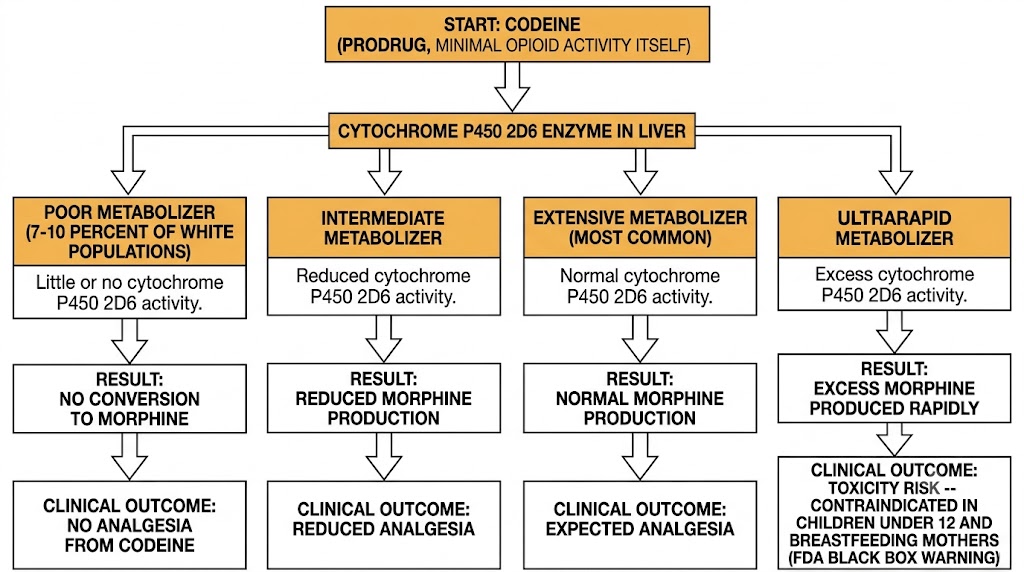
Figure 2. Cytochrome P450 2D6 genetic polymorphism and its effect on codeine analgesia. Four metabolizer phenotypes produce dramatically different clinical outcomes from the same codeine dose. Figure generated by Gemini AI.
Section 3
High-yield distinguishing features of the major opioid agonists
Each opioid agonist has one or more distinguishing pharmacological features that set it apart from the class as a whole. These distinguishing features — not exhaustive drug encyclopedias — are what second-year pharmacology examinations and Step 1 test.
Morphine is the prototype opioid agonist against which all others are compared. It is a full mu receptor agonist with well-characterized pharmacokinetics and a long track record across all pain settings. Its active metabolite morphine-6-glucuronide is more potent than morphine itself and accumulates in renal failure, making dose adjustment essential in patients with impaired kidney function. Morphine causes histamine release from mast cells when given by rapid intravenous injection, which can cause flushing, itching, and hypotension — this is a pharmacological effect, not an allergic reaction, and is reduced by slower administration.
Codeine is a naturally occurring phenanthrene with low intrinsic opioid potency. Its analgesic effect depends entirely on conversion to morphine by the cytochrome P450 2D6 enzyme in the liver — codeine itself has minimal receptor activity. At subanalgesic doses, codeine is an effective antitussive and is widely used in cough preparations. The cytochrome P450 2D6 polymorphism makes codeine's analgesic effect highly variable and unpredictable. It is now contraindicated in children under 12 and in breastfeeding mothers due to fatalities from morphine toxicity in cytochrome P450 2D6 ultrarapid metabolizers.
Oxycodone and hydrocodone are semisynthetic phenanthrenes with higher oral bioavailability than morphine, making them well suited for oral pain management. Both are available in immediate-release and extended-release formulations. Extended-release oxycodone was among the first opioids aggressively marketed for chronic non-cancer pain in the 1990s and played a central role in initiating the current opioid epidemic. Both drugs require partial cytochrome P450 2D6 conversion to more active metabolites, though this dependence is less absolute than for codeine. Hydrocodone is also an antitussive at lower doses.
Fentanyl is approximately 100 times more potent than morphine and is highly lipophilic, producing onset of action within one to two minutes of intravenous administration. It is the preferred opioid for procedural analgesia, intraoperative use, and labor analgesia. Transdermal fentanyl patches provide 72-hour continuous delivery and are used for chronic pain requiring around-the-clock opioid analgesia. Key clinical cautions with the patch: it should not be cut or exposed to heat (which accelerates absorption and can cause overdose), and residual drug continues to be absorbed from the skin depot for 12 to 24 hours after removal. Illicit fentanyl and its analogs (carfentanil, acetylfentanyl) are now the leading cause of opioid overdose deaths in the United States.
Methadone is distinguished by three pharmacological features: an unusually long and variable half-life (24 to 36 hours or longer), N-methyl-D-aspartate receptor antagonism in addition to mu receptor agonism, and blockade of cardiac potassium channels that prolongs the electrocardiographic QTc interval. The long half-life makes methadone effective for once-daily dosing in opioid use disorder treatment and provides stable blood levels, but it also creates serious risk of drug accumulation during dose initiation. Because the analgesic duration (4 to 8 hours) is much shorter than the elimination half-life, sedation and respiratory depression can accumulate even when the patient reports that the pain relief has worn off. QTc prolongation risk increases at higher doses and is compounded by other QTc-prolonging drugs and by cytochrome P450 3A4 inhibitors that raise methadone levels.
Meperidine (also known as pethidine outside the United States) is a phenylpiperidine with a critical liability: its hepatic metabolite normeperidine is neuroexcitatory. Normeperidine lowers the seizure threshold and, at high concentrations, causes tremors, myoclonus, and seizures. Normeperidine is renally eliminated, so it accumulates in patients with renal impairment and in patients receiving high or repeated doses. Meperidine also has a dangerous interaction with monoamine oxidase inhibitors — this combination can cause either serotonin syndrome (agitation, hyperthermia, clonus) or a hypertensive excitatory reaction. Meperidine has largely fallen out of favor in modern pain management and is rarely used outside of specific procedural contexts.
Tramadol combines weak mu receptor agonism with serotonin and norepinephrine reuptake inhibition. This dual mechanism produces analgesia at lower opioid receptor occupancy than full agonists, which contributes to its lower abuse potential — though dependence and misuse do occur. Tramadol is used for moderate pain, particularly neuropathic pain where its monoaminergic mechanism provides added benefit. The most clinically important risks are serotonin syndrome (when combined with monoamine oxidase inhibitors, selective serotonin reuptake inhibitors, or other serotonergic drugs) and seizures at high doses or in patients with lowered seizure threshold. Tramadol requires cytochrome P450 2D6 for conversion to its active opioid metabolite, making analgesic effect variable.
High-Yield Exam Associations
Morphine in renal failure — morphine-6-glucuronide accumulates, prolonged respiratory depression.
Codeine in pediatrics or breastfeeding — contraindicated; ultrarapid metabolizer deaths.
Fentanyl patch and heat — accelerates absorption, overdose risk; do not cut patch.
Methadone and QTc — monitor electrocardiogram; avoid with other QTc-prolonging drugs.
Meperidine and monoamine oxidase inhibitors — potentially fatal; serotonin syndrome or excitatory hyperthermic reaction.
Tramadol and monoamine oxidase inhibitors or selective serotonin reuptake inhibitors — serotonin syndrome risk.
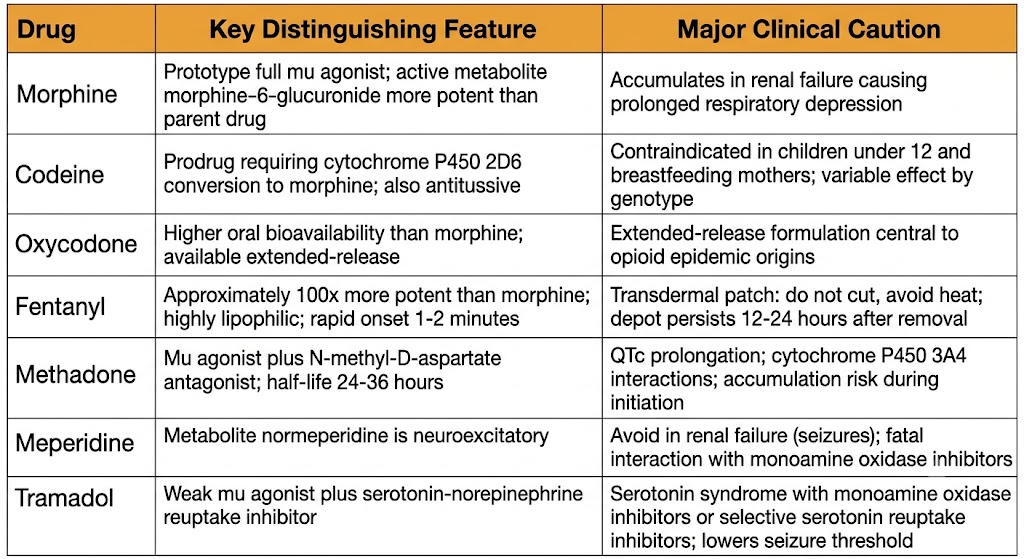
Figure 3. High-yield distinguishing features and clinical cautions for the major opioid agonists. Each drug has one or more properties that set it apart from the class as a whole. Figure generated by Gemini AI.
Section 4
Converting between opioids and routes while maintaining analgesic effect
Equianalgesic dosing is the practice of calculating doses of different opioids, or different routes of the same opioid, that produce equivalent analgesia. This skill is essential when switching a patient from one opioid to another, changing routes of administration, or transitioning from parenteral to oral therapy.
Different opioids have different intrinsic potencies at mu receptors, and the same drug given by different routes achieves different systemic concentrations because of first-pass hepatic metabolism. Oral morphine, for example, requires a substantially higher dose than intravenous morphine to achieve equivalent analgesia, because a large fraction of oral morphine is metabolized in the liver before reaching the circulation. Equianalgesic conversion tables provide reference ratios that allow clinicians to calculate equivalent doses when making these transitions.
When switching a patient from one opioid to another — a practice called opioid rotation — the calculated equianalgesic dose is typically reduced by 25 to 50 percent. This reduction accounts for incomplete cross-tolerance: the tolerance a patient has developed to one opioid does not fully transfer to a new opioid, meaning the patient is relatively more sensitive to the new drug than the equianalgesic table alone would predict. Starting at a reduced dose and titrating upward is safer than starting at the full calculated equivalent. Methadone is a special case — its equianalgesic ratio to morphine varies widely depending on the patient's prior opioid exposure and total daily opioid dose, and conversion to methadone should only be performed by clinicians with specific experience managing this drug.
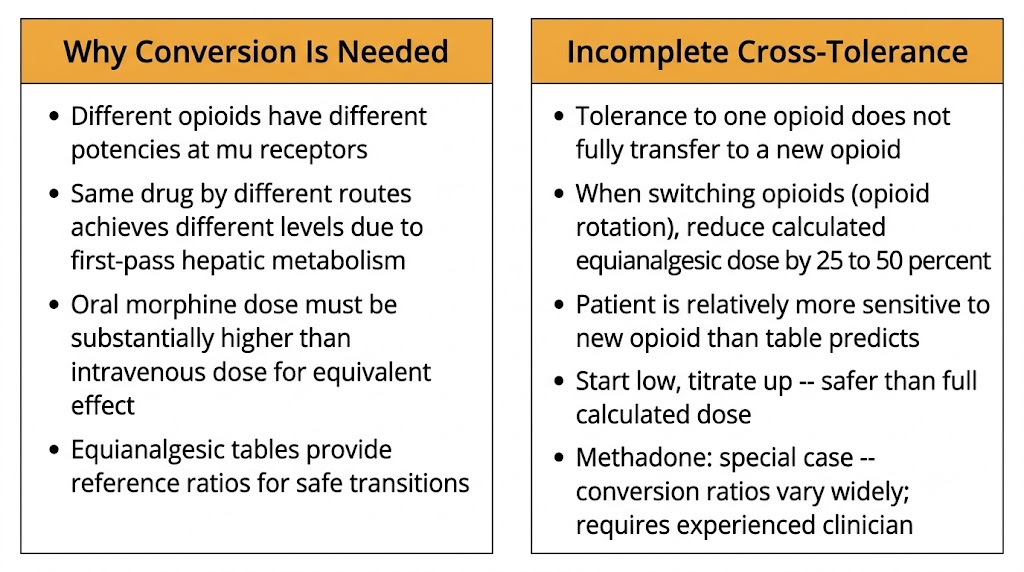
Figure 4. Equianalgesic dosing principles. Incomplete cross-tolerance means the calculated equianalgesic dose should be reduced by 25 to 50 percent when rotating between opioids. Figure generated by Gemini AI.
| Author / Organization | Title | Source |
|---|---|---|
| Trescot AM, Datta S, Lee M, Hansen H | Opioid pharmacology | Pain Physician. 2008;11(2 Suppl):S133–S153 |
| Chou R, Fanciullo GJ, Fine PG, et al. | Clinical guidelines for the use of chronic opioid therapy in chronic noncancer pain | J Pain. 2009;10(2):113–130 |
| Crews KR, Gaedigk A, Dunnenberger HM, et al. | Clinical Pharmacogenetics Implementation Consortium guidelines for cytochrome P450 2D6 genotype and codeine therapy | Clin Pharmacol Ther. 2012;91(2):321–326 |
| Stamer UM, Stuber F | The pharmacogenetics of analgesia | Expert Opin Pharmacother. 2007;8(14):2235–2245 |
| Kaplan R, Parris WC, Citron ML, et al. | Comparison of controlled-release and immediate-release oxycodone tablets in patients with cancer pain | J Clin Oncol. 1998;16(10):3230–3237 |
| Krantz MJ, Martin J, Stimmel B, Mehta D, Haigney MC | QTc interval screening in methadone treatment | Ann Intern Med. 2009;150(6):387–395 |
| Boyer EW | Management of opioid analgesic overdose | N Engl J Med. 2012;367(2):146–155 |
| United States Food and Drug Administration | Drug safety communication: FDA restricts use of prescription codeine pain and cough medicines in children | FDA.gov. 2017 |