5Overview:
propofol (Diprivan): This anesthetic, first of a new class of intravenous anesthetic agents - the alkylphenols,
is currently the most popular induction agent and is used in over 50
countries. In addition, propofol (Diprivan) may even be used for
continuous IV infusion for anesthesia maintenance while still allowing
for rapid recovery. At a certain point, perhaps when surgeries
last more than two hours, propofol (Diprivan) use may not be
cost-effective. Cardiovascular effects are relatively minor,
slightly depressants in nature, with similar relatively minor effects
on ventilation (even in doses used for continuous infusion). The
reduction in BP following propofol (Diprivan) may be slightly
greater than that observed with thiopental (Pentothal).
Propofol (Diprivan) appears to act
by enhancing the GABA neurotransmitter system.
Because of propofol (Diprivan)'s
lipid solubility, the drug must be administered as the emulsion
consisting of soybean oil, glycerol, and purified egg phosphatide.
[soybean oil (100 mg/mL), glycerol (22.5 mg/mL), egg lecithin (12 mg/mL); and disodium edetate (0.005%); with sodium hydroxide to adjust pH.
The DIPRIVAN emulsion is isotonic and has a pH of 7-8.5.] Because
propofol (Diprivan) solutions are emulsions, is not surprising
that it appears "milky" white as a result of light
scattering.
Recently, the FDA has issued a
warning (April, 2001) concerning the off-label use of propofol (Diprivan)
has a sedative in the pediatric ICU setting:
"The FDA has determined that there may be important safety concerns when propofol, marketed by AstraZeneca as DIPRIVAN (propofol) Injectable
Emulsion, is used for sedation in the Intensive Care Unit (ICU) in pediatric patients. Healthcare professionals are reminded that propofol is not approved in
the U.S. for sedation in pediatric ICU patients" This
conclusion was based on analysis described below:
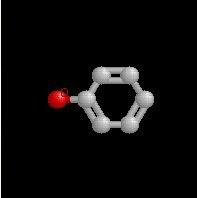
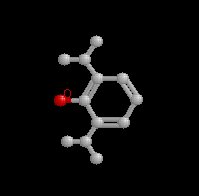
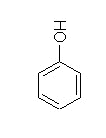
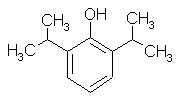
Propofol (Diprivan) structure: Propofol
(Diprivan) is a phenol derivative (2,6-Diisopropylphenol)
phenol
propofol (Diprivan)
phenol
propofol (2,6-Diisopropylphenol)
5Pharmacokinetics
of propofol (Diprivan):
Following IV bolus administration,
propofol (Diprivan) CNS actions are terminated by redistribution
from the brain to other compartments. This process occurs
with a redistribution halftime in the 2-8 minute range. The plasma
elimination halftime is about 1-3 hours in its accounted for by
significant and rapid metabolism and hepatic and extrahepatic
sites.
A "context-sensitive"
halftime of about 40 minutes has been described as applicable
after many hours of continues infusion. [Recall that by definition
a "context-sensitive" halftime refers to the time it
takes for the plasma concentration to fall by half after cessation
of continuous infusion]
For IV bolus administration,
propofol (Diprivan) pharmacokinetic is reasonably described
by a two-compartment model.
Propofol (Diprivan) metabolites are
inactive glucuronide and sulfate derivatives.
Propofol (Diprivan) volume of
distribution is about 20-40 L.
For propofol (Diprivan), in a
manner similar to other rapid-onset induction agents, anesthesia
occurs in a "one arm-brain circulation"; anesthesia by
this bolus IV method lasts about 5-10 minutes using a dose of
2-2.5 mg/kg, followed by rapid recovery. Propofol (Diprivan),
used for sedation & amnesia, may be infused at a rate of 2
mg/kg/h. Note the warning above concerning the warning
against the off-label propofol (Diprivan) use in the pediatric ICU
setting.
5,6Propofol
(Diprivan) pharmacology-- a summary of organ system and other effects:
CNS: Propofol (Diprivan) reduces
cerebral metabolic rate as measured in terms of oxygen
consumption. Cerebral blood flow and intracranial
pressure (ICP) are reduced following propofol (Diprivan) as
well. Alterations in PaCO2 will
additionally change ICP even after propofol (Diprivan) use.
Thiopental (Pentothal) and
propofol (Diprivan) induce changes in the EEG. For
propofol (Diprivan), these changes appear complex since
anticonvulsive properties may be present in some
circumstances, whereas post-anesthesia seizures have also been
noted.
Pulmonary: Following IV
administration, propofol (Diprivan) often induces apnea (frequency
= 25%-30%). The characteristics associated with apnea will
be dependent on dose, rate of drug administration and importantly,
the presence of other drugs. Apnea may last >
thirty seconds and may be further prolonged by agents that
themselves are respiratory depressants, such as opioids.The apneic
state is typically preceded by a decrease tidal volume and
tachypnea (rapid breathing).
Propofol (Diprivan) infusion is
associated with not only a reduction in tidal volume and
respiratory rate, but also reduced ventilatory responses to CO2
levels and hypoxia.
Ventilatory depressant effects
caused by these drugs are counteracted by painful surgical
stimulation.
Propofol (Diprivan) (to a
lesser degree than halothane (Fluothane) an inhalational
agent) causes some bronchodilation which in patients with
asthma may induce increased intraoperative wheezing.
Some other considerations
regarding propofol (Diprivan) administration:
Propofol (Diprivan) does not
induce malignant hyperpyrexia or affect cortisol synthesis
which is suppressed by etomidate (Amidate)
Anaphylactic reactions have
been noted with propofol (Diprivan), perhaps relating to the
presence of sulfite, a preservative,found in some generic
formulations, to the isopropyl phenol structure itself, or to
the solvent (emulsion)
The emulsion used propofol (Diprivan)
is particularly conducive to bacterial growth. To minimize
postoperative complications, aseptic techniques should be used
in opening and ampules containing propofol (Diprivan) with
contents withdrawn immediately into the sterile syringe.
The syringe should be used only on a single patient.
Propofol (Diprivan)
administration tends to decrease the likelihood of
postoperative nausea and vomiting and can even be used, in
reduced doses (10-15 mg IV), to manage nausea vomiting in the
post anesthesia care unit (PACU).
Propofol (Diprivan) injection
may be painful but the pain may be reduced by adding a local
anesthetic.
1Katzung, B. G. Basic
Principles-Introduction , in Basic and Clinical
Pharmacology, (Katzung, B. G., ed) Appleton-Lange, 1998,
pp 1-33
2Benet, Leslie Z, Kroetz, Deanna
L. and Sheiner, Lewis B The Dynamics of Drug Absorption,
Distribution and Elimination. In, Goodman and Gillman's
The Pharmacologial Basis of Therapeutics,(Hardman, J.G, Limbird, L.E,
Molinoff, P.B., Ruddon, R.W, and Gilman, A.G.,eds) TheMcGraw-Hill Companies, Inc.,1996, pp. 3-27
3Correia, M.A., Drug
Biotransformation. in Basic and Clinical Pharmacology, (Katzung, B. G., ed) Appleton-Lange, 1998, pp 50-61.
4Stoelting, R.K.,
"Pharmacokinetics and Pharmacodynamics of Injected
and Inhaled Drugs", in Pharmacology and Physiology
in Anesthetic Practice, Lippincott-Raven Publishers,
1999, 1-17.
5Dolin, S. J. "Drugs and
pharmacology" in Total Intravenous Anesthesia, pp. 13-35 (Nicholas L.
Padfield, ed), Butterworth Heinemann, Oxford, 2000
6Stoelting, R. K. and
Miller, R.D. Intravenous Anesthetics, in Basics of Anesthesia, 4th edition, pp.
58-69, Churchill-Livingstone, 2000.